Polymeric binder based on PAA and conductive PANI for high performance silicon-based anodes

Kukjoo Leea, Sanghyun Lima, Artur Tronb, Junyoung Munb, Young-Jun Kimc, Taeeun Yim*a and Tae-Hyun Kim*a
aDepartment of Chemistry, Incheon National University, 119 Academy-ro, Songdo-dong, Yeonsu-gu, Incheon 406-772, Korea. E-mail: tkim@inu.ac.kr
bDepartment of Energy and Chemical Engineering, Incheon National University, 119 Academy-ro, Songdo-dong, Yeonsu-gu, Incheon 406-772, Korea
cSKKU Advanced Institute of Nanotechnology (SAINT), Sungkyunkwan University, Gyeonggi-do 16419, Korea

Received 25th September 2016 , Accepted 20th October 2016

First published on 20th October 2016


Abstract

A novel polymeric binder, PAA–PANI, was prepared which effectively controls the uniformity of a Si anode. PANI provided electrical conductivity for this system, and furthermore participated in an acid–base interaction with PAA and as a result displayed remarkable mechanical properties. These electrical and mechanical properties together apparently led to PAA–PANI having yielded stable cycling and high utilization of the active Si material even after 300 cycles.

Introduction

Lithium-ion batteries (LIBs) have received praise as a promising energy conversion/storage system for many applications including electric vehicles (EVs) and energy-storage systems (ESSs).1–3 However, the current level of energy density of LIBs does not satisfy the needs for large-scale applications due to the active materials having low theoretical capacity. Therefore, employing advanced materials having higher specific capacities is necessary to obtain high energy density in LIBs. An effective approach to achieving high energy density is replacing conventional graphite anode material with silicon (Si) material. Compared to graphite (372 mA h g−1), Si yields specific capacities about an order of magnitude higher, at about 4200 mA h g−1.4,5 Employing Si in LIBs would therefore seem to be an attractive way to improve the energy density of the cell, and yield a high-performance battery. However, a critical limitation of directly employing Si in LIBs is the resulting poor cycling performance. After conversion of Si to lithiated Si during the initial discharge process, the volume of the electrode has been shown to substantially increase, by up to 400%, with the electrode material thereafter becoming seriously pulverized as a result of severe mechanical stress.6–8 Note that this mechanical stress has been observed to be accompanied by a continuous deformation of the electrode, resulting in a rapidly accelerating fading of the performance of cells employing the Si-based anode material. Therefore, ensuring a certain level of electrode uniformity is the most challenging issue in attempts to achieve high performance of LIBs using Si-based anode materials.

A certain level of uniformity for Si-based electrodes has been realized by applying effective binder materials to the electrode.9–11 Among the many candidates, one of the most promising binders is poly(acrylic acid) (PAA), which has excellent mechanical properties and hence effectively delays deformation of the electrode.12–15 Widespread application of PAA to Si anodes, however, faces the critical limitation of the PAA not sufficiently well managing internal stress arising from drastic volume expansion/contraction of Si electrode, leading to loss of electronic networks. In addition, commercial PAA is not electrically conductive, hence limiting maximal utilization of Si active materials during electrochemical processes.

Result and discussion

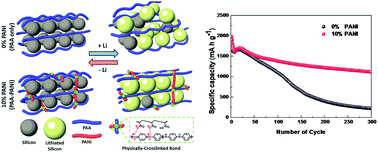
Here we prepared a novel polymeric binder material, PAA–PANI (Fig. 1), and showed that this new binder system displayed both conductivity and enhanced mechanical properties. The binder was designed to fine tune the PAA properties by blending in PANI (polyaniline) components so that (1) amine (NH) functional groups on PANI would reversibly interact with carboxylic acid (COOH) functional groups on PAA by an acid–base reaction to improve the mechanical properties of the material and (2) the electronically conductive PANI component16 would participate in facilitating the electrochemical conversion reaction of the anode, resulting in a high utilization of active Si. In this way, PAA–PANI would be useful for not only enhancing the cycling performance but also providing high specific capacities.
image file: c6ra23805j-f1.tif
Fig. 1 Design of the PAA–PANI binder.

PAA–PANI binders were prepared by simple blending of different ratios of these two components (0%, 10%, 20%, and 50% PANI) (see ESI for Experimental details). The chemical structure of PAA–PANI was analyzed by carrying out Fourier transform infrared spectrometry (FT-IR) (Fig. 2 and S2 in the ESI). A peak corresponding to C[double bond, length as m-dash]O stretching from COOH of the PAA backbone was observed at 1720 cm−1 and so was an additional vibrational peak for [O–C–O] at 1658 cm−1; the peaks provided evidence that an acid–base interaction between PAA and PANI occurred. Moreover, the intensity of a transmittance signal at 1658 cm−1, associated with a chemical interaction between PAA and PANI, gradually increased as the relative amount of PANI included was increased. This trend provided evidence for a specific function for the PANI component: blending in more PANI enabled the formation of more chemical connections between the chains, resulting in stronger transmittance intensity regarding [O–C–O].


image file: c6ra23805j-f2.tif
Fig. 2 FT-IR analyses of PAA–PANI with various PANI contents.

Peel tests provided good support for this function (Fig. S3): a Si electrode composed of 10% PANI showed a much higher binding affinity than did that containing 0% PANI (i.e., only PAA) (1.05 vs. 0.73 N for average binding affinity). Including some PANI thus enhanced the overall mechanical properties of the electrode via formation of an additional network of chemical bonds, allowing the electrode to be highly durable in the presence of mechanical stress. Including too much PANI, however, degraded the mechanical properties of the Si electrode: binding affinities were reduced as the relative amount of PANI was increased past 10% (0.43 N for 20% PANI and 0.28 N for 50% PANI). This degradation was attributed to a loss of COOH groups from the PAA backbone. The COOH group of PAA promotes a certain level of binding with the Si electrode via formation of hydrogen bonding-based chemical networks,8,17 and including too much PANI in our experiment apparently reduced the relative number of free COOH groups on PAA because of the acid–base reaction. The COOH groups participating in the acid–base reaction apparently did not contribute to the binding at all, leading to poor binding performances when too much PANI was included. These results taken together clearly revealed the relative ratio of PAA and PANI to be one of the significant factors determining the overall mechanical properties of the Si electrode.

In addition to the mechanical behaviors resulting from these binders, we also evaluated their electrochemical performances (Fig. 3). When evaluating the cycling performance at a low rate (0.5C), most of the cells employing PAA–PANI binder showed higher initial specific capacities than did the cell only composed of PAA (Fig. 3a). Note that none of the electrodes contained any kind of conducting agent, and specific discharge capacities were therefore considered to be mainly influenced by the binder materials. Therefore, the relatively high discharge specific capacities for PAA–PANI-employed cells may have been due to the contribution of PANI components providing desirable conducting pathways during the electrochemical process.18 Consistent with this explanation, the rate capability test we conducted (Fig. 3b) showed a remarkable rate performance, especially at high rate currents (>10C), for the cell employing 10% PANI binder, but a poorer performance for that employing 0% PANI (i.e., only PAA).


image file: c6ra23805j-f3.tif
Fig. 3 (a) Cycle life and (b) rate capability of LIBs having various compositions of PAA–PANI.

Binders having different PANI compositions yielded quite different cycle retentions. The electrode with 10% PANI, which displayed the best mechanical properties, also yielded the greatest cycle retention (55.8%) after 300 cycles. Increasing the relative amount of PANI past 10%, however, seriously disturbed the stability of the Si electrode, with retention values of only 43.5% for 20% PANI, and 23.9% for 50% PANI. The additional acid–base cross-linking reaction resulting from increasing the PANI content, and the subsequent loss of free COOH groups (responsible for binding performance), apparently produced the rapid fading of the cell performance. Therefore, the cell employing the binder with the most PANI (i.e., 50% PANI) yielded, after 300 cycles, an even lower cycle retention than did the 0% PANI-based cell (29.8%). These results imply the optimum relative amount of PANI in the binder to be 10% because this amount afforded both the best mechanical and electrical properties for the Si electrode. This result is also consistent with the analyses of long-term cycling performances at a high rate (1.0C, Fig. S4). The cell with 10% PANI showed a higher initial discharge specific capacity (1979 mA h g−1) and cycling retention (56.5%) than did the 0% PANI-based cell (1913 mA h g−1 for initial discharge specific capacity and 11.3% retention at 300 cycles).

After evaluating cycling performances, each cycled electrode was analyzed using scanning electron microscopy (SEM) in order to visualize the effects of binder material on the surface morphology (Fig. 4). The surface of the electrode containing 10% PANI was observed to be relatively clean, indicating that this binder greatly prevented pulverization and delamination that would result from continuous electrode fatigue. In contrast, the electrode cycled with 0% PANI (i.e., only PAA) showed huge cracks together with a serious amount of delamination of active material even after one cycle. In addition, the galvanostatic intermittent titration technique (GITT) was applied to help estimate the effect of the acid–base interaction on the electrode uniformity (Fig. S5). Potential profiles for all of the cells at the initial discharge stage were almost identical regardless of the specific binder material, but that containing 10% PANI yielded a less polarizable potential curve than did the cell composed of 0% PANI at the initial charge. This result corresponded well to that obtained using electrochemical impedance spectroscopy (EIS) (Fig. S6), which indicated the resistance behaviors at discharge to be almost the same for the different binder materials, and there to be obvious differences during the charge process. In EIS results, diameter of semi-circles represents resistances comprising two modes of lithium transportation through surface film (RSEI) and charge transfer (RCT).19 A line having 45°, reflecting Warburg diffusion element follows the semi-circles. The 10% PANI yielded much less resistance comprising RCT and RSEI than did 0% PANI at every state of charge (SOC). This result implied that mechanical stresses originating from drastic volume expansions can be effectively managed by the excellent mechanical properties provided by the PAA component at the discharge stage and the acid–base interaction made by the PANI component controlling a sudden contraction of the electrode based on its remarkable binding affinities. Therefore, 10% PANI was effective for not only increasing the utilization of the Si material but also withstanding mechanical stresses due to its optimized properties, which led to the considerable long-term cycling performances.


image file: c6ra23805j-f4.tif
Fig. 4 SEM analyses for the Si electrode after various numbers of cycles.

Conclusions

PANI-blended PAA binders were prepared and the effects of the relative amount of PANI on electrochemical performances were measured. Embedding the electrically conductive and basic PANI component with the acidic PAA polymer allowed for an acid–base interaction, which improved the overall mechanical properties, and afforded electrical pathways on the Si electrode, resulting in remarkable electrochemical performances. We believe that the material and strategy described will be appropriate for not only Si electrodes but also for those made of other conversion chemistry-based electrochemical materials including silicon monoxide (SiO) and tin oxide (SnO), which suffer from drastic volume expansions and contractions.

Acknowledgements

This work was supported by the IT R&D program of MKE/KEIT (10044962) and the National Research Foundation of Korea (NRF) grant funded by the Korea government (No. 2016R1C1B1009452 for T. Yim and 2015R1D1A1A01058625 for T.-H. Kim).

Notes and references

  1. B. Dunn, H. Kamath and J.-M. Tarascon, Science, 2011, 334, 928 CrossRef CAS PubMed.
  2. M. Armand and J.-M. Tarascon, Nature, 2008, 451, 652 CrossRef CAS PubMed.
  3. B. Scrosati, J. Hassoun and Y.-K. Sun, Energy Environ. Sci., 2011, 4, 3287 CAS.
  4. H. Wu and Y. Cui, Nano Today, 2012, 7, 414 CrossRef CAS.
  5. J. Guo and C. Wang, Chem. Commun., 2010, 46, 1428 RSC.
  6. W.-J. Zhang, J. Power Sources, 2011, 196, 13 CrossRef CAS.
  7. V. A. Sethuraman, M. J. Chon, M. Shimshak, N. Van Winkle and P. R. Guduru, Electrochem. Commun., 2010, 12, 1614 CrossRef CAS.
  8. D. Mazouzi, Z. Karkar, C. R. Hernandez, P. J. Manero, D. Guyomard, L. Roué and B. Lestriez, J. Power Sources, 2015, 280, 533 CrossRef CAS.
  9. S. Komaba, K. Shimomura, N. Yabuuchi, T. Ozeki, H. Yui and K. Konno, J. Phys. Chem. C, 2011, 115, 13487 CAS.
  10. J. Liu, Q. Zhang, T. Zhang, J.-T. Li, L. Huang and S.-G. Sun, Adv. Funct. Mater., 2015, 25, 3599 CrossRef CAS.
  11. G. Liu, H. Zheng, X. Song and V. S. Battaglia, J. Electrochem. Soc., 2012, 159, A214 CrossRef CAS.
  12. Z.-J. Han, N. Yabuuchi, K. Shimomura, M. Murase, H. Yui and S. Komaba, Energy Environ. Sci., 2012, 5, 9014 CAS.
  13. C. Erk, T. Brezesinski, H. Sommer, R. Schneider and J. Janek, ACS Appl. Mater. Interfaces, 2013, 5, 7299 CAS.
  14. S. Komaba, N. Yabuuchi, T. Ozeki, Z.-J. Han, K. Shimomura, H. Yui, Y. Katayama and T. Miura, J. Phys. Chem. C, 2012, 116, 1380 CAS.
  15. S. Lim, H. Chu, K. Lee, T. Yim, Y.-J. Kim, J. Mun and T.-H. Kim, ACS Appl. Mater. Interfaces, 2015, 7, 23545 CAS.
  16. S. Bhadra, D. Khastgir, N. K. Singha and J. H. Lee, Prog. Polym. Sci., 2009, 34, 783 CrossRef CAS.
  17. J.-S. Bridel, T. Azaïs, M. Morcrette, J.-M. Tarascon and D. Larcher, Chem. Mater., 2010, 22, 1229 CrossRef CAS.
  18. S.-M. Kim, M. H. Kim, S. Y. Choi, J. G. Lee, J. Jang, J. B. Lee, J. H. Ryu, S. S. Hwang, J.-H. Park, K. Shin, Y. G. Kim and S. M. Oh, Energy Environ. Sci., 2015, 8, 1538 CAS.
  19. T. Swamy and Y. M. Chiang, J. Electrochem. Soc., 2015, 162, A7129 CrossRef CAS.

Footnote

Electronic supplementary information (ESI) available: Synthetic scheme for PANI and its FT-IR results are shown in Fig. S1 and S2. PEEL tests are illustrated in Fig. S3. Cycle life at 1.0C rate is described in Fig. S4. GITT and EIS results are included in Fig. S5 and S6. See DOI: 10.1039/c6ra23805j

This journal is © The Royal Society of Chemistry 2016
Click here to see how this site uses Cookies. View our privacy policy here.