Recycled LiCoO2 in spent lithium-ion battery as an oxygen evolution electrocatalyst

Ning Chen a, Jing Qib, Xuan Duc, Yi Wangc, Wei Zhang*b, Yanyong Wanga, Yanbing Lu*a and Shuangyin Wang*a
aState Key Laboratory of Chem/Bio-Sensing and Chemometrics, College of Chemistry and Chemical Engineering, Hunan University, 410082, Changsha, P. R. China. E-mail: shuangyinwang@hnu.edu.cn; yanbinglu@hnu.edu.cn
bSchool of Chemistry and Chemical Engineering, Shaanxi Normal University, Xi'an, China
cNational Engineering Laboratory for Hydrometallurgical Cleaner Production Technology, Institute of Process Engineering, Chinese Academy of Sciences, China

Received 21st September 2016 , Accepted 22nd October 2016

First published on 24th October 2016


Abstract

Lithium cobalt oxide (LCO) is a common cathode material in lithium ion batteries (LIBs). On the other hand, the recycling of electrode materials in LIBs has attracted serious attention due to environmental, resourcing and energy issues. In order to reduce the cost of the recycling and make full use of the transition metal in the cathode materials in LIBs, herein, we developed a simple method to convert the recycled LCO from spent LIBs into an efficient electrocatalyst for oxygen evolution reaction (OER). The long-time cycling of LCO in a LIB would lead to several structural changes in terms of chemical composition, particle size and metal valence etc. The altered structural properties of the recycled LCO with a relatively smaller particle size and activated surface may contribute to enhanced electrocatalytic activity for OER. The electrocatalytic activity improves with the increase of the cycle number of LIBs. As an electrocatalysts for OER, the recycled LCO from spent LIBs after cycling for 500 cycles can deliver a current density of 9.68 mA cm−2 at 1.65 V, which is about 3.8 times that of pristine LCO (2.50 mA cm−2).

Lithium ion batteries (LIBs) show advantages of high output voltage, long cycle life and so on, and have been widely used in many applications such as electronic vehicles, power stations and portable electronics.1 However, because they contain flammable substances and toxic substances, the improper handling of spent LIBs will cause a series of serious problems.2 Recycled of cathode materials for LIBs includes physical recovery methods and chemical recycling methods.3 The present experimental methods are mostly based on the hydrometallurgical chemistry process and are not suitable for large-scale industrialization.3–5 The reason for the invalid of the cathode material in LIBs is mainly due to the volume expansion, the surface formation of the solid-electrolyte interphase (SEI) and lattice strain.6,7 General LIBs cathode materials (e.g. LiCoO2,8,9 LiMn2O4 (ref. 10) and LiFeO2 (ref. 11)) contain transition metals. Due to those transition metals rare and precious, therefore, we should recycle these transition metals for electrocatalyst to improve the economic benefit. Considering that these transition metal compounds are widely used as electrocatalysts owing to abundant resources, low cost and their good catalytic activity.12–17 As reported, the electrocatalytic activity of cathode materials will be improved after delithiated.18–20

Electrochemical oxygen evolution reaction is one of the several critical clean-energy electrochemical technologies, which can be applied to store solar, wind and electrical renewable energy.21 However, this reaction is kinetically sluggish because it is a multi-electron transfer and multi-intermediate process.22 Layered (space group: R[3 with combining macron]m) and spinel (space group: Fd3m) are two main kinds crystal forms of LCO.20 In the layered-type LCO, Li+ and Co3+ are arranged alternately on the surface. While in the spinel-type, Co3+ ions and Li+ ions occupy all the 16d octahedral sites and 16c octahedral sites respectively.23–25 The spinel-type has a higher catalyst activity than other crystal types.23 In addition, spinel LCO has good performance both in OER and ORR.26,27 Garcia et al.28 had investigated the OER property of LCO collected from spent LIBs using a heating pretreatment method and then the recycled materials are composited with graphene. In the same period, the OER property of delithiated LCO was also researched.18 In the work, the delithiated LCO show better OER property compared to LCO benefiting from a unique electronic configuration of the cobalt formed after delithiated. Certainly, the recycled LCO material has good catalytic activity of OER12 due to the formation Co3O4 after delithiated on the surface of LCO.20 Besides, LCO will proceed phase transition in Li+ extraction.2 The oxidation of cobalt ions played an vital role with the OER activity,21 therefore the surface properties of the LCO have association with the OER catalytic activity. Herein, we can propose that OER property probably has an intimate relation with Co atom electronic structure. The OER activity may be improved owing to the increased specific surface area by the volume expansion and particle fragmentation.

To reuse the transition metal in the spent LIBs, in this work, we studied the electrocatalytic activity of the recycled LCO from the spent LIBs for OER. In addition, the delithiation during the use of LCO in LIBs, the structural transformation may also show significant effect on the electrochemical behavior. Firstly, we run the LCO-based LIBs for different cycles from 100 to 500 cycles (denoted as 100C, 200C, 300C, 400C, 500C) and then recycled the LCO from the cycled LIBs for potential applications as electrocatalysts for OER. The electrochemical characterizations demonstrate that the OER activity improved remarkably with the increase of the number of cycles compared with the pristine LCO due to the altered electronic properties and the structural transformation producing higher surface area. This study may provide us a simple but effective method to realize the waste reuse in spent LIBs.

1. Experimental

1.1 Syntheses

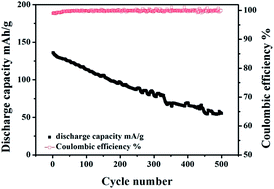
The electrodes were prepared by mixing active material LCO (Sigma-Aldrich), Super P and polyvinylidene fluoride (PVDF, AlfaAesar) in a weight ratio of 70[thin space (1/6-em)]:[thin space (1/6-em)]20[thin space (1/6-em)]:[thin space (1/6-em)]10 with the methyl-2-pyrrolidone (NMP, Sigma-Aldrich) as solvent. The slurry was coated on the aluminum foil and dried in an vacuum oven overnight. LIBs were assembled in an argon-filled glove box and then tested batteries for different cycles on a LAND charge/discharge station with the potential range from 2.8 V to 4.3 V at 0.5C. The cycle durability of LCO battery was shown in Fig. 1. Batteries were disassembled in an argon-full glove box after the durability test completed and the electrode plates were washed with ethanol several times. And then electrode plates were put into 25 ml NMP and the electrode material was dissolved in NMP. To remove the aluminum foil, the sample was ultrasounded for 30 min to further dissolve the PVDF completely. The solution was centrifuged for 45 min under 10000 rpm. Subsequently, the product was dried in an oven. As a comparison, the original sample was directly dissolved in the NMP and then coated on the aluminum foil and dried in an vacuum oven overnight.
image file: c6ra23483f-f1.tif
Fig. 1 Cycle performance of LCO at a current rate of 0.5C.

1.2 Electrochemical measurements

Typically, 5 mg production was dispersed in 980 μl ethanol and 20 μl Nafion mixed solution. After forming a homogeneous catalyst ink through ultrasonication for 30 min, 10 μl of the catalyst ink was coated on a glassy carbon electrode (GCE, 5 mm in diameter) and dried at room temperature. The measurements were performed in a three-electrode setup with 0.1 M KOH solution as the electrolyte. The carbon rod acted as counter electrode and the saturated calomel electrode (SCE) as reference electrode. Linear sweep voltammetry experiments were used infrared (current-internal resistance) compensation supplied by the electrochemical workstation (CHI 760E, CH Instrument).

2. Results and discussion

The discharge capacity and columbic efficiency over 500 cycles was shown in Fig. 1, indicating the poor cycling stability of LCO in LIBs. The initial specific capacity is 136.10 mA h g−1. However, only 40.56% of the capacity was retained after 500 cycles. The electrode material almost loses its activity after 500 cycles of charge–discharge. This is due to the change in the structure of LCO and the electronic structure change.

After the long-term durability test, the batteries were disassembled to recycle the LCO after different cycles. The structures and phases of the original LCO and the recycled LCO after 500 cycles (500C) were analyzed by XRD shown in Fig. 2. From the whole X-ray diffraction patterns of 500C, it still retains the layered structure. The peak intensity and peak area change as shown in Fig. 1b–d at the 2θ ≈ 18.7°, 37.2°, 38.2° and 65° which were corresponding to the [003], [101], [006], [108] and [110] plan, indicating that the crystal particles become disordered. The half peak width (FWHM) change at 2θ ≈ 18.7° indicates that the crystal particles size increased and the peak shift to the left indicates that the delithiation occurs.18,20 All the change may also indicate that the LCO was partially delithiated and the [003], [101], [006], [108] and [110] plan changed, which was beneficial to electrocatalytic oxygen evolution. Riveted refinement also reveals that the LCO possesses a lattice parameters of a = 2.8262 Å and c = 14.1784 Å and the 500C possesses a larger parameters of a = 3.712 Å and c = 14.1801 Å. The lattice parameters are further confirmed by high-resolution transmission electron microscopy (HRTEM). The lattice parameters change may be caused by LCO volume expansion during Li+ insertion and extraction and formation the Li1−xCoO2 new phase.20


image file: c6ra23483f-f2.tif
Fig. 2 XRD patterns of (a) original and 500C (b) localized XRD patterns with the 2θ range from 18.3–19.1° (c) localized XRD patterns with the 2θ range from 36–40° (d) localized XRD patterns with the 2θ range from 64.5–67.25°.

The original and 500C surface morphology can be seen in the Fig. 3a and b. A small amount of Super P is attached to the surface. Compared with the original sample, the 500C sample surface is rough and has cracks. We can clearly see the LCO pulverization. This could expose more active sites. SEM images of other samples were shown in Fig. S1. The volume expansion is more and more obvious and the surface roughness increases. The Fig. 3c show the HRTEM image of the original sample (the d spacing value of 0.241 nm for [101] zone axes) surface image, the lattice fringe can be seen directly. Fig. 3d show the HRTEM image of 500C sample (the d spacing value of 0.201 nm for [104] zone axes), the lattice fringe is still visible. But at the edge of the sample, defects can be clearly seen. The results demonstrate that the lithiation of LCO not only lead to the expansion of the volume of LCO, but also corrosion the surface of the LCO.


image file: c6ra23483f-f3.tif
Fig. 3 SEM images of (a) original LCO (b) 500C and HRTEM images of (c) original LCO (d) 500C.

In order to investigate the change of the surface electronic properties of LCO before and after the durability testing, X-ray photoelectron spectroscopy (XPS) were performed on the samples. Fig. 4 shows the XPS spectra of Co and O atom before and after cycling. The outer electron configuration of cobalt is 2p6 3d6 in ground state in LCO. Under the photoexcitation, the 2p orbit of Co may appear in several different states. Due to the spin–orbit coupling, this spectral splitting into two peaks (2p3/2 and 2p1/2). The positions of the two peaks are about 780 and 795 eV. At the 780 eV is mainly due to the 2p5 3d7 L configuration. There were two satellite peaks at 790 and 805 eV which are assigned to 2p5 3d6 and 2p5 3d8 configurations. Satellite peaks are related to the oxidation state of the metal cobalt and the environment where it is located. The broad main peak of Co atom in the sample 500C was observed and the binding energy shift to a higher energy and the weakened satellite peak intensity imply that part of the Co is oxidized to a higher valence state.29 Cobalt ions with higher valence state usually have stronger affinity which was advantageous to the adsorption and reaction of OH with the catalysts to form adsorbed –OOH species.29 Fig. 3b showed the O 1s peak of LCO before and after durability testing. The peak near 529.7 eV is related to the position of the oxygen atom, which indirectly reflects the crystallinity of the LCO. The decrease of peak intensity at 529.7 eV shows the variation of crystallinity.7 The peaks of 532.5 eV and 534 eV are respectively representative of the adsorption of water molecules or –OH and carbon oxygen bonds.30 The 500C ratio of the two peak area is larger than that of the original sample, which shows that it is easier to adsorb –OH indicating that the 500C sample has higher catalytic activity. During the process of delithiation, Co3+ and O2− undergo partial oxidation.31


image file: c6ra23483f-f4.tif
Fig. 4 XPS spectra of (a) Co 2p peak (b) O 1s peak in the original and the recycled LCO after 500 cycles.

The OER catalytic activities of LCO, 100C, 200C, 300C, 400C and 500C were shown in Fig. 5a. We can see from Fig. 5a that the catalytic activity of those samples increased gradually with the increase of the number of cycles of the cell cycle. The 500C sample showed markedly improved OER catalyst activity with a reduced onset potential of 1.52 V and fastened current increase compared with the original sample. The Tafel slope (Fig. 5b) for 500C (67.41 mV dec−1) is slightly smaller than that for the original (72.58 mV dec−1) implying an alike reaction kinetics. Other samples Tafel slopes were shown in Fig. S4a. The Tafel slope has a slight change. The Fig. 5c showed the charge transfer resistance (Rct) by the electrochemical impedance spectroscopy (EIS) testing. The 500C showed lower transfer resistance compared with original which was benefit to OER activity. The EIS curves of other samples were shown in Fig. S4d. With the increase of the number of cycles, the Rct decreases gradually. Fig. 5d showed the durability and stability of the sample 500C for OER. It has almost maintained the original catalytic activity after repeating potential cycling test for 1000 cycles. The effective surface areas of the original and 500C were estimated by measuring the capacitance of the double layer (EDLC, electric double layer capacitance) at the solid–liquid interface with cyclic voltammetry (shown in Fig. S2). The EDLC of original electrode was estimated to be 998.5 μF cm−1 while that of 500C was 2050 μF cm−1. Based on these data, we can conclude that the number of electrochemically effective sites of 500C catalyst is much higher than that of original LiCoO2 catalyst, which should be a main reason for the enhanced OER activity. CV and EDLC curves of control samples were shown in Fig. S3 and they changed regularly.


image file: c6ra23483f-f5.tif
Fig. 5 (a) Polarization curves of LCO after different cell cycles number, (b) Tafel slopes of original and 500C, (c) EIS of original and 500C, (d) stability of 500C after 1000 cycles, ring current of 500C on an RRDE (1600 rpm) in (e) O2-saturated and (f) N2-saturated KOH solutions.

To study the reaction mechanism, the rotating ring-disk electrode (RRDE) technique was employed with a Pt-ring electrode to determine the faradaic efficiency. The disk current was first fixed at 200 μA to generate O2 molecules from the 500C catalyst. Then the O2 molecules were further reduced by sweeping across the surrounding Pt-ring electrode fixed at an ORR potential of 0.4 V to reduce the sweeping across O2 molecular. Consequently, a ring current of approximately 5.50 μA was detected (Fig. 5e) with a high faradaic efficiency of 96.49%. We also analyze the byproduct contents (peroxide intermediates) formed at the surface of the 500C catalyst during the OER process with the Pt-ring electrode potential of 1.50 V. Fig. 5f shows a relatively low ring current which indicates few peroxide intermediates formed.

3. Conclusion

In summary, we studied the change of LCO and the OER catalyst activity after the long-term use of the LIBs. It can be seen that LCO catalyst activity increased with the increase of the number of cycles of LIBs. Those results indicate that spent LIBs cathode material can be an efficient, durable, economical, and earth-abundant OER electrocatalyst and have promising in practical application. The OER activity improvement was attributed to the formation of new phase of Li1−xCoO2 and the LCO surface corrosion during the Li+ insertion and extraction process. This may provide us an easy and effective method to recycling the material from spent LIBs. We can use this method on other LIBs cathode materials acting as catalyst materials, which can be a great help to solve environmental and energy sources problems.

Acknowledgements

This work was supported by the National Natural Science Foundation of China (Grant No. 51402100 and 21573066), the Youth 1000 Talent Program of China, and Inter-discipline Research Program of Hunan University.

References

  1. Q. Jiang, N. Chen, D. Liu, S. Wang and H. Zhang, Nanoscale, 2016, 8, 11234–11240 RSC.
  2. S. Castillo, J. Power Sources, 2002, 112, 247–254 CrossRef CAS.
  3. J. Xu, H. R. Thomas, R. W. Francis, K. R. Lum, J. Wang and B. Liang, J. Power Sources, 2008, 177, 512–527 CrossRef CAS.
  4. D. D. Macneil, Z. Lu and J. R. Dahn, J. Electrochem. Soc., 2002, 149, A1332–A1336 CrossRef CAS.
  5. Z. Takacova, T. Havlik, F. Kukurugya and D. Orac, Hydrometallurgy, 2016, 163, 9–17 CrossRef CAS.
  6. J. L. Tebbe, A. M. Holder and C. B. Musgrave, ACS Appl. Mater. Interfaces, 2015, 7, 24265–24278 CAS.
  7. R. Dedryvère, H. Martinez, S. Leroy, D. Lemordant, F. Bonhomme, P. Biensan and D. Gonbeau, J. Power Sources, 2007, 174, 462–468 CrossRef.
  8. N. Wu, Y. Zhang, Y. Guo, S. Liu, H. Liu and H. Wu, ACS Appl. Mater. Interfaces, 2016, 8, 2723–2731 CAS.
  9. M. Zhao, X. Zuo, X. Ma, X. Xiao, L. Yu and J. Nan, J. Power Sources, 2016, 323, 29–36 CrossRef CAS.
  10. Z. J. Zhang, S. L. Chou, Q. F. Gu, H. K. Liu, H. J. Li, K. Ozawa and J. Z. Wang, ACS Appl. Mater. Interfaces, 2014, 6, 22155–22165 CAS.
  11. M. Büyükyazi and S. Mathur, Nano Energy, 2015, 13, 28–35 CrossRef.
  12. L. Xu, Q. Jiang, Z. Xiao, X. Li, J. Huo, S. Wang and L. Dai, Angew. Chem., 2016, 55, 5277–5281 CrossRef CAS PubMed.
  13. I. Abidat, N. Bouchenafa-Saib, A. Habrioux, C. Comminges, C. Canaff, J. Rousseau, T. W. Napporn, D. Dambournet, O. Borkiewicz and K. B. Kokoh, J. Mater. Chem. A, 2015, 3, 17433–17444 CAS.
  14. J. Chi, H. Yu, G. Li, L. Fu, J. Jia, X. Gao, B. Yi and Z. Shao, RSC Adv., 2016, 6, 90397–90400 RSC.
  15. S. Dou, L. Tao, J. Huo, S. Wang and L. Dai, Energy Environ. Sci., 2016, 9, 1320–1326 CAS.
  16. C. Ouyang, X. Wang, C. Wang, X. Zhang, J. Wu, Z. Ma, S. Dou and S. Wang, Electrochim. Acta, 2015, 174, 297–301 CrossRef CAS.
  17. X. Li, Y. Fang, X. Lin, M. Tian, X. An, Y. Fu, R. Li, J. Jina and J. Ma, J. Mater. Chem. A, 2015, 3, 17392–17402 CAS.
  18. Z. Lu, H. Wang, D. Kong, K. Yan, P. C. Hsu, G. Zheng, H. Yao, Z. Liang, X. Sun and Y. Cui, Nat. Commun., 2014, 5, 4345 CAS.
  19. S. Lee, G. Nam, J. Sun, J. S. Lee, H. W. Lee, W. Chen, J. Cho and Y. Cui, Angew. Chem., 2016, 55, 8599–8604 CrossRef CAS PubMed.
  20. N. Colligan, V. Augustyn and A. Manthiram, J. Phys. Chem. C, 2015, 119(5), 2335–2340 CAS.
  21. S. W. Lee, C. Carlton, M. Risch, Y. Surendranath, S. Chen, S. Furutsuki, A. Yamada, D. G. Nocera and Y. Shao-Horn, J. Am. Chem. Soc., 2012, 134, 16959–16962 CrossRef CAS PubMed.
  22. M. T. M. Koper, J. Electroanal. Chem., 2011, 660, 254–260 CrossRef CAS.
  23. G. Gardner, J. Al-Sharab, N. Danilovic, Y. B. Go, K. Ayers, M. Greenblatt and G. Charles Dismukes, Energy Environ. Sci., 2016, 9, 184–192 CAS.
  24. G. P. Gardner, Y. B. Go, D. M. Robinson, P. F. Smith, J. Hadermann, A. Abakumov, M. Greenblatt and G. C. Dismukes, Angew. Chem., 2012, 51, 1616–1619 CrossRef CAS PubMed.
  25. H. Liu, Y. Zhou, R. Moré, R. Müller, T. Fox and G. R. Patzke, ACS Catal., 2015, 5, 3791–3800 CrossRef CAS.
  26. T. Maiyalagan, K. A. Jarvis, S. Therese, P. J. Ferreira and A. Manthiram, Nat. Commun., 2014, 5, 3949 CAS.
  27. C. Su, T. Yang, W. Zhou, W. Wang, X. Xu and Z. Shao, J. Mater. Chem. A, 2016, 4, 4516–4524 CAS.
  28. E. M. Garcia, V. d. F. C. Lins, H. A. Tarôco, T. Matencio, R. Z. Domingues and J. A. F. dos Santos, Int. J. Hydrogen Energy, 2012, 37, 16795–16799 CrossRef CAS.
  29. Y. Zhu, W. Zhou, Y. Chen, J. Yu, M. Liu and Z. Shao, Adv. Mater., 2015, 27, 7150–7155 CrossRef CAS PubMed.
  30. J. Fang, A. Kelarakis, Y. W. Lin, C. Y. Kang, M. H. Yang, C. L. Cheng, Y. Wang, E. P. Giannelis and T. Ld, Phys. Chem. Chem. Phys., 2011, 13, 14457–14461 RSC.
  31. K. Gao, X. Hu, T. Yi and C. Dai, Electrochim. Acta, 2006, 52, 443–449 CrossRef CAS.

Footnotes

Electronic supplementary information (ESI) available. See DOI: 10.1039/c6ra23483f
These authors contributed equally to this work.

This journal is © The Royal Society of Chemistry 2016
Click here to see how this site uses Cookies. View our privacy policy here.