
Strong modification of intrinsic spin Hall effect in FeMn with antiferromagnetic order formation

Y. Kangab, Y. S. Changb, W. Heb, J. W. Cai*b and S. S. Kang*a
aSchool of Physics and State Key Laboratory of Crystal Materials, Shandong University, Jinan, Shandong 250100, China. E-mail: skang@sdu.edu.cn
bBeijing National Laboratory for Condensed Matter Physics, Institute of Physics, Chinese Academy of Sciences, Beijing 100190, China. E-mail: jwcai@aphy.iphy.ac.cn

Received 5th September 2016 , Accepted 26th September 2016

First published on 26th September 2016


Abstract

FeMn films with and without a Cu seed layer were deposited on Y3Fe5O12 (YIG) substrates, and their inverse spin Hall effect (ISHE) was examined through both spin Seebeck effect and spin pumping. From the ISHE voltage, the spin Hall angle of FeMn in YIG/Cu/FeMn is greatly enhanced with its polarity opposite to that in YIG/FeMn. Anisotropic magnetoresistance measurements on the samples with an additional NiFe layer show that the FeMn layers in YIG/Cu/FeMn and YIG/FeMn are antiferromagnetic and paramagnetic, respectively. The present work demonstrates that the antiferromagnetic order in FeMn alloy intensely influence its intrinsic spin Hall effect.

Introduction

Pure spin current phenomena and devices are new arrivals in spin electronics.1 Several methods have been reported to generate pure spin current, including nonlocal spin valves,2 spin Hall effect (SHE),1,3 spin pumping,4–7 and spin Seebeck effect (SSE).8,9 The inverse spin Hall effect (ISHE) in a nonmagnetic metal can be adopted to detect a pure spin current by converting the spin current into a charge current with a resultant charge accumulation.6 So far, Pt, Ta, and W among the transition metals with large intrinsic spin Hall angles show distinct advantages in exploring spin current phenomena.10 Extrinsic scattering is one of important mechanisms to give rise to SHE in addition to the intrinsic SHE caused by the Berry-phase curvature.11 Remarkably, large extrinsic SHE has been found in Cu(Bi),12,13 Cu(Ir),14,15 and Au–Cu alloys.16 Very recently, spin current exploration involves antiferromagnetic (AF) materials because of their exotic properties (e.g., zero net magnetization, nontrivial spin–orbit coupling, and non-collinear magnetism).17–22 Several effects have already been investigated in AF materials, such as tunnel anisotropic magnetoresistance,23 anisotropic magnetoresistance,24–26 spin Seebeck,27 inverse spin Hall,28,29 and inverse spin galvanic effects.30 Meanwhile, a large anomalous Hall effect (AHE) has been theoretically proposed in γ-FeMn, IrMn3 and Cr, owing to the large spin–orbit coupling and the Berry phase of the non-collinear spin textures.31,32 However, the role of AF order in SHE or ISHE is experimentally not clarified yet.

As is known, the FeMn alloy tends to crystallize in the nonmagnetic α phase, and the growth of AF γ-FeMn films requires an fcc conforming substrate or seed layer, usually Cu, permalloy etc.33 This offers an opportunity to investigate the effect of AF ordering on SHE in simple heterostructures. It should be emphasized that the spin Hall angle of FeMn obtained in NiFe/Cu/FeMn system is nearly 102 larger than that reported in YIG/FeMn system with opposite sign.18,29,34 The authors took for granted that the FeMn directly grown on YIG is AF without any experiment proof.29 In this work, we have identified that FeMn films with and without a Cu seed layer on single crystal YIG films are AF and paramagnetic (PM), respectively. The SSE and spin pumping experiments reveal that the spin Hall angle of the AF FeMn film is significantly larger than that of the paramagnetic FeMn with opposite polarities for them, demonstrating that the AF order in FeMn alloy indeed strongly influence its intrinsic spin Hall effect. Based on the present results, the previously observed huge difference in the SHE of FeMn films in different systems18,29,34 becomes understandable.

Experimental

The single crystal (111) YIG films of about 9 μm in thickness were grown by liquid phase epitaxy on (111) Gd3Ga5O12 (GGG) single crystal substrates. Using DC magnetron sputtering, four multilayered films were deposited on the YIG films cut from the same single crystal YIG sample, i.e.

(1) YIG/Cu (3 nm)/FeMn (10 nm),

(2) YIG/FeMn (10 nm)/Cu (3 nm),

(3) YIG/Cu (3 nm)/FeMn (10 nm)/NiFe (6 nm),

(4) YIG/FeMn (10 nm)/NiFe (6 nm).

Besides, control samples of YIG/Cu (6 nm) and YIG/W (3 nm) were also prepared. A 10 nm SiO2 capping layer is adopted to protect the metal films against oxidation for all samples. FeMn, Cu, NiFe (Py), and SiO2 films were deposited from Fe50Mn50 alloy, Cu, Ni80Fe20 alloy, and SiO2 targets, respectively. The purity is 99.95% or above for all these targets. The base pressure of the sputtering system was lower than 4 × 10⁻⁵ Pa and the working argon pressure was 0.5 Pa. A shadow mask was used to pattern the films into eight terminal Hall bars. Each Hall bar includes a 4.8 mm × 0.5 mm channel with three symmetrically placed 1.2 mm × 0.3 mm side bars 1.7 mm apart. During sample deposition, an in-plane static field of about 300 Oe was applied orthogonal to the main channel of the Hall bar. It will induce observable exchange bias in the NiFe film if the FeMn is antiferromagnetic ordered.33 MH curves were measured by vibrating sample magnetometer (VSM) and superconducting quantum interference device (SQUID) magnetometer at room temperature (RT) and 78 K, respectively. X-ray diffraction was performed on a Bruker D8 Discover X-ray diffractometer using Cu Kα radiation. For longitudinal spin Seebeck effect (LSSE) experiment (see Fig. 1 (a)),35 a temperature gradient was applied along the z direction by a temperature difference ΔT = 13 K between the top and the bottom of the sample; the heat sink in thermal contact with the film surface was maintained at 300 K; the DC voltage was measured between two ends of sample (x direction) with external field along y-direction. The spin pumping experiment was done at room temperature at a frequency f = 9.7 GHz of TE10 mode in the X-band cavity, where the microwave field is along the x direction with microwave power of 20 dBm. The sample was mounted in the center of a rotatable shorted copper plate at one end of the cavity as illustrated in Fig. 1(b). Ultrasonic Al wire bonding (20 μm in diameter) was used to connect electrodes for transport measurements. Anisotropic magnetoresistance (AMR) was measured at RT and 78 K in a four-point probe geometry. The growth field and cooling field are parallel to the measurement field as shown in Fig. 1(c).


image file: c6ra22256k-f1.tif
Fig. 1 (a) A schematic setup for measuring the ISHE induced by longitudinal spin Seebeck. Here, ΔT and H denote a temperature gradient and an external field H. (b) The schematic of spin pumping experiment. The external field H was long the y-axis. h is the magnetic component of the microwave long the x-axis. (c) Schematic diagram of MR measurement at RT and 78 K. The growth field and cooling field are parallel to the measurement field as shown.

The single crystal YIG film was checked by X-ray diffractometer using Cu Kα1 radiation. The 2θ/θ scan pattern together with the rocking curve is depicted in Fig. 2(a). The Full width at half maximum of the (444) peak rocking curve from these YIG is about 0.012°, indicative of the high quality of the YIG film. Magnetic hysteresis loops of the YIG film measured at RT and 78 K were shown in Fig. 2. The YIG films are magnetically soft with an in-plane saturation field of about 40 Oe (Fig. 2 (a)). The saturation magnetization (4πMs) is determined to be about 1.73 kG and 2.36 kG at RT and 78 K. The room temperature perpendicular hysteresis loop is shown in Fig. 2(c). One can note that the perpendicular saturation field is roughly equal to the value of 4πMs. These magnetic properties are in agreement with the YIG films reported before.36


image file: c6ra22256k-f2.tif
Fig. 2 (a) XRD θ–2θ scan of YIG. Inset: rocking curve of the YIG (444) peak. (b) The in-plane hysteresis loops of YIG at room temperature and 78 K. (c) The out-of-plane hysteresis loop of YIG at RT.

Results and discussion

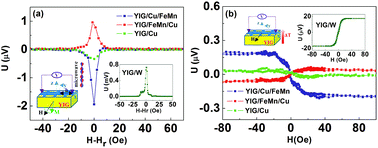
Spin pumping and SSE were performed on the two YIG/FeMn samples with and without a 3 nm Cu seed layer. Since the Cu layer has a thickness much smaller than its spin diffusion length, in addition, Cu has very weak spin–orbit coupling, the spin current should pass through the Cu layer in the YIG/Cu/FeMn sample with the measured ISHE voltage mostly coming from the FeMn layer as demonstrated later. However, shunting effect of Cu cannot be ignored. In order to deal with the ISHE of the two samples on equal footing, an additional 3 nm Cu layer was deposited on the YIG/FeMn film without the Cu seed layer. As expected, the YIG/Cu/FeMn and YIG/FeMn/Cu samples are found to exhibit little difference in resistivity with the relative difference below 5%. Fig. 3(a) shows the DC voltage of ISHE from spin pumping. Remarkably, the voltage of YIG/Cu/FeMn is about 2 μV, twice as large as that of YIG/FeMn/Cu. Moreover, the sign of the voltage is opposite for these two samples, indicating that the spin Hall angle of the FeMn is opposite in sign in these two samples. The SSE results give the same tendency. As shown in Fig. 3(b), the thermal ISHE voltages for the YIG/Cu/FeMn and YIG/FeMn/Cu are opposite with magnitudes of about 0.4 μV and 0.2 μV, respectively. We would like to emphasize that, the control measurement on YIG/Cu gives ISHE voltage of about 0.04 μV for SSE, and 0.38 μV for spin pumping (cf. Fig. 3), both are almost one order smaller than the corresponding values for YIG/Cu/FeMn. Therefore, the large enhanced ISHE voltage in the YIG/Cu/FeMn cannot come from the ISHE signal of the Cu seed layer.
image file: c6ra22256k-f3.tif
Fig. 3 (a) DC voltage of ISHE measured in spin pumping experiments for YIG/Cu (3 nm)/FeMn (10 nm), YIG/FeMn (10 nm)/Cu (3 nm) and YIG/Cu (3 nm). Inset is ISHE voltage for YIG/W (3 nm) in spin pumping experiment. (b) Field-dependent thermal voltages for YIG/Cu (3 nm)/FeMn (10 nm), YIG/FeMn (10 nm)/Cu (3 nm) and YIG/Cu (3 nm). Inset is thermal voltage for YIG/W (3 nm).

In order to further determine the different spin Hall angle polarities exhibited in the YIG/FeMn samples with and without a Cu seed layer, controlled experiments were done on YIG/W (3 nm). The insets of Fig. 3(a) and (b) show the ISHE voltages of the YIG/W sample from the spin pumping and SSE, respectively. Apparently, the voltage polarity of YIG/W is the same as that of YIG/FeMn/Cu. Since W has a negative spin Hall angle,10 the spin Hall angle of FeMn is negative for YIG/FeMn/Cu, but positive for YIG/Cu/FeMn. To sum up, by using the Cu seed layer, the spin Hall angle of FeMn is substantially enhanced with its polarity changed from negative to positive.

As pointed out earlier, the FeMn alloy is generally crystallized in the nonmagnetic α phase, and with the aid of Cu seed layer, the γ phase FeMn films can be formed with antiferromagnetism.33 In order to ascertain the magnetic properties of FeMn in YIG/FeMn system with and without Cu seed layer, another two samples, YIG/Cu/FeMn/Py and YIG/FeMn/Py, were fabricated and magnetically characterized through AMR measurement.37 Fig. 4(a) and (b) show the room temperature AMR loops of these two samples. The observed magnetoresistance should mostly come from the Py AMR with the resistance peaks corresponding to the coercive forces of the Py layer.37 From the AMR curves, an exchange bias (EB) field of about 13 Oe is evident for the YIG/Cu/FeMn/Py, it means that the FeMn film on the seed layer of Cu is definitely in AF order. On the contrary, there is no EB in the YIG/FeMn/Py, suggesting that the FeMn film directly deposited on YIG is nonmagnetic or antiferromagnetic with a relatively low blocking temperature. These two samples were further cooled to 78 K in a field of 1500 Oe with its direction parallel to the film growth field direction during sputtering. Fig. 4(c) and (d) show the corresponding AMR loops at 78 K after field cooling. The EB in the YIG/Cu/FeMn/Py is significantly increased to 110 Oe, but there is still lack of EB in YIG/FeMn/Py with a symmetric AMR curve. Therefore, the FeMn film grown on the Cu seed layer is convincingly proved to be AF ordered, whereas the FeMn film deposited directly on YIG is highly probably in PM state. We would like to point out that, the room temperature AMR curves in Fig. 4(a) and (b) approach to saturate at about 50 Oe, coincided with saturation field of YIG (cf. Fig. 2(a)). This means that, besides the dominant AMR from the Py layer, a very small spin Hall magnetoresistance (SMR) associated with the YIG magnetization switching may present in the heterostructures.38 For the low temperature AMR curve of the YIG/Cu/FeMn/Py in Fig. 4(c), small bumps or shoulders around zero field are observable, which should also originate from the SMR. As for the AMR curve of the YIG/FeMn/Py at 78 K in Fig. 4(d), there is not such a recognizable feature, probably because the YIG switches magnetization around the coercivity of the Py. Parenthetically, the YIG/FeMn/Py at 78 K has a saturation field much larger than its room temperature value, it seems that spin fluctuations in the paramagnetic FeMn film become significant at 78 K. We would like to point out that XRD patterns do not exhibit any obvious FeMn characteristic peak for all samples. Besides that the FeMn layer is too thin, the film of FeMn deposited on YIG surface or through a very thin Cu layer might be poorly crystallized.


image file: c6ra22256k-f4.tif
Fig. 4 (a) MR result of YIG/Cu (3 nm)/FeMn (10 nm)/Py (6 nm) as a function of magnetic field H at room temperature. (b) MR result of YIG/FeMn (10 nm)/Py (6 nm) as a function of magnetic field H at room temperature. (c) MR loop of YIG/Cu (3 nm)/FeMn (10 nm)/Py (6 nm) as a function of magnetic field H at 78 K. (d) MR loop of YIG/FeMn (10 nm)/Py (6 nm) as a function of magnetic field H at 78 K.

It is a well-established fact that interface plays an important role in spin pumping.18,29,39 Du and Wang et al. reported that a Cu spacer (thinner than 5 nm) introduced in the YIG/NiFe, Ni structures decreases the ISHE voltage to some extent, but never observed the change of the ISHE voltage sign.18,29,39 Zhang et al. found that the values of ISHE voltage for Py/FeMn, PdMn, IrMn, PtMn also becomes slightly smaller with almost identical thickness dependence when a Cu spacer is inserted into the interface.18,29,39 In the present case, we observed significant enhancement of the ISHE voltage magnitude together with a reversed polarity when the Cu seed layer was introduced, and remarkably, it coincided with the appearance of the exchange bias. Therefore, the strong effect of Cu seed layer on spin Hall angle of FeMn should be correlated with the AF order formation in the FeMn film. As is known, the AF γ-FeMn has a non-coplanar spin structure.31,32,40 Theoretically, this non-coplanar spin texture gives finite spin chirality, and the Berry phase due to the spin wave function gives rise to orbital ferromagnetism and anomalous Hall effect for the distorted FCC lattice.30,31 The orbital ferromagnetism is simply the thermodynamic average of the orbital moment. Thus, stronger spin–orbit coupling should exit in AF-FeMn system, resulting in a large ISHE voltage in both spin pumping and SSE measurements. In addition, the sign of ISHE voltage could depend on a subtle interplay between the orientations of orbital and spin momenta as well as on the character (repulsive vs. attractive) of scattering potentials, which might be strong related to the large exchange filed in AF-FeMn system.41 In other words, the influence of the non-collinear AF order on the spin–orbit coupling and/or on Berry phase curvature can be significant. Therefore, the intrinsic SHE of FeMn alloy critically depends on its AF ordering.

Conclusions

In conclusion, the ISHE of FeMn films with different magnetic properties was investigated through spin pumping and SSE. The spin Hall angle is positive for the AF-FeMn, but negative for the PM-FeMn. Moreover, the magnitude of spin Hall angle for AF-FeMn is much higher than that for PM-FeMn. The present results show that AF order in a material could strongly affect its intrinsic SHE, which will provide more insight into the spin current study.

Acknowledgements

This work was supported by the National Key Research and Development Program of China under grant No. 2016YFA0300804, National Basic Research Program of China under Grant Nos 2015CB921403, 2015CB921502, the National Natural Science Foundation of China under Grant Nos 51371191, 51431009 and 11474184, the 111 Project (Grant No. B13029), and the Fundamental Research Funds of Shandong University, China.

References

  1. T. Jungwirth, J. Wunderlich and K. Olejník, Nat. Mater., 2012, 11, 382–390 CrossRef CAS PubMed.
  2. L. Vila, T. Kimura and Y. Otani, Phys. Rev. Lett., 2007, 99, 226604 CrossRef PubMed.
  3. J. E. Hirsch, Phys. Rev. Lett., 1999, 83, 1834 CrossRef CAS.
  4. Y. Tserkovnyak, A. Brataas and G. E. W. Bauer, Phys. Rev. Lett., 2002, 88, 117601 CrossRef PubMed.
  5. A. Azevedo, L. H. V. Leão, R. L. Rodriguez-Suarez, A. B. Oliveira and S. M. Rezende, J. Appl. Phys., 2005, 97, 10C715 CrossRef.
  6. E. Saitoh, M. Ueda, H. Miyajima and G. Tatara, Appl. Phys. Lett., 2006, 88, 182509 CrossRef.
  7. Y. Kajiwara, K. Harii, S. Takahashi, J. Ohe, K. Uchida, M. Mizuguchi, H. Umezawa, H. Kawai, K. Ando, K. Takanashi, S. Maekawa and E. Saitoh, Nature, 2010, 464, 262–266 CrossRef CAS PubMed.
  8. K. Uchida, S. Takahashi, K. Harii, J. Ieda, W. Koshibae, K. Ando, S. Maekawa and E. Saitoh, Nature, 2008, 455, 778–781 CrossRef CAS PubMed.
  9. K. Uchida, M. Ishida, T. Kikkawa, A. Kirihara, T. Murakami and E. Saitoh, J. Phys.: Condens. Matter, 2014, 26, 389601 CrossRef.
  10. H. L. Wang, C. H. Du, Y. Pu, R. Adur, P. C. Hammel and F. Y. Yang, Phys. Rev. Lett., 2014, 112, 197201 CrossRef CAS PubMed.
  11. P. Laczkowski, J.-C. Rojas-Sánchez, W. Savero-Torres, H. Jaffrès, N. Reyren, C. Deranlot, L. Notin, C. Beigné, A. Marty, J.-P. Attané, L. Vila, J.-M. George and A. Fert, Appl. Phys. Lett., 2014, 104, 142403 CrossRef.
  12. D. V. Fedorov, C. Herschbach, A. Johansson, S. Ostanin, I. Mertig, M. Gradhand, K. Chadova, D. Ködderitzsch and H. Ebert, Phys. Rev. B: Condens. Matter Mater. Phys., 2013, 88, 085116 CrossRef.
  13. Y. Niimi, H. Suzuki, Y. Kawanishi, Y. Omori, T. Valet, A. Fert and Y. Otani, Phys. Rev. B: Condens. Matter Mater. Phys., 2014, 89, 054401 CrossRef.
  14. A. Fert and P. M. Levy, Phys. Rev. Lett., 2011, 106, 157208 CrossRef PubMed.
  15. Y. Niimi, M. Morota, D. H. Wei, C. Deranlot, M. Basletic, A. Hamzic, A. Fert and Y. Otani, Phys. Rev. Lett., 2011, 106, 126601 CrossRef CAS PubMed.
  16. L. K. Zou, S. H. Wang, Y. Zhang, J. R. Sun, J. W. Cai and S. S. Kang, Phys. Rev. B, 2016, 93, 014422 CrossRef.
  17. L. Frangou, S. Oyarzún, S. Auffret, L. Vila, S. Gambarelli and V. Baltz, Phys. Rev. Lett., 2016, 116, 077203 CrossRef CAS PubMed.
  18. W. Zhang, M. B. Jungfleisch, W. Jiang, J. E. Pearson and A. Hoffmann, Phys. Rev. Lett., 2014, 113, 196602 CrossRef PubMed.
  19. H. Wang, C. Du, P. C. Hammel and F. Yang, Phys. Rev. Lett., 2014, 113, 097202 CrossRef PubMed.
  20. W. Lin, K. Chen, S. Zhang and C. L. Chien, Phys. Rev. Lett., 2016, 116, 186601 CrossRef PubMed.
  21. A. B. Shick, S. Khmelevskyi, O. N. Mryasov, J. Wunderlich and T. Jungwirth, Phys. Rev. B: Condens. Matter Mater. Phys., 2010, 81, 212409 CrossRef.
  22. V. M. T. S. Barthem, C. V. Colin, H. Mayaffre, M.-H. Julien and D. Givord, Nat. Commun., 2013, 4, 2892 CAS.
  23. B. G. Park, J. Wunderlich, X. Martí, V. Holý, Y. Kurosaki, M. Yamada, H. Yamamoto, A. Nishide, J. Hayakawa, H. Takahashi, A. B. Shick and T. Jungwirth, Nat. Mater., 2011, 10, 347–351 CrossRef CAS PubMed.
  24. F. Freimuth, S. Blügel and Y. Mokrousov, Phys. Rev. Lett., 2010, 105, 246602 CrossRef PubMed.
  25. A. S. Núñez, R. A. Duine, P. Haney and A. H. MacDonald, Phys. Rev. B: Condens. Matter Mater. Phys., 2006, 73, 214426 CrossRef.
  26. C. Wang, H. Seinige, G. Cao, J.-S. Zhou, J. B. Goodenough and M. Tsoi, Phys. Rev. X, 2014, 4, 041034 Search PubMed.
  27. Y. Ohnuma, H. Adachi, E. Saitoh and S. Maekawa, Phys. Rev. B: Condens. Matter Mater. Phys., 2013, 87, 014423 CrossRef.
  28. J. B. S. Mendes, R. O. Cunha, O. A. Santos, P. R. T. Ribeiro, F. L. A. Machado, R. L. Rodŕıguez-Sú, A. Azevedo and S. M. Rezende, Phys. Rev. B: Condens. Matter Mater. Phys., 2014, 89, 140406(R) CrossRef.
  29. C. Du, H. Wang, F. Yang and P. C. Hamme, Phys. Rev. B: Condens. Matter Mater. Phys., 2014, 90, 140407(R) CrossRef.
  30. J. Železný, H. Gao, K. Výborný, J. Zemen, J. Mašek, A. Manchon, J. Wunderlich, J. Sinova and T. Jungwirth, Phys. Rev. Lett., 2014, 113, 157201 CrossRef PubMed.
  31. H. Chen, Q. Niu and A. H. MacDonald, Phys. Rev. Lett., 2014, 112, 017205 CrossRef PubMed.
  32. R. Shindou and N. Nagaosa, Phys. Rev. Lett., 2001, 87, 116801 CrossRef CAS PubMed.
  33. C. Tsang, N. Heiman and K. Lee, J. Appl. Phys., 1981, 52, 2471 CrossRef CAS.
  34. W. Zhang, M. B. Jungfleisch, F. Freimuth, W. Jiang, J. Sklenar, J. E. Pearson, J. B. Ketterson, Y. Mokrousov and A. Hoffmann, Phys. Rev. B: Condens. Matter Mater. Phys., 2015, 90, 144405 CrossRef.
  35. T. Kikkawa, K. Uchida, Y. Shiomi, Z. Qiu, D. Hou, D. Tian, H. Nakayama, X.-F. Jin and E. Saitoh, Phys. Rev. Lett., 2013, 110, 067207 CrossRef CAS PubMed.
  36. Y. M. Lu, Y. Choi, C. M. Ortega, X. M. Cheng, J. W. Cai, S. Y. Huang, L. Sun and C. L. Chien, Phys. Rev. Lett., 2013, 110, 147207 CrossRef CAS PubMed.
  37. J. Noguésa and I. K. Schuller, J. Magn. Magn. Mater., 1999, 192, 203–232 CrossRef.
  38. H. Nakayama, M. Althammer, Y.-T. Chen, K. Uchida, Y. Kajiwara, D. Kikuchi, T. Ohtani, S. Gepra, M. Opel, S. Takahashi, R. Gross, G. E. W. Bauer, S. T. B. Goennenwein and E. Saitoh, Phys. Rev. Lett., 2013, 110, 206601 CrossRef CAS PubMed.
  39. H. Wang, C. Du, P. C. Hammel and F. Yang, Appl. Phys. Lett., 2014, 104, 202405 CrossRef.
  40. Y. Endoh and Y. Ishikawa, J. Phys. Soc. Jpn., 1971, 30, 1614–1627 CrossRef CAS.
  41. W. Pötz and J. Fabian, Lect. Notes Phys., Springer, 2007, vol. 712, p. 29 Search PubMed.

This journal is © The Royal Society of Chemistry 2016
Click here to see how this site uses Cookies. View our privacy policy here.