
Y. C. Wangab,
C. H. Hsua,
Y. Y. Hsucd,
C. C. Changa,
C. L. Dongde,
T. S. Chand,
Krishna Kumarf,
H. L. Liub,
C. L. Chen
*ad and
M. K. Wua
aInstitute of Physics, Academia Sinica, Nankang, Taipei, Taiwan. E-mail: chen.cl@nsrrc.org.tw
bDepartment of Physics, National Taiwan Normal University, Taipei, Taiwan
cProgram for Science and Technology of Accelerator Light Source, National Chiao Tung University, Hsinchu, Taiwan
dNational Synchrotron Radiation Research Center, Hsinchu, Taiwan
eDepartment of Physics, Tamkang University, New Taipei city, Taiwan
fDepartment of General Studies, Physics Division, Jubail Industrial College (JIC), Jubail Industrial City 31961, Kingdom of Saudi Arabia
First published on 7th November 2016
Rubidium tungsten bronzes (RbxWO3) have recently attracted much attention due to their intriguing phenomena, such as complex structural phase transitions, strong electron–phonon coupling, and superconducting properties. This study investigates the local atomic and electronic structures of RbxWO3 (0.17 ≤ x ≤ 0.33). X-ray powder diffraction patterns showed a hexagonal tungsten bronze (HTB) phase. X-ray absorption spectra (XAS) at the W L3-edge and Rb K-edge of RbxWO3 were carried out. The XAS analysis indicated a local distorted WO6 octahedron which leads to a splitting of eg and t2g energy states in the tungsten 5d orbital and this splitting of energy levels exhibited an asymmetrical behavior at x = 0.23 and 0.27. Overall analysis revealed a distortion of local atomic structure of the WO6 octahedra by rubidium doping, leading to the modification of the electronic structures of eg and t2g states in the tungsten 5d orbital, thereby accounting for the property changes in CDW formation and superconducting transition temperature of these materials.
![]() | ||
| Fig. 1 X-ray diffraction pattern of RbxWO3. Inset shows the lattice constant (a and c values marked in blue and red respectively) as a function of Rb doping(x). | ||
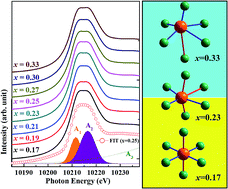
XANES provides information on the symmetry of the unoccupied electronic states. Fig. 2(a) presents W L3-edge XANES spectra of RbxWO3, x is ranged from 0.17 to 0.33. The strong resonance near the absorption edge in the energy region 10
190–10
225 eV is due to the excited electron transfer from W 2p3/2 to 5d unoccupied states with multiple excitations for hybridized W 5d–O 2p conduction band states.17–20 XANES is sensitive to the local structural symmetry and to the influence of the bonding effect with oxygen ligands. The W L3-edge spectra exhibit several features and are consistent with the h-WO3 electronic structural calculations on crystal-field 10 Dq results of the Oh symmetries.18 The figure shows two prominent features A1 and A2, which are attributed to the splitting of W 5d orbital into t2g and eg degenerate states, respectively, due to crystal field effect. To study the symmetry of W 5d electronic states, the decomposed A1(t2g) and A2(eg) features are obtained by subtracting the arctangent (edge jump for step function) curve with best fitted Gaussian curves (absorption white line) (as shown in the bottom of Fig. 2(a)).19,20 The fitted spectrum is consistent with the result from first principle calculation, as shown in the bottom of Fig. 2(a) which depicts a W L3-edge XANES spectra of h-WO3 and the corresponding density of states (DOS) t2g and eg orbitals.18 The band-structure calculations were carried out in the scheme of generalized gradient approximation GGA with the on-site Coulomb interaction U taken into account,18 i.e., GGA+U calculations, are presented to interpret the XAS results. Fig. 2(a) shows that the line profiles of the spectra are nearly identical for RbxWO3, irrespective of Rb doping and closely resemble that of h-WO3. These findings are consistent with the XRD data where no major change was noticed in the hexagonal structure irrespective of Rb doping. Further, it is noticed that the integrated area of W L3-edge for the RbxWO3 almost matches with the h-WO3 standard which means that the total unoccupied state of W 5d hole does not change when Rb is doped into WO6 octahedra. This finding imply that the valence of W in all the RbxWO3 samples is not altered and may therefore be confirmed as 6+. Fig. 2(b) presents the shift of W L3-edge as a function of Rb doping which are obtained from first derivative W L3-edge XANES spectra.19,20 Inset of Fig. 2(b) shows W L3-edge XANES first derivative spectra of Rb-doped WO3 and reference h-WO3. A shift of ∼0.5 eV in the absorption edge between the x = 0.17 and 0.23 are observed (region I). A shift in the W L3-edge XANES spectra of HxWO3 from that of pure W and h-WO3 spectrum was reported earlier, which was due to the displacement of the electron density of W atoms.17 The absorption edge shift in W L3-edge XANES, especially at x ≤ 0.23 may be attributed to a change in the energy gap, as suggested by Sato et al.12 They suggested an alteration in the energy gap and Fermi level position in the electronic structure of tungsten, with a maximum around x = 0.25. Unlike the region I in which the energy of absorption edge position is monotonically decreased with an increase in Rb concentration, the absorption edge shifts to high energy as x = 0.23 increases to 0.27 in region II. Indeed to fully understand the structure of RbxWO3, its phase transition and the lattice distortions in WO6 octahedra with doping, it is necessary to have a knowledge on how the structural models were built. K. S. Lee et al.11 performed the electronic band structure calculations on RbxWO3 and presented a detailed structural model to explain the metal–semiconductor–metal phase transition. Further, P. Krüger et al.,18 carried out a density functional theory study on pure and potassium doped tungsten trioxide which has a similar structure to RbxWO3 and estimated the DOS. In Fig. 2(b), three distinct regions (I, II, III) with different colors represent the phase transition. The green and yellow regions represent the metal and semiconductor phases of RbxWO3 respectively. From a band structure calculation,18 the Fermi level (EF) of WO3 can be tailored by introduction of Rb and subsequent lattice structural distortion. Thus the lower part of conduction band which is composed of W 5d-t2g band and 5d-eg band is critical. The W 5d-t2g band (unoccupied states above EF) exhibit mainly electron–orbital interaction in 5d characters. Above results suggest that presence of Rb can cause the energy shift of W 5d states and thus modify the DOS around the Fermi level. BCS theory suggests that superconducting state is strongly correlated to the electron–phonon interactions. Tc increases with an increase in the electron–phonon coupling. A reduced electron–phonon interaction and thus a decrease in Tc at x = 0.25 was reported earlier by K. S. Lee et al.11 As x decreases (x < 0.33) in RbxWO3, cation vacant sites increases and are randomly distributed creating a random potential for conducting electrons. However, this is expected to suppress the superconductivity. Hence, disappearance of superconductivity at x = 0.25 is likely to be due to CDW formation associated with the 1D Fermi surface which removes lattice phonons that contribute to superconductivity. Their calculations also showed the presence of 1D as well as 3D Fermi surfaces in the system.11 In general, more doping of Rb ions increase the stiffness of the WO3 lattice which reduces the chance of CDW formation, whereas the electronic instability favors. Briefly, the CDW formation depends on the interplay of lattice stiffness and the electronic instability.11 It is worth to recall that an interesting behavior of RbxWO3 type materials is their composition dependent resistivity anomaly that has strong correlation with CDW formation. The superconductivity behavior of these materials is also correlated to the CDW onset temperature TB at which resistivity anomaly occurs (an anomalous hump in the resistivity).8,10,11 A few reports also indicated an electron–hole correlations in AxWO3 due to W ions at distorted lattice structure which may influence the electronic transport behavior.21,22
Fig. 2(c) depicts the Δ0 (Δ0 = A2(eg) − A1(t2g) = 10 Dq), estimated by the Oh crystal field theory, as a function of Rb doping. The t2g–eg splitting energy levels in the 5d with Rb doping suggests an instability and distortion of Oh symmetry. The d orbital splitting directly reflects the energy gap.20 The result demonstrates that Δ0 is minimum at x = 0.23 and maximum at x = 0.27. Interestingly, the room temperature resistivity (ρ) of RbxWO3 at various doping levels shows a similar behavior to Δ0 (Fig. 2(c)). The resistivity gradually decreases from x = 0.17 to 0.23, exactly in the same trend as Tc decreases with x and recall that RbxWO3 exhibit metallic properties in this region. Thus, it can be deduced that both the effect of lattice structure modulation and electronic-orbital overlapping variations with doping lead to the state of semiconductor behavior along with no sign of superconductivity in the range 0.23 < x < 0.27. At the metal–semiconductor–metal phase transition region in RbxWO3, the instability in the local structure as discussed above can make changes in the W 5d band structure and the position of EF. CDW can cause an electronic instability, and it is strongly correlated to the variation in the crystal structure. The W 5d orbital symmetry is strongly correlated to the crystal lattice and corner-sharing atoms in WO6 octahedron. Thus, the values of full width at half maximum (FWHM) of eg states (marked in blue) are estimated and plotted as a function of Rb doping in Fig. 3. A maximum at x = 0.23 is observed in Fig. 3. As the eg (dz2 and dx2−y2) orbitals point directly to the corners of WO6 octahedron, the variation in FWHM eg unoccupied states with Rb doping is likely to cause a distortion in the octahedron. The CDW onset temperature TB as a function of x in RbxWO3 (adapted from ref. 10) is also included in Fig. 3 for comparison. Interestingly, the variation in TB show a maximum near x = 0.25. The similar trend in the variation of FWHM eg and TB again suggest that the Rb doping changes the structural ordering and modifies the local structure symmetry of WO3.11,12 Therefore, it is essential to investigate the local atomic structure of RbxWO3 using EXAFS.
![]() | ||
| Fig. 3 The full width at half maximum (FWHM) values of eg states (marked in blue) at various Rb doping. CDW onset temperature TB as a function of x in RbxWO3 is also shown (adapted from ref. 10). | ||
Fig. 4 shows Fourier transform (FT) of EXAFS k3χ data at the W L3-edge from k = 3 to 11 Å−1 (inset) for RbxWO3 at various Rb doping and the reference h-WO3. For all samples, radial distribution of FT spectra are similar to each other. The FT profiles in real (R)-space provide direct evidence on the changes in the W–O bond length, coordination number, and Debye–Waller factor (σ2).23 The first two main peaks near 1.38 and 1.85 Å correspond to the first (W–O1), nearest neighbor, and second (W–O2), next nearest neighbor, shells/bond length in the WO6 octahedron, respectively.19,20,24 The O1 and O2 corresponds to the oxygen atom in the equatorial and axial positions in the octahedron, respectively. The EXAFS curves are fitted by FEFF analysis using ARTEMIS program23 (open symbols in Fig. 4) and the results are presented in Table 1. The spectra shows a best fitting within the limits of 0.5 Å and 2.3 Å. Fig. 5(a) shows the variation of W–O bond length in the first and second shell in WO6 octahedron (from Fig. 4) as a function of Rb doping. The figure demonstrates that the W–O1 bond length (blue) increases from 1.83 Å at x = 0.17 to 1.888 Å at x = 0.33, the error in bond length is less than ±0.01. In contrast, the W–O2 bond length (red) slightly decreases with Rb doping initially (i.e. x = 0.17 to 0.23) and then increases. The W–O bond length variation (Fig. 5(a)), especially asymmetrical shift of the second shell near x = 0.23, imply that the structural symmetry of WO6 (Oh) octahedron has distorted keeping the hexagonal structure, which is consistent with the XRD analysis. The FWHM of W 5d-eg orbital exhibits a maximum value at x = 0.23 (Fig. 3). The increase in W–O bond length with Rb doping is attributed to the increased occupation of comparatively large atomic radius Rb compared to W. This probably create an increased disorder in the WO6 octahedron, with a local lattice distortion that may lead to changes in the lattice phonon behavior. Fig. 5(b) compares the coordination number (CN) of first and second shells as a function of Rb doping. The result indicates a discontinued change of CN at x = 0.23 for both the O1 (blue) and O2 (red) cases. The CN in the first shell indicates a substantial decrease (increase) at x ≤ 0.23 (x ≥ 0.23). In contrast, the second shell demonstrate an opposite trend. These changes in the CN suggest an off center effect in the octahedron as predicted by earlier electronic structure calculation.6,25 In order to get an insight into the local structural modification caused by Rb doping and the nature of distortion in WO6 octahedral symmetry, a schematic model of distortion duly taking account of W–O1 and W–O2 variation is presented in Fig. 6. The W–O bond length and CN estimated from EXAFS analysis are also considered. Analytic results from Fig. 5 and 6 infer that at low Rb doping, though the WO6 octahedron does not exhibit a major distortion, the W–O bond length along z-axis increases. As the Rb doping gradually increases to 0.23, it appears that the position of central W ions is modulated and shifted in the xy-plane (equatorial) of octahedron. In this region, CN slightly increases in second shell (W–O2) and a corresponding decrease is observed in the first shell (W–O1). Further increase in Rb doping (x > 0.23) results the structure (octahedron) extend along z-axis at one side that lead to an increase in CN of W–O1 and a corresponding decrease in W–O2. To sum up, Rb doping caused a local structure distortion and the tungsten ions off center in the WO6 octahedron. The electron–phonon coupling mechanism in quasi-1-D lattice structure is contributed by vibration of Einstein-like phonon modes.10–15 Hence, the change of local electronic structure and distortion of local atomic structure of the WO6 octahedron, revealed by XANES and EXAFS, modify the electron–phonon coupling in RbxWO3 and generate an Einstein-like phonon mode vibration. This alteration in the phonon mode vibration accounts for the superconducting transition temperature and CDW formation in RbxWO3. Recall that the W L3-edges XANES indicate a variation in the W5d-orbital electronic states due to the t2g–eg splitting of energy levels by the ligand fields of the surrounding oxygen atoms and an associated distortion in the local structure symmetry by Rb doping. Further, it is worth to point out that our Rb K-edge XANES of RbxWO3, as shown in Fig. 7, does not show any change in the Rb valence with Rb doping which is consistent with other studies on hexagonal alkali tungsten bronzes AxWO3 (A = K, Rb and Cs) that A+ cations are occupied at the tunnel of hexagonal lattices. Finally, this study indicate an off center shift for tungsten ions in WO6 octahedral symmetry and an associated change in phonon mode of vibration. Analytic result from XAS evidences the changes in W 5d electronic states and the local structural distortion cause the suppression of superconductivity and the phase transition in RbxWO3.
![]() | ||
| Fig. 4 EXAFS results (solid line) from the W L3-edge. The FEFF fitting (open symbols) presents the WO6 octahedral coordination. The inset shows the k space results. | ||
| Sample | Shell | N | σ2 | R (Å) |
|---|---|---|---|---|
| h-WO3 | 1 | 4 | 0.005 | 1.7714 (±0.003) |
| 2 | 2 | 0.004 | 2.0456 (±0.005) | |
| Rb0.17WO3 | 1 | 4.009 | 0.007 | 1.8303 (±0.010) |
| 2 | 1.982 | 0.005 | 2.0123 (±0.001) | |
| Rb0.19WO3 | 1 | 4.009 | 0.006 | 1.8403 (±0.002) |
| 2 | 1.973 | 0.004 | 2.0172 (±0.006) | |
| Rb0.21WO3 | 1 | 3.977 | 0.006 | 1.8405 (±0.003) |
| 2 | 1.984 | 0.006 | 2.0017 (±0.009) | |
| Rb0.23WO3 | 1 | 3.782 | 0.004 | 1.8451 (±0.010) |
| 2 | 2.158 | 0.004 | 1.9854 (±0.006) | |
| Rb0.25WO3 | 1 | 4.442 | 0.007 | 1.8559 (±0.008) |
| 2 | 1.479 | 0.007 | 2.0423 (±0.005) | |
| Rb0.27WO3 | 1 | 4.543 | 0.009 | 1.8622 (±0.002) |
| 2 | 1.367 | 0.009 | 2.0700 (±0.008) | |
| Rb0.30WO3 | 1 | 4.7 | 0.009 | 1.8779 (±0.003) |
| 2 | 1.2 | 0.009 | 2.1399 (±0.007) | |
| Rb0.33WO3 | 1 | 4.824 | 0.008 | 1.8888 (±0.006) |
| 2 | 1.002 | 0.005 | 2.0159 (±0.008) |
![]() | ||
| Fig. 5 (a) The W–O bond length in first (blue) and second (red) shell, (b) is the oxygen coordination number in first and second shell. | ||
| This journal is © The Royal Society of Chemistry 2016 |