
Liming Taoa,
Fang Niub,
Jingang Liuc,
Tingmei Wanga and
Qihua Wang*a
aState Key Laboratory of Solid Lubrication, Lanzhou Institute of Chemical Physics, Chinese Academy of Sciences, Lanzhou, Gansu 730000, P. R. China. E-mail: qhwang@licp.cas.cn; Fax: +86 0931 4968252; Tel: +86 0931 4968252
bCollege of Chemistry and Chemical Engineering, Lanzhou University, Lanzhou, Gansu 730000, P. R. China. E-mail: niufang@lzu.edu.cn
cSchool of Materials Sciences and Technology, China University of Geosciences, Beijing, 100083, P. R. China. E-mail: liujg@iccas.ac.cn
First published on 29th September 2016
A series of covalent triazine frameworks containing Troger's base segments (CTF-TBs) were designed and prepared by dynamic trimerization under ionothermal conditions, based on the novel dicyano monomer of dicyano Troger's base (DCTB). The CTF-TBs were all amorphous and exhibited surface areas between 294 to 732 m2 g−1. The effect of reaction conditions including ratio of catalyst/monomer and temperature on the pore properties was discussed. Meanwhile, the adsorption capacity of CO2 for all the CTF-TBs was studied and the CO2 uptake capacity was up to 16.84 wt% at 273 K and 1.10 bar for CTF-TB-3.
On the other hand, covalent triazine frameworks (CTFs) have high nitrogen content and high surface areas, and their preparation procedure is adapted to a large scale.27–32 Nowadays, A. Thomas et al. developed a novel two-step procedure to prepare CTFs, in which an amorphous, non-porous polymer network was converted into an ordered, microporous covalent organic framework under ionothermal conditions.33 This method makes the CTF synthesis easier, safer and scalable. Although with high nitrogen loading of about 21.8 wt%, the CO2 uptake of CTF-1 derived from 1,4-dicyanobenzene (DCB) is not so high. Further modification of CTFs by other CO2-philic groups, e.g. F atoms,34 pyridine groups,35 and benzimidazole groups,36 have been proved their effectiveness in enhancement of CO2 adsorption.
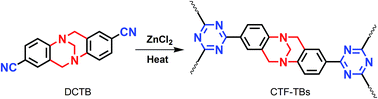
In the present work, we combined CTF and TB together to prepare MOPs with high CO2 adsorptions. CTFs with TB segments are designed and prepared by the ionothermal polymerization procedure. We expect that the CO2-philic TB segments can enhance the binding affinity between the CTF-TBs and CO2, and thus increase the CO2 adsorption. The synthesis and properties of the CTF-TBs, the effect of reaction conditions on the porosity, CO2 adsorption ability and the selectivity of CO2/N2, have been studied in detail.
| Polymer code | DCTB (mmol) | ZnCl2 (mmol) | Molar ratio of DCTB/ZnCl2 | Reaction conditions | Yield (%) |
|---|---|---|---|---|---|
| CTF-TB-1 | 0.50 | 0.50 | 1 : 1 |
400 °C/40 h | 82 |
| CTF-TB-2 | 0.50 | 1.0 | 1 : 2 |
400 °C/40 h | 80 |
| CTF-TB-3 | 0.50 | 2.5 | 1 : 5 |
400 °C/40 h | 80 |
| CTF-TB-4 | 0.50 | 5.0 | 1 : 10 |
400 °C/40 h | 84 |
| CTF-TB-5 | 0.50 | 10.0 | 1 : 20 |
400 °C/40 h | 84 |
| CTF-TB-6 | 0.50 | 2.5 | 1 : 5 |
350 °C/40 h | 84 |
| CTF-TB-7 | 0.50 | 2.5 | 1 : 5 |
450 °C/40 h | 74 |
| CTF-TB-8 | 0.50 | 2.5 | 1 : 5 |
500 °C/40 h | 71 |
| CTF-TB-9 | 0.50 | 2.5 | 1 : 5 |
550 °C/40 h | 65 |
In comparison, the super acid TFSA catalyzed polymerization of DCTB in solution was also performed as following. In a 50 mL round bottom flask equipped with a magnetic stir, 20 mL of anhydrous DCM and DCTB (272.3 mg, 1.0 mmol) were added. Under ice bath, TFSA (1.5 g, 10 mmol) was dropped into the mixture slowly. The color turned to deep red finally and some brownish powders precipitated. The mixture was stirred at room temperature for 3 days and it was poured into methanol. The brown powders were collected by filtration and washed several times to neutral and drying in vacuum at 150 °C. The sample was denoted as CTF-TB-S.
The CTF-TBs were synthesized by ionothermal polymerization in sealed tube. In order to find the relationship between the reaction conditions and the porosity properties, a set of reaction conditions was listed in Table 1. The molar ratios of DCTB to ZnCl2 were set as 1
:
1, 1
:
2, 1
:
5, 1
:
10, and 1
:
20, respectively. The reaction temperature was set as 350 °C, 400 °C, 450 °C, 500 °C and 550 °C. All the reaction time was set as 40 hours. In all cases, after polymerization, the light yellow powdery reactants turned black dust in the sealed glass tube. For CTF-TB-1 to CTF-TB-6, there were no positive pressures when the sealed tubes were opened. In comparison, for CTF-TB-7, CTF-TB-8 and CTF-TB-9 reacted at 450 °C, 500 °C and 550 °C, there was obviously positive pressure, which should be paid more attention. All black dusts were grounded in agate mortar to get fine powders. The black powder were all washed and extracted thoroughly to remove the residual ZnCl2. The final yields were in the range of 65–84%, which were a little lower than the reported results on CTF-1. This can be mainly attributed to the TB segments, which were relatively fragile to thermal treatment, especially at elevate temperatures (Fig. S4†). For comparison, the polymerization catalyzed by TFSA in solution was also carried out at room temperature. The formation of CTF-TBs was characterized by FT-IR, PXRD, solid-state 13C NMR spectra, and thermogravimetric analysis (TGA).
Representative FT-IR spectra of polymer (CTF-TB-3, CTF-TB-S) and DCTB were shown in Fig. 1a. After polymerization, the nitrile groups at about 2226 cm−1 were totally disappeared, indicating a high degree of reaction. The characteristic peaks of triazine rings were not very strong, which were located at 1430 cm−1 and 870 cm−1, may be covered by the nearby peaks. At the same time, maybe because the TB segments were fragile to high temperature, the characteristic peaks at around 2800 cm−1 were very weak. The adsorption peaks of aliphatic C–H vibrations were all relatively weak in the other CTF-TBs (Fig. S2 and S3†). As the reaction temperature rose up to 550 °C, the adsorption peaks of TB and triazine segments became even weaker (Fig. S3†), due to the partially decomposition or fragmentation of both TB segments and triazine groups.38,39 In the solid-state 13C NMR spectra shown in Fig. 1b, the chemical signals located at 107.5 ppm should be assigned to the asymmetric nitrile carbons,40,41 which almost disappeared completely after reaction. The nitriles first trimerized to triazine groups and then partially decomposed under high temperatures. Accordingly, the peaks of TB segments disappeared completely after reaction due to the fragile aliphatic methylene, in well accordance with the results by FT-IR. CTF-TB-7 exhibited remarkable thermal stability up to 800 °C in N2 (Fig. S4†). The initial weight loss before 100 °C could be attributed to the absorbed moisture. The slightly weight loss from 300 °C should be attributed to the further degradation of organic frameworks. Therefore, they have similar thermal stability compared with the reported MOPs with TB segments.7,8,24 There was no observable glass transition temperature within the range of 30–500 °C, except the endothermal peak according to the evaporation of adsorbed moisture below 100 °C. The PXRD patterns of CTF-TB-3 and CTF-TB-7 (Fig. S6†) indicated no long-range structures. They were all amorphous with broad diffraction peaks at about 24.8°, which was in well accordance with the reported MOPs containing TB segments.8,22,26 The morphology was also characterized by FESEM as shown in Fig. 1c and S7,† which revealed aggregated particles. In the HR-TEM images shown in Fig. 1d and S8,† the alternating areas of light and dark contrast revealed their disordered porous structural natures.
| Polymer code | SABETa [m2 g−1] | SALangb [m2 g−1] | SAmicroc [m2 g−1] | SAextd [m2 g−1] | V0.1e [m3 g−1] | Vtotf [m3 g−1] | V0.1/Vtot |
|---|---|---|---|---|---|---|---|
| a BET surface area calculated over the pressure range 0.05–0.30 P/P0 at 77.3 K.b Langmuir specific surface area calculated from the nitrogen adsorption isotherm by application of the Langmuir equation.c Micropore surface area calculated from the nitrogen adsorption isotherm using the t-plot method.d The external surface areas calculated using the t-plot method based on the Halsey thickness equation.e V0.1, pore volume at P/P0 = 0.1 at 77.3 K.f Vtot, total pore volume calculated at P/P0 = 0.99 at 77.3 K.g Not detected any reasonable data. | |||||||
| CTF-TB-1 | 294 | 431 | 243 | 51 | 0.146 | 0.155 | 0.942 |
| CTF-TB-2 | 446 | 653 | 302 | 144 | 0.212 | 0.244 | 0.869 |
| CTF-TB-3 | 612 | 901 | 338 | 274 | 0.283 | 0.349 | 0.811 |
| CTF-TB-4 | 581 | 858 | 293 | 288 | 0.265 | 0.329 | 0.805 |
| CTF-TB-5 | 495 | 721 | 257 | 238 | 0.225 | 0.295 | 0.763 |
| CTF-TB-6 | 10 | 17 | 17 | —g | 0.007 | 0.009 | 0.778 |
| CTF-TB-7 | 731 | 1077 | 488 | 244 | 0.350 | 0.415 | 0.843 |
| CTF-TB-8 | 689 | 1014 | 486 | 203 | 0.332 | 0.373 | 0.890 |
| CTF-TB-9 | 625 | 919 | 424 | 202 | 0.298 | 0.343 | 0.868 |
| CTF-TB-S | 11 | 16 | 4 | —g | —g | —g | —g |
The influence of the amount of ZnCl2, as well as reaction temperatures on the properties of the materials was investigated. First, the influence of the DCTB/ZnCl2 ratio was investigated under standard conditions at 400 °C. It was found that the amount of ZnCl2 had obvious effect on the pore properties of CTF-TBs, because it played the role of both solvent and catalyst in the reaction. When the ratios increased from 1
:
1 to 1
:
20, the BET surface areas first increased and then decreased gradually, as shown in Fig. 2b, which was in good agreement with that of dicyanobisphenyl (DCBP) and dicyanobenzimidazole (DCBI) under similar conditions.36,42 For CTF-TB-3, where the ratio of DCTB to ZnCl2 was 1
:
5, the BET surface area was 612 m2 g−1. This value was much lower than that of CTF-1 derived from 1,4-dicyanobenzene (DCB, 1123 m2 g−1) and dicyanobenzimidazole (DCBI, 1025 m2 g−1),27,36 under similar conditions. The main reason should be the serious decomposition of the unstable TBs under high temperatures. Further increase of ZnCl2 amount lead to decrease in BET surface areas may be due to the dilutive effect of excess amount of solvents.
It was revealed that higher reaction temperatures generate mesoporosity in addition to microporosity.27 Therefore, a series of temperatures from 350 °C to 550 °C was checked. When reaction temperatures increased, the BET surface areas first increased gradually and then decreased slightly as shown in Fig. 2e. For CTF-TB-7 obtained at 450 °C, the BET surface area was higher than that of CTF-TB-3 (731 m2 g−1 vs. 612 m2 g−1). However, compared with the reported CTFs with high surface areas, for example, CTF-0 derived from 1,3,5-tricyanobenzene (TCB, 2011 m2 g−1) and CTF-1 derived from DCB (1750 m2 g−1) under similar conditions,28,43 the present value was much lower. Furthermore, higher temperatures lead to some side reactions such as carbonizations, decompositions and ring fragmentations, as evidenced by FT-IR and solid-state 13C NMR analysis. In the present system, both the triazine rings and the TBs could decompose under higher temperatures to a relatively high extent, leading to partially collapse of pores. The obviously different tendency of BET surface areas vs. reaction temperatures can be mainly ascribed to the relatively lower thermal stability of TB segments, compared with benzene rings in CTF-1. According to results obtained by A. Thomas, the mesoporous pores mainly derived from a retrotrimerization/recombination pathway.28 If the TB segments were destroyed by the high temperatures, they cannot reorganize to form porous structures, thus leading to decrease in surface areas.
The gas storage properties of the CTF-TBs were tested. There are two kinds of CO2-philic groups in the CTF-TBs, e.g., the TB segments which contained tertiary amine and the triazine groups. Therefore, it can be predicted that the CTF-TBs would have high CO2 adsorption ability. We tested the CO2 adsorption properties at 273 K and a pressure up to 1.10 bar (Fig. 3a and b). The adsorption data were summarized in Table 3, from which we can see that all CTF-TBs showed moderate to high capacity of CO2 adsorption, consistent with our expecting. The CO2 adsorptions for all CTF-TBs ranged from 10.67 wt% to 16.84 wt% at 273 K and 1.10 bar. However, the CO2 adsorptions were not in good agreement with their BET surface areas, which was quite different from the results obtained in the CTF-BIs. CTF-TB-3 had the highest CO2 adsorption amount at 273 K and 1.10 bar (about 16.84 wt%). This adsorption amount was in the range of the highest values observed for CTFs under similar conditions. For example, CTF-1 (10.87 wt%, 746 m2 g−1) and CTF-1-600 (16.81 wt%, 1553 m2 g−1) based on DCB,34 CTF-P6M (18.35 wt%, 947 m2 g−1) prepared by microwave method,29 MCTF@500 (13.90 wt%, 640 m2 g−1) containing metalloporphyrin segments,44 PCTF-1 (14.21 wt%, 2235 m2 g−1) derived from tetranitrile containing tetraphenyl ethylene segments,45 and TPI-1 (10.78 wt%, 809 m2 g−1) containing imide groups,46 etc. Compared with the above mentioned CTFs, the present values showed comparable or better adsorption ability with relatively lower BET surface areas (CTF-TB-3, 16.2 wt% at 1.0 bar, 612 m2 g−1), which can be ascribed to the introduction of CO2-philic TB segments into the frameworks. However, compared with the recently reported FCTF-1-600 (24.33 wt%, 1535 m2 g−1),34 bipy-CTF600 (24.55 wt%, 2479 m2 g−1),35 and CTF-BI-11 (21.7 wt%, 1549 m2 g−1),36 the present result was still much lower. On the other hand, compared with the reported MOPs containing TBs, the present CTF-TBs showed comparable adsorption ability with relatively lower BET surface area under similar conditions. For instance, TB-MOP (17.8 wt%, 694 m2 g−1) with triptycene segments,7 and TB-MOP (16.89 wt%, 802 m2 g−1) derived from tris(4-aminophenyl)amine.12 However, compared with TB-COP-1 (22.8 wt%, 1340 m2 g−1) derived from tetraanilyladamantane,8 the present CTF-TBs didn't show any advantage. The main reason would be ascribed to the partially decomposition and fragmentations of TB segments, which lead to sharply decrease of both surface areas and TB concentrations in the final CTF-TBs.
| Polymer codea | SABET (m2 g−1) | CO2 adsorption (cm3 g−1) | N2 adsorption (cm3 g−1) | CO2/N2c | |||
|---|---|---|---|---|---|---|---|
| 273 Kb | 303 K | 273 K | 303 K | 273 K | 303 K | ||
| a The CO2 adsorptions of CTF-TB-6 and CTF-TB-S were not measured due to the very low BET surface areas.b CO2 adsorption of CTF-TBs at 273 K and 1.10 bar.c Selectivity estimated using the ratios of the Henry law constant calculated from the initial slopes of the single-component gas adsorption isotherms at low pressure coverage (<100 mbar). | |||||||
| CTF-TB-1 | 294 | 54.94 | 33.57 | 4.07 | 1.25 | 44.3 | 50.0 |
| CTF-TB-2 | 446 | 65.92 | 43.46 | 5.34 | 2.56 | 41.0 | 52.2 |
| CTF-TB-3 | 612 | 85.77 | 55.13 | 6.69 | 2.11 | 43.4 | 48.1 |
| CTF-TB-4 | 581 | 61.37 | 37.65 | 4.77 | 2.49 | 34.4 | 39.0 |
| CTF-TB-5 | 495 | 54.35 | 33.56 | 2.74 | 2.10 | 53.3 | 39.5 |
| CTF-TB-7 | 732 | 78.59 | 50.62 | 6.96 | 3.72 | 31.0 | 35.4 |
| CTF-TB-8 | 689 | 66.26 | 39.96 | 4.34 | 2.70 | 42.5 | 32.5 |
| CTF-TB-9 | 626 | 66.47 | 41.01 | 5.66 | 1.77 | 34.1 | 41.0 |
As mentioned above, the CO2 adsorption ability did not show a positive proportional relationship with the BET surface areas. CTF-TB-7 had a higher BET surface area than that of CTF-TB-3 (732 m2 g−1 vs. 612 m2 g−1), but had a lower CO2 adsorption amount (15.43 wt% vs. 16.84 wt%). The main reason should be again ascribed to the partially decomposition and fragmentations, as mentioned above. From the elemental analysis results (Table S1†), as the reaction temperature increased, the loadings of N decreased gradually from 11.82 wt% (350 °C) to 8.52 wt% (550 °C). It should be evidence of the ring fragmentation. X-ray photoelectron spectroscopy (XPS) analysis of CTF-TBs were performed in order to further explore the origin of the effect of reaction temperatures on the CO2 adsorption ability. The N 1s XPS results of DCTB and CTF-TBs (Fig. S14†) reveal that about three to four distinct N configurations exist in the skeletons of CTF-TBs: pyridinic N (397.98–398.40 eV, N(1)), pyrrolic N (399.60–399.99 eV, N(2)), quaternary N (400.86–401.19 eV, N(3)), and N-oxide (402.65–403.94 eV, N(4)).47,48 For CTF-TB-6 (350 °C) and CTF-TB-3 (400 °C), there were three distinct N configurations while for CTF-TB-7 (450 °C), CTF-TB-8 (500 °C), and CTF-TB-9 (550 °C), there were four, also indicated the decomposition or fragmentation reactions may occur under high temperature conditions. The atomic ratios of the four N-configurations in CTF-TBs were further evaluated from the deconvolution of N 1s peaks, and the results are plotted as a function of synthesis temperature in Fig. 3c. In general, the ratio of N(1) and N(2) tend to decrease when the synthesis temperature increases; while the ratios of N(3) and N(4) increase with increasing synthesis temperature. The high CO2 uptakes by nitrogen containing polymers were found to arise from strong interactions of the polarizable CO2 molecules and N atoms with Lewis basic sites. The interactions between CO2 and quaternary N and N-oxide were much weaker than those of pyridinic and pyrrolic N. Although CTF-TB-7 had a much higher BET surface area, the content of quaternary N and N-oxide were also much higher than that of CTF-TB-3 (24.5% vs. 9.2%, Fig. S14†), thus leading to a lower CO2 uptakes.
To determine the binding affinity of CTF-TBs for CO2, we calculated the isosteric heat of adsorption (Qst) for CO2 using the Clausius–Clapeyron equation, as shown in Fig. 3d and S15.† The Qst values of CTF-TBs were in the range of 27.0–30.4 kJ mol−1, which were well below the values expected for a chemisorption process (>40 kJ mol−1). Therefore, the high CO2 affinity of the CTF-TBs was mainly attributed to the inherent microporosity and the enhanced dipole–quadrupole interactions between the quadrupole moment of the CO2 molecules and the nitrogen-rich polar binding sites, both from TB and triazine rings.
CO2 and N2 sorption properties were measured by volumetric methods at the same conditions of 273 K and 303 K, respectively. The selectivity of CO2 over N2 was estimated according to a reported method by using the Henry law constants (Fig. S16†). For all CTF-TBs, the calculated CO2/N2 adsorption selectivities were in the range of 31.0–53.3 at 273 K, and 32.5–52.2 at 303 K, respectively (Table 3 and Fig. S17†). The selectivities were comparable to most of reported CTFs, for instance, TPC-1 with F atoms (selectivity for CO2/N2 at 273 K: 38),49 Cz-POFs with carbazoles (selectivity for CO2/N2 at 273 K: 19–37),50 fl-CTFs (selectivity for CO2/N2 at 273 K: 13–35),40 which were calculated by the same method. However, compared with the highly selective MOPs for CO2 adsorptions, e.g. the azo-COPs with multiple azo groups (selectivity for CO2/N2: 73–124 at 273 K, 113–142 at 298 K),4 these values herein were much lower.
:
5 at 400 °C for 40 hours. This made these materials potential candidates for applications in CO2 capture and storage technology.
Footnote |
| † Electronic supplementary information (ESI) available: Structure characterization of CTF-TBs; the nitrogen adsorption and desorption isotherms and pore size distributions of all CTF-TBs; the CO2 adsorption isotherms, and the CO2/N2 selectivities of all CTF-TBs. See DOI: 10.1039/c6ra21196h |
| This journal is © The Royal Society of Chemistry 2016 |