Xing Yang,
Chao-Xian Yan,
Da-Gang Zhou,
Fan Yang and
Pan-Pan Zhou*
Key Laboratory of Nonferrous Metal Chemistry and Resources Utilization of Gansu Province, State Key Laboratory of Applied Organic Chemistry, College of Chemistry and Chemical Engineering, Lanzhou University, 222 South Tianshui Road, 730000, Lanzhou, P. R. China. E-mail: zhoupp@lzu.edu.cn; Fax: +86-931-8912582; Tel: +86-931-8912862
First published on 2nd November 2016
A series of V-shaped molecular complexes formed by NH3, X1X2 and X3Y (X1, X2, X3 = Cl, Br; Y = F, Cl, Br) molecules via two halogen bonds (i.e., N⋯X1 and X2⋯X3 interactions) have been investigated at the MP2/aug-cc-pVTZ level of theory to obtain their optimized geometries, stretching modes and interaction energies. Molecular electrostatic potential was used to illustrate how X1 and X2 act as the halogen bond donor and acceptor in N⋯X1 and X2⋯X3 interactions, respectively. The evaluation of the binding distances, interaction energies and the electron density at the bond critical points of the halogen bonds reveals the existence of cooperativity between the two halogen bonds. Subsequently, the concepts of pair interaction and pairwise non-additive contributions to the total interaction energy, and the cooperativity factor were further employed to assess the cooperativity. The formation mechanisms of these complexes were analyzed based on the contour maps of the Laplacian (∇2ρ) of electron density. Energy decomposition analysis suggests that electrostatic force is the main net contribution to the stability of these complexes. The work would provide valuable insights into the design of related halogen-bonded complexes.
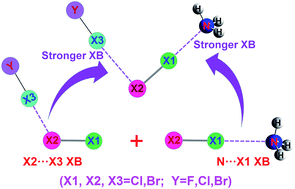
In recent years, X⋯D halogen bonds have been widely investigated, including X⋯O, X⋯S and X⋯N halogen bonds.33,51,54–59 For instance, Glaser et al. studied the O⋯I halogen bonded complexes formed between DMSO and a series of iodoarenes experimentally and theoretically.33 Sutradhar et al. investigated the O⋯Cl halogen bond in the complexes of fluorinated dimethyl ethers and FCl, and they suggested that the strength of the O⋯Cl halogen bond is weaker than that of the corresponding O⋯H hydrogen bond.55 Joseph and McDowell suggested that the FKrCl molecule can form weak complex with H2O via Cl⋯O halogen bond.56 Similarly, the N atom can also serve as the electron donor of halogen bond. Li et al. reported the interplay between the X⋯N halogen bond and H⋯Li lithium bond in MCH–LiCN–XCCH (M = H, Li and Na; X = Cl, Br and I) complex, in which the X⋯N halogen bond is enhanced by the lithium bond.51 Also, they studied the cooperativity between the X⋯N halogen bond and the Y⋯H hydrogen bond in H3N⋯XY⋯HF complexes (X, Y = F, Cl, Br).57 Solimannejad and coworkers have studied the X⋯N halogen-bonded interactions in 4-Z–Py⋯XCN⋯XCN triads (Z = H, F, OH, OCH3, CH3, NH2, NO2, and CN; Py = pyridine; and X = Cl and Br), in which the substituent effects on the cooperativity of halogen bonds were elaborated.54 The investigations of the complexes of XCN (X = F, Cl, Br and I) and NH3 molecules showed that the N atom of NH3 can interact with both X and C atoms of XCN via X⋯N halogen bond and X⋯C tetrel bond.58 Besides the halogen bonds between O or N atom and X atom, the halogen–halogen interactions were also widely studied.60–63 In the previous work,64 the ring-shaped complexes via NH3, X(Y) and HF (X = Cl, Br and Y = F, Cl, Br) were studied, which displayed that dihalogen molecules can simultaneously act as halogen-bonding donor and hydrogen-bonding acceptor. Hence, in the present continued work, a series of complexes formed by NH3 and two dihalogen molecules with the V-shaped structures were further designed and investigated. Based on the amphoteric features of the halogen atom as shown in Scheme 1a, two dihalogen molecules can interact with each other to form halogen-bonded dimer, as shown in Scheme 1b. By adding an NH3 molecule to one dihalogen molecule or the halogen-bonded dimer between two dihalogen molecules, the corresponding complexes can form, as displayed in Scheme 1c and d. In the designed model systems H3N·X1X2·X3Y (X1, X2, X3 = Cl, Br and Y = F, Cl, Br), the N atom of NH3 molecule and the halogen atom X2 in the dihalogen molecule X1X2 act as the halogen-bonding acceptors, while the halogen atom X1 in X1X2 and the halogen atom X3 in X3Y act as the halogen-bonding donors. Their geometry, spectroscopy and bonding properties were studied to examine the nature of XB, meanwhile, the cooperativity between two distinctive halogen bonds was also investigated.
To understand the topological properties of the complexes, quantum theory of atoms in molecules (QTAIM)68 analysis was carried out at the MP2/aug-cc-pVTZ level using AIMAll (Version 09.11.29) program.69 To investigate the formation mechanism of halogen-bonded trimers, the contour maps of the Laplacian (∇2ρ) of electron density for all the trimers were plotted using Multiwfn 3.3.8(dev) program.70 Meanwhile, the molecular electrostatic potential (MEP) as a powerful tool in exploring the natures of intermolecular interactions71–76 was also employed.
The cooperativity between weak intermolecular interactions have been well established.51,56,57,59,72,77–81 In this work, the concepts of pair interaction and pairwise non-additive contributions to ΔEint proposed by McDowell and Joseph56,77 were adopted to examine the cooperative effects. The pair interaction is the two interacted molecules in the optimized trimer, and the pairwise non-additive contribution (Enon-add) to ΔEint is the energy difference between the total interaction energy of the trimer and the sum of total interaction energies of the corresponding dimers (∑Eij). The energy decomposition analysis (EDA) which can tell us the nature of intermolecular interactions at the energy level82 was used. The localized molecular orbital-energy decomposition analysis (LMO-EDA) method of Su and Li83 based on the methods developed by Kitaura and Morokuma, Ziegler and Rauk, and Hayes and Stone84–86 was performed at the MP2/aug-cc-pVTZ level using the GAMESS program87 because LMO-EDA method is basis-set insensitive. The total interaction energy (ΔEint,EDA) can be decomposed into electrostatic energy (Eelst), exchange energy (Eexch), polarization energy (Epol), dispersion energy (Edisp) and repulsion energy (Erep) terms, that is, ΔEint,EDA = Eelst + Eexch + Epol + Edisp + Erep.
| Complex | Bond | R | v | d | ΔEint,CP (δBSSE) |
|---|---|---|---|---|---|
| D1 | Cl1–Cl2 | 1.9985 | 572.6 | 3.0371 | −2.20 (0.44) |
| Cl3–F4 | 1.6451 | 779.3 | |||
| D2 | Cl1–Cl2 | 1.9987 | 572.8 | 3.2726 | −1.64 (0.39) |
| Cl3–Cl4 | 2.0023 | 566.4 | |||
| D3 | Cl1–Cl2 | 1.9987 | 572.9 | 3.3227 | −1.56 (0.49) |
| Cl3–Br4 | 2.1412 | 456.5 | |||
| D4 | Cl1–Cl2 | 1.9986 | 571.6 | 3.0183 | −3.07 (0.95) |
| Br3–F4 | 1.7675 | 672.0 | |||
| D5 | Cl1–Cl2 | 1.9990 | 572.1 | 3.2507 | −2.19 (0.81) |
| Cl3–Br4 | 2.1441 | 453.1 | |||
| D6 | Cl1–Cl2 | 1.9989 | 572.3 | 3.3135 | −2.03 (0.88) |
| Br3–Br4 | 2.2834 | 336.6 | |||
| D7 | Cl1–Br2 | 2.1365 | 461.1 | 3.1029 | −2.46 (0.89) |
| Cl3–F4 | 1.6480 | 768.6 | |||
| D8 | Cl1–Br2 | 2.1375 | 460.8 | 3.3619 | −1.77 (0.71) |
| Cl3–Cl4 | 2.0035 | 563.3 | |||
| D9 | Cl1–Br2 | 2.1376 | 460.8 | 3.4115 | −1.69 (0.81) |
| Cl3–Br4 | 2.1422 | 454.2 | |||
| D10 | Cl1–Br2 | 2.1357 | 460.8 | 3.0684 | −3.56 (1.51) |
| Br3–F4 | 1.7720 | 660.9 | |||
| D11 | Cl1–Br2 | 2.1372 | 460.7 | 3.3208 | −2.44 (1.22) |
| Cl3–Br4 | 2.1466 | 449.0 | |||
| D12 | Cl1–Br2 | 2.1373 | 460.7 | 3.3853 | −2.25 (1.28) |
| Br3–Br4 | 2.2855 | 334.0 | |||
| D13 | Cl1–Br2 | 2.1394 | 459.2 | 3.0138 | −2.50 (0.60) |
| Cl3–F4 | 1.6462 | 776.3 | |||
| D14 | Cl1–Br2 | 2.1390 | 459.6 | 3.2507 | −1.85 (0.57) |
| Cl3–Cl4 | 2.0028 | 565.4 | |||
| D15 | Cl1–Br2 | 2.1388 | 459.8 | 3.3007 | −1.75 (0.67) |
| Cl3–Br4 | 2.1417 | 455.7 | |||
| D16 | Cl1–Br2 | 2.1400 | 458.3 | 2.9970 | −3.47 (1.16) |
| Br3–F4 | 1.7688 | 669.6 | |||
| D17 | Cl1–Br2 | 2.1397 | 458.9 | 3.2247 | −2.50 (1.01) |
| Cl3–Br4 | 2.1451 | 451.6 | |||
| D18 | Cl1–Br2 | 2.1394 | 459.1 | 3.2889 | −2.31 (1.10) |
| Br3–Br4 | 2.2842 | 335.8 | |||
| D19 | Br1–Br2 | 2.2781 | 341.0 | 3.0853 | −2.73 (1.05) |
| Cl3–F4 | 1.6492 | 765.3 | |||
| D20 | Br1–Br2 | 2.2785 | 340.9 | 3.3431 | −1.98 (0.86) |
| Cl3–Cl4 | 2.0042 | 562.0 | |||
| D21 | Br1–Br2 | 2.2785 | 341.0 | 3.3938 | −1.88 (0.97) |
| Cl3–Br4 | 2.1428 | 453.3 | |||
| D22 | Br1–Br2 | 2.2780 | 340.5 | 3.0554 | −3.93 (1.70) |
| Br3–F4 | 1.7733 | 658.2 | |||
| D23 | Br1–Br2 | 2.2786 | 340.7 | 3.2999 | −2.73 (1.42) |
| Cl3–Br4 | 2.1477 | 447.6 | |||
| D24 | Br1–Br2 | 2.2786 | 340.6 | 3.3636 | −2.52 (1.49) |
| Br3–Br4 | 2.2865 | 332.9 |
| Complex | Bond | R | v | d1 | d2 | ΔEint,CP (δBSSE) |
|---|---|---|---|---|---|---|
| T1 | N1–H2 | 1.0125 | 3496.6 | 2.5146 | 2.9194 | −8.51 (1.17) |
| Cl1–Cl2 | 2.0457 | 481.3 | ||||
| Cl3–F4 | 1.6527 | 760.4 | ||||
| T2 | N1–H2 | 1.0125 | 3496.4 | 2.5714 | 3.1906 | −7.26 (1.04) |
| Cl1–Cl2 | 2.0371 | 497.7 | ||||
| Cl3–Cl4 | 2.0054 | 560.9 | ||||
| T3 | N1–H2 | 1.0125 | 3497.5 | 2.5840 | 3.2514 | −7.00 (1.13) |
| Cl1–Cl2 | 2.0356 | 500.8 | ||||
| Cl3–Br4 | 2.1430 | 453.4 | ||||
| T4 | N1–H2 | 1.0125 | 3495.7 | 2.4518 | 2.8864 | −10.11 (1.89) |
| Cl1–Cl2 | 2.0575 | 460.9 | ||||
| Br3–F4 | 1.7785 | 652.1 | ||||
| T5 | N1–H2 | 1.0125 | 3496.6 | 2.5243 | 3.1348 | −8.36 (1.61) |
| Cl1–Cl2 | 2.0447 | 483.8 | ||||
| Cl3–Br4 | 2.1502 | 445.7 | ||||
| T6 | N1–H2 | 1.0125 | 3497.0 | 2.5430 | 3.2059 | −7.96 (1.68) |
| Cl1–Cl2 | 2.0418 | 489.1 | ||||
| Br3–Br4 | 2.2880 | 332.3 | ||||
| T7 | N1–H2 | 1.0126 | 3496.0 | 2.6213 | 3.0139 | −7.49 (1.79) |
| Cl1–Br2 | 2.1686 | 403.1 | ||||
| Cl3–F4 | 1.6554 | 749.2 | ||||
| T8 | N1–H2 | 1.0125 | 3497.1 | 2.6761 | 3.3001 | −6.22 (1.49) |
| Cl1–Br2 | 2.1651 | 412.3 | ||||
| Cl3–Cl4 | 2.0063 | 558.0 | ||||
| T9 | N1–H2 | 1.0124 | 3497.7 | 2.6851 | 3.3519 | −5.98 (1.58) |
| Cl1–Br2 | 2.1642 | 414.1 | ||||
| Cl3–Br4 | 2.1440 | 450.9 | ||||
| T10 | N1–H2 | 1.0126 | 3496.2 | 2.5666 | 2.9734 | −9.21 (2.56) |
| Cl1–Br2 | 2.1764 | 388.9 | ||||
| Br3–F4 | 1.7825 | 641.1 | ||||
| T11 | N1–H2 | 1.0125 | 3496.6 | 2.6315 | 3.2299 | −7.36 (2.15) |
| Cl1–Br2 | 2.1693 | 403.6 | ||||
| Cl3–Br4 | 2.1528 | 441.4 | ||||
| T12 | N1–H2 | 1.0125 | 3497.0 | 2.6469 | 3.3008 | −6.97 (2.20) |
| Cl1–Br2 | 2.1680 | 406.7 | ||||
| Br3–Br4 | 2.2901 | 329.3 | ||||
| T13 | N1–H2 | 1.0129 | 3491.3 | 2.4317 | 2.8525 | −13.08 (2.58) |
| Cl1–Br2 | 2.2171 | 381.0 | ||||
| Cl3–F4 | 1.6581 | 746.0 | ||||
| T14 | N1–H2 | 1.0127 | 3493.0 | 2.4741 | 3.1250 | −11.39 (2.38) |
| Cl1–Br2 | 2.2066 | 388.7 | ||||
| Cl3–Cl4 | 2.0079 | 555.7 | ||||
| T15 | N1–H2 | 1.0127 | 3493.5 | 2.4848 | 3.1883 | −11.02 (2.47) |
| Cl1–Br2 | 2.2034 | 391.3 | ||||
| Cl3–Br4 | 2.1451 | 449.7 | ||||
| T16 | N1–H2 | 1.0130 | 3489.4 | 2.3889 | 2.8279 | −15.12 (3.40) |
| Cl1–Br2 | 2.2301 | 372.6 | ||||
| Br3–F4 | 1.7856 | 639.1 | ||||
| T17 | N1–H2 | 1.0128 | 3492.0 | 2.4390 | 3.0592 | −12.87 (3.08) |
| Cl1–Br2 | 2.2158 | 381.5 | ||||
| Cl3–Br4 | 2.1558 | 439.1 | ||||
| T18 | N1–H2 | 1.0128 | 3492.2 | 2.4504 | 3.1286 | −12.33 (3.15) |
| Cl1–Br2 | 2.2123 | 384.2 | ||||
| Br3–Br4 | 2.2924 | 327.9 | ||||
| T19 | N1–H2 | 1.0128 | 3492.4 | 2.5067 | 2.9496 | −11.45 (3.20) |
| Br1–Br2 | 2.3416 | 286.3 | ||||
| Cl3–F4 | 1.6620 | 731.0 | ||||
| T20 | N1–H2 | 1.0127 | 3493.6 | 2.5536 | 3.2398 | −9.78 (2.81) |
| Br1–Br2 | 2.3330 | 292.3 | ||||
| Cl3–Cl4 | 2.0092 | 551.8 | ||||
| T21 | N1–H2 | 1.0127 | 3494.0 | 2.5646 | 3.2973 | −9.46 (2.88) |
| Br1–Br2 | 2.3309 | 293.8 | ||||
| Cl3–Br4 | 2.1464 | 446.5 | ||||
| T22 | N1–H2 | 1.0129 | 3490.9 | 2.4627 | 2.9256 | −13.59 (4.06) |
| Br1–Br2 | 2.3520 | 280.3 | ||||
| Br3–F4 | 1.7900 | 627.1 | ||||
| T23 | N1–H2 | 1.0128 | 3492.5 | 2.5122 | 3.1616 | −11.28 (3.61) |
| Br1–Br2 | 2.3413 | 286.5 | ||||
| Cl3–Br4 | 2.1587 | 433.7 | ||||
| T24 | N1–H2 | 1.0127 | 3493.0 | 2.5267 | 3.2313 | −10.77 (3.65) |
| Br1–Br2 | 2.3383 | 288.4 | ||||
| Br3–Br4 | 2.2949 | 324.3 |
Compared to the monomers in Table S1,† with the non-CP and CP optimizations, the bond lengths for the electron donors X1X2 in dimers D1–12 and D19–24 are contracted while those in dimers D13–18 are elongated (Tables 1 and S2†), their stretching vibrational frequencies decrease or increase a few. Obviously, the Cl or Br atom in ClBr acting as the electron donor brings different effect on the X1–X2 bond length. The bond lengths for the electron acceptors X3Y in all the dimers are elongated which are accompanied by the decreased vibrational frequencies, indicating that the X3–Y bonds in these complexes are weakened and red-shifted. In both cases of non-CP and CP optimizations, the X2⋯X3 binding distances (d) are shorter than the sums of the van der Waals radii of the atoms involved in the halogen bonds. Here, the van der Waals radii values of 1.80 and 1.95 Å for Cl and Br atoms are used, respectively.89 Compared to non-CP optimizations, CP optimizations have a little effect on the bond lengths (R) and the vibrational stretching frequencies (v), but they strongly affect the binding distances (d) and interaction energies ΔEint. The ΔEint,CP for dimers D1–24 with CP optimizations are weaker than the ΔEint with non-CP method (<1.70 kcal mol−1), and the BSSE correction energies range from 0.39 to 1.70 kcal mol−1. The results reveal that it is indispensable to consider the BSSE correction for the dimers. Thus, the geometries obtained with CP method will be used for all discussion in the following sections.
For dimers D1–3, D4–6, D7–9, D10–12, D13–15, D16–18, D19–21 and D22–24, their interaction energies have the orders: D1 > D2 > D3, D4 > D5 > D6, D7 > D8 > D9, D10 > D11 > D12, D13 > D14 > D15, D16 > D17 > D18, D19 > D20 > D21 and D22 > D23 > D24, opposite to the orders of the corresponding binding distances (d) shown in Fig. 1 but consistent with the electronegativity order of Y atom: F > Cl > Br. It is in agreement with the fact that the strength of halogen bond can be measured via the binding distance, that is, the shorter the binding distance, the stronger the halogen bond.90–93 In the previous studies, it demonstrates that the strength of halogen bond has close relationship with the electronegativity of the halogen atoms, because the electronegativity of halogen atom can affect the electron-accepting or electron-donating abilities of dihalogen molecules.74,88 The stronger electronegativity of Y atom in X3Y molecule leads to the stronger electron-accepting ability of the σ-hole of X3 atom, enabling X3 atom to form stronger halogen bond.
With respect to trimers T1–24, in both cases of the non-CP and CP optimizations, all the X1–X2 and X3–Y bond lengths are elongated accompanied by the decreased vibrational frequencies (Tables 2 and S4†), so they are weakened and red-shifted. The changes of X1–X2 bonds in trimers T1–24 are different from those in dimers D1–24. The reason should be ascribed to the fact that X1X2 simultaneously acts as an electron donor to X3Y and as an electron acceptor to NH3 in the trimer while it acts only as an electron donor to X3Y in the dimer. The elongation of X3–Y bond length in the trimer is larger than that in the dimer, implying that there exists the cooperativity in the trimer. Addition of NH3 molecule to the dimer leads to the interaction of N atom of NH3 with X1 atom of the halogen-bonded dimer, forming a V-shaped structure connected by N⋯X1 and X2⋯X3 halogen-boned interactions. The BSSE correction energies are in the range from 1.04 to 4.06 kcal mol−1 (Table 2), so it is important to take the BSSE correction into account. All discussion was based on the calculation results obtained with CP method.
The interaction energies of T1–3, T4–6, T7–9, T10–12, T13–15, T16–18, T19–21 and T22–24 have the orders: T1 > T2 > T3, T4 > T5 > T6, T7 > T8 > T9, T10 > T11 > T12, T13 > T14 > T15, T16 > T17 > T18, T19 > T20 > T21 and T22 > T23 > T24, which are contrary to the orders of the binding distances (d1, d2) shown in Fig. 2 but agree with the electronegativity order of Y atom: F > Cl > Br. It can be seen that the shorter N⋯X1 and X2⋯X3 binding distances lead to the stronger interactions. In each trimer, there are two halogen bonds, and it can be seen from Table 2 that the N⋯X1 binding distance is shorter than X2⋯X3 binding distance. It is in accord with the fact that the N⋯X1 interaction is stronger than the X2⋯X3 interaction, which can be derived from the comparison of the interaction energies of H3N⋯X1X2 and X1X2⋯X3Y (Tables 1, S2 and S3†). The formation of N⋯X1 halogen bond by adding NH3 molecule to the X1X2⋯X3Y dimer causes shorter N⋯X1 and X2⋯X3 binding distances in the trimer, meaning both the N⋯X1 and X2⋯X3 interactions are strengthened by the cooperativity of the two halogen bonds.
To assess the cooperativity between H3N⋯X1X2 and X1X2⋯X3Y halogen-boned interactions in trimers T1–24, the pair interactions and pairwise non-additive contributions to ΔEint,CP were employed. Meanwhile, a cooperativity factor Bd defined by Bd = ΔdT/ΔdD was introduced, where ΔdD is the difference between the sum of the atomic van der Waals radii involved in the N⋯X1 (or X2⋯X3) interaction in the dimer and the corresponding binding distance d (Table S5†), and ΔdT is the difference between the sum of the atomic van der Waals radii involved in the N⋯X1 (or X2⋯X3) interaction in the trimer and the corresponding binding distance d1 or d2 (Table S6†). As outlined in Table 3, all the pair interaction energies (ΔEab, ΔEac, Ebc) for trimers T1–24 are negative, suggesting that all the H3N⋯X1X2 and X1X2⋯X3Y complexes are attractive in contributing to the stability of the trimers. The negative Enon-add suggests that ∑Eij is weaker than ΔEint,CP, so it can be concluded that the cooperativity between the pair interactions exists and results in a stronger trimer. These results further confirm that the H3N, X1X2, X3Y (X1, X2, X3 = Cl, Br and Y = F, Cl, Br) molecules form trimeric complexes via two cooperative XBs. Both the cooperativity factors (Bd1 and Bd2) are larger than 1.000, indicating that the N⋯X1 (or X2⋯X3) halogen bonds in dimers D25–28 (or D1–24) are enhanced due to the addition of X3Y (or NH3) molecule. Thereby, the combination of H3N⋯X1X2 and X1X2⋯X3Y interactions will lead to a stronger trimeric complexes because of their cooperativity. Indeed, the trimer with a stronger interaction energy than the sum of the interaction energies (ΔEsum) of H3N⋯X1X2 and X1X2⋯X3Y dimers further proves the existence of cooperativity.
| Complex | ΔEab | ΔEbc | ΔEac | ∑Eij | ΔEint,CP | Enon-add | ΔEsum | Bd1 | Bd2 |
|---|---|---|---|---|---|---|---|---|---|
| a Enon-add = ΔEint,CP − ∑Eij, ∑Eij = ΔEab + ΔEbc + ΔEac, and ΔEab, ΔEbc, and ΔEac are calculated at the geometry of each pair in the corresponding optimized trimer, ∑Eij is the sum of their interaction energy values. The subscripts (a, b and c) represent NH3, X1X2 and X3Y (X1, X2, X3 = Cl, Br and Y = F, Cl, Br) molecules, respectively. ΔEsum is the sum of the interaction energies of H3N⋯X1X2 and X1X2⋯X3Y dimers with CP method taken from Tables S3 and 1. | |||||||||
| T1 | −5.30 | −2.15 | −0.28 | −7.73 | −8.51 | −0.78 | −7.13 | 1.178 | 1.209 |
| T2 | −5.25 | −1.62 | −0.15 | −7.02 | −7.26 | −0.24 | −6.57 | 1.093 | 1.251 |
| T3 | −5.23 | −1.54 | −0.10 | −6.87 | −7.00 | −0.13 | −6.49 | 1.074 | 1.257 |
| T4 | −5.34 | −2.98 | −0.40 | −8.72 | −10.11 | −1.39 | −8.00 | 1.272 | 1.180 |
| T5 | −5.30 | −2.13 | −0.26 | −7.69 | −8.36 | −0.67 | −7.12 | 1.164 | 1.232 |
| T6 | −5.29 | −1.98 | −0.21 | −7.48 | −7.96 | −0.48 | −6.96 | 1.135 | 1.246 |
| T7 | −3.96 | −2.46 | −0.24 | −6.66 | −7.49 | −0.83 | −6.33 | 1.197 | 1.138 |
| T8 | −4.00 | −1.75 | −0.13 | −5.88 | −6.22 | −0.34 | −5.64 | 1.101 | 1.159 |
| T9 | −4.00 | −1.68 | −0.07 | −5.75 | −5.98 | −0.23 | −5.56 | 1.085 | 1.176 |
| T10 | −3.92 | −3.57 | −0.35 | −7.84 | −9.21 | −1.37 | −7.43 | 1.294 | 1.114 |
| T11 | −3.99 | −2.41 | −0.23 | −6.63 | −7.36 | −0.73 | −6.31 | 1.179 | 1.157 |
| T12 | −4.00 | −2.22 | −0.18 | −6.40 | −6.97 | −0.57 | −6.12 | 1.152 | 1.164 |
| T13 | −9.55 | −2.43 | −0.27 | −12.25 | −13.08 | −0.83 | −10.96 | 1.105 | 1.275 |
| T14 | −9.39 | −1.81 | −0.14 | −11.34 | −11.39 | −0.05 | −10.31 | 1.059 | 1.360 |
| T15 | −9.33 | −1.72 | −0.08 | −11.13 | −11.02 | 0.11 | −10.21 | 1.048 | 1.376 |
| T16 | −9.72 | −3.38 | −0.38 | −13.48 | −15.12 | −1.64 | −11.93 | 1.152 | 1.224 |
| T17 | −9.54 | −2.40 | −0.25 | −12.19 | −12.87 | −0.68 | −10.96 | 1.098 | 1.315 |
| T18 | −9.80 | −2.07 | −0.19 | −12.06 | −12.33 | −0.27 | −10.77 | 1.085 | 1.348 |
| T19 | −7.49 | −2.71 | −0.24 | −10.44 | −11.45 | −1.01 | −9.62 | 1.123 | 1.204 |
| T20 | −7.43 | −1.94 | −0.12 | −9.49 | −9.78 | −0.29 | −8.87 | 1.068 | 1.254 |
| T21 | −7.41 | −1.85 | −0.07 | −9.33 | −9.46 | −0.13 | −8.77 | 1.054 | 1.271 |
| T22 | −7.53 | −3.94 | −0.34 | −11.81 | −13.59 | −1.78 | −10.82 | 1.176 | 1.154 |
| T23 | −7.50 | −2.66 | −0.22 | −10.38 | −11.28 | −0.90 | −9.62 | 1.117 | 1.231 |
| T24 | −7.48 | −2.44 | −0.17 | −10.09 | −10.77 | −0.68 | −9.41 | 1.100 | 1.247 |
The electron density (ρ) and its Laplacian (∇2ρ) at the BCPs of dimers D1–28 and trimers T1–24 are listed in Tables S7† and 4, respectively. It can be seen that the ρ and ∇2ρ values are in the ranges of 0.0080–0.0540 a.u. and 0.0331–0.1183 a.u., respectively. These values are comparable to the corresponding intervals for the hydrogen bond (i.e., 0.002–0.035 a.u. for ρ and 0.024–0.139 a.u. for ∇2ρ (ref. 64 and 96)). The ρ value can be used to estimate the XB strength, the larger the ρ value at the BCP of XB, the stronger the interaction energy.21,68 It can be clearly seen from Fig. 1 and 2 that the larger ρ value corresponds to the stronger interaction energy for dimers D1–24 and trimers T1–24 with a smaller binding distance. The ρ(N⋯X1) values for dimers D25–28 are larger than the ρ(X2⋯X3) values for dimers D1–24, so dimers D25–28 are stronger than dimers D1–24 in interaction energy (Tables 1, S2 and S3†). For the H3N⋯X1X2⋯X3Y trimer, the ρ(N⋯X1) and ρ(X2⋯X3) values become larger than the corresponding ρ values for dimers D1–28, which also confirm the cooperativity between the N⋯X1 and X2⋯X3 halogen bonds. The electronic energy density (H) at the BCP is the sum of the kinetic electron energy density (G) and the potential electron energy density (V), which can be used to characterize the intermolecular interaction. The sign of the electronic energy density (H) is indicative of the electrostatic dominant (H > 0) or covalent dominant (H < 0) interaction.97,98 Thereby, we observed that the N1⋯Cl1 halogen bonds for T1, T4–6, the Br2⋯Br3 halogen bond for T10, the N1⋯Br2 halogen bonds for T13–18, the N1⋯Br1 halogen bonds for T19–24, the Cl1⋯Br3 halogen bond for T16 and the Br2⋯Br3 halogen bond for T22 are part covalent features due to their negative H values at these BCPs, while other N1⋯X1 and X2⋯X3 halogen bonds are of primarily electrostatic character due to the positive H values.
| Complex | Binding | ρ | ∇2ρ | V | G | H |
|---|---|---|---|---|---|---|
| T1 | N1⋯Cl1 | 0.0362 | 0.1012 | −0.0266 | 0.0260 | −0.0007 |
| Cl2⋯Cl3 | 0.0201 | 0.0647 | −0.0134 | 0.0148 | 0.0014 | |
| T2 | N1⋯Cl1 | 0.0319 | 0.0937 | −0.0227 | 0.0231 | 0.0004 |
| Cl2⋯Cl3 | 0.0114 | 0.0414 | −0.0065 | 0.0084 | 0.0019 | |
| T3 | N1⋯Cl1 | 0.0310 | 0.0921 | −0.0219 | 0.0225 | 0.0006 |
| Cl2⋯Cl3 | 0.0102 | 0.0372 | −0.0056 | 0.0074 | 0.0019 | |
| T4 | N1⋯Cl1 | 0.0415 | 0.1095 | −0.0318 | 0.0296 | −0.0022 |
| Cl2⋯Br3 | 0.0255 | 0.0704 | −0.0175 | 0.0175 | 0.0001 | |
| T5 | N1⋯Cl1 | 0.0354 | 0.1000 | −0.0259 | 0.0255 | −0.0005 |
| Cl2⋯Br4 | 0.0156 | 0.0482 | −0.0093 | 0.0107 | 0.0014 | |
| T6 | N1⋯Cl1 | 0.0340 | 0.0975 | −0.0246 | 0.0245 | −0.0001 |
| Cl2⋯Br3 | 0.0136 | 0.0430 | −0.0078 | 0.0093 | 0.0015 | |
| T7 | N1⋯Cl1 | 0.0290 | 0.0867 | −0.0199 | 0.0208 | 0.0009 |
| Br2⋯Cl3 | 0.0207 | 0.0567 | −0.0129 | 0.0136 | 0.0006 | |
| T8 | N1⋯Cl1 | 0.0258 | 0.0797 | −0.0170 | 0.0185 | 0.0014 |
| Br2⋯Cl3 | 0.0115 | 0.0368 | −0.0062 | 0.0077 | 0.0015 | |
| T9 | N1⋯Cl1 | 0.0253 | 0.0786 | −0.0166 | 0.0181 | 0.0015 |
| Br2⋯Cl3 | 0.0105 | 0.0339 | −0.0055 | 0.0070 | 0.0015 | |
| T10 | N1⋯Cl1 | 0.0327 | 0.0939 | −0.0232 | 0.0233 | 0.0002 |
| Br2⋯Br3 | 0.0266 | 0.0613 | −0.0171 | 0.0162 | −0.0009 | |
| T11 | N1⋯Cl1 | 0.0284 | 0.0854 | −0.0193 | 0.0203 | 0.0010 |
| Br2⋯Br4 | 0.0162 | 0.0429 | −0.0092 | 0.0099 | 0.0008 | |
| T12 | N1⋯Cl1 | 0.0275 | 0.0834 | −0.0185 | 0.0197 | 0.0012 |
| Br2⋯Br3 | 0.0142 | 0.0387 | −0.0078 | 0.0087 | 0.0010 | |
| T13 | N1⋯Br2 | 0.0493 | 0.1086 | −0.0392 | 0.0332 | −0.0060 |
| Cl1⋯Cl3 | 0.0235 | 0.0715 | −0.0161 | 0.0170 | 0.0009 | |
| T14 | N1⋯Br2 | 0.0450 | 0.1052 | −0.0349 | 0.0306 | −0.0043 |
| Cl1⋯Cl3 | 0.0133 | 0.0466 | −0.0078 | 0.0097 | 0.0019 | |
| T15 | N1⋯Br2 | 0.0440 | 0.1042 | −0.0338 | 0.0299 | −0.0039 |
| Cl1⋯Cl3 | 0.0118 | 0.0418 | −0.0066 | 0.0085 | 0.0019 | |
| T16 | N1⋯Br2 | 0.0540 | 0.1116 | −0.0442 | 0.0361 | −0.0081 |
| Cl1⋯Br3 | 0.0291 | 0.0758 | −0.0203 | 0.0196 | −0.0007 | |
| T17 | N1⋯Br2 | 0.0485 | 0.1081 | −0.0384 | 0.0327 | −0.0057 |
| Cl1⋯Br4 | 0.0184 | 0.0543 | −0.0113 | 0.0124 | 0.0012 | |
| T18 | N1⋯Br2 | 0.0447 | 0.1183 | −0.0401 | 0.0348 | −0.0053 |
| Cl1⋯Br3 | 0.0150 | 0.0531 | −0.0102 | 0.0117 | 0.0015 | |
| T19 | N1⋯Br1 | 0.0425 | 0.1012 | −0.0319 | 0.0286 | −0.0033 |
| Br2⋯Cl3 | 0.0239 | 0.0618 | −0.0152 | 0.0153 | 0.0001 | |
| T20 | N1⋯Br1 | 0.0385 | 0.0965 | −0.0281 | 0.0261 | −0.0020 |
| Br2⋯Cl3 | 0.0133 | 0.0406 | −0.0073 | 0.0087 | 0.0014 | |
| T21 | N1⋯Br1 | 0.0376 | 0.0953 | −0.0272 | 0.0255 | −0.0017 |
| Br2⋯Cl3 | 0.0119 | 0.0372 | −0.0064 | 0.0078 | 0.0015 | |
| T22 | N1⋯Br1 | 0.0466 | 0.1055 | −0.0361 | 0.0312 | −0.0048 |
| Br2⋯Br3 | 0.0294 | 0.0645 | −0.0191 | 0.0176 | −0.0015 | |
| T23 | N1⋯Br1 | 0.0420 | 0.1008 | −0.0314 | 0.0283 | −0.0031 |
| Br2⋯Br4 | 0.0187 | 0.0472 | −0.0108 | 0.0113 | 0.0005 | |
| T24 | N1⋯Br1 | 0.0407 | 0.0993 | −0.0302 | 0.0275 | −0.0027 |
| Br2⋯Br3 | 0.0165 | 0.0428 | −0.0092 | 0.0099 | 0.0008 |
| Complex | Eelst (%) | Eexch (%) | Epol (%) | Edisp (%) | Erep | ΔEint,EDA |
|---|---|---|---|---|---|---|
| a The total attractive components are the sum of Eelst + Eexch + Epol + Edisp, while the magnitude is the percentage of each component contributing to the total attractive components. | ||||||
| T1 | −21.54 (24.7) | −42.14 (48.3) | −13.60 (15.6) | −9.99 (11.4) | 77.89 | −9.38 |
| T2 | −16.73 (25.1) | −32.27 (48.5) | −9.09 (13.6) | −8.51 (12.8) | 58.78 | −7.82 |
| T3 | −15.88 (25.1) | −30.75 (48.6) | −8.39 (13.3) | −8.28 (13.0) | 55.83 | −7.47 |
| T4 | −27.46 (24.3) | −54.29 (48.1) | −19.10 (16.9) | −11.95 (10.7) | 101.54 | −11.26 |
| T5 | −20.34 (24.7) | −39.95 (48.5) | −11.96 (14.5) | −10.09 (12.3) | 73.28 | −9.06 |
| T6 | −18.87 (24.7) | −37.12 (48.7) | −10.66 (14.0) | −9.64 (12.6) | 67.76 | −8.53 |
| T7 | −17.22 (22.9) | −37.07 (49.2) | −11.30 (15.0) | −9.70 (12.9) | 67.51 | −7.78 |
| T8 | −12.69 (23.1) | −27.21 (49.6) | −6.90 (12.6) | −8.10 (14.7) | 48.56 | −6.34 |
| T9 | −12.12 (23.1) | −26.16 (49.8) | −6.40 (12.2) | −7.90 (14.9) | 46.53 | −6.05 |
| T10 | −22.56 (22.8) | −48.37 (48.9) | −16.31 (16.5) | −11.62 (11.8) | 89.31 | −9.55 |
| T11 | −16.04 (22.9) | −34.74 (49.6) | −9.53 (13.6) | −9.74 (13.9) | 62.57 | −7.48 |
| T12 | −14.82 (22.9) | −32.26 (49.8) | −8.41 (13.0) | −9.31 (14.3) | 57.79 | −7.01 |
| T13 | −37.84 (27.1) | −65.61 (46.9) | −24.10 (17.2) | −12.23 (8.8) | 125.03 | −14.75 |
| T14 | −31.29 (27.7) | −53.31 (47.1) | −17.75 (15.7) | −10.76 (9.5) | 100.57 | −12.54 |
| T15 | −30.00 (27.7) | −51.19 (47.3) | −16.64 (15.4) | −10.50 (9.6) | 96.33 | −12.00 |
| T16 | −45.07 (26.7) | −78.93 (46.7) | −30.97 (18.3) | −13.88 (8.3) | 151.63 | −17.22 |
| T17 | −36.36 (27.1) | −63.15 (47.1) | −21.98 (16.4) | −12.47 (9.4) | 119.64 | −14.32 |
| T18 | −37.20 (27.0) | −65.18 (47.4) | −22.38 (16.3) | −12.81 (9.3) | 123.57 | −14.00 |
| T19 | −32.12 (25.6) | −60.26 (48.0) | −20.68 (16.5) | −12.36 (9.9) | 113.10 | −12.32 |
| T20 | −25.51 (26.3) | −46.96 (48.3) | −14.17 (14.6) | −10.51 (10.8) | 86.90 | −10.25 |
| T21 | −24.40 (26.3) | −45.03 (48.5) | −13.22 (14.2) | −10.25 (11.0) | 83.08 | −9.82 |
| T22 | −39.09 (25.4) | −73.53 (47.7) | −27.26 (17.7) | −14.15 (9.2) | 139.39 | −14.64 |
| T23 | −30.79 (25.8) | −57.69 (48.3) | −18.46 (15.5) | −12.48 (10.4) | 107.50 | −11.92 |
| T24 | −28.90 (25.8) | −54.23 (48.5) | −16.70 (14.9) | −12.00 (10.8) | 100.60 | −11.23 |
![]() | ||
| Fig. 4 Correlations for (a) ΔEint,CP versus ΔEint,EDA; (b) ΔEint,EDA versus Eelst; (c) Erep versus (Eexch + Epol + Edisp). | ||
Footnote |
| † Electronic supplementary information (ESI) available: The optimized geometries, structural parameters and stretching vibrational frequencies of the six monomers (NH3, FCl, FBr, Cl2, ClBr, Br2), their MEPs; the optimized geometries of dimers D1–24 and D25–28 with CP methods, the geometrical parameters, stretching vibrational frequencies and interaction energies of dimers D1–24 and D25–28 obtained without CP (non-CP) and with CP methods; the optimized geometries of trimers T1–24 with CP methods, the geometrical parameters, stretching vibrational frequencies and interaction energies of trimers T1–24 obtained without CP (non-CP) method; topological properties for dimers D1–28. See DOI: 10.1039/c6ra21018j |
| This journal is © The Royal Society of Chemistry 2016 |