DOI:
10.1039/C6RA20910F
(Paper)
RSC Adv., 2016,
6, 97293-97301
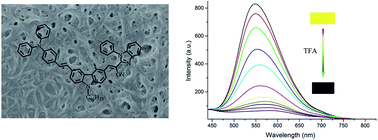
Organogelation of cyanovinylcarbazole with terminal benzimidazole: AIE and response for gaseous acid†
Received
19th August 2016
, Accepted 27th September 2016
First published on 28th September 2016
Abstract
New cyanovinylcarbazole functionalized benzimidazoles CCBM and TCBM were synthesized. It was found that they could self-assemble into organogels in some mixed solvents rapidly upon stimulation by ultrasound. Although the emission of CCBM and TCBM in solutions was very weak, the xerogel-based films emitted intense yellow light under UV irradiation on account of AIE (aggregation-induced emission). It was further proved by the fact that the aggregates emitted strong yellow light in THF/water with high water fraction, while they were almost non-emissive in THF. We found that the emission of CCBM and TCBM in THF/water with high water fraction could be quenched by TFA (trifluoroacetic acid) significantly, so these hydrophobic dyes could be applied to detect acids in water phase. It should be noted that the emission of the nanofibers-based films of CCBM and TCBM could also be quenched rapidly upon exposed to TFA vapor. Particularly, the thinner the film, the higher the performance detected for the sensory properties. For example, the detection limit and the decay time of CCBM towards gaseous TFA in nanofibers-based film with the thickness of 0.21 μm were 0.33 ppm and 0.38 s, respectively, and those were 8.0 ppm and 2.5 s for the film with the thickness of 1.73 μm. We provided a strategy for fabricating new fluorescence sensory materials with high performance in probing gaseous acid via organogelation.
Introduction
As a novel class of self-assembled materials, low molecular weight organogelators (LMOGs)1 have recently gained considerable attention for their potential applications in solar cells,2 field effect transistors,3 molecular recognition,4 light harvesting antennas,5 drug delivery,6 catalysis,7 template synthesis,8 and so on. The self-assembling of LMOGs leads to the formation of supramolecular polymer-like structures that are driven by intermolecular non-covalent interactions (hydrogen bonding, π–π interactions, van der Waals, coordination, and charge-transfer interactions, etc.). Thus, the organogels were sensitive to external chemical or physical stimuli.9 In addition, 1D organic nanostructures, such as fibers, ribbons and tubes, can be fabricated via the organogelation processes, and could be used as sensory materials on account of the high surface-to-volume ratio and the enlarged fluorescent responsive signals originated from efficient exciton migration in 1D nanostructure.10,11 Although the gel–sol transition might take place stimulated by the addition of acid to the organogel phase, the detection limit would be high.12 Till now, the detection of acid vapors using luminescent xerogels was rarely reported.13 We have previously found that the nanofibers-based films formed from phenanthroimidazole derivatives exhibited responsive abilities towards acid vapors.14 In order to generate novel emissive organic nanostructures to detect gaseous acid with high performance we designed new π-gelators based on benzimidazole derivatives CCBM and TCBM (Scheme 1). The molecular design was based on the following points. First, N-phenylbenzimidazole was employed as acid-sensitive group on account of its alkalinity. Second, the introduction of carbazole was due to its strong emission and the long carbon chain substituted carbazole would be helpful for the gelation.15 Third, 1-cyanodiphenylethene derivatives usually showed AIE or AIEE (aggregation-induced enhanced emission) properties,16 so the spacer of cyanovinyl was involved to link carbazole and benzimidazole units to yield the dyes with strong emission in aggregated states. Finally, the terminal groups of triphenylamine and carbazole were electron donors, and the D–π–A features would change if the benzimidazole interacted with acid. It was interesting that CCBM could gelate n-butanol and some mixed solvents of toluene/tert-pentanol (v/v = 1/10) as well as toluene/iso-butanol (v/v = 1/10), while TCBM formed organogel only in toluene/tert-pentanol (v/v = 1/15). Particularly, the xerogels-based films emitted strong yellow light under UV irradiation, which was quenched significantly upon exposed to gaseous TFA. Therefore, the luminescent nanofibers generated from benzimidazole derivatives with extended conjugation could be used as ideal sensory materials to probe volatile acids.
 |
| | Scheme 1 The synthetic routes for CCBM and TCBM. | |
Experimental section
Measurement and characterization
1H NMR spectra were recorded with a Mercury plus instrument at 400 MHz using CDCl3 and DMSO-d6 as solvents. 13C NMR spectra were obtained with on a mercury plus 100 MHz using CDCl3 as the solvent. FT-IR spectra were measured by a Nicolet-360 FT-IR spectrometer by the incorporation of samples into KBr disks. UV-vis absorption spectra were obtained from a Shimadzu UV-1601PC spectrophotometer. Fluorescence emission spectra were taken on a Shimadzu RF-5301 luminescence spectrometer. Mass spectra were recorded with an Agilent 1100 MS series and an AXIMA CFR MALDI-TOF (matrix-assisted laser desorption ionization/time-of-flight) MS (COMPACT). Scanning electron microscopy (SEM) images were obtained on a JEOL JSM-6700F (operating at 3 kV). The samples for SEM measurements were prepared by casting the organogels on silicon wafers and drying at room temperature, followed by coating with gold. Fluorescence microscopy images were measured on a Fluorescence Microscope (Olympus Reected Fluorescence System BX51, Olympus, Japan). The thickness of film was measured by the Step Profiler DEKTAK 150.
Synthesis
Compounds 1, 2 and 2-(1-phenyl-1H-benzo[d]imidazol-2-yl)acetonitrile were synthesized according to the reported procedures.11
(E)-3-(9-Hexadecyl-6-((E)-2-(9-hexadecyl-9H-carbazol-3-yl)vinyl)-9H-carbazol-3-yl)-2-(1-phenyl-1H-benzo[d]imidazol-2-yl)acrylonitrile (CCBM). 2-(1-Phenyl-1H-benzo[d]imidazol-2-yl)acetonitrile (0.6 g, 2.58 mmol) was first dissolved in ethanol (40 mL). After the solution was stirred for 10 min, two drops of pyridine were added and stirred for another 30 min. Then, compound 1 (2.37 g, 2.83 mmol) was added into the mixture, which was stirred at room temperature for 10 h. The crude product was collected by filtration and purified by column chromatography (silica gel) using petroleum ether/ethyl acetate (v/v = 10/1) as elute to afford a yellow solid. Yield: 71%. Mp: 89.0–91.0 °C. FT-IR (KBr, cm−1): 2929, 2853, 2216, 1630, 1488, 1383, 1346, 1261, 1152, 1090, 960, 876, 797, 764, 691. 1H NMR (400 MHz, CDCl3, ppm) δ 8.84 (s, 1H), 8.54 (s, 1H), 8.27 (d, J = 10.7 Hz, 2H), 8.16 (d, J = 7.7 Hz, 1H), 8.08 (d, J = 8.7 Hz, 1H), 7.96 (d, J = 7.9 Hz, 1H), 7.71–7.78 (m, 2H), 7.63–7.70 (m, 3H), 7.54 (dd, J = 7.6 Hz, J = 1.7 Hz, 2H), 7.48 (t, J = 7.5 Hz, 1H), 7.38–7.45 (m, 5H), 7.30–7.37 (m, 3H), 7.27 (d, J = 6.2 Hz, 1H), 7.24 (d, J = 2.1 Hz, 1H), 4.30 (t, J = 6.4 Hz, 4H), 1.88 (dd, J = 13.7 Hz, J = 6.7 Hz, 4H), 1.21–1.42 (m, 52H), 0.87 (dd, J = 6.9 Hz, J = 5.6 Hz, 6H). 13C NMR (100 MHz, CDCl3, ppm) δ 151.85, 148.21, 142.87, 140.87, 140.41, 140.09, 137.34, 135.71, 130.73, 130.15, 129.62, 128.89, 127.97, 127.76, 126.33, 125.72, 125.15, 124.27, 123.97, 123.60, 123.49, 123.35, 123.24, 122.96, 120.48, 119.62, 118.93, 118.57, 118.48, 116.58, 110.56, 109.50, 109.23, 108.90, 108.84, 95.42, 77.37, 77.05, 76.73, 43.49, 43.23, 31.95, 29.73, 29.71, 29.69, 29.65, 29.63, 29.60, 29.55, 29.51, 29.46, 29.39, 29.05, 27.35, 27.28, 22.72, 14.15 ppm. MALDI-TOF MS: m/z: calculated for 1050.5; found: 1052.6 [M + 2H]+.
(E)-3-(6-((E)-4-(Diphenylamino)styryl)-9-hexadecyl-9H-carbazol-3-yl)-2-(1-phenyl-1H-benzo[d]imidazol-2-yl)acrylonitrile (TCBM). Following by the synthetic method for CCBM, TCBM was synthesized from compound 2 (1.95 g, 2.83 mmol) and 2-(1-phenyl-1H-benzo[d]imidazol-2-yl)acetonitrile (0.6 g, 2.58 mmol). The crude product was collected by filtration and purified by column chromatography (silica gel) using petroleum ether/ethyl acetate (v/v = 10/1) as elute to afford a yellow solid. Yield: 80%. Mp: 96.0–98.0 °C. FT-IR (KBr, cm−1): 2925, 2852, 2515, 1596, 1492, 1389, 1331, 1282, 1155, 958, 810, 748, 698, 622. 1H NMR (400 MHz, DMSO-d6, ppm) δ 8.67 (d, J = 8.9 Hz, 1H), 8.28 (d, J = 9.4 Hz, 1H), 8.11 (d, J = 8.9 Hz, 1H), 8.04 (s, 1H), 7.80 (dd, J = 20.3 Hz, J = 9.4 Hz, 3H), 7.67 (d, J = 7.5 Hz, 6H), 7.56 (s, 2H), 7.34 (d, J = 4.4 Hz, 7H), 7.24 (s, 2H), 7.06 (s, 6H), 6.99 (s, 2H), 4.45 (m, 2H), 1.77 (s, 2H), 1.17 (d, J = 14.1 Hz, 26H), 0.83 (s, 3H). 13C NMR (100 MHz, CDCl3, ppm) δ 151.80, 148.16, 147.67, 147.02, 142.86, 140.57, 137.35, 135.69, 132.06, 130.32, 130.15, 129.63, 129.29, 128.94, 127.75, 127.47, 127.17, 126.48, 125.24, 124.42, 124.06, 123.97, 123.87, 123.61, 123.44, 123.34, 123.23, 122.93, 119.63, 118.75, 116.66, 110.56, 109.52, 109.28, 77.38, 77.06, 76.75, 43.50, 31.95, 29.72, 29.62, 29.59, 29.50, 29.39, 29.02, 27.27, 22.72, 14.16 ppm. MALDI-TOF MS: m/z: calculated for 904.3; found: 906.6 [M + 2H]+.
Preparation of the films for the investigation on the fluorescent sensory properties
Method 1. A mixture containing CCBM (1 mg) in n-butanol (1 mL) or TCBM (1 mg) in toluene/n-pentanol (v/v = 1/10, 1 mL) was heated to gain a clear solution. The hot solution was treated by ultrasound, and then dropped on the silica slide, which was covered by a watch glass. After 2 h, the solvent was removed under low pressure in a vacuum drying oven.
Method 2. A hot solution of CCBM (1 mg) in n-butanol (3 mL) or TCBM (1 mg) in toluene/n-pentanol (v/v = 1/10, 3 mL) was treated by ultrasound and cooled to room temperature. After aging for 5 h, the solution was dropped on silica slide. After removing the solvent under low pressure in a vacuum drying oven, the film was obtained.
Results and discussion
Synthesis
Scheme 1 showed the synthetic routes for ((1-cyano-2-carbazolyl)ethylene)benzimidazole derivatives CCBM and TCBM. Firstly, compounds 115b, 217a and 2-(1-phenyl-1H-benzo-[d]imidazol-2-yl)acetonitrile17b were prepared according to the reported procedures. The Knoevenagel condensation reaction between 2-(1-phenyl-1H-benzo[d]imidazol-2-yl)acetonitrile and compound 1 in the presence of pyridine afforded CCBM in a yield of 71%. Similarly, compound 2 could be transformed into TCBM in a yield of 80% through Knoevenagel condensation reaction with 2-(1-phenyl-1H-benzo[d]imidazol-2-yl)acetonitrile. The target compounds were characterized by 1H NMR, 13C NMR spectroscopy, FT-IR and MALDI-TOF mass spectrometry.
UV-vis absorption and fluorescence emission spectra in solutions
The UV-vis absorption and fluorescence emission spectra of CCBM and TCBM in CH2Cl2 (5.0 × 10⁻⁶ M) were shown in Fig. 1. The absorption bands of CCBM appeared at 308 nm and 337 nm with a shoulder at ca. 397 nm, wherein, the former one might be due to π–π* transition and the latter one might come from n–π* transition. Similarly, TCBM exhibited two absorption bands at 301 nm and 365 nm with a shoulder at ca. 411 nm. We deemed that the red-shift of the n–π* transition absorption for TCBM compared with CCBM might due to the stronger electron donating ability of triphenylamine than carbazole. As shown in Fig. 1b, two emission bands at 442 nm and 589 nm were detected for CCBM in CH2Cl2, and the former one might come from (carbazolylethylene)carbazole moiety and the latter might originate from the aggregates, which could be confirmed by concentration-dependent fluorescence emission spectra. As shown in Fig. S1,† it was clear that no emission at ca. 590 nm could be detected when the concentration of CCBM was 1.0 × 10⁻⁶ M, and it emerged when the concentration reached 1.0 × 10⁻⁵ M. The higher was the concentration, the stronger was the emission at ca. 590 nm for CCBM. In the case of TCBM, one strong emission located at 438 nm in CH2Cl2 was detected at 5.0 × 10⁻⁶ M.
 |
| | Fig. 1 Normalized UV-vis absorption (a) and fluorescence emission (b, λex = 365 nm) spectra of CCBM and TCBM in CH2Cl2 (5.0 × 10⁻⁶ M). | |
Gelation behaviors
The gelation abilities of CCBM and TCBM in organic solvents were evaluated by means of the ‘stable to inversion of a test tube’ method.18 It was found that CCBM and TCBM were soluble in variety of solvents, such as non-polar solvents of toluene, xylene, cyclohexane, n-hexane, and polar solvents of ethyl acetate, DMF, DMSO, 1,2-dichloroethane (Table 1). Moreover, they were insoluble in methanol and ethanol, and precipitated from the hot solutions of iso-butanol, n-pentanol and tert-pentanol. Notably, CCBM could gelate n-butanol and the mixed solvents of toluene/tert-pentanol (v/v = 1/10) as well as toluene/iso-butanol (v/v = 1/10), while TCBM formed organogel only in toluene/tert-pentanol (v/v = 1/15). The organogels were obtained easily after cooling the hot solutions, which were stimulated by ultrasound, to room temperature for only several seconds. The critical gel concentration (CGC) for CCBM in n-butanol was as low as 1.90 × 10⁻³ M, meaning that CCBM could entrap ca. 5800 molecules of n-butanol per gelator.19 Therefore, CCBM could be considered as a supergelator. In addition, the CGC for CCBM in toluene/tert-pentanol (v/v = 1/10) and toluene/iso-butanol (v/v = 1/10) were 2.4 × 10⁻³ M and 4.3 × 10⁻³ M, respectively, and for TCBM in toluene/tert-pentanol (v/v = 1/15) was 4.9 × 10⁻³ M, which were also quite low. The obtained organogels were stable for several months at room temperature and could be destroyed into solutions when heated. The organogels could be recovered after the hot solutions were cooled to room temperature stimulated by ultrasound.
Table 1 Gelation abilities of CCBM and TCBM in selected organic solventsa
| Solvent |
CCBM (CGC) |
TCBM (CGC) |
| S: soluble; I: insoluble; G: gel; PG: partial gel; P: precipitate. CGC: critical gelation concentration (mM). |
| Toluene |
S |
S |
| Xylene |
S |
S |
| Cyclohexane |
S |
S |
| n-Hexane |
S |
S |
| Methanol |
I |
I |
| Ethanol |
I |
I |
| n-Butanol |
G (1.9) |
P |
| Iso-butanol |
P |
P |
| n-Pentanol |
P |
P |
| tert-Pentanol |
P |
P |
| Ethyl acetate |
S |
S |
| Petroleum ether |
S |
S |
| DMSO |
S |
S |
| DMF |
S |
S |
| Toluene/methanol (v/v = 1/20) |
S |
P |
| Toluene/n-pentanol (v/v = 1/10) |
G (2.4) |
P |
| Toluene/iso-butanol (v/v = 1/10) |
G (4.3) |
P |
| Toluene/tert-pentanol (v/v = 1/15) |
P |
G (4.9) |
Self-assembling properties in organogels
The morphologies of the xerogels CCBM and TCBM obtained from n-butanol and toluene/tert-pentanol (v/v = 1/15), respectively, were investigated by SEM and fluorescence microscopy. As shown in Fig. 2a, the SEM image illustrated that 3D networks consisting of numerous twisted nanofibers with diameter of tens to hundreds of nanometers and length of tens of microns were formed in xerogel CCBM. The xerogel TCBM showed lots of twisted nanofibers in the diameter of 100–150 nm and in the length of several micrometers (Fig. 2b). It should be noted that more conjunctions emerged in xerogel CCBM than those in xerogel TCBM, which agreed with that CCBM showed lower CGC than TCBM. The fluorescence microscope images of xerogels CCBM and TCBM also showed lots of long nanofibers (Fig. 2c and d), which emitted strong yellow light.
 |
| | Fig. 2 SEM (a) and fluorescence microscopy (c, λex = 365 nm) images of xerogel CCBM obtained from n-butanol; SEM (b) and fluorescence microscopy (d, λex = 365 nm) images of xerogel TCBM obtained from toluene/tert-pentanol (v/v = 1/15). | |
Since the organogels formed quickly after cooling the hot solutions under ultrasound stimuli, we could not monitor the continuous changes of the electronic spectra during the gelation processes for CCBM and TCBM. In order to reveal the driving forces for the gelation, we showed the UV-vis absorption and fluorescence emission spectra for CCBM in solution and in gel phase. It was found that the absorption at 337 nm for CCBM in n-butanol solution decreased upon the gel formation, accompanying with the appearance of a very weak broad band over 470 nm (Fig. 3a). It meant that the aggregation of CCBM occurred, and π–π interactions had effect on the self-assembling in gel state. As shown in Fig. 3b, only weak emission at 416 nm and 570 nm for CCBM was detected in n-butanol solution, but the emission intensity at 570 nm was enhanced significantly in organogel, suggesting AIE during the gelation of CCBM. In the case of TCBM, the absorption at 358 nm in solution red-shifted to 360 nm in its toluene/tert-pentanol gel, and the emission at 576 nm increased significantly in gel state compared with that in solution (Fig. S2†). We suggested that AIE behaviors in organogels of CCBM and TCBM were resulted from the restrained intramolecular rotation (IMR) in the aggregates, which would populate the radiative decay of the excitons, leading to strong emission.20–22
 |
| | Fig. 3 UV-vis absorption (a) and fluorescence emission (b, λex = 337 nm) spectra of CCBM in n-butanol solution and in gel state (1.9 × 10⁻³ M). The inset is the photos of CCBM in solution and in gel states irradiated at 365 nm. | |
AIE properties
To investigate the AIE properties of CCBM and TCBM, we showed their fluorescence emission spectra in THF/H2O with different water fraction (fw, vol%). As shown in Fig. 4a, we could find two emission bands at 425 nm and 543 nm in THF. When small amount of water (fw = 10%) was added, the both emission bands declined and the emission in low-energy region red-shifted to 585 nm. When the fw was in the range of 20–50%, the fluorescence emission bands at ca. 425 nm and ca. 590 nm for CCBM further decreased with increasing the water faction because of the increased solvent polarities. When the fw ascended to 60%, the emission band at ca. 425 nm disappeared and the one at ca. 590 nm became stronger than those in THF/water with fw below 50%. Further increasing fw, the emission increased significantly, for example, the emission intensity in THF/water with fw of 90% was ca. five times larger than that in THF. We deduced that CCBM molecules would aggregate in THF/water with high fw, which could hamper the intramolecular rotation and lead to the reduction of the nonradiative decay channel.23 Thus, the enhanced emission was detected. However, when fw increased to 95%, the emission intensity at ca. 590 nm declined with a slight blue-shift, which might be due to the precipitation of aggregates from the system (Fig. 4b). The fluorescence emission behaviors of TCBM in THF/water with different fw were similar to those of CCBM (Fig. S3†). The emission at ca. 432 nm and at ca. 570 nm for TCBM in THF was weak, and decreased gradually with increasing fw in THF/water when fw was below 60%. With further adding water to THF/water system the emission at ca. 432 nm disappeared and the one at ca. 570 nm continuously increased. When fw reached 95% in THF/water, the emission intensity at ca. 570 nm was approximately four times larger than that in THF.
 |
| | Fig. 4 (a) Fluorescence emission spectra of CCBM (λex = 337 nm) and (b) plots of emission intensity at 590 nm for CCBM in THF/water with different fw. The concentration of CCBM was maintained at 1.0 × 10⁻⁵ M. Inset: photos of CCBM in THF/water with different fw under 365 nm light. | |
Fluorescent sensory properties in THF/water
Benzimidazole has a good capacity of combining with proton and the synthesized benzimidazole derivatives gave strong emission in aggregated states, so we intended to investigate the fluorescent sensory properties of the aggregates of CCBM and TCBM towards TFA in THF/water. It should be noted that the detection of acid in water phase would be beneficent for the application in biological systems. As shown in Fig. 5a, the emission at ca. 560 nm for CCBM in THF/water with fw of 90% decreased when TFA was added. The higher was the concentration of TFA, the higher was the fluorescence quenching efficiency. When 8 equiv. of TFA was added, the fluorescent quench efficiency reached 94%. Meanwhile, we could find that the aggregates of CCBM with strong yellow emission became non-emissive (inset in Fig. 5a). Therefore, the aggregates of CCBM could be used as fluorescent sensory material to detect TFA by naked eye. In order to reveal the fluorescent sensory mechanism of CCBM towards TFA, the UV-vis absorption spectral titration experiments were performed in THF, in which CCBM existed as isolated state. It was clear that with increasing the amount of TFA the absorption at ca. 400 nm for CCBM decreased gradually and a new absorption band at ca. 480 nm emerged and increased gradually (Fig. 5a). Moreover, the appearance of an isosbestic point at 419 nm meant a new species was formed from CCBM induced by TFA. We deduced that CCBM was protonated by TFA. The protonated benzimidazole exhibited stronger electron withdrawing ability than benzimidazole, so that new absorption at low-energy region (ca. 480 nm) appeared and the fluorescence quenching happened on account of the occurrence of photo-induced electron transfer from dicarbazole unit to protonated benzimidazole. Similarly, the emission band at 570 nm for TCBM also decreased gradually when increasing the amount of TFA in THF/water with fw of 95% (Fig. S4a†). The strong yellow emission for the aggregates of TCBM could be quenched significantly by TFA, so the aggregates of TCBM could also detect TFA by naked eyes. Additionally, the appearance of an isosbestic point at 419 nm in absorption spectral titration experiments for TCBM upon the addition of TFA illustrated the formation of protonated TCBM (Fig. S4b†). Moreover, the fluorescence quenching data were analyzed using the Stern–Volmer equation:
where F0 is the initial emission intensity of probe prior to the addition of the quencher, F is the emission intensity at given concentration of the quencher [Q], and Ksv is the Stern–Volmer constant.24 The calculated Ksv values of the aggregates of CCBM and TCBM towards TFA were 18
231 M−1 and 47
496 M−1, respectively, meaning strong interaction between the probes and TFA. Moreover, the detection limit for the aggregates of CCBM and TCBM in THF/water with fw of 90% and 95%, respectively, towards TFA were measured to be 1.6 × 10⁻⁷ M and 6.3 × 10⁻⁸M, respectively, suggesting high sensitive response towards TFA.
 |
| | Fig. 5 (a) Fluorescence emission spectra of CCBM (λex = 345 nm) in THF/water with fw of 90%, and (b) UV-vis absorption spectra of CCBM in THF upon adding 1.0–8.0 equiv. of TFA. The concentration of CCBM was maintained at 1.0 × 10⁻⁵ M. Insert: Stern–Volmer plot for CCBM towards TFA in THF/water with fw of 90% and photos of CCBM before and after adding TFA. | |
Fluorescent sensory properties in the nanofibers-based films
It should be noted that the xerogels of CCBM and TCBM emitted strong yellow light, and we have found previously that the luminescent nanofibers-based film often exhibited high performance in sensors.15b Therefore, we intended to investigate the fluorescent responsive behaviors of CCBM and TCBM in nanofibers-based films, which were prepared by dropping the hot solutions (1 mg/1 mL) on the glass slides, towards gaseous TFA. From the optical microscopy images of the films we found that lots of nanofibers were generated (Fig. S5a and c†), and the thickness of the nanofibers-based films of CCBM and TCBM was measured to be ca. 1.73 μm and ca. 1.12 μm, respectively. As shown in Fig. S6a,† we found that the emission at 556 nm for CCBM in nanofibers-based film decreased upon exposed to gaseous TFA. The higher was the concentration of TFA, the higher was the fluorescence quenching efficiency. When the concentration of TFA vapor reached 180 ppm, the fluorescence quenching efficiency for CCBM in nanofibers-based film reached 96%, and the film with yellow emission became dark under UV irradiation. From the concentration-dependent fluorescence quenching efficiency (1 − I/I0), the detection limit was estimated to be ca. 8 ppm for CCBM in nanofibers-based film towards TFA vapor. Moreover, time-course of fluorescence quenching at 560 nm for CCBM revealed that the response time was 2.5 s (Fig. S6b†). The above results meant that CCBM in nanofibers-based film could detect TFA vapor rapidly with high sensitivity. The fluorescence spectral changes of TCBM in nanofibers-based film upon exposed to different amount gaseous TFA were similar to those of CCBM. When the concentration of TFA vapor was 240 ppm, the fluorescence quenching efficiency reached 94% (Fig. S6c†). We also evaluated the detection limit and the decay lifetime of TCBM in nanofiber-based film towards TFA, and they were 18 ppm and 2.9 s, respectively (Fig. S6d†). In addition, we found that the non-emissive nanofibers-based films of CCBM and TCBM quenched by TFA vapor could be lightened by gaseous NH3, and the fluorescence quenching and recovery could be repeated for several times by the treatment of gaseous TFA and NH3 in sequence (Fig. S7†). It illustrated that the fluorescence response of CCBM and TCBM towards TFA was reversible. Therefore, the nanofibers-based films based on benzimidazole derivatives could be used as fluorescence sensory materials to detect gaseous acids with high performance due to the high specific surface area of the nanostructures, plenty of voids in 3D networks and exciton diffusion in 1D nanofibers to lead to the enlarged fluorescence quenching signal.25
Considering that the thickness of the film might affect the fluorescence sensory efficiency, we prepared thinner films based on CCBM and TCBM with thickness of 0.21 μm and 0.32 μm, respectively, via dropping the hot solutions with the concentration of 0.33 mg mL−1 on glass slides. As shown in Fig. S5,† the nanofibers were more incompact in the thinner films than those in thicker ones. Interestingly, we found that the thinner films based on the nanofibers of CCBM and TCBM gave lower detection limits and shorter decay time than those of the thicker ones. The detection limit and the decay time of CCBM in nanofibers-based film with thickness of 0.21 μm were 0.33 ppm and 0.38 s, respectively, and those of TCBM in nanofibers-based film with thickness of 0.32 μm were 5.0 ppm and 0.43 s, respectively (Fig. 6). Additionally, we found that these nanofibers-based thin films fabricated in this work exhibited high performance in detecting acid compared with the results reported by our and other groups.9f,26 Therefore, the nanofibers-based film with small thickness could be easily generated from the organogelators with strong gelation abilities, and be used as sensory materials with high performance.22
 |
| | Fig. 6 Time-dependent fluorescence emission spectra (λex = 365 nm) of (a) CCBM and TCBM (c) in the nanofibers-based films with thickness of 0.21 μm and 0.32 μm, respectively, upon exposed to saturated vapor of TFA at room temperature; time-course of fluorescence quenching at 560 nm for CCBM (b), and at 550 nm for TCBM (d). Insert: photos of the films based on CCBM and TCBM before and after exposed to TFA (120 ppm), respectively. | |
The UV-vis absorption spectra of CCBM in xerogel-based film with thickness of 0.21 μm upon exposed to different amounts of TFA vapor were measured so as to reveal the fluorescence sensory mechanism. From Fig. S8† we found that the absorption band located at 422 nm for CCBM decreased gradually and a new broad absorption at 530 nm emerged when the concentration of TFA vapor increased. Meanwhile, an isobestic point emerged at 446 nm. The above UV-vis absorption spectral changes were similar to those in solution (Fig. 5b). Therefore, we suggested that the protonated molecules of CCBM were non-emissive and acted as quencher to quench the emission of other CCBM molecules owing to the exciton diffusion in 1D nanofibers. We also selected other acids, including HCl, HNO3, H2SO4, CH3COOH, HCOOH and H3PO4 as analysts to evaluate the fluorescence response properties of CCBM and TCBM in the nanofibers-based films. We found that the fluorescence emission of CCBM in the films with the thickness of 0.21 μm was completely quenched when exposing to saturated vapors of HCl and HNO3 at room temperature. However, the fluorescence quenching efficiencies of CCBM in the films towards H2SO4, H3PO4, HCOOH and CH3COOH was 30%, 48%, 64% and 65%, respectively (Fig. S9†). The fluorescence quenching efficiencies of TCBM in nanofibers-based films with thickness of 0.32 μm towards HCl, HNO3 and CH3COOH was more than 90%, and towards H2SO4, H3PO4 and HCOOH was 57%, 65% and 70%, respectively (Fig. S10†). Moreover, some common solvents of H2O, methanol, ethanol, CHCl3 and DMF could not lead to obvious changes of the emission of CCBM and TCBM in xerogels-based films (Fig. S11†). The above results illustrated that the nanofibers-based films of CCBM and TCBM were candidates for the detection of volatile acid vapors selectively.
Conclusions
In summary, we have synthesized new ((1-cyano-2-carbazolyl)ethylene)benzimidazole derivatives CCBM and TCBM. It was found that they could assemble into organogels stimulated by ultrasound rapidly, and π–π interaction was one of the main driving forces for the gelation. Interestingly, although the emission of CCBM and TCBM in solutions was very weak, the aggregates emitted strong yellow light in THF/water with high water fraction due to AIE. CCBM and TCBM could be used as turn-off type fluorescent sensory materials to detect TFA in THF/water (water fraction over 90%) with detection limits of 1.6 × 10⁻⁷ M and 6.3 × 10⁻⁸ M, respectively. Therefore, such hydrophobic dyes could be applied to detect acids in water phase, which would find application in biological systems. In particular, the nanofibers-based films of CCBM and TCBM fabricated by the organogelation gave strong emission, which could be quenched upon exposed to acid vapors. It should be noted that the thinner were the nanofibers-based films of CCBM and TCBM, the higher performance was detected for the fluorescent sensory properties towards gaseous TFA. For example, the detection limit and the decay time were as low as 0.33 ppm and 0.38 s, respectively, for the film based on CCBM with thickness of 0.21 μm, and those were 8.0 ppm and 2.5 s for the film with thickness of 1.73 μm. Meanwhile, CCBM and TCBM could also act as fluorescence sensory materials in detecting other volatile acids of HCl, HNO3, CH3COOH and so on. This work provided a strategy for fabricating new fluorescent sensory materials with high performance via the organogelation of the π-gelators with AIE.
Acknowledgements
This work was supported by the National Natural Science Foundation of China (21374041 and 21503090) and Open Project of State Key Laboratory of Supramolecular Structure and Materials (SKLSSM201615).
Notes and references
-
(a) H. Qian and I. Aprahamian, Chem. Commun., 2015, 51, 11158–11161 RSC;
(b) X. D. Yu, L. M. Chen, M. M. Zhang and T. Yi, Chem. Soc. Rev., 2014, 43, 5346–5371 RSC;
(c) D. W. Zhang, X. Zhao and Z. T. Li, Acc. Chem. Res., 2014, 47, 1961–1970 CrossRef CAS PubMed;
(d) H. Cao, X. Zhu and M. H. Liu, Angew. Chem., Int. Ed., 2013, 52, 4122–4126 CrossRef CAS PubMed;
(e) X. Y. Yang, G. X. Zhang and D. Q. Zhang, J. Mater. Chem., 2012, 22, 38–50 RSC;
(f) F. J. M. Hoeben, P. Jonkheijm, E. W. Meijer and A. P. H. J. Schenning, Chem. Rev., 2005, 105, 1491–1546 CrossRef CAS PubMed;
(g) J. Gierschner and S. Y. Park, J. Mater. Chem. C, 2013, 1, 5818–5832 RSC;
(h) S. S. Babu, V. K. Praveen and A. Ajayaghosh, Chem. Rev., 2014, 114, 1973–2129 CrossRef CAS PubMed;
(i) G. Yang, C. A. Di, G. X. Zhang, J. Zhang, J. F. Xiang, D. Q. Zhang and D. B. Zhu, Adv. Funct. Mater., 2013, 23, 1671–1676 CrossRef CAS;
(j) Z. X. Liu, Y. Feng, Z. C. Yan, Y. M. He, C. Y. Liu and Q. H. Fan, Chem. Mater., 2012, 24, 3751–3757 CrossRef CAS.
-
(a) R. J. Kumar, J. M. MacDonald, T. B. Singh, L. J. Waddington and A. B. Holmes, J. Am. Chem. Soc., 2011, 133, 8564–8573 CrossRef CAS PubMed;
(b) M. Yoshida, N. Koumura, Y. Misawa and N. Minami, J. Am. Chem. Soc., 2007, 129, 11039–11041 CrossRef CAS PubMed;
(c) S. Park, I. Y. Song, J. Lim, Y. S. Kwon, J. Choi, S. Song, J. Lee and T. Park, Energy Environ. Sci., 2013, 6, 1559–1564 RSC;
(d) Y. Yang, G. X. Zhang, C. M. Yu, C. He, J. G. Wang, X. Chen, J. J. Yao, Z. T. Liu and D. Q. Zhang, Chem. Commun., 2014, 50, 9939–9942 RSC.
-
(a) S. S. Babu, S. Prasanthkumar, A. Ajayaghosh, M. B. Avinash and T. Govindaraju, Nanoscale, 2014, 6, 13348–13369 RSC;
(b) H. Bronstein, J. M. Frost, A. Hadipour, Y. Kim, C. B. Nielsen, R. S. Ashraf and I. McCulloch, Chem. Mater., 2013, 25, 277–285 CrossRef CAS;
(c) D. A. Stone, A. S. Tayi, J. E. Goldberger, L. C. Palmera and S. I. Stupp, Chem. Commun., 2011, 47, 5702–5704 RSC;
(d) S. Diring, F. Camerel, B. Donnio, T. Dintzer, S. Toffanin, R. Capelli, M. Muccini and R. Ziessel, J. Am. Chem. Soc., 2009, 131, 18177–18185 CrossRef CAS PubMed;
(e) Z. X. Cai, Y. L. Guo, S. F. Yang, Q. Peng, H. W. Luo, Z. T. Liu, G. X. Zhang, Y. Q. Liu and D. Q. Zhang, Chem. Mater., 2013, 25, 471–478 CrossRef CAS.
-
(a) Q. Lin, T. T. Lu, J. C. Lou, G. Y. Wu, T. B. Wei and Y. M. Zhang, Chem.
Commun., 2015, 51, 12224–12227 CAS;
(b) D. Y. Xia and M. Xue, Polym. Chem., 2014, 5, 5591–5597 RSC;
(c) A. Hemamalinia and T. M. Das, New J. Chem., 2013, 37, 2419 RSC;
(d) X. L. Pang, X. D. Yu, H. C. Lan, X. T. Ge, Y. J. Li and T. Yi, ACS Appl. Mater. Interfaces, 2015, 7, 13569–13577 CrossRef CAS PubMed.
-
(a) C. Vijayakumar, V. K. Praveen and A. Ajayaghosh, Adv. Mater., 2009, 21, 2059–2063 CrossRef CAS;
(b) R. J. Kumar, J. M. MacDonald, T. B. Singh, L. J. Waddington and A. B. Holmes, J. Am. Chem. Soc., 2011, 133, 8564–8573 CrossRef CAS PubMed.
-
(a) A. Klaewklod, V. Tantishaiyakul, N. Hirun, T. Sangfai and L. Li, Mater. Sci. Eng., C, 2015, 50, 242–250 CrossRef CAS PubMed;
(b) A. Kumar, T. Garg, G. S. Sarma, G. Rath and A. K. Goyal, Eur. J. Pharm. Sci., 2015, 70, 140–151 CrossRef CAS PubMed.
-
(a) J. Nanda, A. Biswas, B. Adhikari and A. Banerjee, Angew. Chem., Int. Ed., 2013, 52, 5041–5045 CrossRef CAS PubMed;
(b) Y. M. Wu, M. Y. Xing, J. L. Zhang and F. Chen, Appl. Catal., B, 2010, 97, 182–189 CrossRef CAS;
(c) J. Liu, Y. Feng, B. D. Ma, Y. M. He and Q. H. Fan, Eur. J. Org. Chem., 2012, 6737–6744 CrossRef CAS.
-
(a) T. Moteki and R. F. Lobo, Chem. Mater., 2016, 28, 638–649 CrossRef CAS;
(b) E. B. Olutas, F. M. Balci and Ö. Dag, Langmuir, 2015, 31, 10265–10271 CrossRef CAS PubMed.
-
(a) G. Qing, X. Shan, W. Chen, Z. Lv, P. Xiong and T. Sun, Angew. Chem., Int. Ed., 2014, 53, 2124–2129 CrossRef CAS PubMed;
(b) K. Sugiyasu, N. Fujita, M. Takeuchi, S. Yamada and S. Shinkai, Org. Biomol. Chem., 2003, 1, 895–899 RSC;
(c) Q. Lin, T. T. Lu, X. Zhu, T. B. Wei, H. Li and Y. M. Zhang, Chem. Sci., 2016, 7, 5341–5346 RSC;
(d) Q. Lin, B. Sun, Q. P. Yang, Y. P. Fu, X. Zhu, Y. M. Zhang and T. B. Wei, Chem. Commun., 2014, 50, 10669–10671 RSC;
(e) Q. Lin, T. T. Lu, X. Zhu, B. Sun, Q. P. Yang, T. B. Wei and Y. M. Zhang, Chem. Commun., 2015, 51, 1635–1638 RSC;
(f) J. B. Sun, P. C. Xue, J. B. Sun, P. Gong, P. P. Wang and R. Lu, J. Mater. Chem. C, 2015, 3, 8888–8894 RSC.
-
(a) T. Naota and H. Koori, J. Am. Chem. Soc., 2005, 127, 9324–9325 CrossRef CAS PubMed;
(b) Y. Matsuzawa, K. Ueki, M. Yoshida, N. Tamaoki, T. Nakamura, H. Sakai and M. Abe, Adv. Funct. Mater., 2007, 17, 1507–1514 CrossRef CAS;
(c) M. O. M. Piepenbrock, G. O. Lloyd, N. Clarke and J. W. Steed, Chem. Rev., 2010, 110, 1960–2004 CrossRef CAS PubMed;
(d) J. Liu, P. L. He, J. L. Yan, X. H. Fang, J. X. Peng, K. Q. Liu and Y. Fang, Adv. Mater., 2008, 20, 2508–2511 CrossRef CAS.
-
(a) X. F. Zhang, X. L. Liu, R. Lu, H. J. Zhang and P. Gong, J. Mater. Chem., 2012, 22, 1167–1172 RSC;
(b) Y. Wang, M. Li, Y. Zhang, J. Yang, S. Zhu, L. Sheng, X. Wang, B. Yang and S. X. Zhang, Chem. Commun., 2013, 49, 6587–6589 RSC;
(c) J. R. Kumpfer, S. D. Taylor, W. B. Connick and S. J. Rowan, J. Mater. Chem., 2012, 22, 14196–14204 RSC;
(d) R. Yoshii, A. Nagai, K. Tanaka and Y. Chujo, Chem.–Eur. J., 2013, 19, 4506–4512 CrossRef CAS PubMed;
(e) P. C. Xue, R. Lu, P. Zhang, J. H. Jia, Q. X. Xu, T. R. Zhang, M. Takafuji and H. Ihara, Langmuir, 2013, 29, 417–425 CrossRef CAS PubMed.
- H. X. Wu, B. B. Ni, C. Wang, F. Zhai and Y. G. Ma, Soft Matter, 2012, 8, 5486–5492 RSC.
- C. M. Yu, M. Xue, K. Liu, G. Wang and Y. Fang, Langmuir, 2014, 30, 1257–1265 CrossRef CAS PubMed.
- J. Peng, J. B. Sun, P. Gong, P. C. Xue, Z. Q. Zhang, G. H. Zhang and R. Lu, Chem.–Asian J., 2015, 10, 1717–1724 CrossRef CAS PubMed.
-
(a) P. Gong, P. C. Xue, C. Qian, Z. Q. Zhang and R. Lu, Org. Biomol. Chem., 2014, 12, 6134–6144 RSC;
(b) G. H. Hong, J. B. Sun, C. Qian, P. C. Xue, P. Gong, Z. Q. Zhang and R. Lu, J. Mater. Chem. C, 2015, 3, 2371–2379 RSC.
-
(a) Z. F. Chang, L. M. Jing, B. Chen, M. S. Zhang, X. L. Cai, J. J. Liu, Y. C. Ye, X. D. Lou, Z. J. Zhao, B. Liu, J. L. Wang and B. Z. Tang, Chem. Sci., 2016, 7, 4527–4536 RSC;
(b) Y. R. Zhang, G. Chen, Y. L Lin, L. F. Zhao, W. Z. Yuan, P. Lu, C. K. W. Jim, Y. M. Zhang and B. Z. Tang, Polym. Chem., 2015, 6, 97–105 RSC.
-
(a) G. H. Hong, C. Qian, P. C. Xue, X. L. Liu, Q. Q. Wang, M. Y. Liu, P. Gong and R. Lu, Eur. J. Org. Chem., 2014, 6155–6162 CrossRef CAS;
(b) M. Hranjec, E. Horak, M. Tireli, G. Pavlovi and G. K. Zamola, Dyes Pigm., 2012, 95, 644–656 CrossRef CAS.
-
(a) N. M. Sangeetha and U. Maitra, Chem. Soc. Rev., 2005, 34, 821–836 RSC;
(b) P. C. Xue, P. P. Wang, B. Q. Yao, J. B. Sun, P. Gong, Z. Q. Zhang and R. Lu, RSC Adv., 2015, 5, 75425–75433 RSC;
(c) P. Chen, R. Lu, P. C. Xue, T. H. Xu, G. J. Chen and Y. Y. Zhao, Langmuir, 2009, 25, 8395–8399 CrossRef CAS PubMed;
(d) C. Y. Bao, R. Lu, M. Jin, P. C. Xue, C. H. Tan, G. F. Liu and Y. Y. Zhao, Org. Biomol. Chem., 2005, 3, 2508–2512 RSC;
(e) P. C. Xue, P. Chen, J. H. Jia, Q. X. Xu, J. B. Sun, B. Q. Yao, Z. Q. Zhang and R. Lu, Chem. Commun., 2014, 50, 2569–2571 RSC.
-
(a) D. Braga, S. D. Agostino, E. D. Amen and F. Grepioni, Chem. Commun., 2011, 47, 5154–5156 RSC;
(b) S. Moyano, J. L. Serrano, A. Elduque and R. Gimenez, Soft Matter, 2012, 8, 6799–6806 RSC;
(c) X. L. Liu, X. F. Zhang, R. Lu, P. C. Xue, D. F. Xu and H. P. Zhou, J. Mater. Chem., 2011, 21, 8756–8765 RSC;
(d) S. Datta and S. Bhattacharya, Chem. Soc. Rev., 2015, 44, 5596–5637 RSC.
- J. Zhou, Z. F. Chang, B. R. He, M. Du, P. Lu, Z. J. Zhao and B. Z. Tang, Chem. Commun., 2013, 49, 2491–2493 RSC.
- H. G. Lu, B. Xu, Y. J. Dong, F. P. Chen, Y. W. Li, Z. F. Li, J. T. He, H. Li and W. J. Tian, Langmuir, 2010, 26, 6838–6844 CrossRef CAS PubMed.
-
(a) P. C. Xue, J. B. Sun, B. Q. Yao, P. Gong, Z. Q. Zhang, C. Qian, Y. Zhang and R. Lu, Chem.–Eur. J., 2015, 21, 4712–4720 CrossRef CAS PubMed;
(b) W. Bai, Z. Y. Wang, J. Q. Tong, J. Mei, A. J. Qin, J. Z. Sun and B. Z. Tang, Chem. Commun., 2015, 51, 1089–1091 RSC.
-
(a) W. Y. Dong, J. Pina, Y. Y. Pan, E. Preis and U. Scherf, Polymer, 2015, 76, 173–181 CrossRef CAS;
(b) A. Rananaware, D. D. La and S. V. Bhosale, RSC Adv., 2015, 5, 56270 RSC;
(c) Y. Y. Yuan, C. J. Zhang and B. Liu, Angew. Chem., Int. Ed., 2015, 54, 11419–11423 CrossRef CAS PubMed.
- L. Mosca, S. K. Behzad and P. Anzenbacher, J. Am. Chem. Soc., 2015, 137, 7967–7969 CrossRef CAS PubMed.
-
(a) J. H. Shin, B. J. Privett, J. M. Kita, R. M. Wightman and M. H. Schoenfisch, Anal. Chem., 2008, 80, 6850–6859 CrossRef CAS PubMed;
(b) S. Srinivasan, P. A. Babu, S. Mahesh and A. Ajayaghosh, J. Am. Chem. Soc., 2009, 131, 15122–15123 CrossRef CAS PubMed.
-
(a) X. X. Qian, W. T. Gong, M. K. Dhinakaran, P. Gao, D. Na and G. L. Nin, Soft Matter, 2015, 11, 9179–9187 RSC;
(b) R. Z. Tang, X. Y. Wang, W. Z. Zhang, X. D. Zhuang, S. Bi, W. B. Zhang and F. Zhang, J. Mater. Chem. C, 2016, 4, 7640–7648 RSC.
Footnote |
| † Electronic supplementary information (ESI) available: Fluorescence emission spectra in CH2Cl2, in toluene/tert-pentanol and in THF/water with different fw; fluorescent emission spectral changes upon adding acids; optical microscope images; 1H NMR, 13C NMR and MALDI/TOF MS spectra of target molecules. See DOI: 10.1039/c6ra20910f |
|
| This journal is © The Royal Society of Chemistry 2016 |
Click here to see how this site uses Cookies. View our privacy policy here.