Jiwei Wang,
Yanying Lu,
Ning Zhang,
Xingde Xiang,
Jing Liang* and
Jun Chen
Key Laboratory of Advanced Energy Materials Chemistry (Ministry of Education), College of Chemistry, Nankai University, Tianjin 300071, People's Republic of China. E-mail: liangjing@nankai.edu.cn; Fax: +86-22-23509571; Tel: +86-22-23497717
First published on 28th September 2016
In this article, we report on the preparation of ultrasmall SnS nanoparticles embedded in carbon spheres (called SnS/C nanocomposite) by one pot aerosol spray pyrolysis and its application as a high-rate and long-cycle life anode material for sodium-ion batteries. The structure and morphology analysis of the as-prepared nanocomposite shows that SnS nanoparticles with a size about 5 nm are homogeneously dispersed in the carbon spheres (denoted as 5-SnS/C). The sizes and components of SnS particles can be controlled by adjusting the precursor's concentration. When applied as an anode material of sodium-ion batteries, the 5-SnS/C nanocomposite delivers an initial charge capacity of 560.8 mA h g−1 at 1 A g−1 and maintains a reversible capacity of 517.6 mA h g−1 after 200 cycles at 1 A g−1. In particular, the 5-SnS/C electrode exhibits a high-rate capability, with reversible capacities of 428.5 mA h g−1 at 3 A g−1 and 315.4 mA h g−1 at 5 A g−1, respectively. The excellent electrochemical performance of 5-SnS/C is due to the fact that the uniformly embedded ∼5 nm SnS nanoparticles in the stable carbon matrix can alleviate the volume expansion during cycling with a buffering effect to prevent aggregation of SnS nanoparticles.
Sn-Based materials, including Sn, SnO2, SnS and SnS2, have been widely explored as anode materials for LIBs and SIBs due to their high theoretical capacities.7–13 Among them, SnS has a higher theoretical capacity (∼1022 mA h g−1) than its equivalent oxide, and is considered as a promising candidate of Na-ion battery anode materials.13 But, bulk SnS-based anodes always undergo the large volume change during Na+ insertion and extraction, which leads to the loss of electric contact and eventually rapid capacity fading.14 To improve battery performance, nanostructured electrode materials are usually proposed because of facile stress release and preventing structural defect formations. It has been demonstrated that decreasing the particle sized can shorten the migration path for Na+ transfer which would weaken the negative effect of a low Na+ diffusion coefficient.15,16
However, nanoparticles tend to aggregate during cycling, which limits their long-term cycling life. To overcome this problem, an effective method is to prepare SnS-based carbon or graphene coated nanocomposites for Na-ion storage.17–19 For example, carbon coated 3D porous interconnect structure with a capacity of 266 mA h g−1 at 1 A g−1 after 300 cycles, have been synthesized by electrostatic spray deposition obtained by Yu's group.18 Zhou et al. reported a SnS–graphene hybrid nanostructured composite with an excellent specific capacity of 492 mA h g−1 after 250 cycles at a current density of 810 mA g−1.19 The inclusion of carbon enhances the stability of SnS-based nanocomposites and improves the conductivity of the active materials. The carbon acts as buffer matrix to accommodate the large volume change during discharge/charge process. Thus, fabricating SnS/C nanocomposite with SnS nanoparticles homogeneously dispersed in carbon matrix could effectively accommodate volume expansion and inhibit particles' aggregation. But the preparation of such nanocomposites remains a great challenge.
Compared with the traditional methods (e.g. hydrothermal route, sol–gel, ball-milling etc.), spray pyrolysis is a simple approach with rapid reaction and scalable production, which has been widely used in industry.20–26 It is a robust way to prepare various nanomaterials. In recent work, Choi et al. applied this technology to prepare SnS/C nanocomposite with nano-cubic SnS attached on carbon spheres, which delivered an initial capacity of 480 mA h g−1 with the capacity retention of 58.5%.27 Our group have synthesized Fe2O3/C, Sn/C and CuO/C nanocomposites with unique structures by the spray pyrolysis method, which all achieved good electrochemical performance in SIBs.6,15,28 In this work, we prepared SnS/C nanocomposite with ultrasmall (around 5 nm in diameter) SnS nanoparticles embedded in carbon microspheres as anode material for SIBs via aerosol spray pyrolysis process. At the current density of 1, 3 and 5 A g−1, the reversible capacities of 5-SnS/C are 453.8, 428.5, and 315.4 mA h g−1, respectively. As expected, the obtained 5-SnS/C nanocomposite exhibited stable cycle performance and high rate capability, owing to the unique structure with good stress accommodation and rapid Na+ diffusion.
:
1 volume mixture of ethylene carbonate/dimethyl carbonate (EC/DMC) with 5 wt% fluoroethylene carbonate (FEC). The discharge–charge cycling tests were carried out in the potential range of 0.01–2.9 V at different rates using a LAND-CT2001A battery-testing system. Cyclic voltammetry (CV) were carried out in the voltage range of 0.01–2.90 V with a scan rate of 0.1 mV s−1 on the Parstat 263A at room temperature. The coin cells were fully discharged/charged at a current density of 50 mA g−1 for 50 cycles to obtain stabilized cells and then were analyzed using electrochemical impedance spectroscopy (EIS, Zahner IM6ex), at a sine wave with the amplitude of 5.0 mV from 0.01 Hz to 100 kHz. In order to study the morphology change of SnS/C composites, the electrode slice was peeled off from the cells in an argon-filled glove box and then washed with dimethyl carbonate (DMC) for several times. The capacity in this study was calculated basing on the total weight of SnS/C composite.
![]() | ||
| Fig. 2 (a) XRD patterns of 5-SnS/C, 20-SnS/C and pure SnS, compared with JCPDS no. 45-0937. (b) Raman spectra of 5-SnS/C, 20-SnS/C, and pure SnS. | ||
The X-ray diffraction (XRD) patterns of 5-SnS/C, 20-SnS/C and bulk SnS were compared in Fig. 2a. All of the diffraction peaks match well with the orthorhombic crystal system SnS, space group Pbnm (JCPDS no. 39-0354), indicating high purity of the synthesized composites. In Fig. S3,† 5-SnS/C composite with the well-crystalline SnS nanoparticles embedded in carbon spheres could be obtained under at 800 °C, but not at lower temperature (700 °C). At higher temperature (900 °C), main peaks shifted slightly towards higher degree. Although the crystalline SnS could be obtained at 900 °C, the carbon sphere has been partly destroyed (Fig. S4†). Fig. 2b shows the Raman spectra of 5-SnS/C, 20-SnS/C and bulk SnS. Compared with that of the bulk SnS, the peaks of the as-prepared samples at 296 and 223 cm−1 are typical, confirming the existence of SnS. Moreover, there are two characteristic peaks at 1382.5 and 1571.9 cm−1, attributed to the D band and G band of carbon, respectively.6 This indicates the coexistence of SnS and C in the two samples.
The X-ray photoelectron spectroscopy (XPS) was also applied to analyze the chemical states of S and C in our samples (Fig. S5, ESI†). The peak at 283 eV is characteristic peak of carbon, indicating that the carbon was not oxidized at high temperature, and only C–C bond existed.32 As shown in Fig. S5c,† the peaks located at 162.11 and 163.04 eV are attributed to S2p1/2 and S2p3/2 of S2+ in 5-SnS/C.27 The peak of 485.423 eV is the typical position of Sn3d5/2 (shown in Fig. S5d†), indicating the crystalline SnS was synthesized. These results are in good agreement with reported values for SnS in the literatures.18,25,27
The composition of pure SnS, 5-SnS/C and 20-SnS/C composites was measured by thermogravimetric analysis (TGA) in air, as shown in Fig. S6 (ESI†). As seen in Fig. S6b,† the XRD patterns of product for pure SnS is well indexed to SnO2 after 600 °C annealing. It indicates that the pure SnS transformed to SnO2 completely and no other phase transformation (SnS + 2O2 = SnO2 + SO2). As the molar mass of SnS and SnO2 were same, there were no weight loss from room temperature to 350 °C, which is in good agreement with previous reports.19,32 For the TG curves of 5-SnS/C and 20-SnS/C, there was also no obvious weight loss up to 350 °C, which is similar with the previous results. And then, the TG curves show one step weight loss in the range of 350 °C to 550 °C, which could be attributed to the carbon decomposition (C + O2 = CO2). The carbon contents of 5-SnS/C and 20-SnS/C detected by element analyzer, were 43.96% and 36.61% (Table S2†), which is consistent with the TGA results.
Moreover, the porosity of 5-SnS/C and 20-SnS/C composites was confirmed via BET method. N2 adsorption/desorption isotherms of 5-SnS/C and 20-SnS/C show typical type-IV isotherms in Fig. S7 (ESI†), suggesting that the composites were mesoporous. This mesoporous structure can be attributed to the volatilization of gas during the carbonization of RF resin accompanied by the pyrolysis of SnCl4·5H2O.6 Calculated based on the Brunauer–Emmett–Teller (BET) analysis results, the specific surface areas of 5-SnS/C and 20-SnS/C are 142.04 m2 g−1 and 50.74 m2 g−1, respectively. The average pore size of 20-SnS/C were 2.85 (inset images of Fig. S7a†). As seen in Fig. S7b,† the pore size distribution of 5-SnS/C have two main peaks, 2.88 nm and 22.5 nm, respectively. The different distribution of pore sizes for 5-SnS/C and 20-SnS/C might result in the different DES shapes of 5-SnS/C and 20-SnS/C.39,40 In detail, the presence of a porous structure in SnS/C nanocomposites, in combination with well-impregnated active materials, warrants a high ionic conductivity, as well as providing enough void spaces for expansion and shrinkage of nanoparticles during charge/discharge cycling.
The electrochemical properties of the SnS/C nanocomposites were investigated in coin CR2032 cells using sodium as the counter electrode. The capacity in this study was calculated on the basis of total mass of the SnS/C nanocomposites. Fig. 3a shows the cyclic voltammograms (CV) curves of 5-SnS/C at 0.1 mV s−1 between 0.01 V and 2.9 V at the initial three cycles, revealing similar electrochemical reactions features as discussed in the literatures.32 In the first reaction scan, a strong sharp peak at 0.60 V corresponds to Na+ insertion into SnS/C, accompanied with the formation of solid electrolyte interphase (SEI) film.17 The SEI film is a gel-like layer consisting of organic and inorganic electrolyte decomposition products. The reduction peak at 1.06 V should correspond to the conversion reaction between SnS and Na. In the second and third scans, the CV curves are well overlapped, suggesting good cycling stability of the electrode. In the first anodic scans, three peaks at 0.30 V, 0.75 V and 1.05 V is assigned to the multistep dealloying process of NaxSn to Sn metal. Oxidation peaks at 1.28 and 1.73 V suggested that the change from Sn to SnS was a reversible conversion reaction.19,32 The details of Na+ insertion/extraction process is subsequently discussed below.
Fig. 3b and c display the charge/discharge performance of 5-SnS/C and 20-SnS/C between 0.01 V and 2.9 V at 50 mA g−1. As shown in Fig. 3b, the short plateau of 5-SnS/C at around 0.8 V corresponds to the conversion of SnS particles to Sn metal nanograins and amorphous Na2S. Based on the equation (CSnS/C = CSnS × % mass of SnS + Ccarbon × % mass of carbon), the initial theoretical capacities of 5-SnS/C and 20-SnS/C are 757.7 and 825.3 mA h g−1, respectively.14 The pure carbon capacity was given in Fig. S8 (ESI†). The first sodiation step of 5-SnS/C and 20-SnS/C composites deliver capacities of 750.7 mA h g−1 and 823.9 mA h g−1, which is close to the theoretical capacities, with the coulombic efficiency of 75% and 86%, respectively. The irreversible capacity loss of 189.9 mA h g−1 for 5-SnS/C in the initial cycle is mainly attributed to the formation of the SEI layer, which is also observed in the case of the 20-SnS/C electrode in Fig. 3c. In particular, after the 100 cycles, the reversible capacities of 5-SnS/C and 20-SnS/C are 553.7 mA h g−1 and 475.6 mA h g−1, respectively.
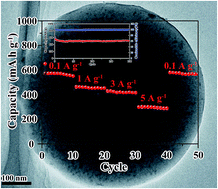
Fig. 3d depicts the rate performance of 5-SnS/C electrode at various current densities ranging from 0.1 mA g−1 to 5 A g−1. At the current density of 1 A g−1 and 3 A g−1, the discharge capacities of 5-SnS/C are 453.8 mA h g−1 and 428.5 mA h g−1, respectively. Even at a higher current density of 5 A g−1, it can deliver a reversible capacity of 315.4 mA h g−1, demonstrating excellent rate capability. Impressively, as high as about 590 mA h g−1 of reversible capacity is recovered, when the current density is switched from 5 A g−1 to 0.1 A g−1. In contrast, the 20-SnS/C electrode shows an inferior rate performance with the desodiation capacities of 359.9 mA h g−1, 225.6 mA h g−1 and 161.2 mA h g−1 at 1, 3 and 5 A g−1, respectively. Therefore, 5-SnS/C has a better performance than 20-SnS/C. Because the smaller size of SnS nanoparticles provide the shorter diffusion distance, which is beneficial for the high-rate capability.
In Fig. 3e, the cycling performance of 5-SnS/C, 20-SnS/C and bulk SnS electrodes are compared, at a current density of 1000 mA g−1 between 0.01 and 2.9 V. As mentioned in the previous reports, it is usually very difficult to achieve long cycling sulfide anodes especially for sodium storage, owing to the large volume changes during cycling. In the literature, most reports for SnS only show less than 100 charge–discharge cycles. In this work, the 5-SnS/C exhibits much higher cycling stability than that of the other two electrodes. After 200 cycles, 5-SnS/C still delivers a desodiation capacity of 517.6 mA h g−1 with a high capacity retention of 94%, which is much higher than that of the reported SnS/C composite materials.27 Although the capacity of 5-SnS/C decayed slightly in the initial cycles, the coulombic efficiency approaches 100% after several cycles, suggesting superior reversibility of 5-SnS/C composite. In comparison, 20-SnS/C displays a capacity as low as 290.9 mA h g−1 after 200 cycles, and pure SnS was only 357.1 mA h g−1 with severe capacity decay after 30 cycles. It is noted that EC, DEC and sodium ion is small (Fig. S9 in ESI†) and could easily permeate into the as-obtained carbon spheres with mesoporous pores. It means that SnS/C composites with the ultrasmall SnS nanoparticles embedded in carbon spheres are readily accessible to the electrolyte and easy to be fully utilized for Na-storage.36
Compared to the other reported SnS/C composites (Table S3†), 5-SnS/C shows a better performance, which could be attributed to the unique structure. The ultrasmall SnS nanoparticles could facilitate ions transport during cycling, and the carbon matrix can not only prevent aggregation of nanoparticles, but also improve the electric conductivity.
Moreover, the structural stability of 5-SnS/C electrode were investigated by XRD, SEM and TEM. Fig. S10a† displays the XRD image of 5-SnS/C after 50 cycles at 100 mA g−1. The XRD pattern is well indexed to metallic Sn (JCPDS no. 5-390). Fig. 4a shows the SEM and elemental mapping images of 5-SnS/C after 50 cycles at 100 mA g−1. It can be clearly seen that the composite still maintains its original spherical morphology after 50 cycles. Moreover, the TEM image reveal that the morphology of 5-SnS/C electrode is not changed so much (Fig. 4b). As seen in Fig. S10b,† the set of parallel fringes with the space of 0.37 and 0.23 nm correspond to the (111) and (220) plane of the Sn crystal structure, respectively. All of these observations demonstrate that the unique structure can effectively suppress the volume change and curb the aggregation of SnS nanoparticles, thus retaining the integrity of the whole electrode and extending the cycle life.31,32
![]() | ||
| Fig. 4 (a) SEM and (b) TEM images of the 5-SnS/C after 50 cycles. SEM elemental mapping images of 5-SnS/C for C, Sn and S. | ||
To further understand the difference in electrochemical performance among 5-SnS/C, 20-SnS/C and bulk SnS, the electrochemical impedance spectroscopy (EIS) was used to investigate the Na+ ions migration dynamics. As shown in Fig. 5a, the impedance spectra all contain a semicircle in the high frequency region and a straight line in the low frequency region, corresponding to the charge transfer resistance (Rct, the value of which depends on the diameter of the semicircle) and a semiinfinite Warburg diffusion (Zw) process, respectively. Obviously, the diameter of 5-SnS/C electrode in the high-frequency region is rather smaller than that of 20-SnS/C and bull SnS. The charge-transfer resistance of 5-SnS/C, 20-SnS/C and bulk SnS anodes are 196.63, 438.2 and 930 Ω on the basis of the equivalent circuit, respectively. It indicates that 5-SnS/C composite possesses the lower charge transfer resistance, leading to the rapid electron transport during insertion and extraction process. As calculated with the equation (io = RT/nFRct), the exchange current densities of cells based on 5-SnS/C are higher than those of 20-SnS/C. The lower slope of Z′ between ω−1/2 at middle and low frequency implies a higher charge transfer rate, and better Na+ kinetics.27,33–35 In Fig. 5b, 5-SnS/C shows a lower slope, which demonstrated the smaller charge-transfer resistance and better Na+ kinetics of 5-SnS/C. The smaller resistance also contributes to the outstanding rate performance of 5-SnS/C.
![]() | ||
| Fig. 5 (a) EIS spectra of 20-SnS/C, 5-SnS/C and bulk SnS electrodes, respectively; (b) linear fits in the low-frequency region between Z′ and ω−1/2 before and after 50 cycles. | ||
Footnote |
| † Electronic supplementary information (ESI) available. See DOI: 10.1039/c6ra19353f |
| This journal is © The Royal Society of Chemistry 2016 |