
Jingxuan Xu,
Yang Yang,
Hang Chu,
Jianhua Tang,
Yuancai Ge,
Jianfeng Shen* and
Mingxin Ye*
Department of Materials Science, Fudan University, 200433, Shanghai, China. E-mail: mxye@fudan.edu.cn; jfshen@fudan.edu.cn
First published on 17th October 2016
We present a simple one-step solvothermal method for in situ growth of nickel cobalt sulfide (NiCo2S4) nanoparticles on the reduced graphene oxide (rGO) sheets and carbon nanotube (CNT) without adding any surfactant. The NiCo2S4@rGO@CNT structure was fabricated successfully with the hydrothermal method. When serving as an electrochemical supercapacitor electrode material, the NiCo2S4@rGO@CNT delivers a highly improved specific capacitance of 1242.51 F g−1 at the current density of 2.0 A g−1, as compared with that of pure NiCo2S4 (519.51 F g−1) counterpart. Its durability is mainly owing to the synergistic effects of NiCo2S4, rGO and CNT, further presenting potential applications in energy storage.
Although significant advances have been made in SCs, the practical applications of SCs are still held back by the really inferior electrochemical performances of the electrode materials, such as high cost of typical transition metal oxides, low specific capacitance of carbon-based materials and poor cycling stability of conductive polymers.6,7
As an important kind of electrode material, transition metal oxide has been widely exploited for high performance supercapacitors due to their low cost, low toxicity and high theoretical specific capacity.8,9 Unfortunately, its low conductivity impedes the application of transition metal oxides in high rate capability demanding fast electron transport. Stimulated by the remarkable electrochemical properties of NiCo2O4, spinel ternary nickel cobalt sulfides (NiCo2S4) is being explored more and more deeply because of its striking electrochemical performance. The research of NiCo2S4 has become a new hotspot recently.10 Theoretically, replacing oxygen with sulphur may create a more flexible structure with the elongation of chemical bonds, thus making it easier for electrons to transport in this tuned structure, which can further contribute to the enhancement of electrochemical performances of SCs.11 Lately, transition metal sulfides have attracted more and more attention owing to their higher conductivity, comparing with the transition metal oxides and promising applications in high-performance supercapacitors.12 Especially, NiCo2S4 can provide much higher electrochemical activity and specific capacitances than mono-metal sulfides, but also possesses 100 times higher conductivity than that of NiCo2O4.13,14 In this sense, nanostructured NiCo2S4 is deemed to be a kind of promising candidate as an electroactive material for energy storage.15,16
Generally, the serious aggregation of nanoparticles is likely to be caused during its preparation and application, which reduces its performance significantly.17,18 An effective way to overcome this problem is building hierarchical nanoarchitecture.19–21 Reduced Graphene Oxide (rGO) has large surface area and good electrical conductivity, superior mechanical property and good electrochemical stability, which make it an ideal support for nanocomposites.22 It has been demonstrated that the performances of supercapacitors can be improved significantly by constructing nanocomposites with rGO and transition metal oxides or sulfides.7,23,24 On the other hand, carbon nanotube (CNT) has got significant attention since its great adaptability in building the highly conductive network like conductive paper and sponge.25 It puts up with several promising characteristics, for example, excellent electrical conductivity, high surface area, durability, flexibility, high chemical stability and great mechanical strength. Notably, multi-walled carbon nanotubes (MWCNTs) permit a conducting pathway to support a fast electrochemical kinetic process during charge/discharge process at high a current density in a hybrid supercapacitor. A variety of electrode materials, such as metal oxide, metal sulfide and conducting polymers fabricated on MWCNTs have exhibited superior electrochemical behaviours.26–29 The advantages of fabrication of metal oxide on CNT network in supercapacitor applications have been well demonstrated by many researchers.30,31
To this end, CNT provides high electrical conductivity, because of the low interfacial resistance along the electron-transfer path way results in low energy loss during the charge/discharge cycles.32,33 Graphene possesses numerous functional groups and edge planes, resulting in a high electro chemical activity of the electrode.34–37 In addition, the network structure of rGO@CNT provides ion channels and electron-transfer pathways.38,39 The main challenge is that these materials are difficult to be produced in quantity. Thus, in this work, we intend to synthesis a kind of NiCo2S4@rGO@CNT composite to reduce the defects of every component and increase the charge/discharge rate and cycling performance when the composite is used in supercapacitors.
The electrochemical properties of the samples were tested with cyclic voltammetry (CV) and galvanostatic charge/discharge (GCD) technique by a three-electrode system using Autolab PGSTAT302N electrochemical workstation (Metrohm AG, Switzerland).
The electrochemical studies of individual electrodes were carried out in a three-electrode cell with 6 M KOH aqueous solution. The working electrodes were fabricated by mixing active materials (80 wt%), conductive material (acetylene black, 10 wt%) and binder (polytetrafluoroethylene, 10 wt%). All of the mixtures were first coated onto the surface of Ni foam sheet, and followed by drying at 120 °C for 12 h to obtain the working electrodes. The mass of the NiCo2S4 electrode is 9.41 mg, while that of NiCo2S4@rGO@CNT nanocomposites is 13.24 mg. A platinum rod and an Hg/HgO electrode were used as counter and reference electrodes, respectively.
The specific capacitance can be calculated by the following equation (eqn (1))
![]() | (1) |
XPS spectra of NiCo2S4@rGO@CNT are demonstrated in Fig. 2a–d. Fig. 2a shows a full-scan survey XPS spectrum of the sample in the range of 0–1000 eV. It can be clearly seen that the elements of Co, Ni, S and C were detected. Fig. 2b shows the Ni 2p spectrum of NiCo2S4@rGO@CNT, with two doublets main peaks and two shake-up satellites. The binding energy at 852.7 eV in Ni 2p3/2 and 869.8 eV in Ni 2p1/2 agrees well with the spin–orbit characteristic of Ni2+, while the binding energy at 856.2 eV in Ni 2p3/2 and 874.5 eV in Ni 2p1/2 are characteristic of Ni3+.41 As shown in Fig. 2c, the Co 2p spectrum can be properly fitted with two spin–orbit doublets and two shake-up satellites by using a Gaussian fitting method. The first doublet (at 777.9 and 793.0 eV) and the second doublet (at 780.6 and 797.2 eV) can be assigned to Co3+ and Co2+, respectively.42 As for the S 2p spectrum shown in Fig. 2d, the peaks at 161.9 and 162.9 eV correspond respectively to the S 2p3/2 and S 2p1/2, and the binding energy at 168.7 eV can be assigned to the shake-up satellite.43 According to these XPS analysis results above, the NiCo2S4@rGO@CNT holds chemical composition of Co2+, Co3+, Ni2+, Ni3+ and S2− in its near-surface area.
![]() | ||
| Fig. 2 (a) XPS survey spectra of NiCo2S4@rGO@CNT, (b–d) high resolution XPS of Ni 2p, Co 2p and S 2p for NiCo2S4@rGO@CNT nanocomposites. | ||
The morphologies and microstructural features of the NiCo2S4 and NiCo2S4@rGO@CNT are characterized by SEM, TEM and EDS. As showed in Fig. 3a, the as-formed NiCo2S4 nanosheets are interconnected with each other and an open framework is exhibited, which is beneficial to the electrolyte wetting for better penetration. In Fig. 3b, the NiCo2S4 nanosheets grow on the rGO and the CNTs twine with them. In this structure, rGO acts as a growth substrate and a current collector for NiCo2S4 arrays. Especially, the special interconnected network structure not only provides a convenient ion and electron diffusion channel, but also increases efficient contact between the ions and the active material. Both of them are seen as promising electrode materials for supercapacitors.
The EDS elemental mapping of NiCo2S4 and NiCo2S4@rGO@CNT are shown in Fig. 4 and 5 all elements offer good dispersibility, corresponding to the SEM image. Besides, the three elements ratio confirms the formation of pure NiCo2S4. In Fig. 5, the element of carbon can be detected in large quantities, the EDS analysis demonstrates that the Ni, Co, and S elements are uniformly and continuously distributed on the graphene nanosheets. Since the nanosheets are very thin, the density of elements is lower than the pure NiCo2S4.
![]() | ||
| Fig. 4 (a) SEM image of the NiCo2S4 sample; (b–d) elemental mapping images of nickel, cobalt, and sulphur elements. | ||
![]() | ||
| Fig. 5 (a) SEM image of the NiCo2S4@rGO@CNT; (b–d) elemental mapping images of nickel, cobalt, and sulphur elements. | ||
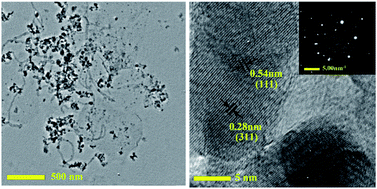
The morphologies of NiCo2S4@rGO@CNT nanocomposites and pure NiCo2S4 were revealed in detail by TEM observation. Fig. 6 shows representative TEM images of two samples from low to high magnification. The low-magnification TEM images (Fig. 6a and c) indicate that the NiCo2S4 nanoparticles are composed of several thin layers. Its microscopic morphology is demonstrated to be nanosheet, same as SEM image. Besides, the composite is that the NiCo2S4 grows on the graphene and CNTs densely. The high-resolution TEM (HRTEM) image (Fig. 6b and d) confirms further close contacts in rGO, CNT and NiCo2S4 nanosheets, implying a formation of strongly coupled NiCo2S4@rGO@CNT. In addition, rGO sheets not only play a crucial role in providing nucleation sites for NiCo2S4 crystals growth, but also confine the increase of nanoparticles size by the restraint of its space environment. The d-spacing of 0.54 nm, 0.28 nm and 0.33 nm corresponds to the (111), (311) and (220) plane of NiCo2S4, respectively.44 Moreover, its polycrystalline nature is demonstrated in SAED pattern with those typical diffraction rings representative of certain lattice planes.
To evaluate the electrochemical performance of the NiCo2S4 and NiCo2S4@rGO@CNT, the electrochemical properties of as-prepared NiCo2S4 and NiCo2S4@rGO@CNT nanocomposites were firstly investigated by using a three-electrode cell. Fig. 7a shows typical cyclic voltammetry (CV) curves of the electrodes made with the materials and tested in 6 M KOH electrolytes at 5 mV s−1. NiCo2S4@rGO@CNT nanocomposites show a much higher current in a potential window of −0.1 to 0.4 V (vs. Hg/HgO), which reveals that the electrochemical performance characteristics mainly resulted from faradaic pseudocapacitance related to Co2+/Co3+ and Ni2+/Ni3+ redox couples.
The integrated CV area for the NiCo2S4@rGO@CNT electrode is significantly larger than the NiCo2S4 electrode, confirming that the NiCo2S4@rGO@CNT material facilitates electron transport and enhances the electrochemical utilization of rGO@CNT. The reason can be assigned to the unique structure of the present electrode. First, the ultrathin and interconnected network structure characteristics of NiCo2S4@rGO@CNT endowed a very high surface area, which could provide numerous electroactive sites for redox reactions. Secondly, the open space between these ultrathin layers can be served as robust reservoir for ions, thus enhancing the electrolyte penetration within the electrode greatly. Third, the mesoporous structure of the electrode surface ensured efficient contact between the surface of the active materials and the electrolyte. In addition, the direct growth of NiCo2S4@rGO@CNT with good intrinsic electrical conductivity and robust adhesion could allow the rapid transportation of electrons.15,45
The galvanostatic charge/discharge curves of this NiCo2S4@rGO@CNT electrode displayed a highly symmetry at different current densities (Fig. 7b). Fig. 7c displayed the specific capacitance of the NiCo2S4@rGO@CNT and the NiCo2S4 calculated by eqn (1). The specific capacitances of NiCo2S4@rGO@CNT nanocomposites are 1242.51, 768.77, 746.02, 720.02, 676.04 and 645.05 F g−1 at current densities of 2, 3, 4, 5, 8 and 10 A g−1, respectively, which are much higher than that (519.51, 465.77, 347.02, 253.77, 144.04 and 90.05 F g−1) of the NiCo2S4 nanoparticles. By calculating, the theoretical specific capacitance of NiCo2S4 is 1899.61 F g−1. Relatively, the specific capacitance of the samples almost meet the expectations. Fig. 7d reveals the cycle performance of the NiCo2S4@rGO@CNT and NiCo2S4 electrodes measured at a high current density of 10 A g−1 for 2000 cyclic charging/discharging measurements. After 2000 cycles, the NiCo2S4@rGO@CNT and NiCo2S4 electrodes retained, respectively, 53.91% and 68.84% of their initial specific capacitances, indicating that the NiCo2S4 electrode material had excellent cycle stability and good reversibility. However, the whole specific capacitance of NiCo2S4@rGO@CNT is still much higher than NiCo2S4. When testing the supercapacitor of the composite material at a lower current density, we did the cyclic voltammetry and galvanostatic charge/discharge experiment by a three-electrode cell with 6 M KOH aqueous solution. After that, the test of cycling stability was further conducted. During these tests, the electrode varied with time. For example, the microstructure of the NiCo2S4@rGO@CNT collapse, the NiCo2S4@rGO@CNT didn't attach to the Ni foam sheet tightly and in this three-electrode cell system, the oxidation–reduction reaction is not reversible completely. The results confirm that the electrochemical stabilities of the as-synthesized hybrid nanocomposites need to be enhanced in the applications as electrode materials for energy storage.
The highly improved capacitances of NiCo2S4@rGO@CNT nanocomposites maybe attributed to their distinctive structure. Firstly, the strong chemical attachment and electrical coupling among the NiCo2S4 nanoparticles, rGO and CNT afford facile electron transport among CNT, rGO and the NiCo2S4 nanoparticles. In addition, the ultra-dispersed NiCo2S4 nanoparticles exceedingly increase the quantity of electroactive sites. Furthermore, rGO sheets overlapped with each other to provide a three-dimensional structure and substantially facilitate transport of the electrolyte. CNTs make the composites be less compact with large specific surface area, and originate the electric double layer capacitance with high conductivity.
Fig. 8 shows the comparison of CV curves, charge–discharge curves and the specific capacitance of the as-prepared samples. In Fig. 8a, the specific capacitance of NiCo2S4, NiCo2S4@rGO@CNT nanocomposites, NiCo2S4@rGO, NiCo2S4@CNT and rGO@CNT are 481.99, 1236.75, 362.68, 865.12 and 43.25 F g−1 at a scan rate of 5 mV s−1. At the same time, we can calculate the capacitance by the GCD curves in Fig. 8b, which are 519.51, 1242.51, 468.51, 845.01 and 31.51 F g−1 at 2 A g−1, respectively. Therefore, we can draw a conclusion that the specific capacitance of NiCo2S4@rGO@CNT is much higher than others. Obviously, we can see that the specific capacitance delivered by NiCo2S4@rGO@CNT is always higher than others under different current densities in Fig. 8c. That evaluates the great performance of the NiCo2S4@rGO@CNT furtherly.
The specific surface area and porosity measurement of the as prepared NiCo2S4 and NiCo2S4@rGO@CNT samples were investigated by N2 adsorption–desorption measurements (Fig. 9). On the basis of the adsorption–desorption isotherm, the Brunauer–Emmett–Teller (BET) surface area of the NiCo2S4 and NiCo2S4@rGO@CNT were calculated to be as 9.86 m2 g−1 and 19.63 m2 g−1. Fig. 9b and (d) present the pore size distribution calculated from the N2 adsorption–desorption isotherm using the Barrett–Joyner–Halenda (BJH) method. The porosity measurement of NiCo2S4 and the composites are 14.34 nm and 15.64 nm, respectively. The maximum pore size distribution of the sample mainly centres in the range of 2–20 nm. Such a pore size distribution is favourable for electrolyte penetration, allowing reaction species to access the electrode quickly and contributes to excellent electrochemical behaviours. The surface area of NiCo2S4@rGO@CNT is twice than that of the NiCo2S4. The porosity measurement is similar, while the composite is a little bigger. It can explain the electrical conductivity of the NiCo2S4@rGO@CNT is better than the NiCo2S4.
| This journal is © The Royal Society of Chemistry 2016 |