
Vertically aligned gold nanomushrooms on graphene oxide sheets as multifunctional nanocomposites with enhanced catalytic, photothermal and SERS properties

Shu Jun Zhen*a, Wen Liang Fua, Bin Bin Chena, Lei Zhanb, Hong Yan Zoub, Ming Xuan Gaoa and Cheng Zhi Huang*ab
aKey Laboratory of Luminescent and Real-Time Analytical Chemistry (Southwest University), Ministry of Education, College of Chemistry and Chemical Engineering, Southwest University, 400715, Chongqing, P. R. China. E-mail: zsj@swu.edu.cn; Fax: +86-23-68367257; Tel: +86-23-68254059
bCollege of Pharmaceutical Sciences, Southwest University, 400715, Chongqing, P. R. China. E-mail: chengzhi@swu.edu.cn; Tel: +86-23-68254659

Received 19th July 2016 , Accepted 26th September 2016

First published on 26th September 2016


Abstract

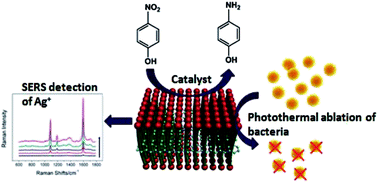
A novel and simple strategy for preparing vertically aligned gold nanomushrooms (AuNMs) on graphene oxide (GO) has been developed. The as-prepared GO/AuNM nanocomposites have been successfully applied in the catalytical organic transformation, photothermal ablation of bacteria and SERS detection.

Interest has recently grown in the fabrication of nanocomposites because these materials possess a unique combination of the mechanical, optical, and electronic properties of their various nanoscale building blocks.1 Graphene-based nanocomposites containing metal nanoparticles are particularly good candidates for materials science applications,2 because of their usefulness as catalysts,3 sensors,4 surface enhanced Raman scattering (SERS) substrates,5 electrodes,6 supercapacitors,7 etc. To date, many powerful approaches, including in situ5a,8 and self-assembly methods,5b,d,9 have been developed, but most successful graphene-based nanocomposites have involved zero-dimensional (0D) metal nanoparticles. Compared with the traditional spherical nanoparticles, one-dimensional (1D) metal nanowires have attracted considerable attention because of their beneficial size- and shape-dependent physical properties.10 Graphene/metal nanowire nanocomposites are potential building blocks for the creation of novel nanoscale electronic, photonic, and electromechanical devices.11 However, a well-controlled nanocomposite composed of graphene and 1D metal nanowires is difficult to achieve. Although efforts have been made to prepare such structures,12 no effective strategy has been developed for the direct solution-phase growth of vertically aligned metal nanowires on graphene.

In this work, a novel method was developed to prepare the nanocomposites of gold nanowires (AuNWs) and graphene oxide (GO). By using 4-mercaptobenzoic acid (MBA) as a binding ligand and our previously reported polyethyleneimine (PEI) modified GO as substrates,5b Au seeds anchored above and below the plane of GO sheets were grown into ultrathin AuNWs (Scheme 1). The Au seeds were located at the ends of the AuNWs, forming gold mushroom-like structures, which are referred to here as gold nanomushrooms (AuNMs). The obtained GO/AuNMs nanocomposites were significantly different with previously reported graphene-based nanocomposites.12 For instance, the AuNMs were vertically aligned on both sides of the GO sheets. The density of AuNMs on the GO was much higher than that achieved by other methods. The AuNMs formed a network-like structure of the caps of AuNMs with a “side-by-side” assembly structure composed of aligned stipes of AuNMs. This regular orientation of AuNMs resulted in strong localized surface plasmon resonance (LSPR) coupling and a high surface-area-to-volume ratio. Because of these unique properties, the synthesized GO/AuNMs had excellent catalytic, photothermal, and SERS properties, allowing them to impact a range of fields involving catalysis, nanomedicine, biosensing, and nanodevices.


image file: c6ra18371a-s1.tif
Scheme 1 Schematic illustrating the growth of AuNMs on GO substrate.

The hybrid material containing GO and Au seeds was prepared according to our previously reported PEI-mediated method (Fig. S1).5b Vertically aligned AuNMs were then synthesized on the GO sheets through the addition of a growing solution, which was a water/ethanol mixture containing MBA, HAuCl4, and L-ascorbic acid (L-AA), into a mixture containing GO/Au seeds at room temperature for 30 min. Fig. 1a and b show the SEM images of the AuNMs grown from 6.5 nm Au seeds. According to these images, a high density of vertically aligned AuNMs was successfully formed on the GO sheets. The average diameter of the AuNMs' caps was 12.2 ± 2 nm. The average length and diameter of the AuNMs' stipes were approximately 233 ± 33 nm and 8.9 ± 1.7 nm, respectively. The stipes were not perfectly straight. Interestingly, the AuNMs were found to grow both above and below the planes of the GO sheets, as both the top and bottom surfaces of the GO were covered with Au seeds. Further experiments indicated that the diameters of the stipes were independent of the size of the Au seeds used (Fig. S2). Control experiments revealed that the self-assembly of the Au seeds on GO was essential for the growth of AuNWs (Fig. S3). High-resolution transmission electron microscopy (HRTEM) images (Fig. 1c and S4) revealed that the synthesized AuNMs were polycrystalline. The X-ray diffraction (XRD) pattern of the GO/AuNMs (Fig. 1d) exhibited peaks at 38.23°, 44.31°, 64.58° and 77.60°, which were indexed to the (111), (200), (220) and (311) planes, respectively (JCPDS, 04-0784). X-ray photoelectron spectroscopy (XPS) measurements (Fig. 1e) indicated that the binding energies of the two peaks for Au 4f5/2 and Au 4f7/2 were 88.1 eV and 84.4 eV, respectively, which were attributed to the Au0 species.13 In addition, the lengths and diameters of the AuNMs' stipes depended on the concentration of MBA and ethanol used (Fig. S5 and 6). Long, thin stipes were only obtained in the presence of high concentrations of MBA and ethanol.


image file: c6ra18371a-f1.tif
Fig. 1 Characterization of the GO/AuNMs. (a and b) SEM images of the vertically aligned AuNMs on GO, scale bar = 100 nm; (c) HRTEM images of AuNMs, scale bar = 5 nm; (d) XRD spectrum of GO/AuNMs; (e) XPS spectrum of the AuNMs in the region containing the Au 4f5/2 and Au 4f7/2 doublet.

Since MBA is a strong ligand, it was bound strongly to the Au seeds through Au–S interactions. Most of the newly formed Au that was produced by the reaction between L-AA and HAuCl4 preferentially deposits onto the Au seeds-GO interface because of the insufficient MBA binding in this region.14 The continued deposition of Au at this interface pushes the seeds to grow upward, forming vertically aligned nanomushrooms. As GO is a 2D nanomaterial and its two sides were covered by Au seeds, AuNM growth occurred both above and below the plane of the GO sheets.

Previously, GO/gold nanoparticle hybrids have been shown to possess a high catalytic activity towards the chemical transformation of organic compounds, because of the synergistic catalytic effects of the Au nanoparticles and GO.15 Interestingly, the as-prepared GO/AuNMs displayed a much higher catalytic activity than the GO/Au seeds for the catalytic reduction of 4-nitrophenol (4-NP) when NaBH4 was used as a hydrogen source (Fig. 2a). Time-dependent UV/vis spectra (Fig. 2b) indicated that, the absorption at 400 nm, which was characteristic of 4-NP, slowly decreased and the peak at 300 nm, which was characteristic of the reaction product (4-aminophenol), slowly increased after the addition of NaBH4 in the presence of the GO/Au seeds catalyst. The reduction process was completed within approximately 40 min. Using the GO/AuNMs catalyst, the mixture containing 4-NP and NaBH4 rapidly changed from yellow to colourless (inset to Fig. 2c), and the UV/vis absorbance at 400 nm decreased to negligible values within 3 min (Fig. 2c). To further compare the catalytic activities of the two materials, pseudo-first-order reaction kinetics were used to extract reaction rate constants, k, from the UV/vis spectra. From the linear relations of ln(ct/c0) vs. reaction time, the GO/AuNMs had a much higher catalytic reaction rate (k = 1.27 min−1) than did the GO/Au seeds (k = 0.11 min−1) (Fig. 2d). Furthermore, the reaction rate was also much higher than many previously reported works (Table S1), confirming the high catalytic activity of the GO/AuNMs nanocomposites. The significantly increased catalytic activity of the GO/AuNMs might have been caused by both its high surface-area-to-volume ratio and the synergistic catalytic effects of the AuNMs and GO.15,16 Since the selective hydrogenation of nitroarenes to aminoarenes is an important reaction for the production of pharmaceutical and agrochemical products, dyes, rubbers, and polymers,15 these GO/AuNMs nanocomposites should be useful as efficient catalysts for industrial applications.


image file: c6ra18371a-f2.tif
Fig. 2 The reduction of 4-NP over different catalyst. (a) Schematic representation of the reduction of 4-NP. (b and c) Time-dependent UV/vis absorption spectra for the reduction of 4-NP over GO/Au seeds (b) and GO/AuNMs (c) at 298 K. The inset in (c) shows the colour of solution after 3 min of reaction (1, GO/AuNMs; 2, GO/Au seeds). (e) Plot of ln(ct/c0) vs. time for the reduction of 4-NP. Concentrations: 4-NP, 3.4 × 10⁻⁴ M; NaBH4, 0.1 M; GO/Au seeds, 0.3 μg mL−1 (with respect to the GO concentration); GO/AuNMs, 0.3 μg mL−1 (with respect to the GO concentration).

The GO/AuNMs also displayed more effective heat conversion abilities than did the GO/Au seeds (Fig. 3a). Because of the strong LSPR coupling of the vertically aligned AuNMs, the GO/AuNMs had a much stronger optical absorbance in the visible to near infrared (NIR) region than did the GO/Au seeds (Fig. S7). Fig. 3b showed the temperature evolution profiles of GO/seeds and GO/AuNMs upon NIR laser irradiation as a function of time. Pure water was used as a negative control. The temperatures of the water and the GO/Au seeds slightly increased from 28.3 °C to 33.9 °C during 9 min of irradiation, while the GO/AuNMs produced a drastic increase in temperature from 28.3 °C to 44.3 °C in 6 min. Clearly, the photothermal transduction efficiency of the GO/AuNMs was greatly enhanced compared to that of the GO/Au seeds precursor. The GO/AuNMs were then used for the photothermal killing of bacteria using Staphylococcus aureus (S. aureus) as a model. The growth of S. aureus was slightly affected by GO/Au seeds and GO/AuNMs without NIR irradiation (Fig. 3c, 1–3). The GO/Au seeds had only a small effect on the bacteria's growth (Fig. 3c, 4 and 5). In contrast, in the presence of both NIR light and GO/AuNMs, the number of bacteria colonies decreased dramatically (Fig. 3c, 6), indicating that the GO/AuNMs acted as an effective photothermal agent for the inhibition of bacterial growth.


image file: c6ra18371a-f3.tif
Fig. 3 Investigation of photothermal effects. (a) Schematic illustration of the enhanced photothermal transduction efficiency of the GO/AuNMs compared to that of the GO/Au seeds. (b) Heating curves of water (black), GO/Au seeds (blue) and GO/AuNMs (red) containing the same concentration of GO (3.8 μg mL−1) under irradiation by an 808 nm laser at a power density of 175 mW cm−2; (c) growth of S. aureus after incubation with H2O (1 and 4), GO/Au seeds (2 and 5), and GO/AuNMs (3 and 6) for 12 h. 1–3, without NIR irradiation; 4–6, with 10 min of NIR exposure (808 nm, 175 mW cm−2) prior to culture on LB-agar plates.

A finite-difference time-domain (FDTD) simulation (Fig. S8) indicated that there were many “hot spots” in the networked structures of AuNMs' caps, at the interfaces between the AuNMs' caps and stipes, within the “side-by-side” assembly of AuNMs' stipes, and at the interface between the GO and AuNMs, making the GO/AuNMs attractive candidates for SERS substrates. Therefore, the GO/AuNMs were used for the SERS-based detection of Ag+. Fig. 4a illustrates the SERS detection strategy. In the presence of L-AA, reduced Ag0 was deposited on the surface of the GO/AuNMs, leading to a enhancement in the electromagnetic fields, which enhanced the SERS signal of MBA near the surface of GO/AuNMs. A Raman spectrum of MBA was first acquired on the surface of the GO/AuNMs. Two predominant bands located at 1080 cm−1 and 1590 cm−1 were observed (Fig. 4b), corresponding to the a1 modes of vCS and vCC, respectively.17 When the concentration of Ag+ was increased, the SERS intensity increased gradually (Fig. 4c). The SERS intensity of the vibration at 1080 cm−1 was plotted as a function of Ag+ concentration in Fig. 4d. A linear response was obtained at Ag+ concentrations from 40 μM to 600 μM (R2 = 0.993). Furthermore, this method was highly selective for Ag+ detection (Fig. 4e). These results confirmed that the as-prepared GO/AuNMs can be used as efficient SERS substrates for the sensitive and selective detection of Ag+.


image file: c6ra18371a-f4.tif
Fig. 4 SERS applications. (a) Schematic illustrating the mechanism for Ag+ detection. (b) SERS spectrum of MBA on the as-prepared GO/AuNMs. (c) SERS spectra of MBA after addition of different amount of Ag+: 1, 40 μM; 2, 120 μM; 3, 200 μM; 4, 400 μM; 5, 600 μM. (d) The linear relationship between the SERS intensity at 1080 cm−1 and the concentration of Ag+. (e) The selectivity for Ag+ detection over other metal ions. The concentrations of all metal ions were 250 μM.

In conclusion, a novel strategy was developed to fabricate multifunctional GO/AuNMs nanocomposites. Because of the strong ligand binding at the surface of the Au seeds and the insufficient ligand binding at the GO/Au seeds interface, Au seeds were grown on both sides of GO sheets into vertically aligned nanomushrooms. This method was extremely simple and effective. Furthermore, the GO/AuNMs displayed significantly enhanced catalytic, photothermal and SERS features. This method should enable the fabrication of novel multifunctional nanocomposites that will have potential applications in catalysis, nanomedicine, biosensing, and nanodevices. Research efforts towards reaching these goals are currently underway.

Acknowledgements

This work was supported by the National Natural Science Foundation of China (NSFC, No. 21305113), the fund of Chongqing Fundamental and Advanced Research Project (cstc2013jcyjA50008) and the Fundamental Research Funds for the Central Universities (XDJK2015B029).

Notes and references

  1. (a) L. L. Beecroft and C. K. Ober, Chem. Mater., 1997, 9, 1302 CrossRef CAS; (b) A. C. Balazs, T. Emrick and T. P. Russell, Science, 2006, 314, 1107 CrossRef CAS PubMed; (c) T. D. Schladt, M. I. Shukoor, K. Schneider, M. N. Tahir, F. Natalio, I. Ament, J. Becker, F. D. Jochum, S. Weber, O. Köhler, P. Theato, L. M. Schreiber, C. Sönnichsen, H. C. Schröder, W. E. G. Müller and W. Tremel, Angew. Chem., Int. Ed., 2010, 49, 3976 CrossRef CAS PubMed; (d) X.-J. Wu, J. Chen, C. Tan, Y. Zhu, Y. Han and H. Zhang, Nat. Chem., 2016, 8, 470 CrossRef CAS PubMed.
  2. (a) M. Oyama, X. Chen and X. Chen, Anal. Sci., 2014, 30, 529 CrossRef CAS PubMed; (b) Q. Li, N. Mahmood, J. Zhu, Y. Hou and S. Sun, Nano Today, 2014, 9, 668 CrossRef CAS; (c) O. C. Compton and S. T. Nguyen, Small, 2010, 6, 711 CrossRef CAS PubMed.
  3. (a) M. J. Fernández-Merino, S. Villar-Rodil, J. I. Paredes, P. Solís-Fernández, L. Guardia, R. García, A. Martínez-Alonso and J. M. D. Tascón, Carbon, 2013, 63, 30 CrossRef; (b) C.-H. Liu, X.-Q. Chen, Y.-F. Hu, T.-K. Sham, Q.-J. Sun, J.-B. Chang, X. Gao, X.-H. Sun and S.-D. Wang, ACS Appl. Mater. Interfaces, 2013, 5, 5072 CrossRef CAS PubMed; (c) Q. Li, X. Li, S. Wageh, A. A. Al-Ghamdi and J. Yu, Adv. Energy Mater., 2015, 5, 1500010 CrossRef.
  4. (a) Z. Yin, Q. He, X. Huang, J. Zhang, S. Wu, P. Chen, G. Lu, Q. Zhang, Q. Yan and H. Zhang, Nanoscale, 2012, 4, 293 RSC; (b) R. Liu, S. Li, X. Yu, G. Zhang, S. Zhang, J. Yao, B. Keita, L. Nadjo and L. Zhi, Small, 2012, 8, 1398 CrossRef CAS PubMed.
  5. (a) W. L. Fu, S. J. Zhen and C. Z. Huang, Analyst, 2013, 138, 3075 RSC; (b) W. L. Fu, S. J. Zhen and C. Z. Huang, RSC Adv., 2014, 4, 16327 RSC; (c) X. Liu, L. Cao, W. Song, K. Ai and L. Lu, ACS Appl. Mater. Interfaces, 2011, 3, 2944 CrossRef CAS PubMed; (d) W. Ren, Y. Fang and E. Wang, ACS Nano, 2011, 5, 6425 CrossRef CAS PubMed.
  6. (a) S. Guo, D. Wen, Y. Zhai, S. Dong and E. Wang, ACS Nano, 2010, 4, 3959 CrossRef CAS PubMed; (b) J.-D. Qiu, L. Shi, R.-P. Liang, G.-C. Wang and X.-H. Xia, Chem.–Eur. J., 2012, 18, 7950 CrossRef CAS PubMed.
  7. Q. Zhang, Y. Zhang, Z. Gao, H.-L. Ma, S. Wang, J. Peng, J. Li and M. Zhai, J. Mater. Chem. C, 2013, 1, 321 RSC.
  8. (a) Q. Chen, L. Zhang and G. Chen, Anal. Chem., 2011, 84, 171 CrossRef PubMed; (b) P. Xu, H. Yu and X. Li, Chem. Commun., 2012, 48, 10784 RSC.
  9. (a) Y. Wang, S. J. Zhen, Y. Zhang, Y. F. Li and C. Z. Huang, J. Phys. Chem. C, 2011, 115, 12815 CrossRef CAS; (b) C. Hu, J. Rong, J. Cui, Y. Yang, L. Yang, Y. Wang and Y. Liu, Carbon, 2013, 51, 255 CrossRef CAS.
  10. T.-K. Huang, Y.-C. Chen, H.-C. Ko, H.-W. Huang, C.-H. Wang, H.-K. Lin, F.-R. Chen, J.-J. Kai, C.-Y. Lee and H.-T. Chiu, Langmuir, 2008, 24, 5647 CrossRef CAS PubMed.
  11. (a) M.-S. Lee, K. Lee, S.-Y. Kim, H. Lee, J. Park, K.-H. Choi, H.-K. Kim, D.-G. Kim, D.-Y. Lee, S. Nam and J.-U. Park, Nano Lett., 2013, 13, 2814 CrossRef CAS PubMed; (b) S.-T. Hsiao, H.-W. Tien, W.-H. Liao, Y.-S. Wang, S.-M. Li, C.-C. Mma, Y.-H. Yu and W.-P. Chuang, J. Mater. Chem. C, 2014, 2, 7284 RSC; (c) J. L. Xie, C. X. Guo and C. M. Li, Energy Environ. Sci., 2014, 7, 2559 RSC; (d) W. Zhang, Z. Yin, A. Chun, J. Yoo, Y. S. Kim and Y. Piao, ACS Appl. Mater. Interfaces, 2016, 8, 1733 CrossRef CAS PubMed.
  12. (a) P. Gnanaprakasam and T. Selvaraju, RSC Adv., 2014, 4, 24518 RSC; (b) J. Tang, D. Tang, B. Su, Q. Li, B. Qiu and G. Chen, Electrochim. Acta, 2011, 56, 8168 CrossRef CAS; (c) M. Arif, K. Heo, B. Y. Lee, J. Lee, D. H. Seo, S. Seo, J. Jian and S. Hong, Nanotechnology, 2011, 22, 355709 CrossRef PubMed.
  13. A. Karpenko, R. Leppelt, J. Cai, V. Plzak, A. Chuvilin, U. Kaiser and R. J. Behm, J. Catal., 2007, 250, 139 CrossRef CAS.
  14. J. He, Y. Wang, Y. Feng, X. Qi, Z. Zeng, Q. Liu, W. S. Teo, C. L. Gan, H. Zhang and H. Chen, ACS Nano, 2013, 7, 2733 CrossRef CAS PubMed.
  15. Y. Choi, H. S. Bae, E. Seo, S. Jang, K. H. Park and B.-S. Kim, J. Mater. Chem., 2011, 21, 15431 RSC.
  16. M. Chirea, A. Freitas, B. S. Vasile, C. Ghitulica, C. M. Pereira and F. Silva, Langmuir, 2011, 27, 3906 CrossRef CAS PubMed.
  17. E.-Z. Tan, P.-G. Yin, T.-T. You, H. Wang and L. Guo, ACS Appl. Mater. Interfaces, 2012, 4, 3432 CAS.

Footnote

Electronic supplementary information (ESI) available: Experimental details and additional Table S1 and Fig. S1–S8. See DOI: 10.1039/c6ra18371a

This journal is © The Royal Society of Chemistry 2016
Click here to see how this site uses Cookies. View our privacy policy here.