DOI:
10.1039/C6RA17643G
(Paper)
RSC Adv., 2016,
6, 82793-82800
Tunable donor and acceptor impurity states in a WSe2 monolayer by adsorption of common gas molecules
Received
11th July 2016
, Accepted 26th August 2016
First published on 26th August 2016
Abstract
A gas sensor of common gas molecules, such as CO, H2O, NH3, O2, NO and NO2 on a WSe2 monolayer is investigated systematically by using first-principle calculations. The results show that the effects of NH3, H2O, CO adsorption on the electronic structures of the WSe2 monolayer are not obvious; while the adsorption of O2, NO and NO2 molecules has an obvious influences on electronic structures of the WSe2 monolayer. Moreover, our calculations show that NH3 acts as a charge donor, whereas O2, CO, H2O, NO and NO2 gas molecules act as an acceptor impurity. In particular, our results also show that NO2 molecule adsorptions can result in an effective p-type doping in the WSe2 monolayer. These results suggest that the carrier type can be tuned effectively in the monolayer WSe2 by adsorption of common gas molecules.
1. Introduction
Recently, the two-dimensional (2D) tungsten diselenide (WSe2) monolayer has attracted intensive attention due to its suitable gap value, typical electronic and optoelectronic properties in the 2D transition-metal dichalcogenides (TMDs).1–3 The 2D WSe2 nanosheets were fabricated by micromechanical cleavage exfoliation and applied to ultra-thin UV-light emitting diodes (LEDs).4 Campbell et al. studied direct selenization of e-beam evaporated W thin films and used them for manufacturing highly uniform few-layer p-type WSe2.5 Moreover, studies show that 2D WSe2 photoelectrode is stable under acidic and alkaline environments, and can be used in the photoelectrochemical cell.6 For the optoelectronic device applications, carrier type is also a key role in the related p–n junction. Moreover, high performance p-type field-effect transistor (FET) has been successfully fabricated from WSe2 monolayer with chemically doped contacts.7 Liu et al. also studied the role of metal contacts in designing high-performance n-type WSe2 FET.8 Recent experimental studies also show that NO2 molecules adsorbed on WSe2 surface can be identified as the dominant configuration leading to p-doping.9 Furthermore, studies also show that p-type WSe2(1−x)S2x with a tunable band gap is the ideal complement to n-type tunable monolayers in the application of p–n junction-related flexible nanodevices.10 In addition, the effective mass and negative compressibility have also been calculated in WSe2 monolayer and bilayer systems.11 These studies show that 2D WSe2 nanosheets can be a promising optoelectronic material in future studies.
As is well known that surface adsorption is a practicable method to manipulate and control the electronic properties of materials, typical for 2D TMDs material due to their large surface-to-volume ratio and high conductivities, which is extremely appropriate for highly sensitive sensors and other devices. For example, previous studies of MoS2,12,13 WS2,14 phosphorene15 and graphene16,17 indicate that the adsorbates can cause the variation of carrier concentration. Moreover, studies also showed that the molecular adsorption was identified to be a superior method to tune p- and n-doping of graphene.18 Furthermore, a band gap can be opened in low-buckled silicene by the surface adsorption without degrading its electronic properties.19 Adsorbates which are close to the carbon nanotube can greatly impact the charge transport properties of nanotube.20 In addition, the adsorbed NH3 on 2D Ti2CO2 lead to the high sensitivity of sensor and could be used as the NH3 capture.21 These results indicate surface adsorption can be an effective method to regulate electronic structure properties of 2D materials.
To our knowledge, there are few theoretical studies involved on gas sensor effects on electronic structures of 2D WSe2 nanosheets, and its underlying adsorption mechanism is still not clear. Therefore, in order to understand the effects of gas adsorption on electronic structures in the 2D WSe2 nanosheets, we systematically performed the theoretical studies on the adsorption of small molecules CO, O2, NH3, H2O, NO and NO2 on WSe2 monolayer by using a first-principle calculations in this work. Our results show that NO and NO2 adsorption can accept electrons from the WSe2 monolayer, leading to a p-type doping in WSe2 monolayer, while other gas molecules have a slight influences on electronic structures WSe2 monolayer. Thus, the electronic properties of WSe2 monolayer can be regulated by selective gas adsorption.
2. Computational methods
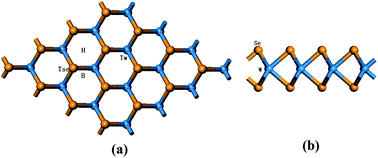
Our first-principle calculations were performed using Vienna ab initio Simulation Package (VASP)22–25 which implements a supercell approach to density functional theory (DFT).26 In order to simulate the influences of adsorption molecules on electronic structures of WSe2 monolayer, a 4 × 4 × 1 WSe2 supercell is used, which is large enough to neglect the interactions of the adsorbate.27,28 In this study, we adopted the Perdew–Burke–Ernzerhof (PBE) functional within generalized gradient approximation (GGA)29 to treat the exchange and correlation effects. The energy cutoff is set to 400 eV in all calculations. 5 × 5 × 1 Monkhorst–Pack30 k-points in Brillouin zone are sampled for geometry optimization and 9 × 9 × 1 k-points for static total energy and band structure calculation. Moreover, to ensure good boundary conditions, more than 15 Å vacuum layer is used to avoid periodic interactions between imaging layers. Moreover, four adsorption sites are considered to seek out the most stable one on WSe2 monolayer: H site (the hollow on the center of a hexagon), B site (the bridge site above the center of W–Se bond), Tw site (the top site above a W atom of sublattice WSe2 monolayer) and the TSe site (the top of a Se atom of sublattice WSe2 monolayer). The corresponding sites are also labeled in Fig. 1.
 |
| | Fig. 1 Top view (a) and size view (b) of the buckled hexagonal structure of WSe2 monolayer. The four adsorption sites are marked by the symbol H, Tw, TSe and B, respectively. | |
To survey the adsorption properties of these several molecules on WSe2 monolayer; firstly, we calculate the lattice constant of pristine WSe2 monolayer, and then explore the configurations of WSe2 monolayer with different adsorbates including NH3, H2O, O2, CO, NO and NO2. These molecules in initial orientations are also fully optimized. The convergence criterion for energy is chosen to be less than 10−5 eV between two consecutive steps, and the atomic positions are relaxed until the residual forces on each atom are smaller than 0.02 eV Å−1. In addition, charge transfer is obtained based on Bader analysis.31
3. Results and discussion
To confirm the stability of an adsorption configuration after total energy optimization, the adsorption energy (Ea) of gas molecules on WSe2 monolayer is defined as:| | |
Ea = Egas+WSe2 − Egas − EWSe2
| (1) |
where Egas+WSe2 is the total energy of the compound system, while Egas and EWSe2 are the total energies of pristine WSe2 monolayer and isolated gas molecule, respectively. Moreover, we also define the equilibrium height as the vertical distance between the top of Se-layer of WSe2 monolayer and the nearest atom of gas molecule in the z-coordinate direction. The calculated results of the adsorption energies, charge transfer and equilibrium height are presented in Table 1.
Table 1 Calculated parameters for WSe2 monolayer with adsorbed O2, CO, NH3, H2O, NO, NO2: total magnetic moment before and after gas molecule M/M′ (μB), adsorption energy Ea (meV), charge transfer from WSe2 to gas molecules ΔQ (e), the equilibrium height between the adsorbed molecule and the top-surface WSe2 h (Å)
| Molecule |
M/M′ (μB) |
Site |
Ea (meV) |
ΔQ (e) |
h (Å) |
| O2 |
2/2 |
H |
−8.6 |
0.0154 |
3.45 |
| B |
−6.9 |
0.0166 |
3.49 |
| Tw |
−8.7 |
0.0182 |
3.21 |
| TSe |
−6.6 |
0.0136 |
3.69 |
| CO |
0/0 |
H |
−7.2 |
0.0092 |
3.68 |
| B |
−9.2 |
0.0089 |
3.76 |
| Tw |
−8.8 |
0.0073 |
3.78 |
| TSe |
−7.1 |
0.0085 |
3.68 |
| NH3 |
0/0 |
H |
−40 |
−0.0142 |
3.10 |
| B |
−19 |
−0.0187 |
3.24 |
| Tw |
−42 |
−0.0172 |
3.11 |
| TSe |
−24 |
−0.0037 |
3.60 |
| H2O |
0/0 |
H |
−44 |
0.0179 |
2.75 |
| B |
−39 |
0.0177 |
2.87 |
| Tw |
−45 |
0.0186 |
2.78 |
| TSe |
−25 |
0.0130 |
3.13 |
| NO |
1/1 |
H |
−19 |
0.0162 |
3.30 |
| B |
−25 |
0.0346 |
2.95 |
| Tw |
−22 |
0.0244 |
3.21 |
| TSe |
−21 |
0.0421 |
3.24 |
| NO2 |
1/1 |
H |
−60 |
0.1110 |
3.10 |
| B |
−67 |
0.1165 |
3.04 |
| Tw |
−57 |
0.0960 |
3.21 |
| TSe |
−63 |
0.1213 |
3.08 |
Our results show that all gas molecules are physically adsorbed on WSe2 monolayer. It can be seen that for H2O, O2 and NH3, the most stable position is Tw site, while CO, NO and NO2 prefer to be adsorbed on the B site. Moreover, we can see that the most stable adsorption configurations of H2O and NH3 are parallel to the WSe2 surface, while O2 is perpendicular to the WSe2 monolayer. The H atoms of H2O point towards the WSe2 monolayer and the H atoms of NH3 point away from the WSe2 surface as shown in Fig. 2(b), (c) and (e). In Fig. 2(a), (d) and (f) the homologous structures of NO and CO are sloping to the surface with N and C atoms close to the substrate. O atoms of NO2 are parallel to the WSe2 surface. Furthermore, the optimized bond lengths of the isolate molecules CO, O2, H2O, NH3, NO and NO2 are found to be 1.14 Å, 1.23 Å, 0.97 Å, 1.02 Å, 1.16 Å and 1.21 Å, respectively. These isolate molecules' bond lengths are in good accordance with previous theoretical and experimental results.32,33 In addition, the equilibrium height for O2, CO, NH3, H2O, NO and NO2 is 3.21 Å, 3.76 Å, 3.11 Å, 2.78 Å, 2.95 Å, 3.04 Å with corresponding adsorption energies −8.7 meV, −9.2 meV, −42 meV, −45 meV, −25 meV, −67 meV, respectively. Combined with Table 1, we find that NH3 and H2O are not easy to be adsorbed on WSe2 monolayer. The adsorption energy of NO and NO2 systems are much higher than that of O2 system. We also see stronger charge transfer among the NO and NO2 systems compared with the O2 system as shown in Table 1. In view of these results, it is anticipated that WSe2 will be rather sensitive when used as NO and NO2 sensor device.
 |
| | Fig. 2 The most stable adsorption configurations of WSe2 monolayer adsorbed with (a) CO, (b) NH3, (c) O2, (d) NO2, (e) H2O, (f) NO from the top view and side view. The blue and orange balls represent W and Se atoms. H, C, O and N atoms are represented by white, gray, red and iceblue balls, respectively. The equilibrium height is labeled around gas molecules. | |
To understand the electronic properties of various adsorbates on WSe2 monolayer, we calculated the total density of states (TDOS) of adsorbate systems and the relevant local DOS (LDOS) projected on the adsorbed gas molecules, partial density of states (PDOS) of W(Se) atom and band structures of the WSe2 monolayer under different configurations as shown in Fig. 3 and 4. In Fig. 4(a) and (e), the band structures of pristine WSe2 has a direct band gap of 1.51 eV at the high symmetry point K, which is in consistent with the previous result.34 Furthermore, when CO, NH3, and H2O are adsorbed, the band structures of WSe2 monolayer are not distinctly changed, the band gap value remain around 1.51 eV as shown in Fig. 4(b)–(d). The spin-up and spin-down TDOS are symmetric, which indicates that these systems exhibit the non-magnetic ground states. It's also in good agreement with the calculated total magnetic moment of 0 μB in the CO, NH3 and H2O adsorbed WSe2 systems (see Table 1). In addition, for NO, O2 and NO2, they lead to spin polarized ground states in the WSe2 monolayer. From the calculation, for NO and NO2 adsorbates, the total magnetic moment are 1.00 μB, while adsorption of O2 leads to a total magnetic moment of 2.00 μB as shown in Table 1. More interestingly, these adsorbates induced impurity states in the gap from the TDOS and band structure as shown in Fig. 3(d)–(f) and 4(f)–(h). It shows that three impurity states appeared after the adsorption of NO: one occupied down-spin state 0.006 eV below the Fermi level, one unoccupied down-spin state 0.26 eV above the Fermi level, and one unoccupied up-spin state close to the bottom of the conduction band with an energy separation of 0.57 eV. NO2 introduces an unoccupied down-spin state 0.10 eV above the Fermi level as shown in Fig. 4(g). In addition, O2 introduces a down-spin state 0.32 eV above the Fermi level in the band as shown in Fig. 4(f). Besides, from the LDOS of the adsorbed gas molecules in Fig. 3, we know that the contribution of impurity states is mainly from the adsorbed gas molecules. The phenomenon of Fermi-level pinning in the case of gas molecules CO, H2O, NH3, O2, NO and NO2 adsorbed on 2D TMDs has not been systematically evaluated before. In particular, though adsorption of O2, NO, and NO2 induced impurity states in the bandgap of WSe2 monolayer, there have almost no influence on the bandgap energy of pristine WSe2 monolayer due to the weak physisorption interaction. Moreover, these impurity states are all localized around the adsorbed gas molecules because there is no obvious hybridization between these impurity states and WSe2 substrate.
 |
| | Fig. 3 The spin-polarized TDOS of WSe2 monolayer after adsorption of (a) CO, (b) NH3, (c) H2O, (d) O2, (e) NO2 and (f) NO, respectively. The corresponding LDOS projected on the adsorbed gas molecules as well as the partial DOS of their nearest W and Se atoms are also displayed. The Fermi level is indicated by the green dotted line. | |
 |
| | Fig. 4 Band structures of (a) pristine, (b) CO, (c) NH3 and (d) H2O on WSe2 monolayer, respectively. The spin-polarized band structures of (e) pristine, (f) O2, (g) NO2, and (h) NO on WSe2 with up-spin bands and down-spin bands are indicated in black and red, respectively. The dashed green line donates the Fermi level. And the Fermi energy is set as reference zero energy. | |
In order to explore the adsorption-induced charge transfer on the system, Bader charge analysis method is used to analyze the charge transfer.35 The calculated results are listed in Table 1. Numerical results show that NH3 behaves as a charge donor, providing 0.0172 e to the WSe2 substrate, while O2, CO, NO, H2O, NO2 behave as charge acceptors, which obtain 0.0182 e, 0.0089 e, 0.0346 e, 0.0186 e, 0.1165 e from the substrate, respectively. Our charge analysis reveals that the adsorbed NO2 accepts 0.1165 e from WSe2 monolayer, indicating that NO2 works as an acceptor with obvious charge transfer happening. It is also reflected by its high adsorption energy as described in Table 1. In view of this conclusion, the charge transfer is expected to induce changes on the conductivity of the system.
To further gain insight into the charge transfer between gas adsorbates and WSe2 monolayer, we calculated the electron charge density difference for these considered adsorption configurations. The charge density difference is calculated using the following equation:
| | |
Δρ = ρgas+WSe2 − (ρWSe2 + ρgas)
| (2) |
where
ρgas+WSe2,
ρWSe2,
ρgas are the charge density of the molecule-adsorbed WSe
2 monolayer, pristine WSe
2 monolayer, and isolated gas molecule, respectively. The results are shown in
Fig. 5, where the blue distribution represents the charge depletion and the yellow one represents the charge accumulation. It is indicated that there is a charge depletion on WSe
2 surface for CO, H
2O, O
2, NO and NO
2 adsorbates, whereas NH
3 presents a charge accumulation area near the WSe
2 monolayer. Meanwhile it is demonstrated that there is large charge transfer occurs between NO
2 and WSe
2 monolayer, which also gives larger adsorption energy as mentioned above in
Table 1. The charge depletion in WSe
2 monolayer reduces the number of electrons in the monolayer, which results in the lower charge carriers and more intensive resistance. These results show that the interactions between WSe
2 and adsorption gas molecules can lead to remarkable conductivity change and provide a charming basis for application in gas sensing.
 |
| | Fig. 5 The isosurface plots of electronic charge density defference for (a) CO, (b) H2O, (c) NH3, (d) NO, (e) O2, and (f) NO2 on WSe2 monolayer. The isosurface value for all of the cases is 0.002 e Å−3 (top and side view are provided for each adsorbed molecules). Charge accumulation and depletion are represented in yellow and blue plots, respectively. | |
4. Conclusions
In conclusion, on the basis of first-principle calculations, we systematically investigated common gas molecules, such as CO, H2O, NH3, O2, NO and NO2 on WSe2 monolayer. Various adsorption sites and molecule orientations are considered to judge the most favorable configurations. We also analyzed the electronic properties of WSe2 monolayer upon adsorption of gas molecules. Numerical results show that for H2O, O2 and NH3, the most stable position is on the top site above the W atom of sublattice WSe2 monolayer, while CO, NO and NO2 prefer to be adsorbed on the bridge site above the center of W–Se bond. In addition, Bader analysis indicates that all adsorbed gas molecules behave as either charge donors or charge acceptors. Moreover, when NH3, H2O or CO is adsorbed, the electronic structures of WSe2 monolayer do not change significantly. However, O2, NO and NO2 molecules can introduce the lowest unoccupied molecular orbitals around the Fermi level. Furthermore, the marked charge transfers from 2D WSe2 nanosheets to NO, NO2 and O2 molecules suggest that the physical adsorption is an effective approach for modulating the carries density on WSe2 monolayer. All these results show that 2D WSe2 is a promising candidate for molecular sensor application.
Acknowledgements
This research was supported by the National Natural Science Foundation of China under Grant No. U1304518, 61674053 and 11204121. The calculations are also supported by The High Performance Computing Center of Henan Normal University.
References
- K. S. Tiefenbacher, V. Eyert, C. Pettenkofer and W. Jaegermann, Thin Solid Films, 2000, 380, 221–223 CrossRef.
- A. H. Reshak and S. Auluck, Phys. B, 2007, 393, 88–93 CrossRef CAS.
- A. H. Reshak and S. Auluck, Phys. Rev. B: Condens. Matter Mater. Phys., 2003, 68, 195107 CrossRef.
- D. Johnson, IEEE Spectrum, Spain, 2014 Search PubMed.
- P. M. Campbell, A. Tarasov, C. A. Joiner, M. Y. Tsai, G. Pavlidis, S. Graham, W. J. Ready and E. M. Vogel, Nanoscale, 2016, 4, 2268–2276 RSC.
- J. Gobrecht, H. Gerischer and H. Tributsch, Ber. Bunsen-Ges., 1978, 12, 1331–1335 CrossRef.
- H. Fang, S. Chuang, T. C. Chang, K. Takei, T. Takahashi and A. Javey, Nano Lett., 2012, 12, 3788–3792 CrossRef CAS PubMed.
- W. Liu, J. Kang, D. Sarkar, Y. Khatami, D. Jena and K. Banerjee, Nano Lett., 2013, 13, 1983 CrossRef CAS PubMed.
- P. D. Zhao, D. Kiriya, A. Azcatl, C. X. Zhang, M. Tosun, Y. S. Liu, M. Hettick, J. Seuk Kang, S. McDonnell, K. C. Santosh, J. H. Guo, K. Cho, R. M. Wallace and A. Javey, ACS Nano, 2014, 8, 10808–10814 CrossRef CAS PubMed.
- J. Huang, W. H. Wang, Q. Fu, L. Yang, K. Zhang, J. Y. Zhang and B. Xiang, Nanotechnology, 2016, 27, 13LT01 CrossRef PubMed.
- B. Fallahazad, H. C. P. Movva, K. Kim, S. Larentis, T. Taniguchi, K. Watanabe, K. B. Sanjay and E. Tutuc, Phys. Rev. Lett., 2016, 116, 086601 CrossRef PubMed.
- S. J. Zhao, J. M. Xue and W. Kang, Chem. Phys. Lett., 2014, 595, 35–42 CrossRef.
- L. Z. Kou, A. J. Du, C. F. Chen and T. Frauenheim, Nanoscale, 2014, 6, 5156 RSC.
- X. Luo, Y. Y. Zhao and J. Zhang, Phys. Rev. B: Condens. Matter Mater. Phys., 2013, 88, 195313 CrossRef.
- Y. Q. Cai, Q. Q. Ke, G. Zhang and Y. W. Zhang, J. Phys. Chem. C, 2015, 119, 3102–3110 CAS.
- C. Mücksch, C. Rösch, C. Mülle-Renno, C. Ziegler and H. M. Urbassek, J. Phys. Chem. C, 2015, 119, 12496 Search PubMed.
- F. Schedin, A. K. Geim, S. V. Morozov, E. W. Hill, P. Blake, M. I. Katsnelson and K. S. Novoselov, Nat. Mater., 2007, 6, 652 CrossRef CAS PubMed.
- L. M. Kong, E. Axel, T. S. Rahman and P. A. Dowben, J. Phys.: Condens. Matter, 2014, 26, 443001 CrossRef PubMed.
- R. Quhe, R. Fei, Q. Liu, J. Zheng, H. Li, C. Xu, Z. Ni, Y. Wang, D. Yu, Z. Gao and J. Lu, Sci. Rep., 2012, 2, 853 Search PubMed.
- K. Chikkadi, M. Muoth, C. Roman, M. Haluska and C. Hierold, Beilstein J. Nanotechnol., 2014, 5, 2179–2191 CrossRef CAS PubMed.
- X. F. Yu, Y. C. Li, J. B. Cheng, Z. B. Liu, Q. Z. Li, W. Z. Li, X. Yang and B. Xiao, ACS Appl. Mater. Interfaces, 2015, 7, 13707–13713 CAS.
- G. Kresse and J. Hafner, Phys. Rev. B: Condens. Matter Mater. Phys., 1993, 47, 558 CrossRef CAS.
- G. Kresse and J. Furthmuller, Phys. Rev. B: Condens. Matter Mater. Phys., 1996, 54, 11169 CrossRef CAS.
- G. Kresse and J. Hafner, Phys. Rev. B: Condens. Matter Mater. Phys., 1994, 49, 14251 CrossRef CAS.
- G. Kresse and J. Furthmuller, Comput. Mater. Sci., 1996, 6, 15 CrossRef CAS.
- P. Hohenberg and W. Kohn, Phys. Rev. B: Condens. Matter Mater. Phys., 1964, 136, 864 Search PubMed.
- A. Basak, D. Das, D. Sen and K. K. Chattopadhyay, Comput. Mater. Sci., 2014, 95, 399–407 CrossRef CAS.
- Q. Yue, Z. Z. Shao, S. L. Chang and J. B. Li, Nanoscale Res. Lett., 2013, 8, 425 CrossRef PubMed.
- J. P. Perdew, K. Burke and M. Ernzerhof, Phys. Rev. Lett., 1996, 77, 3865 CrossRef CAS PubMed.
- H. J. Monkhorst and J. D. Pack, Phys. Rev. B: Condens. Matter Mater. Phys., 1976, 13, 5188 CrossRef.
- G. Henkelman, A. Arnaldsson and H. Jónsso, Comput. Mater. Sci., 2006, 36, 354 CrossRef.
- J. Guan, P. Duffy, J. T. Carter, D. P. Chong, K. C. Casida, M. E. Casida and M. Wrinn, J. Chem. Phys., 1993, 98, 4753 CrossRef CAS.
- D. R. Lide, CRC Handbook of Chemistry and Physics, CRC Press, USA, 1988 Search PubMed.
- C. H. Chang, X. F. Fan and S. H. Lin, Phys. Rev. B: Condens. Matter Mater. Phys., 2013, 88, 195420 CrossRef.
- E. Sanville, S. D. Kenny, R. Smith and G. Henkelman, J. Comput. Chem., 2007, 28, 899 CrossRef CAS PubMed.
|
| This journal is © The Royal Society of Chemistry 2016 |
Click here to see how this site uses Cookies. View our privacy policy here.