Xianhu Liu
ab,
Yamin Panb,
Guoqiang Zheng*a and
Chuntai Liu*a
aNational Engineering Research Center for Advanced Polymer Processing Technology, Zhengzhou University, Zhengzhou, 450002, China. E-mail: ctliu@zzu.edu.cn
bInstitute of Polymer Materials, Friedrich-Alexander University Erlangen Nuremberg, Martensstr. 7, 91058 Erlangen, Germany. E-mail: xianhu.liu@fau.de
First published on 15th July 2016
The thickness of oriented zones in water-assisted injection moulded β-iPP parts increased with the increasing of β-nucleating agent (β-NA) content. More interestingly, the high β-NA content suppressed the hierarchical structure effectively, which is consistent with the almost invariable crystallinity and orientation. Meanwhile, an unexpected lamellar branching of the β-crystal was observed.
Processing methods strongly affect the final microstructure of semicrystalline polymers.1–10 It has been well proved that there exists a “skin–core–water-channel” structure in the water-assisted injection moulded (WAIM) parts due to the melt filling and water penetration.6–10 However, from a practical point of view, the heterogeneous structure is not beneficial for the mechanical properties due to the residual stress produced by different levels of crystal orientation across the thickness direction.4 Therefore, the homogeneous structure is expected.
The presence of nucleating agents (NAs) can eliminate the hierarchical structure due to it suppresses the crystal orientation. However, in this case, the crystal orientation is generally low.4,5 In WAIM, the rapid cooling rate and shear brought by water penetration are the two principal factors in the oriented structures formation, and they have a dramatic effect on the morphological development through the thickness of WAIM part.6–10 Thus, in this study, the objective is to study the effect of β-NA content on the hierarchical crystalline structure of WAIM parts.
Commercially available iPP T30S with a melt flow index of 2.6 g/10 min (190 °C, 21.6 N) and a number average molecular weight of 1.1 × 10⁵ g mol−1 was bought from Lanzhou Petrochemical. The β-NA, a kind of rare earth organic complex (WBG), was kindly provided by Guangdong Winner Functional Materials, China. The iPP was melt mixed with β-NA by a twin-screw extruder (Giant, SHJ-20B, L/D ratio = 20 and D = 20 mm). The screw speed was 110 rpm and the temperature profile from hopper to die was 150, 160, 170, 185, 195 and 190 °C, respectively. Injection moulding machine (HTF80B-W2) with a controllable water injection unit was used for preparing WAIM specimens. The barrel temperature was 170, 185, 205 and 200 °C, respectively, from the hopper to nozzle. The melt and water injection pressure was 65 and 15 MPa, respectively. The water injection delay time was 2 s. WAIM parts' profile is of cylindrical hollow shape with a diameter of 10 mm and a length of 300 mm. The residual-wall of the WAIM parts in our case is ca. 1.1 mm. WAIM parts were labelled as iPP-0.05, iPP-0.2 and iPP-1.0, corresponding to 0.05, 0.2 and 1.0 wt% of β-NA content, respectively.
Ultrathin slices (ca. 10 μm) were cut from the middle of WAIM parts along flow direction and observed by a polarized optical microscope (POM, Olympus BX61). Two-dimensional wide-angle X-ray diffraction (2D-WAXD) measurements were carried out using U7B beam line (NSRL, Hefei, China). The chosen X-ray wavelength was 0.154 nm. The schematic of sample preparation can be found in the ref. 9. The overall crystallinity Xc was calculated by Xc = ∑Ac/(∑Ac + ∑Aa), where Ac and Aa are the fitted areas of the crystalline and amorphous phases. The relative content of β-crystal Kβ was evaluated according to ref. 11. Thus, the crystallinity of β-crystal Xβ is given by Xβ = XcKβ. The degree of orientation F is roughly analysed by relatively evaluating the intensity of the main peak (at 90° and 180°): F = (180 − Wh)/180, where Wh is the peak width at the height of the half of the peaks.
The macroscopic hierarchical structure of WAIM β-iPP across the residual-wall from skin surface to water-channel surface at different position is shown in Fig. 1. Clearly, hierarchical crystal morphology forms across the residual-wall. For iPP-0.05 and iPP-0.2, a thin, oriented skin and water-channel zone as well as an anisotropic intermediate zone are observed. The thickness of the skin and water-channel zone is about 60 and 35 μm for iPP-0.05 and 120 and 70 μm for iPP-0.2, respectively, which is larger than that of the pure WAIM part.9 Interestingly, for iPP-1.0, the whole part almost shows a uniform oriented structure. Above results suggest that the nucleation role of β-NA is very apparent; meanwhile, the high content of β-NA suppresses the hierarchical structure effectively. This is due to the presence of high β-NA content during the WAIM process is significantly helpful to promote the formation of the oriented structure,4,10 i.e., WAIM parts with high and homogeneous orientation can be obtained by addition of high β-NA content.
![]() | ||
| Fig. 1 POM micrographs of (a) iPP-0.05, (b) iPP-0.2 and (c) iPP-1.0 across the residual-wall. The flow direction is vertical. | ||
As well known, the combined effects of shear and the addition of NAs have been proven to produce a synergistic increase in the number of active nuclei and accelerating crystallization rates further than their individual contribution.3 In our case, with the increase of β-NA content, the value of critical shear rate decreases and the nucleation density increases. Thus, with the help of shear flow, β-NA is oriented parallel to flow direction and promotes the formation of shish in the vicinity of β-NA.10 Accordingly, due to the high content of β-NA in iPP-1.0, after the shear flow, more oriented structures are formed, and therefore, the hierarchical structure was suppressed.
To further investigate the influence of β-NA on the hierarchical crystalline structure of WAIM parts, 2D-WAXD measurement was carried out. For a brevity purpose, the measurements were taken about 100 μm from the skin surface (named skin zone), intermediate and about 100 μm from the water-channel surface (named water-channel zone) and the results are shown in Fig. 2a. From the analysis of the diffraction peak positions and integrated peak intensities (Fig. 2b), the crystals composition in the different zones is determined. As shown in Table 1, Xβ in skin zone of iPP-0.05 is negligibly small, but high Xβ are found in other zones of iPP-0.05 and all zones for iPP-0.2 and iPP-1.0. Meanwhile, one observes a moderate increases in Xc with increasing β-NA content. Accordingly, it demonstrates that addition of β-NA not only induces the generation of β-crystal serving as the nucleating agent, but also increases the overall crystallinity.4 Moreover, Xc and Xβ in intermediate zone are larger than that of skin and water-channel zone, but the differences become less pronounced for iPP-1.0, which further indicates a suppression of hierarchical structure. These results are in consistent with the POM results.
![]() | ||
| Fig. 2 2D-WAXD patterns of iPP-0.05, iPP-0.2 and iPP-1.0 (a) as well as the corresponding 1D-WAXD curves (b). | ||
| iPP-0.05 | iPP-0.2 | iPP-1.0 | ||||||
|---|---|---|---|---|---|---|---|---|
| Xc | Xβ | Xc | Xβ | Xc | Xβ | R | [R] | |
| Skin | 0.48 | 0.01 | 0.63 | 0.36 | 0.70 | 0.51 | 0.71 | 2.4 |
| Inter | 0.56 | 0.35 | 0.69 | 0.57 | 0.71 | 0.56 | 0.73 | 2.8 |
| Water | 0.54 | 0.34 | 0.43 | 0.35 | 0.66 | 0.46 | 0.69 | 2.2 |
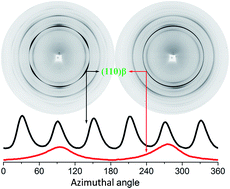
From Fig. 2a, obviously diffraction arcs and isotropic rings are found in oriented and intermediate zone, respectively. Nevertheless, iPP-1.0 shows the similar diffraction arcs in all zones. Of note, molecular orientation is manifested by the diffraction arcs on the patterns; and a decrease in molecular orientation corresponds to the weakening of the arcs into circles.12 Therefore, in order to estimate the molecular orientation in different zones, the azimuthal profiles of the α(040) and β(110)13 reflections are illustrated in Fig. 3.
![]() | ||
| Fig. 3 Traces showing the variation in intensity of the (a) α(040) and (b) β(110) reflections as a function of the azimuthal angle. | ||
Combined with Fig. 2a, it is seen that, for β(110), there are two obvious diffraction peaks and arcs in iPP-0.05 and iPP-0.2, while six peaks and arcs in iPP-1.0. Note that the weak diffraction peaks off the meridian for α(040) is from the strong diffraction of β(110). The two-peak azimuthal profile indicates molecular orientation along the flow direction, while the six-peak azimuthal profile maybe suggests at least two kinds of molecular orientation. As well known, the parent–daughter model, which is usually find in the α-crystal, is a mixed bimodal orientation, and corresponding with the bimodal α(110) reflections (Fig. 2a), i.e., the c-axis of parent lamellae is preferentially oriented to the flow direction, whereas daughter lamellae grow epitaxially on the parent lamellae.9 Therefore, analogous to the definition of parent–daughter model in α-crystal, the reflection peaks in Fig. 3b at ca. 30° and 150° may be originated from the “daughter lamellae” of β-crystal and that at ca. 90° from the “parent lamellae”.3,14 Thus, the fraction of daughter lamellae R and the parent–daughter ratio [R] was estimated.3,9 Compared to the conventional injection moulded iPP-1.0 with a value of 0.75,9 the WAIM iPP-1.0 has the highest [R] (Table 1), suggesting the existence of fewer β-crystal “parent lamellae” and less space for nucleation. That is, the high content of β-NA will lower the free energy barrier, and the growth of “daughter lamellae” in β-crystal confines the growth of “parent lamellae”. However, to our knowledge, the direct daughter lamellae epitaxial growth of parent lamellae for β-crystal has not been observed. But, on one hand, it has been reported that the β-from spherulite grows epitaxially on the β-from crystal;15 on the other hand, the lamellae grow perpendicular to the surface of NAs has been observed, especially for the needle-like NAs.16–18 In our case, the WBG can be self-assemble into various aggregates, such as needle and snowflake-like.10,18 Therefore, the appearance of six-arcs can be related to the epitaxial growth of β-crystal induced by β-NA with various self-assembled aggregates.
Fig. 4 shows the degree of orientation F from α(040) and β(110) reflections at different zones. Generally, F increases as the increasing β-NA content, especially in the oriented zones. But, the highest F with a similar value is found in all zones of iPP-1.0. Accordingly, our results demonstrate that WAIM parts with a high and homogeneous orientation can be achieved in the presence of high content of β-NA.
| This journal is © The Royal Society of Chemistry 2016 |