Manu Joseab,
P. T. Aswathia,
K. Srirama,
Priyadarshini Parakhc,
Halan Prakashc and
Satyajit Shukla*ab
aFunctional Materials Section (FMS), Materials Science and Technology Division (MSTD), CSIR-National Institute for Interdisciplinary Science and Technology (NIIST), Council of Scientific and Industrial Research (CSIR), Thiruvananthapuram 695019, Kerala, India. E-mail: satyajit_shukla@niist.res.in; Fax: +91-471-2491712; Tel: +91-471-2515385
bAcademy of Scientific and Innovative Research (AcSIR), CSIR-NIIST Campus, Thiruvananthapuram 695019, Kerala, India
cDepartment of Chemistry, Birla Institute of Technology and Science (BITS), Pilani, K. K. Birla, Goa Campus NH17B, Zuarinagar, Goa 403 726, India
First published on 16th August 2016
Magnetic nanocomposites (HTNSF) consisting of hydrogen titanate (H2Ti3O7) nanosheets (HTNS) and maghemite (γ-Fe2O3) nanoparticles with varying weight-fraction (5–25 wt%) of the latter have been successfully synthesized by simple mechanical mixing of precursors in an aqueous solution having neutral solution-pH. A new model has been proposed to explain the typical attachment of γ-Fe2O3 nanoparticles to the edges of HTNS via an ion-exchange bond formation. The dye-adsorption properties of HTNSF magnetic nanocomposites have been investigated using the cationic methylene blue (MB) dye as a target pollutant. The new model satisfactorily explains a strong dependence of positive deviation (relative to the variation governed by the law-of-mixture) observed in the variation of dye-adsorption capacity on the similar variation observed in the pore volume of HTNSF magnetic nanocomposite as a function of weight-fraction of γ-Fe2O3 nanoparticles. The maximum MB adsorption capacity of 76 mg g−1 is exhibited by HTNSF-10 sample which is higher than that (67 mg g−1) of HTNS sample. The MB adsorption on the surface of HTNSF magnetic nanocomposite follows the pseudo-second-order kinetics and Langmuir and Dubinin–Kaganer–Radushkevich (DKR) isotherm models. The variation in the regression correlation coefficient (〈r2〉) values as a function of initial MB concentration strongly supports the Azizian analysis. The HTNSF-5 magnetic nanocomposite which contains the lowest weight-fraction (5 wt%) of γ-Fe2O3 nanoparticles shows the effective magnetic separation from the aqueous solution in 5 min. The reuse of HTNSF-5 magnetic nanocomposite has been successfully achieved through its regeneration via activation of persulfate (S2O82−) in an aqueous solution involving the synergy effect in between thermal activation and that by the constituents of HTNSF-5 magnetic nanocomposite.
It appears that there are only few reports available in the literature which have attempted to utilize HTNS for the removal of synthetic-dyes from the aqueous solutions using either adsorption or photocatalysis mechanism.9,10,12 Surprisingly, all of the layered titanate nanosheets utilized for various applications (including the dye-removal) are non-magnetic in nature. No attempt has been made to convert the non-magnetic titanate nanosheets to magnetic nanosheets for any of the aforementioned applications. It is realized that, in the dye-removal application, the magnetic nanocomposites provide ease of solid–liquid separation via the use of an external magnetic field which offer large benefits over the several issues associated with the separation of non-magnetic counterparts.14 In view this, the first major objective of this investigation has been set to synthesize, for the first time, the magnetic nanocomposites (HTNSF) based on the HTNS and maghemite (γ-Fe2O3) nanoparticles via a novel ion-exchange mechanism.15 The second major objective has been set to use this magnetic nanocomposite, for the first time, for the removal of cationic methylene blue (MB) dye from the aqueous solutions via adsorption mechanism and investigate the effect of weight-fraction of γ-Fe2O3 on the variation in the MB adsorption capacity of magnetic nanocomposite. MB dye has been utilized for different industrial applications such as the medical photodynamical therapy, chromoendoscopy, textile industries, analytical chemistry, and sensitizer in the solar energy conversion.16 All these applications, however, generate MB-charged effluents that may have carcinogenic and mutagenic properties towards the aquatic organisms. This is a serious cause of risk to the human life and eco-environment. Hence, the development of novel technology for the effective removal of MB dye from the aqueous solutions is of significance. The third major objective of present investigation has been set to demonstrate, for the first time, the magnetic separation of HTNSF nanocomposite using an external magnetic field followed by its regeneration and reuse via non-light driven synergistic activation of persulfate.16
It is to be noted that in comparison with the conventional dye-removal technologies such as the photocatalysis9 and electro-chemical oxidation,17 the proposed dye-removal technology can be conducted in the dark without the use of any external radiation (such as the UV, solar, visible, and infrared) and power sources (such as the voltage, sonicator, and microwave generator) which suggests considerable cost-saving in the dye-removal process. Moreover, further cost saving is achievable by the successful regeneration of catalyst via the activation of cheaper persulfate than that of costlier H2O2.
The HTNSF magnetic nanocomposites were synthesized in an aqueous solution using the process involving an ion-exchange mechanism operating in between HTNS and magnetic γ-Fe2O3 nanoparticles as described in detail elsewhere for the hydrogen titanate nanotubes (HTN),15 (refer the section-A.2 of ESI†). The as-synthesized magnetic nanocomposites are designated as HTNSF-X where X represents the weight-fraction of γ-Fe2O3 in the magnetic nanocomposite.
![]() | ||
| Fig. 1 TEM images of as-received γ-Fe2O3 nanoparticles at lower (a) and higher (b) magnifications. The corresponding SAED pattern is shown in (c). | ||
The TEM images of HTNS and HTNSF magnetic nanocomposites are presented at lower and higher magnifications in Fig. 2 and S1 (see the ESI†) respectively. The corresponding SAED patterns are shown as insets in the upper-left corners, Fig. 2. The HTNS sample, Fig. 2a and S1a (see the ESI†), clearly shows highly aggregated curled nanosheets having the average thickness of 5 nm. Surprisingly, two diffused concentric rings normally observed in the SAED pattern of hydrogen titanate which are indexed according to either monoclinic H2Ti3O7 or orthorhombic protonic lepidocrocite titanate (HxTi2−x/4□x/4O4, where x ∼ 0.7 and □ is a vacancy),19,20 are not observed in the SAED pattern presented in Fig. 2a. This is also consistent with the previous analysis reported by Hareesh et al.10 The SAED pattern instead consists of large number (>2) of closely spaced concentric rings which suggests the presence of unknown nanocrystalline phase in addition to that of hydrogen titanate phase. Interestingly, the SAED patterns presented in Fig. 2b–d (see the insets in upper-left corners) also contain number of closely spaced concentric rings; however, they resemble that of γ-Fe2O3, Fig. 1c, instead of those of hydrogen titanate. This is a result of the formation of HTNSF magnetic nanocomposites consisting of hydrogen titanate having lower crystallinity and varying weight-fraction of highly crystalline γ-Fe2O3. Due to difference in the crystallinity of two phases, the HTNSF magnetic nanocomposites exhibit SAED pattern corresponding to that of γ-Fe2O3.
As demonstrated in Fig. S1 (see the ESI†), the average thickness of curled aggregated nanosheets is noted to increase from 5 nm to 23 nm with the increasing weight-fraction of γ-Fe2O3 from 0 to 25 wt%. This possibly suggests that spacing between the stacked nanosheets within the aggregates increases with the weight-fraction of γ-Fe2O3 which is reflected in an increase in the average thickness of nanosheets. As demonstrated in the lower-right corner insets of Fig. 2b–d (and also in Fig. S1b–d of ESI†), the magnetic γ-Fe2O3 nanoparticles are typically seen to be attached to the edges of nanosheets rather than on their surfaces. As shown in Fig. S2 (see the ESI†), the nanoparticles are also seen to be attached to the edges of HTNS which do not belong to those of γ-Fe2O3. However, in the latter case, these appear to be quartz (SiO2) nanoparticles as per the EDX spectrum presented in Fig. S3a (see the ESI†). The latter confirms the presence of Si in the HTNS in exceptionally large amount; while, all HTNSF magnetic nanocomposites, Fig. S3b–d (see the ESI†) show the presence of larger amount of Fe relative to that of Si in agreement with the TEM and SAED analyses. This also suggests that the SAED pattern presented in Fig. 2a predominantly belongs to that of SiO2 nanoparticles rather than that of γ-Fe2O3 or hydrogen titanate. Moreover, the intense Si peak as noted in Fig. S3a (see the ESI†) is also possibly contributed by the adsorption of silicate (SiO44−) ions on the surface of HTNS. The attachment of SiO2 nanoparticles to the edges of nanosheets of hydrogen titanate and the presence of SiO44− ions on their surfaces are ascribed to the mechanism of formation of nanosheets during hydrothermal treatment of TiO2-coated flyash particles and the subsequent washing of hydrothermal product as proposed earlier by Hareesh et al.10
The powder XRD patterns of different samples are presented in Fig. S4 and S5 (see the ESI†); while, all identified phases, the diffracting angles and planes, and the corresponding JCPDS card numbers are tabulated in the Table S1 (see the ESI†). It is noted that the as-received flyash particles consists of SiO2, mullite (Al6Si2O13), and hematite (α-Fe2O3) having the weight-fraction of 69, 20, and 11 wt% respectively. The flyash–TiO2 composite particles synthesized via sol–gel process show the successful deposition of anatase-TiO2 on the surface of flyash particles. The product obtained after the hydrothermal treatment of flyash–TiO2 core–shell composite particles exhibits two new broad peaks, which are identified as belonging to either monoclinic H2Ti3O7 (with the interlayer spacing of 0.78 nm within the walls of nanotubes) or orthorhombic lepidocrocite-type or H2Ti2O4(OH)2-type hydrogen titanate structures, similar to the analysis presented earlier for the formation of nanotubes of hydrogen titanate via hydrothermal by Jose et al.20 and others15,21 (note: for further discussion on the mechanism of formation of HTNS, refer the section-H of ESI†). The XRD patterns of HTNSF magnetic nanocomposites show a gradual increase in the intensity of main peak, (311), of γ-Fe2O3 which is in accordance with its increasing weight-fraction in these samples. It is to be noted that the XRD pattern of magnetic nanoparticles is ascribed to that of γ-Fe2O3 as per the JCPDS card number of 39-1346 rather than to magnetite (Fe3O4) which has the XRD pattern almost similar to that of the former. Chen et al.,22 however, demonstrated that the XRD peaks of γ-Fe2O3 are slightly shifted to higher diffraction angles relative to those of Fe3O4. In consonance with this, in the present investigation it is noted that the obtained 2θ values for the magnetic nanoparticles, Table S1,† are slightly larger than those listed in the JCPDS card numbers 19-0629, 75-0033, and 85-1436 for Fe3O4. In contrast to this, these 2θ values are closer to those reported by Barakat et al.23 and also comparable with those listed in the JCPDS card number 39-1346 belonging to γ-Fe2O3. Moreover, the average lattice parameter of 0.8365 nm is calculated which is closer to that (0.835 nm) of γ-Fe2O3 than that (0.840 nm) of Fe3O4 as reported by Chen et al.22 and Cai et al.24 Hence, in this investigation, the structure of as-received magnetic nanoparticle is considered to be γ-Fe2O3.
The N2 adsorption/desorption isotherms obtained using the different samples are presented in Fig. S6a (see the ESI†); while, the corresponding Barrett–Joyner–Halenda (BJH) pore size distribution graphs are shown in Fig. S6b (see the ESI†). The values of specific surface-area and pore volume as obtained for the different samples are tabulated in the Table S2 (see the ESI†). According to the IUPAC classification,25 the as-received flyash particles exhibit close to type I reversible isotherm with the absence of any mesoporosity with the specific surface-area and pore volume as low as 2 m2 g−1 and 0.008 cm3 g−1. The deposition of nanocrystalline anatase-TiO2 via sol–gel method results in a change of the isotherm to type IV which is the characteristic feature of capillary condensation taking place in the mesopores. The flyash–TiO2 composite particles exhibit the specific surface-area and pore volume of 21.5 m2 g−1 and 0.08 cm3 g−1 which are higher almost by 10 times than those of as-received flyash. This is in contrast to the observation made by Shi et al.26 who deposited TiO2 on the surface of flyash via sol–gel method; however, did not observe any significant increase in the specific surface-area and pore volume possibly due to the relatively larger concentration (250 g l−1) of flyash used in their experiments which significantly reduced the amount of TiO2 deposited over each individual flyash particle. In the present investigation, the increased specific surface-area and pore volume after the anatase-TiO2 deposition on the surface of flyash is further supported by the presence of small hysteresis loop which is of type H2 which in turn suggests the presence of ink-bottle type mesopores in the nanocrystalline anatase-TiO2 coating. The HTNS and HTNSF magnetic nanocomposites exhibit the isotherms of type II and the associated hysteresis loop is of type H3 which strongly suggests the presence of aggregates of plate-like particles giving rise to slit-shaped pores. Comparison shows that the shape of isotherms and pore size distribution graphs as obtained for HTNS and HTNSF magnetic nanocomposites are similar to those reported recently for the magnetic nanocomposite consisting of molybdenum disulfide (MoS2) nanosheets decorated with Fe3O4 nanoparticles by Song et al.27 and for the layered protonated titanate nanosheets by Lin et al.6 (note: for further analysis of Fig. S6,† refer the discussion presented in the sections-I and J of ESI†).
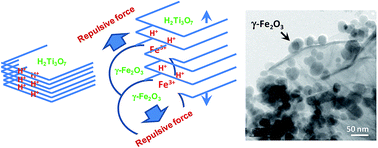
The variation in the specific surface-area and pore volume as a function of weight-fraction of γ-Fe2O3 as obtained for HTNS and HTNSF magnetic nanocomposite samples is shown in Fig. 3. According to Lin et al.,6 the specific surface-area for the layered protonic titanate nanosheets generally lies within the range of 96–350 m2 g−1. The specific surface-area of HTNS (334 m2 g−1), Fig. 3a, is within this reported range (note: the dotted lines are obtained by joining the values of specific surface-area and pore volume of HTNS with those associated with pure γ-Fe2O3 nanoparticles which follow the law-of-mixture of these two phases without any synergy effect in between them). It is clearly seen that the obtained variations in the specific surface-area and pore volume do not follow the law-of-mixture of two phases. The values of both of these parameters exhibit positive deviations from the law-of-mixture as a function of increasing weight-fraction of γ-Fe2O3. This clearly suggests the synergy effect in between HTNS and γ-Fe2O3 nanoparticles which is described in the model presented in the Scheme 1. The latter also explains the ion-exchange mechanism responsible for the formation of HTNSF magnetic nanocomposite. As shown in the Scheme 1a, H+ ions are intercalated in between the H2Ti3O7 nanosheets made up of TiO6 octahedra; while, the as-received γ-Fe2O3 nanoparticles consist of Fe–O bonds on the surface with Fe having the oxidation state of +3. During the formation of HTNSF magnetic composite, the close approach of γ-Fe2O3 nanoparticles towards the aggregated H2Ti3O7 nanosheets results in the ion-exchange reaction in between Fe3+ cations and H+ ions which replaces the intercalated H+ ions with Fe3+ cations. Since Fe3+ cations are already anchored to the surface of γ-Fe2O3 nanoparticles, the ion-exchange reaction results in the formation of ion-exchange bond at the interface of γ-Fe2O3 nanoparticles and aggregated H2Ti3O7 nanosheets. Thus, the magnetic nanocomposite is formed in which the γ-Fe2O3 nanoparticles are attached to the aggregated H2Ti3O7 nanosheets via ion-exchange bond typically at the edges of nanosheets where the ion-exchange reaction is highly likely to occur. This clearly explains the observation made in the TEM images, Fig. 2b–d (see lower-right corner insets) and S1b–d (see the ESI†), where γ-Fe2O3 nanoparticles are seen to be attached to the aggregated H2Ti3O7 nanosheets typically at the edges of nanosheets. In the Scheme 1b, the nanosheets are shown to be highly aggregated for HTNS. However, in the case of HTNSF magnetic nanocomposite, due to the existence of strong repulsive forces between the adjacent γ-Fe2O3 nanoparticles, the nanosheets tend to move apart from each other. This may reduce the aggregation tendency of nanosheets by increasing the average stacking distance in between the nanosheets. It appears that the magnitude of repulsive force increases with the weight-fraction of γ-Fe2O3 nanoparticles within the HTNSF magnetic nanocomposites. As a result, the average stacking distance between the aggregated nanosheets may increase with the weight-fraction of γ-Fe2O3 nanoparticles. This is strongly supported by an increase in the average thickness of aggregated nanosheets from 5 nm to 23 nm with the weight-fraction of γ-Fe2O3 nanoparticles, Fig. S1 (see the ESI†). Moreover, it is noted that an increase in the average stacking distance between the aggregated nanosheets as per the mechanism proposed in the Scheme 1b should also result in an increase in the volume of slit-shaped pores, and hence, in the specific surface-area. This satisfactorily explains the positive deviations in the values of these parameters from the variation governed by the law-of-mixture with the increasing weight-fraction of γ-Fe2O3 nanoparticles as observed in Fig. 3.
![]() | ||
| Fig. 3 Variation in specific surface-area (a) and pore-volume (b) as a function of weight-fraction of γ-Fe2O3 nanoparticles. | ||
![]() | (1) |
30 respectively. Moreover, the maximum MB adsorption capacity value obtained here is also higher than those (30 and 60 mg g−1) reported for the MWCNTs–Fe3O4 and activated carbon (AC)–Fe3O4 magnetic nanocomposites respectively as reported by Ai et al.29 The MB adsorption capacity of CNTs and commercial adsorbent such as the activated carbon is reviewed to be 35–65 and 521 mg g−1.28,30 Thus, the MB adsorption capacity (67 mg g−1) of HTNS as observed in this investigation is comparable with that of CNTs and graphene nanosheets28 but lower than that of activated carbon. This is in agreement with the results obtained using the various carbon-based nanomaterials as sorbents as reported by Beless et al.31 (note: Li et al.,32 however, demonstrated that activated carbon may exhibit lower MB adsorption capacity normalized by BET surface-area compared with that shown by the graphene oxide and CNTs. By using the organic pollutants other than MB, Apul et al.33 and Ersan et al.34 also showed that under certain test conditions granular activated carbon may exhibit lower adsorption capacity relative to that exhibited by other carbon-based adsorbents).
![]() | ||
| Fig. 5 Variation in MB adsorption capacity as a function of weight-fraction of γ-Fe2O3 nanoparticles. The initial solution-pH is 10. | ||
The time dependent MB adsorption on the surface of HTNS and HTNSF magnetic nanocomposites is analyzed using two different kinetics models – Lagergren pseudo-first-order35,36 and pseudo-second-order35,37 (refer the section-N of ESI†). The linear plots (see Fig. S10 of ESI†) with the regression correlation coefficient, 〈r22〉, approximately equal to one and qe values approximately equal to that of experimentally observed values, qe(Exp), (see the Table 1a) suggest that MB adsorption on the surface of HTNS and HTNSF magnetic nanocomposites follows the pseudo-second-order kinetics. In the Table 1b, the values of parameters of pseudo-first-order kinetics model have been tabulated typically for the lower and higher initial MB dye concentrations of 7.5 and 150 μM. It is noted that, for all samples, the lower the initial MB concentration, the lower the 〈r12〉 value and vice versa. As a result, the pseudo-first-order kinetics model which is not applicable for the lower initial MB concentration, becomes applicable at higher value of latter. The comparison with 〈r22〉 values at the initial MB concentrations of 7.5 and 150 μM for all samples, Table 1a, suggests that 〈r22〉 values slightly decrease at higher initial MB concentration. This suggests that the pseudo-second-order kinetics model which is applicable for the lower initial MB concentration, becomes inapplicable at higher value of latter. As demonstrated in Fig. 6, in the present investigation, this transition from the pseudo-second-order to Lagergren pseudo-first-order kinetics for HTNS typically occurs at the initial MB concentration of 150 μM which is highly consistent with the assumptions made in the theoretical derivations of these two kinetics models by Azizian.35
| (a) | |||||
|---|---|---|---|---|---|
| Sample | [MB] μM | qe(Exp.) mg g−1 | qe mg g−1 | k2 g mg−1 min−1 | 〈r22〉 |
| HTNS | 7.5 | 5.8 | 5.81 | 2.12 | 0.999 |
| 60 | 47 | 47.6 | 0.44 | 1 | |
| 90 | 67 | 76.9 | 0.003 | 0.998 | |
| 150 | 64 | 100 | 0.0003 | 0.959 | |
| HTNSF-5 | 7.5 | 5.9 | 5.95 | 0.81 | 1 |
| 60 | 47 | 47.6 | 0.15 | 1 | |
| 90 | 69.8 | 76.9 | 0.005 | 0.999 | |
| 150 | 74.5 | 125 | 0.0002 | 0.973 | |
| HTNSF-10 | 7.5 | 5.9 | 5.95 | — | 1 |
| 60 | 46.7 | 47.6 | 0.023 | 0.999 | |
| 90 | 66.7 | 71.4 | 0.004 | 0.999 | |
| 150 | 75.6 | 91 | 0.0008 | 0.989 | |
| HTNSF-25 | 7.5 | 5.7 | 5.78 | 1.5 | 1 |
| 60 | 46.3 | 47.6 | 0.016 | 0.999 | |
| 90 | 64.4 | 76.9 | 0.0015 | 0.999 | |
| 150 | 68.3 | 111 | 0.0003 | 0.992 | |
| (b) | |||||
|---|---|---|---|---|---|
| Sample | [MB] μM | qe(Exp.) mg g−1 | qe mg g−1 | k1 min−1 | 〈r12〉 |
| HTNS | 7.5 | 5.8 | 1.47 | 0.083 | 0.597 |
| HTNSF-5 | 5.9 | 2.5 | 0.19 | 0.822 | |
| HTNSF-10 | 5.9 | — | — | — | |
| HTNSF-25 | 5.7 | 4.86 | 0.193 | 0.978 | |
| HTNS | 150 | 64 | 79.4 | 0.067 | 0.973 |
| HTNSF-5 | 74.5 | 89.9 | 0.062 | 0.976 | |
| HTNSF-10 | 75.6 | 71 | 0.06 | 0.959 | |
| HTNSF-25 | 68.3 | 69.7 | 0.046 | 0.987 | |
![]() | ||
| Fig. 6 Variation in the 〈r2〉 value as a function of initial MB concentration as obtained for HTNS using the Lagergren pseudo-first-order (i) and pseudo-second-order (ii) kinetics models. | ||
The fitted curves for the equilibrium MB adsorption on the surface of HTNSF-5 magnetic nanocomposite obtained using the Langmuir,15,38 Freundlich,15,39 and Dubinin–Kaganer–Radushkevich (DKR),15,40,41 isotherm models (refer the section-P of ESI† for the theoretical description of these models) are presented in Fig. S11 (refer the sections-Q and R of ESI†). The calculated values of different parameters of these equilibrium isotherm models are listed in the Table 2. The qm values as obtained via Langmuir and DKR models match with the experimentally observed values (qm(Exp)), along with 〈r2〉 values which are close to unity. This strongly suggests a monolayer adsorption of MB on the surface of HTNS and HTNSF magnetic nanocomposites. Moreover, RL values (a dimensionless parameter which is described in the section-P of ESI†) for the MB adsorption on the surface of both HTNS and HTNSF magnetic nanocomposites lies in between 0.004 and 0.17, Table 2, which indicates that the adsorption process is favorable.15 In addition to this, both the negative values of ΔG0 and E values less than 8 kJ mol−1, Table 2, strongly suggest the spontaneous MB adsorption on the surface of HTNS and HTNSF magnetic nanocomposites via electrostatic attraction mechanism.15,41
| Sample | qm(Exp.) mg g−1 | Langmuir | Fruendlich | DKR | |||||||||
|---|---|---|---|---|---|---|---|---|---|---|---|---|---|
| qm mg g−1 | KL l mg−1 | 〈r〉2 | RL | ΔG kJ mol−1 | n | KF mg1−1/n g−1 l1/n | 〈r〉2 | qm mg g−1 | β mol2 J−2 | 〈r〉2 | E kJ mol−1 | ||
| a Note: qm: adsorption capacity; KL: Langmuir constant; RL: separation factor; ΔG: change in Gibb's free energy; n: a constant related to adsorption intensity; KF: Freundlich constant; β: a constant related to adsorption energy; E: adsorption energy. | |||||||||||||
| HTNS | 67.0 | 66.7 | 3.0 | 0.999 | 0.007–0.12 | −37.0 | 1.35 | 57.4 | 0.851 | 69.7 | 6 × 10⁻⁸ | 0.988 | 2.9 |
| HTNSF-5 | 74.5 | 76.9 | 4.3 | 0.999 | 0.004–0.09 | −38.0 | 1.23 | 94.6 | 0.974 | 73.2 | 4 × 10⁻⁸ | 0.991 | 3.5 |
| HTNSF-10 | 75.6 | 83.3 | 2.0 | 0.999 | 0.01–0.17 | −36.0 | 1.36 | 56.9 | 0.856 | 73.3 | 6 × 10⁻⁸ | 0.989 | 2.9 |
| HTNSF-25 | 68.3 | 71.4 | 2.8 | 0.999 | 0.007–0.13 | −37.0 | 1.40 | 55.9 | 0.842 | 70.3 | 6 × 10⁻⁸ | 0.991 | 2.9 |
| Sample | Saturation magnetization (emu g−1) | Remanent magnetization (emu g−1) | Coercive field (Oe) |
|---|---|---|---|
| HTNS-5 | 4.3 | 0.4 | −62.6 |
| HTNSF-10 | 6.7 | 0.64 | −58.2 |
| HTNSF-25 | 29.0 | 2.96 | −57.5 |
| γ-Fe2O3 | 71.0 | 5.9 | −58.7 |
After the magnetic separation of HTNSF magnetic nanocomposite from the treated aqueous solution, in order to reuse the catalyst for the next cycle of dye-adsorption, it is necessary to regenerate the catalyst either by desorption of previously adsorbed-dye or by completely decomposing the adsorbed-dye on the surface of catalyst. Since the first method merely transforms the adsorbed-dye from the solid phase to the liquid phase causing the secondary pollution,43,44 in the present investigation, the second method of catalyst regeneration has been attempted and compared for H2O2 and K2S2O8 activation techniques.12,15,16
The obtained variation in the normalized concentration of MB adsorbed as a function of contact time, at the initial MB concentration of 90 μM, is presented in Fig. 7a for three consecutive cycles of dye-adsorption. It is noted that the amount of MB adsorbed at the equilibrium decreases from 97% to 13% after three consecutive cycles of dye-adsorption which results in the total MB adsorption of 107 mg g−1 on the surface of HTNSF-5 magnetic nanocomposite. The regeneration of catalyst is then attempted using 30 wt% H2O2 solution to decompose MB dye which is adsorbed in the previous three cycles. However, as noted in Fig. 7a, only 8% of MB is adsorbed on the surface of HTNSF-5 magnetic nanocomposite in the fourth dye-adsorption cycle following its regeneration conducted using H2O2 solution. This strongly suggests that the regeneration treatment conducted using H2O2 solution could not decompose the previously adsorbed MB dye on the surface of HTNSF-5 magnetic nanocomposite. Surprisingly, Harsha et al.15 successfully demonstrated that H2O2 can be easily activated using the nanotubes of H2Ti3O7 generating the superoxide radical ions (O2˙−) and hydroxyl radicals (˙OH) which can attack and decompose the surface-adsorbed MB dye.
![]() | (2) |
![]() | (3) |
Zhou et al.12 also reported recently that the delaminated two-dimensional titanate nanosheets are superior non-light driven catalyst for the degradation of organic dyes (RhB) obtained through the generation of superoxide radical-ions via H2O2 activation. It is to be noted that, in the present investigation, the H2Ti3O7 nanosheets are stabilized with SiO44− ions and SiO2 nanoparticles. Hence, there is a strong possibility that the potential sites available on the surface and edges of HTNSF-5 magnetic nanocomposite are already occupied by the foreign species reducing the concentration of surface-adsorbed O2− ions and H2O2. As per the reaction shown in the eqn (3), the adsorption of O2− ions and H2O2 in significant amount on the surface of HTNSF-5 magnetic nanocomposite appears to be an essential requirement in order to generate ˙OH in large amount. This requirement is seriously hampered due to the prior presence of SiO44− ions and SiO2 nanoparticles on the surface and at the edges of HTNS nanosheets. In addition to this, it also appears that the activation of H2O2 via the visible-light induced photo-Fenton reaction45,46 and direct photolysis47 is also not possible in this investigation (for the further discussion, refer the section-T of ESI†).
As an alternative, the regeneration treatment of HTNSF-5 magnetic nanocomposite after the third cycle of MB adsorption is conducted at room temperature (30 °C) by replacing H2O2 solution with K2S2O8 solution. Surprisingly, it is noted that the fourth MB adsorption cycle conducted after the regeneration treatment in K2S2O8 solution results in a drastic increase in the adsorption capacity of HTNSF-5 magnetic nanocomposite from 13% to 90%, Fig. 7a. This successfully demonstrates that the regeneration treatment conducted in the K2S2O8 solution can decompose the previously adsorbed MB dye on the surface of HTNSF-5 magnetic nanocomposite. It is to be noted that persulfate (S2O82−) is a strong oxidizing agent with the redox potential of 2.01 eV. Upon thermal, chemical, or photochemical activation, it is possible to generate sulfate radical-ion (SO4˙−) which are relatively stronger oxidizing species with the redox potential of 2.6 eV.48 Moreover, SO4˙− can further lead to the formation of ˙OH.
![]() | (4) |
| SO4˙− + H2O → SO42− + ˙OH + H+ | (5) |
These SO4˙− and ˙OH can then attack and degrade the surface-adsorbed cationic MB dye. In the present investigation, it appears that the thermal activation of S2O82− has a major contribution in the successful regeneration of HTNSF-5 magnetic nanocomposite.16
As demonstrated in Fig. 7b, the regeneration treatment conducted in K2S2O8 solution at slightly higher temperature (75 °C), after each single cycle of MB adsorption, also maintains the original MB adsorption capacity for the consecutive five adsorption cycles with the reduced time (1 h) required for the regeneration treatment (note: the regeneration time at the room temperature is 3 h). The oxidation of MB (30–70 °C)17 and other organic pollutants in water such as sulfamonomethoxinum (80 °C),48 1,1,1-trichloroethane (20–50 °C),49 and methyl tert-butyl ether (20–50 °C)50 via thermal activation of S2O82− is reported in the literature by others. The findings in these earlier reports suggest that the degradation of organic pollutants via thermal activation of S2O82− is highly temperature dependent. In general, higher temperatures provide more energy to rupture O–O bonds of S2O82− and more readily produce reactive species such as SO4˙− and ˙OH, thereby leading to more rapid degradation of synthetic dyes in water. This is consistent with the results of ˙OH trapping experiments conducted at 30 °C without and with the presence of HTNS-5 magnetic nanocomposite as presented in Fig. 8a and b respectively. Without the presence of latter, Fig. 8a, the concentration of ˙OH produced is noted to increase continuously with the activation time (also see the inset in Fig. 8b). In view of the chemical reaction presented in the eqn (5), this strongly suggests corresponding increase in the concentration of SO4˙− with the activation time via chemical reaction presented in the eqn (4). The inset in Fig. 8b shows that the concentration of ˙OH produced within the first 20 min of activation time is larger in the presence of HTNS-5 magnetic nanocomposite than that produced in the absence of latter. This strongly suggests a positive synergy effect between the thermal activation and that by the constituents of HTNSF-5 magnetic nanocomposite. It appears that in the presence of HTNS-5 magnetic nanocomposite, having relatively smaller amount of γ-Fe2O3 nanoparticles with +3 oxidation state of Fe, the sulfate ions produced via chemical reaction presented in the eqn (5) may react with Fe3+ ions present on the surface of γ-Fe2O3 nanoparticles producing Fe2+ and SO4˙−.48
| Fe3+ + SO42− → Fe2+ + SO4˙− | (6) |
Since the HTNSF-5 nanocomposite can absorb visible-light (see Fig. S13 of ESI†), the O2˙− generated on the surface may also produce SO4˙−.
| O2 + e− → O2˙− | (7) |
| O2˙− + S2O82− → SO4˙− + SO42− + O2 | (8) |
The chemical reactions presented in the eqn (5), (6) and (8) satisfactorily explain the higher concentration of ˙OH observed within the first 20 min of activation time in the presence of HTNSF-5 magnetic nanocomposite. As observed in the inset of Fig. 8b, the concentration of ˙OH produced is noted to decrease and then to increase marginally with further increase in the activation time above 20 min. Such variation in the ˙OH concentration, and possibly that of SO4˙− concentration, is attributed to their consumption by Fe2+ ions51 and O2˙−.
| Fe2+ + ˙OH → Fe3+ + OH− | (9) |
| O2˙− + ˙OH → OH− + O2 | (10) |
| Fe2+ + SO4˙− → Fe3+ + SO42− | (11) |
| O2˙− + SO4˙− → SO42− + O2 | (12) |
Nevertheless, above the activation time of 20 min, the combined concentration of SO4˙− and ˙OH appears to be sufficiently large enough to decompose MB adsorbed on the surface of HTNSF-5 magnetic nanocomposite, Fig. 7a. The comparison of Fig. 8a and b, thus, reflect a strong synergy effect in between the thermal activation and that by the constituents of HTNSF-5 magnetic nanocomposite in the generation of SO4˙− and ˙OH. Overall, the magnetic separation of HTNSF-5 magnetic nanocomposite followed by its regeneration and reuse via synergistic activation of S2O82− are successfully achieved in this investigation.
Footnote |
| † Electronic supplementary information (ESI) available. See DOI: 10.1039/c6ra14902b |
| This journal is © The Royal Society of Chemistry 2016 |