
Hui Xianga,
Bo Xu*a,
Yidong Xiaa,
Jiang Yin*ab and
Zhiguo Liuab
aNational Laboratory of Solid State Microstructures, Department of Materials Science and Engineering, Nanjing University, Nanjing, 210093, China. E-mail: xubonju@gmail.com; jyin@nju.edu.cn
bCollaborative Innovation Center of Advanced Microstructures, Nanjing University, Nanjing, 210093, China
First published on 9th September 2016
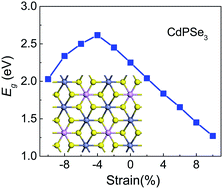
By density functional theory calculations, we systematically investigate the strain effect on electronic structures of MPX3 (M = Zn, Cd; X = S, Se) monolayers. An indirect–direct band gap transition occurs under compressive strains in ZnPS3, ZnPSe3, and CdPSe3, but CdPS3 always remains in an indirect band gap phase. The band gaps of MPX3 monolayers increase firstly and then decrease under compressive strain, while they only decrease in the case of tensile strain. In addition, we find that MPX3 monolayers are perfect substitutes for the unachievable two-dimensional MX (M = Zn, Cd; X = S, Se), due to their quite comparable electronic structures, such as their band gaps and effective masses. This indicates that MPX3 monolayers should be promising candidates in optoelectronic applications for tunable electronic structures by strain engineering.
Group-IIB chalcogenides MX (M = Zn, Cd; X = S, Se, Te), with wurtzite and zinc-blende structures, have been extensively investigated for their broad applications in electronic, photonic, and optoelectronic devices, due to their large range of band gaps (2.0–3.9 eV).14–17 With the technology revolution, heterostructures composed from these compounds, including core/shell quantum dots,18 nanocrystals,19 nanowires,20 nanoribbons21 and nanobelts,22 have been studied as functional parts in UV-light sensors, photocatalysts and photovoltaic devices. The 2D MX nanostructures have also attracted considerable attention; however, only a few theoretical calculations have reported the mono-atomic-layer graphene-like MX,23,24 which mainly attributes to the unavailability of MX monolayers in ambient conditions. Therefore, to develop stable and high performance 2D heterostructures for a wide range of wavelengths, it is important to find a family of compounds to substitute for these MX monolayers.
Since layered transition metal phosphorus trichalcogenides MPX3 were synthesized by Hahn and Klingen in 1965,25 they have been extensively studied for particular electronic, optoelectronic and magnetic properties.26–30 In recent years, attention has mostly focused on exploring the properties of atomically thin MPX3.31–35 For example, Liu et al.32 studied theoretical electronic structures of MPX3 (M = Zn, Cd, Mg; X = S, Se) monolayers, and predicted their potential for photocatalytic water splitting. Du et al.35 successfully fabricated single layered MPS3 (M = Fe, Mn, Ni, Cd and Zn) by micromechanical exfoliation, and demonstrated the stability of these compounds by cleavage energy calculations. The electronic structures of MPX3 monolayers are quite similar to those of bulk MX structures, implying that they could substitute for 2D MX monolayers. Of particular interest to us are the 2D group-IIB MPX3 (M = Zn, Cd; X = S, Se) monolayers, which have shown significant advantages in optoelectronics due to their wide range of band gaps (2.2–3.5 eV), and thus they could be considered as the optimal candidates for the building of 2D MPX3-based heterostructures.
As electronic structures around the Fermi level are highly sensitive to orbit coupling and interactions with neighboring atoms, strain engineering is an effective method for tuning electronic structures, especially in 2D materials, due to their extraordinary break strength and structural stability.36–39 For example, it has been previously indicated that strain can open up a band gap in graphene,40 and local strain on NbS2 and NbSe2 can induce a ferromagnetic characteristic.41 Moreover, for semiconducting devices, 2D materials are often supported on substrates, which could lead to a lattice mismatch and consequently result in an external strain.42 However, there is scarcely any research about the strain effect on the electronic structures of MPX3 monolayers. Therefore, by first principle calculations, we mainly focus on the tunable electronic structures of MPX3 (M = Zn, Cd; X = S, Se) monolayers produced by strain engineering.
3.28,30 Reducing the film thickness of either MPS3 or MPSe3 from bulk to a monolayer, results in the same M2P2X6 unit cell, as shown in Fig. 1. For each intralayer of MPX3, there are two layers of chalcogen atoms, between which are located octahedrally coordinated transition metal atoms and phosphorus pairs. A hexagonal unit cell was used for all calculations, as marked in Fig. 1. Before studying the electronic structures, we optimized the structures by DFT calculations. The optimized geometries, including the lattice constants, monolayer chalcogenide heights, and the nearest atomic distances of M–X, M–P, and P–P, are summarized in Table 1. The detailed crystal structures including lattice vectors and atomic coordinates are shown in Table S1 of the ESI.† It is obvious that the parameters of MPSe3 are larger than those of MPS3, and that the parameters of CdPX3 are larger than those of ZnPX3, differences which can be attributed to the various elements. Moreover, the results are consistent with the previous calculations by Liu et al.32 but slightly larger than those of bulks obtained by experiments or calculations.
![]() | ||
| Fig. 1 The top view (a) and side view (b) of monolayer MPX3, where the gray, yellow and purple balls represent the M (Zn or Cd), X (S or Se) and P atoms, respectively. | ||
Next, we studied detailed band structures for unstrained MPX3 (M = Zn, Cd; X = S, Se) monolayers. The exchange–correlation functional by GGA typically underestimates band gaps. Hybrid functionals, such as HSE06, which contain part of the exact Hartree–Fock exchange, generally tend to be more accurate. Thus we employed the HSE06 functional to obtain the band structures, and we also give the results by PBE for comparison. Fig. 2 shows the band structures calculated with both the HSE06 and PBE functionals. It is clear that the valence band maximum (VBM) is at the K point and the conduction band minimum (CBM) is located at the Γ point, indicating indirect band gaps for MPX3 monolayers. The family of MPX3 (M = Zn, Cd; X = S, Se) monolayers exhibits a large range of band gaps from 2.24 to 3.30 eV by HSE06, which is greater than that obtained by PBE (1.29–2.13 eV). The values of the band gaps are listed in Table 2, and are in good agreement with the previous calculations and the experimental results for the bulk compounds.29,32,35,48 Moreover, the band gaps of wurtzite MX structures were calculated with HSE06 and are shown in Table 2 together with the theoretical and experimental values obtained in previous reports.17,49–53 When the results of MPX3 monolayers and MX are compared, it can be seen that the band gaps of ZnPS3 (ZnPSe3) and the corresponding ZnS (ZnSe) are quite similar, but that the value of CdPS3 (CdPSe3) is a bit larger than that of CdS (CdSe).
![]() | ||
| Fig. 2 Band structures of (a) ZnPS3, (b) ZnPSe3, (c) CdPS3, and (d) CdPSe3. The red and black lines represent the HSE06 and PBE functionals, respectively. The Fermi level is set to zero. | ||
| Materials | EHSEg (eV) | EPBEg (eV) | Eg (bulk in experiment) (eV) |
|---|---|---|---|
| a Liu et al.32b Du et al.35c Brec et al.48d Calareso et al.29e Yadav et al.52f Fang et al.17g Zhang et al.50h Schröer et al.53i Hayashi et al.49j Kale and Lokhande.51 | |||
| ZnPS3 | 3.30 (3.30a) | 2.13 (2.14a) | 3.5b, 3.4c |
| ZnPSe3 | 2.32 (2.31a) | 1.31 (1.32a) | |
| CdPS3 | 3.03 (3.03a) | 1.92 (1.93a) | 3.4b, 3.3c, 3.06d |
| CdPSe3 | 2.24 (2.25a) | 1.29 (1.29a) | 2.29d |
| ZnS | 3.29 | 2.14e | 3.77f |
| ZnSe | 2.42 | 1.20e | 2.67g |
| CdS | 2.19 | 1.3 (LDA)h | 2.42i |
| CdSe | 1.57 | 0.6 (LDA)h | 1.7j |
Subsequently, we considered the partial density of states (PDOS) of MPX3 monolayers including the s, p, and d orbitals of Zn (Cd), S (Se) and P atoms, and compared them to those of the corresponding MX (Fig. 3). As expected, the PDOS near the VBM and CBM of MPX3 is very close to that of the corresponding MX. The VBM is mainly dominated by p orbitals of the S or Se atoms, and the CBM is mainly comprised of the s orbital of the Zn or Cd atoms, but the P atoms do not contribute to the CBM or VBM. Therefore, MPX3 monolayers would have potential for optoelectronic devices, due to their comparable and wide range of band gaps.
We also examined the effective masses of electrons and holes of MPX3 monolayers. The effective masses of electrons
and holes
is calculated by
, where ℏ is the reduced Planck constant, and
can be obtained by parabolic fitting near the VBM or CBM.54,55 Table 3 summarizes the variations of effective masses of electrons and holes for MPX3 monolayers in different directions. Small effective masses of electrons remain in all MPX3 compounds, with 0.29, 0.18, 0.29 and 0.21me for ZnPS3, ZnPSe3, CdPS3 and CdPSe3, respectively, which are nearly half of the hole effective masses, implying n-type semiconductors. Moreover, in order to compare carrier transport properties, the effective masses of the corresponding MX-wurtzite structure and single layered group-VIB dichalcogenides are listed as well.50,56,57 It is obvious that the effective masses of MPX3 are very close to those of the corresponding MX, whereas they are much smaller than those of MoS2 and WS2. As effective masses of carriers generally indicate carrier transport, the smaller
in MPX3 provide a meaningful insight into the carrier transport performance of these materials in optoelectronic devices.
and holes
for the unstrained MPX3 (M = Zn, Cd; X = S, Se) monolayers stated in units of the electron rest mass (m0). Effective masses of the wurtzite MX, 2H-MoS2 and WS2 are also summarized
| ZnPS3 | ZnPSe3 | CdPS3 | CdPSe3 | ZnSa | ZnSeb | CdSa | CdSeb | MoS2c | WS2c | |
|---|---|---|---|---|---|---|---|---|---|---|
a Lippens and Lannoo.56b Zhang et al.50c Wickramaratne et al.57 The values of 0.30/0.29 (ZnPS3) mean along Γ–K and Γ–M directions, respectively, and values of 0.51/0.60 (ZnPS3) mean along K–Γ and K–M directions, respectively. |
||||||||||
![]() |
0.30/0.29 | 0.19/0.18 | 0.30/0.29 | 0.22/0.21 | 0.42 | 0.16 | 0.18 | 0.11 | 0.50 | 0.35 |
![]() |
0.51/0.60 | 0.44/0.47 | 0.61/0.79 | 0.51/0.62 | 0.61 | 0.58 | 0.53 | 0.44 | 0.54 | 0.34 |
Based on the above comparisons, it is clear that the electronic structures of MPX3 monolayers are quite comparable with those of MX structures, with both having a wide range of band gaps, similar contributions to the VBM by X-p orbitals and to the CBM by M-s orbitals, and similar electron effective masses, which can be explained by the limited contribution of P atoms to the VBM and CBM. These results suggest that MPX3 monolayers could be the perfect candidates to substitute for the unachievable MX monolayers and to provide further potential in optoelectronic applications.
It is well known that the manipulation of band structures can enhance the performance of electronic and optoelectronic devices, for their remarkable modulation of phase transitions, band gaps and so on.40,58 Therefore, we studied strain effects on the electronic characteristics of MPX3 monolayers. Calculations of electronic properties for the strained MPX3 monolayers were carried out, starting with the relaxed structures. Fig. 4 shows the evolution of band structures calculated by HSE06 under biaxial compressive and tensile strains from −10% to 10%. It is clear that all MPX3 compounds are semiconductors with large tunable band structures under the strain. An indirect–direct band gap transition occurs under compressive strains for ZnPS3, ZnPSe3, and CdPSe3, but CdPS3 always remains in an indirect band gap phase. In the case of tensile strain for the above four compounds, the VBM is located at the K point and the CBM is located at the Γ point, so a phase transition does not exist.
To precisely investigate the strain effect on the band gaps, we plotted the band gaps from the VB to the CB, including Γ → Γ, K → K, K → Γ, and Γ → K, as shown in Fig. 5. The plots are divided into three regions to distinguish the distinct band gaps under the applied strains. It is noted that band gaps increase initially and then decrease under compressive strain, while they decrease steadily in the case of tensile strain. The band gap maxima are at about 3.67 eV, 2.54 eV, 3.50 eV and 2.60 eV for ZnPS3, ZnPSe3, CdPS3 and CdPSe3, respectively. These values are about 12 percent larger than those of the unstrained states, and located at the boundary of the indirect (I) and direct (II) states for ZnPS3, ZnPSe3 and CdPSe3. The transition from the indirect (I) to direct (II) band gap occurs when the monolayers suffer strains of about −4%, −2% and −4% for ZnPS3, ZnPSe3 and CdPSe3, respectively. With an increase in compression, ZnPSe3 and CdPSe3 revert back to indirect (III) states when the compressive strength exceeds the value of −8%. The origin of the indirect–direct transitions is mainly the orbit coupling and interactions with neighboring atoms, due to the changes in the lattice parameters and the atomic coordinates under the strain. In order to visually analyze the contribution of the CBM, we compare the spatial distributions of wave functions of CdPSe3 in the unstrained and strained (−8%) state in Fig. S1 (ESI†). It is obvious that the CBM is mainly comprised of the s orbital of the Cd atom in Fig. S1(a)† and the p orbital of the Se atom in Fig. S1(b),† which can be attributed to the increase of the monolayer chalcogenide heights and the decrease of the nearest atomic distances of Cd–Cd under the compressive strain. Therefore, the CBM of MPX3 monolayers is determined by the competition between the p orbitals of X atoms and the s orbital of M atoms.
In addition, we depict the evolution of the band structures and the change of band gaps calculated by the PBE functional (in Fig. S2 and S3 of the ESI†). Despite the underestimated band gaps by PBE, the general trends of the strain effects on the band structures are consistent with those obtained by HSE06. Therefore, strain has remarkable effects on the modulation of the band structures of MPX3 compounds, which suggests their potential applications in the design of novel MPX3-based 2D heterostructures in photodetectors, as well as photocatalysts, solar cells and hydrogen storage, due to the fact that they offer tunable band gaps over a large range.
Footnote |
| † Electronic supplementary information (ESI) available. See DOI: 10.1039/c6ra14101c |
| This journal is © The Royal Society of Chemistry 2016 |