
A.
Tavana
* and
M. R.
Sahmani
Department of Physics, University of Mohaghegh Ardabili, Ardabil, Iran. E-mail: tavana@uma.ac.ir
First published on 25th July 2016
We have calculated the electronic structure and optical properties of gallium-selenide (GaSe) layered semiconductor in the β-structural phase based on the Tran–Blaha modified Becke–Johnson (TB-mBJ) approximation. Because of the spatial separation of the valence band maxima (VBM) and conduction band minima (CBM) electronic states, using the TB-mBJ approximation, the calculated gap considerably improves and becomes comparable to the experimental values. We have also calculated the electronic structure and optical properties of the single-layer GaSe structure and a two nanometer GaSe particle. The quantum confinement effect can be clearly observed from the enhanced obtained gap of the restricted structures. The optical refraction index and absorbance are in close agreement with the experiment, though these properties are calculated within the random phase approximation (RPA). Our calculation shows the ability of TB-mBJ and RPA in producing the optical properties of this semiconductor family in bulk and nano-size structures.
![]() | ||
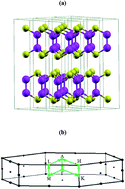
| Fig. 1 Crystal structure of GaSe in the β-phase (a) and the corresponding Brillouin zone, with high-symmetry k-points k-paths (b). | ||
Calculation of the energy band gap of semiconductor materials has always been a major challenge of density functional theory (DFT). Conventional exchange–correlation functionals, i.e. the local density approximation (LDA) and various parameterizations of the generalized gradient approximation (GGA), usually fail to estimate the experimentally observed energy band gaps, with a reasonable accuracy. Also, the optimized effective potential (OEP) approaches fail to give a reasonable band gap for many semiconductors despite they are usually computationally expensive.7 The methods based on the many body Green's function, e.g. the GW method, is the most promising computationally available approach to the band gap problem of semiconductors. But its applicability is mostly restricted because of the computational resources it demands. Another choice is to use the hybrid exchange–correlation functionals method that is based on the adiabatic connection approach.8 In this method, the exchange part of LDA or GGA functionals, which is a parameterized approximation of the real exchange energy, is replaced by the exact exchange energy from the Hartree–Fock method, partly or completely.9 This approach is more efficient than OEP and GW methods, however, like every other approximate methods, doesn't work for every semiconductor material, perfectly.
Besides, there is an alternative low-cost and effective method for calculating the energy band gap of semiconductors, i.e. using the Becke–Johnson (BJ) potential.10 In this method an isotropic correction term is added to the GGA or LDA exchange–correlation potential:
![]() | (1) |
is the density of kinetic energy, and vBRx,σ(
) is the Becke–Roussel (BR) exchange potential which models the Coulomb potential of the Fermi hole.11 BJ potential usually increases the energy difference between the valence band maxima (VBM) and conduction band minima (CBM) in comparison to the LDA or the GGA functionals, hence enhancing the calculated energy gap of the semiconductors. Tran and Blaha modified the BJ potential, i.e. the Tran–Blaha modified BJ (TB-mBJ) potential, by introducing a new factor C, which determines the relative weight of the BR term and the kinetic energy density term.12 For C = 1 the original BJ potential is retained. For every system the relevant value for the parameter C can be determined from the electronic charge density,12 as it will be explained below. Introducing a new parameter e, Koller et al. suggested three different parameters sets {A, B, e}, each one suitable for a special class of materials.13 For example, there is a special parameter set for small-gap semiconductors which can make the calculated gap even closer to the experimental value in comparison with the calculations based on the Tran–Blaha parameterizations, with e = 1 and permanent A and B values. In this formalism, the parameter C is calculated from:![]() | (2) |
This modification leads to very satisfactory band gap values for small to large gap semiconductors and insulators, with a computational cost comparable to ordinary LDA or GGA calculations. The obtained band gaps based on the TB-mBJ potential are typically within ten percent of the experimentally measured values, the accuracy which is comparable with the accuracy of the GW and the hybrid Heyd–Scuseria–Ernzerhof (HSE) methods.12
Having a better band structure in hand, ab initio study of various physical properties, e.g. the optical properties, can be more accurate, especially investigating the confinement effects. In addition to finding a better energy gap value for semiconductor systems, it is also important to investigate why a special method is improving the results. This usually helps to clarify the underlying electronic properties and the extent of the electron–electron interactions.
So, the TB-mBJ method is a novel electronic structure calculation approach which its applicability and precision in the band structure calculation of different materials is still under investigation. In this paper we investigate the electronic structure and optical properties of the β-GaSe semiconductor, which is an important optical material, based on the density functional theory using the TB-mBJ potential, for the first time. Based on the results, it is found out that in addition to the better estimation of the energy band gaps, TB-mBJ method has qualitatively different results in comparison to the GGA calculations for the GaSe system, when one investigates the detailed properties of the band structure near the band gap. Also, we study the infinite and nano-sized single-layer GaSe structure. Comparison of the calculated optical properties with the experimental measurements indicates that TB-mBJ in association with the RPA, are noticeably capable to predict the electronic and optical properties of these semiconductor structures.
The initial lattice parameters for the calculation have been taken from experiment2 and then the structure is relaxed. During the volume relaxation process the ratios of c/a and b/a have been kept constant. The equilibrium values obtained for lattice parameters a and c are equal to 3.83 and 16.30 Å, respectively. After relaxing the volume, the c/a ratio is also relaxed which gives a slightly larger value in comparison to experimental values. This stretch perpendicular to the GaSe planes shows the effect of the van der Waals interactions which have not been taken into account. While the impact of this stretch on the total energy of the system and on the band structure is in the order of 1 meV, we ignore it and the calculations continued with the experimental c/a. In this paper, we will also investigate the single-layer GaSe. From the single-layer GaSe, we mean an almost two dimensional structure built from two Ga and two Se layers, i.e. only one of the two bi-layer components of the β-GaSe structure depicted in Fig. 1.
In the calculations of the dielectric function, the RPA has been used as its details are described in ref. 16. Also, much denser k-mesh has been considered for the Brillouin zone integrations, to obtain a converged dielectric function. Finally, in order to study the effect of quantum confinement in the geometrically restricted structures, we have used the supercell method. A more fundamental approach is the Green's function method which directly takes into the account the finite size perturbation of the crystal potential. Investigations however shows whenever comparisons had been possible, the two methods have had similar accuracies.
![]() | ||
| Fig. 2 Calculated band structure of the bulk β-GaSe using PBE-GGA (a) and TB-mBJ (b) and single-layer GaSe using PBE (c) and TB-mBJ (d) approximations. In (a) atomic orbital contributions to different energy bands are indicated. The high-symmetry k-paths are according to Fig. 1(b). | ||
From Fig. 2(a), it is apparent that the s states of the gallium atoms, which are partially hybridized with the p states of the selenium ions, are situated well below the Fermi level, i.e. approximately from −3.2 to −7.4 eV relative to the Fermi level. px and py states of the selenium atoms are also at least 2 eV below the Fermi energy. The manifold of the selenium pz states are located just below the Fermi level. These states are slightly hybridized with the s states of the Ga ions and constitute the valence band maxima of the system. The conduction band minima are mainly constituted by the selenium p states and gallium s states. Comparison of the PBE-GGA, Fig. 2(a) and (c), and the TB-mBJ, Fig. 2(b) and (d), band structures, shows that the obtained electronic bands are slightly narrower by the TB-mBJ approach. In addition, there is an upward shift of the conduction bands and a downward shift of the valence bands in the TB-mBJ calculations, resulting in a wider band gap. The reason is the better, i.e. the larger, estimation of the exchange–correlation energy of the p states of the selenium and s states of the gallium atoms, in the TB-mBJ in comparison with the PBE-GGA approximation.
In Fig. 2(c) and (d) the energy band diagrams of a single-layer GaSe structure are depicted in PBE-GGA and TB-mBJ approximations, respectively, and the corresponding band gaps are equal to 1.726 and 2.780 eV. In the single-layer GaSe, the inter-layer interactions are absent and the structure is confined along the lattice c direction. If the electronic structure of the bulk GaSe was purely two-dimensional then minor difference in the energy band gaps of the bulk and single-layer GaSe was expected. However, the calculated energy gaps for the single-layer GaSe has been considerably, i.e. 1 eV, increased relative to the bulk GaSe. This shows, the strength of the inter-layer coupling between the two GaSe layers, e.g. the van der Waals-type interactions, in this material. So, including the van der Waals interactions in the calculations may improve the band gap obtained for the bulk structure.
A fine feature in the band structure of the single-layer GaSe is that in the PBE-GGA calculations, the maximum of the valence band is notably displaced from the Γ-point while the conduction band maximum is, similar to the bulk system calculations, located at the Γ-point. So, based on the PBE-GGA calculations, the single-layer GaSe is an indirect band gap semiconductor. However, using TB-mBJ for the single-layer structure, moves the valence band maximum back to the Γ-point and again a direct band gap semiconductor is obtained. Care has been taken to make sure the difference in the PBE-GGA and the TB-mBJ results is not an artifact developed from non-converged calculations. Comparison between Fig. 2(b) and (d), also indicates that the effective mass of the hole carriers in the single-layer GaSe is much larger than the bulk β-GaSe. From Fig. 2(d), it is clear that at the Γ-point, the valence band is almost flat and the effective mass of the hole carries diverge.
In order to investigate how the TB-mBJ approximation improves the band gap estimations, the spatial representation of the additive TB-mBJ potential term is plotted in Fig. 3(a). Also, the electron charge density corresponding to the manifold of VBM and the CBM bands of the bulk β-GaSe are shown in Fig. 3(b) and (c), respectively. According to this figure, in the regions where the valence electron density is high, the TB-mBJ potential is negative which pushes the valence electronic bands toward lower energies. Conversely, in the regions where the density of conduction electrons is high, the TB-mBJ potential is positive. This causes the conduction electronic bands to shift toward higher energy values. Therefore, the resulting energy band gap becomes wider in comparison with the PBE-GGA band gap. Results indicate that there is an overestimation of the exchange–correlation energy of the Se-pz states and an underestimation of the Ga-s and Se-px,y states, in the PBE-GGA calculations which are improved in the TB-mBJ calculations.
![]() | ||
| Fig. 3 Spatial representation of the difference between the PBE-GGA and TB-mBJ exchange–correlation energies, in Ry/a.u.3 (a), electron charge density of the valance band maxima, in e/a.u.3 (b) and the conduction band minima, in e/a.u.3 (c), in a plane perpendicular to lattice vector c. | ||
. In materials with symmetric dielectric tensor, e.g. crystals with hexagonal lattice symmetry, each diagonal element of the diagonalized tensor can be directly calculated from the electronic structure of the material in the corresponding orientation. In ab initio calculations, a better estimation of the electronic band structure improves the estimation of the calculated dielectric functions. Although, DFT is a ground state theory but it is claimed that the Kohn–Sham eigenstates, calculated for weakly correlated electron systems are in very close correspondence with the excited states obtained from the many body calculations.18,19 It should be noticed that there is a DFT analog to the Koopmans' theorem that makes the interpretation of the Kohn–Sham eigenstates as the excited states of the electronic system, more sensible.20 In this paper, we use the RPA to calculate the dielectric tensor of the GaSe material. In the RPA, the electron–hole interaction is ignored, however, this approximation still works excellent for the materials with long range interactions. For semiconducting materials it gives satisfactory results in most of cases. The resulting dielectric function based on the RPA is called the Lindhard function which is able to describe many physical properties of the system, e.g. the plasmons.
In Fig. 4, the calculated real and imaginary parts of the two independent elements of the dielectric tensor for both the bulk and the single-layer of GaSe are plotted as a function of energy, based on the PBE-GGA and TB-mBJ approximations. For bulk and single-layer structures, the real part of the xx element of the dielectric tensors, i.e.εxx1(ω), are negative in energy range of 5.18 to 6.76 eV and 5.51 to 6.76 eV, respectively. This is in very good agreement with the results of the ellipsometry experiments for the bulk structure.21–24 So, in the corresponding polarizations, GaSe can be used as an electromagnetic shield, which is in ultraviolet region. The real part of the static dielectric constant of the bulk and the single-layer structures are respectively equal to 8.4 and 4.7 with the PBE-GGA and 6.4 and 3.6 with the TB-mBJ approaches. The difference is due to lower estimation of band gap in the PBE-GGA relative to the TB-mBJ. This also causes a right shift of the TB-mBJ dielectric functions in the range of 4 to 8 eV on the energy axis. This shift becomes smaller for higher frequencies. The minor difference between the calculated results and the experiments,25 partly originates from ignoring the excitonic effects and the local fields. Based on the results of TB-mBJ calculations, the quantum confinement effect in the single-layer structure, causes a 0.7 eV difference in the calculated absorption edge, relative to the bulk structure.
From the calculated dielectric functions, the refraction and the extinction coefficients and the optical conductance of the β-GaSe and the single-layer GaSe have been extracted and depicted in Fig. 5. As expected, the calculated functions based on the TB-mBJ method, have very good quantitative agreement with the experimentally obtained values.21 The peaks of the optical refraction functions and the starting edge of the extinction functions generally have less than 5% difference with the experimental measurements.21 In Fig. 5, also the optical conductance of the β-GaSe and the single-layer GaSe in the TB-mBJ approximation, is plotted. From the figure, the real part of the optical conductance for the transverse polarization of the incident light, Re[σzz], has the maximum value at 6.21 and 6.63 eV, respectively for the bulk and single-layer structures. Also, for the longitudinally polarized incident light, Re[σxx] has maximums at 5.02 and 5.10 eV, respectively for the bulk and single-layer structures. The imaginary parts of the optical conductance function of the bulk and single-layer structures for the transverse polarization, Im[σzz], reach their minimum values at 3.69 and 3.90 eV, respectively. For the longitudinal polarization, Im[σxx] has minima respectively at 4.67 and 4.91 eV.
In Fig. 6, the electron energy loss spectrum (EELS), L(ω), of the bulk GaSe is depicted as a function of energy. The peaks in the EELS diagrams correspond to the plasmonic oscillations frequencies. From the figure the peaks of the Lxx(ω) occurs at 6.73 and 12.78 eV and the peaks of Lzz(ω) occurs at 5.23 and 11.88 eV. The EELS of the single-layer GaSe is generally similar to the bulk EELS except for a 1.7 eV right shift in the energy axis, as expected.
We have also calculated the absorbance of a two-nanometer size GaSe single-layer particle. The longitudinal and transverse absorbance functions are depicted in Fig. 7. For this particle, we haven't performed structure relaxation and we have just assumed that it has a hexagonal shape, based on the TEM images.26 There are, 126 Ga and Se atoms in this nano-particle, in total. Despite the mentioned simplifications, comparison of the calculated absorbance spectra with the experiment26 indicated very noticeable agreement. These all show that DFT in the TB-mBJ approximation is suitably capable to reproduce the electronic structure and optical properties of GaSe semiconductor structures within RPA approach. It is also expected that the mentioned approach work well for similar semiconductor structures.
![]() | ||
| Fig. 7 Absorbance spectra of the two-nanometer size GaSe particle in the TB-mBJ approximation. Inset is the corresponding supercell structure. | ||
| This journal is © The Royal Society of Chemistry 2016 |