A catalyst-free approach to 3-thiocyanato-4H-chromen-4-ones

Xiao-Zhuan Zhang, Dao-Liang Ge, Shan-Yong Chen* and Xiao-Qi Yu*
Key Laboratory of Green Chemistry and Technology, Ministry of Education, College of Chemistry, Sichuan University, Chengdu, 610064, P. R. China. E-mail: chensy@scu.edu.cn; xqyu@scu.edu.cn; Fax: +86-28-85415886; Tel: +86-28-85415886

Received 23rd May 2016 , Accepted 5th July 2016

First published on 6th July 2016


Abstract

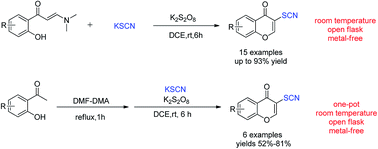
A facile and efficient approach to 3-thiocyanato-4H-chromen-4-ones was realized at room temperature. In the presence of KSCN and K2S2O8, various enaminones underwent thiocyanation and cyclization, affording 3-thiocyanatochromenones in good yields. In addition, one-pot synthesis of 3-thiocyanatochromenones from 2-hydroxylacetophenones was also developed.

Introduction

Aryl thiocyanates are versatile intermediates for various sulfur-containing derivatives such as sulfides, thiocarbamates and related heterocyclic compounds.1 Aryl thiocyanates can be prepared via two classic methods. One is the direct electrophilic thiocyanation of electron-rich arenes2 and another is the coupling of diazonium salt with metal thiocyanates under Sandmeyer-type conditons.3 Metal-catalyzed coupling reaction of aryl halide or analogue with thiocyanate salt has been developed recently, which is a good complement to the traditional methods.4 In these reported approaches, preformed or prefunctionalized aromatic rings are needed. From the point of view of atom- and step-economy, a tandem thiocyanation/cyclization reaction, where the heterocyclic is constructed at the same time, is highly desirable.

Chromones and their derivatives exit widely in natural products and have been identified with a variety of biologicalactivities.5 Therefore, the synthesis of chromone derivatives has been studied extensively.6 For example, sulfenylation with TsNHNH2, TsCl or TsNa,6a–c regioselective oxidative amination with azoles,5c trifluoromethylthiolation6e were reported recently. However, the synthesis of thiocyanatochromenones is overlooked. It is well-known that functional groups affect biological activity, thus the combination of thiocyanates with chromones may generate new biologically active compounds. Nevertheless, we found the reported methods2a,d such as I2/KSCN, K2S2O8/KSCN at elevated temperature were invalid for the thiocyanation of chromones, indicating that the thiocyanation of chromones is more difficult than we imagined. We hypothesized that dimethyl amino group in enaminones can serve as an activation group, which could facilitate the thiocyanation, and act as a leaving group for cyclization. Herein, we report a facile, efficient, and metal-free method to synthesize 3-thiocyanato-4H-chromen-4-one with simple and readily available KSCN as the sulfur source under mild conditions.

Results and discussion

Firstly, (E)-3-(dimethylamino)-1-(2-hydroxyphenyl)prop-2-en-1-one (1a) and KSCN were used to test our hypothesis. In the presence of K2S2O8, the reaction did undergo as we expected, affording the product in 70% yield (Table 1, entry 1). After optimization of the amounts of KSCN and K2S2O8, an increased yield (85%) was obtained by stirring the mixture in DCE at room temperature for 6 h. When DCE was replaced by other solvents, the reactions gave lower yields (entries 5–13). Notably, we found that a decreased yield was obtained when the reaction was conducted under an argon atmosphere (entry 14 vs. entry 4). Therefore, the optimal reaction conditions are following: 1a (0.4 mmol), K2S2O8 (2 equiv.), KSCN (3 equiv.), DCE (2 mL); stirring under air atmosphere at room temperature for 6 h.
Table 1 Optimization of reaction conditionsa

image file: c6ra13303g-u1.tif

Entry KSCN (equiv.) K2S2O8 (equiv.) Solvent Yieldb (%)
a Reaction conditions: 1a (0.4 mmol), solvent (2 mL), open flask.b Isolated yields, n.d = no detected.c The reaction is carried out under argon atmosphere.
1 2 1.5 DCE 70
2 1 1.5 DCE 62
3 3 1.5 DCE 80
4 3 2 DCE 85
5 3 2 CH3CN 17
6 3 2 H2O 63
7 3 2 THF n.d
8 3 2 DMF 24
9 3 2 1,4-Dioxane 19
10 3 2 HOAc 54
11 3 2 CH2Cl2 31
12 3 2 EA 7
13 3 2 EtOH 20
14c 3 2 DCE 50
15 3 0 DCE n.d


With the optimized reaction conditions in hand, the scope of substrates was investigated, and the results are summarized in Scheme 1. To our delight, most of the tested substrates afforded good yields. All halo-substituted compounds gave the corresponding 3-thiocyanato-4H-chromen-4-ones in excellent yields (3c–3e, 3g–3k). The substrates bearing halo substituents at the para-position or meta-position of the phenol groups achieved similar yields (3c vs. 3g, 3d vs. 3h, 3e vs. 3i). When the benzene moiety was replaced by a naphthalene moiety for compounds 1, the corresponding 3-thiocyanatochromone 3f was obtained in good yield. Enaminones containing a CN or NO2 substituent at the para-position of the phenol group hardly underwent this transformation (data not shown).


image file: c6ra13303g-s1.tif
Scheme 1 Exploration of substrate scope. Reaction conditions: 1 (0.4 mmol), KSCN (2 equiv.), DCE (2 mL), open flask. Isolated yields.

Various enaminones 1 were prepared via the condensation of 2-hydroxyacetophenones with DMF–DMA. We wondered if the condensation and the thiocyanation would occur in one pot to provide a convenient way to 3-thiocyanatochromones. This hypothesis was investigated by the following experiments: the mixture of 2-hydroxyacetpheone (1 mmol) and DMF–DMA (1 mmol) was refluxed for 60 minutes. After cooling to room temperature, KSCN (3 mmol), K2S2O8 (2 mmol), and DCE (5 mL) were added. Then the resulting mixture was stirred at room temperature for 6 hours under open flask. To our delight, 81% isolated yield of 3a was obtained (Scheme 2). Encouraged by this result, we applied this one-pot strategy to other 2-hydroxyacetophenones. As shown in Scheme 2, the tested 2-hydroxyacetophenones proceeded well, affording the desired products in moderate to good yields.


image file: c6ra13303g-s2.tif
Scheme 2 Scope of 2-hydroxyacetophenones for the one-pot thiocyanation.

To demonstrate the utility of this method, we conducted the reaction on a gram scale; the yield was obtained in 89% with a slight increase (Scheme 3). Furthermore, the potential synthetic utilities of 3 were also investigated (Scheme 4, for details see the ESI). As shown in Scheme 4, the SCN group of the product 3a could undergo cycloaddition reaction with NaN3 to afford 3aa in 71% yield.


image file: c6ra13303g-s3.tif
Scheme 3 Synthesis of 3a on a gram scale.

image file: c6ra13303g-s4.tif
Scheme 4 Synthetic utility of this reaction.

To gain further insight into the reaction mechanism, several control experiments were performed (Scheme 5). When (E)-3-(dimethylamino)-1-phenylprop-2-en-1-one instead of enaminone 1a was subjected to the reaction, the expected 2-thiocyanato-1H-inden-1-one was not observed (Scheme 5, eqn (1)). This result shows that the hydroxy group of enaminones might play a key role in the reaction. Chromone did not provide the product, indicating that chromone was not involved in the reaction process (Scheme 5, eqn (2)). When TEMPO (2,2,6,6-tetra-methyl-1-piperi-dinyloxy) was added into the reaction system, a distinctly decreased yield was obtained (Scheme 5, eqn (3)). Besides, the formation of (SCN)2 was not observed (for experiments see ESI).


image file: c6ra13303g-s5.tif
Scheme 5 Control experiments.

On the basis of the experimental results above and previous related literature,2d,6e,7,8 a plausible mechanism is proposed in Scheme 4. Firstly, SCN radical was generated by the oxidation of KSCN.2d Subsequently, the addition of SCN radical to the double bond of 1 gave radical intermediate A,8 which was oxidized to carbocation intermediate B. Finally, the intramolecular cyclization of B followed by the elimination of N,N-dimethylamine afforded the desired product 3 (Scheme 6).


image file: c6ra13303g-s6.tif
Scheme 6 Proposed mechanism.

Conclusions

In summary, we have developed a facile and efficient approach to 3-thiocyanato-4H-chromen-4-one with easily available KSCN as thiocyanation agents. 2-Hydroxyacetophenones also give moderate to good yields through one-pot two-step reactions. Importantly, the finally product can converted into other useful structures. This method enriches current chromone chemistry and sulfur chemistry, and will be a highly valuable and practical approach in pharmaceutical industry. Further studies on the applications of this reaction are in progress in our laboratory.

Acknowledgements

This work was supported financially by the National Program on Key Basic Research Project of China (973 Program, 2013CB328905) and the National Science Foundation of China (Grant No. 21202107, 21321061 and J1103315).

Notes and references

  1. (a) T. Nguyen, M. Rubinstein and C. Wakselman, J. Org. Chem., 1981, 46, 1938 CrossRef CAS; (b) M. Pawliczek, L. K. Garve and D. B. Werz, Org. Lett., 2015, 17, 1716 CrossRef CAS PubMed; (c) Y. T. Lee, S. Y. Choi and Y. K. Chung, Tetrahedron Lett., 2007, 48, 5673 CrossRef CAS; (d) F. D. Toste, F. LaRonde and I. W. Still, Tetrahedron Lett., 1995, 36, 2949 CrossRef CAS; (e) P. Jansa, L. Čechová, M. Dračínský and Z. Janeba, RSC Adv., 2013, 3, 2650 RSC; (f) R. Riemschneider, F. Wojahn and G. Orlick, J. Am. Chem. Soc., 1951, 73, 5905 CrossRef; (g) Z. P. Demko and K. B. Sharpless, Org. Lett., 2001, 3, 4091 CrossRef CAS PubMed, for reviews, see: (h) A. W. Erian and S. M. Sherif, Tetrahedron, 1999, 55, 7957 CrossRef CAS; (i) T. Castanheiro, J. Suffert, M. Donnard and M. Gulea, Chem. Soc. Rev., 2016, 45, 494 RSC.
  2. (a) J. Yadav, B. S. Reddy, S. Shubashree and K. Sadashiv, Tetrahedron Lett., 2004, 45, 2951 CrossRef CAS; (b) X.-Q. Pan, M.-Y. Lei, J.-P. Zou and W. Zhang, Tetrahedron Lett., 2009, 50, 347 CrossRef CAS; (c) W. Fan, Q. Yang, F. Xu and P. Li, J. Org. Chem., 2014, 79, 10588 CrossRef CAS PubMed; (d) D. Yang, K. Yan, W. Wei, G. Li, S. Lu, C. Zhao, L. Tian and H. Wang, J. Org. Chem., 2015, 80, 11073 CrossRef CAS PubMed.
  3. M. Barbero, I. Degani, N. Diulgheroff, S. Dughera and R. Fochi, Synthesis, 2005, 6, 0961 Search PubMed.
  4. (a) Y.-F. Wang, Y. Zhou, J.-R. Wang, L. Liu and Q.-X. Guo, Chin. Chem. Lett., 2006, 17, 1283 CAS; (b) N. Sun, L. Che, W. Mo, B. Hu, Z. Shen and X. Hu, Org. Biomol. Chem., 2015, 13, 691 RSC.
  5. (a) M. Cabrera, M. Simoens, G. Falchi, M. L. Lavaggi, O. E. Piro, E. E. Castellano, A. Vidal, A. Azqueta, A. Monge, A. L. de Ceráin, G. Sagrera, G. Seoane, H. Cerecetto and M. González, Bioorg. Med. Chem., 2007, 15, 3356 CrossRef CAS PubMed; (b) A. Matin, N. Gavande, M. S. Kim, N. X. Yang, N. K. Salam, J. R. Hanrahan, R. H. Roubin and D. E. Hibbs, J. Med. Chem., 2009, 52, 6835 CrossRef CAS PubMed; (c) R. Samanta, R. Narayan, J. O. Bauer, C. Strohmann, S. Sievers and A. P. Antonchick, Chem. Commun., 2015, 51, 925 RSC; (d) S. Gobbi, Q. Hu, C. Zimmer, M. Engel, F. Belluti, A. Rampa, R. W. Hartmann and A. Bisi, J. Med. Chem., 2016, 59, 2468 CrossRef CAS PubMed; (e) O. Talhi, L. Brodziak-Jarosz, J. Panning, B. Orlikova, C. Zwergel, T. Tzanova, S. Philippot, D. C. G. A. Pinto, F. A. A. Paz, C. Gerhäuser, T. P. Dick, C. Jacob, M. Diederich, D. Bagrel, G. Kirsch and A. M. S. Silva, Eur. J. Org. Chem., 2016, 965 CrossRef CAS; (f) Y. N. Sun, W. Li, S. Y. Yang, J. S. Kang, J. Y. Ma and Y. H. Kim, J. Funct. Foods, 2016, 21, 232 CrossRef CAS; (g) C. Proença, H. M. Albuquerque, D. Ribeiro, M. Freitas, C. M. Santos, A. M. Silva and E. Fernandes, Eur. J. Med. Chem., 2016, 115, 381 CrossRef PubMed.
  6. (a) W. Zhao and A. Zhou, ChemCatChem, 2015, 7, 3464 CrossRef CAS; (b) Y. Ding, W. Wu, W. Zhao, Y. Li, P. Xie, Y. Huang, Y. Liu and A. Zhou, Org. Biomol. Chem., 2016, 14, 1428 RSC; (c) W. Zhao, P. Xie, Z. Bian, A. Zhou, H. Ge, M. Zhang, Y. Ding and L. Zheng, J. Org. Chem., 2015, 80, 9167 CrossRef CAS PubMed; (d) B. Niu, W. Zhao, Y. Ding, Z. Bian, C. U. Pittman, A. Zhou and H. Ge, J. Org. Chem., 2015, 80, 7251 CrossRef CAS PubMed; (e) H. Xiang and C. Yang, Org. Lett., 2014, 16, 5686 CrossRef CAS PubMed; (f) J. Yang and N. Yoshikai, Angew. Chem., Int. Ed., 2016, 55, 2870 CrossRef CAS PubMed.
  7. H. Yang, X.-H. Duan, J.-F. Zhao and L.-N. Guo, Org. Lett., 2015, 17, 1998 CrossRef CAS PubMed.
  8. Y.-Y. Yu, A. R. Ranade and G. I. Georg, Adv. Synth. Catal., 2014, 356, 3510 CrossRef CAS.

Footnote

Electronic supplementary information (ESI) available. See DOI: 10.1039/c6ra13303g

This journal is © The Royal Society of Chemistry 2016
Click here to see how this site uses Cookies. View our privacy policy here.