DOI:
10.1039/C6RA11557H
(Communication)
RSC Adv., 2016,
6, 60080-60083
Hydroperfluoroalkylation of electron-deficient olefins with perfluoroalkyl iodides promoted by zinc/viologen†
Received
4th May 2016
, Accepted 15th June 2016
First published on 15th June 2016
Abstract
The hydroperfluoroalkylation of electron-deficient olefins with perfluoroalkyl iodides promoted by a zinc/viologen system is described. Interestingly, no iodoperfluoroalkylation product was observed without the presence of radical H-donor.
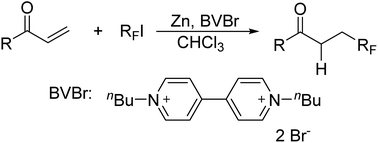
As the incorporation of a fluoroalkyl group into a drug candidate may result in profound modification of its physicochemical properties including increased lipophilicity and superior metabolic stability,1 significant efforts have been directed towards the exploration of efficient methods for fluoroalkylation.2 Although the use of perfluoroalkyl moieties as pharmacophores has been less investigated compared with other fluorinated functionalities such as trifluoromethyl and difluoromethyl groups,1 the development of perfluoroalkylation strategies may open up avenues for further study on the biological potential of perfluoroalkyl groups. Therefore, a number of general and mild perfluoroalkylation approaches have been developed.3 As one of the most convenient and straightforward protocols, radical perfluoroalkylation has received a great deal of attention recently.2d,3g,4 Since perfluoroalkyl radicals exhibit electrophilic reactivity, these species are reactive towards perfluoroalkylation of electron-rich substrates.5 However, radical perfluoroalkylation of electron-deficient olefins remains a largely ignored research area.
The readily commercially available source for perfluoroalkyl radical is perfluoroalkyl halide. The conversion of electron-deficient olefins with perfluoroalkyl halides usually results in haloperfluoroalkylation.6 In order to suppress the halogenation process, the addition of a radical hydrogen donor into the reaction system may be required.7 Interestingly, perfluoroalkylation without halogenation could also occur well promoted by an appropriate initiator, such as bimetal system,8 photocatalyst,9 and triethylborane.10 But these reactions suffer from narrow substrate scope, low yields, or the use of expensive initiator. On the basis that viologens11 and arenes12 have served as valuable electron-transfer reagents, we speculated that viologen should be able to be used in perfluoroalkylation of electron-deficient olefins via a single-electron-transfer process. In continuation of our research interest in the chemistry of fluoroalkylation,13 we have now investigated the hydroperfluoroalkylation of α,β-unsaturated ketones and esters with perfluoroalkyl iodides promoted by zinc/viologen system.
Our initial attempt at the hydroperfluoroalkylation of α,β-unsaturated ketone 1a with iodide 2a promoted by zinc powder and butyl viologen in DMF at 110 °C was successful to afford the desired product 3a, albeit in low yield (entry 1, Table 1). A brief survey of the reaction solvents (entries 1–6) revealed that chloroform was a suitable solvent (entry 5). Both zinc powder and viologen were necessary for this conversion, as evidenced by the results that no expected product was observed with the absence of either one (entries 7–8). Decreasing the loading of viologen led to the dramatic decrease in the yield (entries 9–10 vs. entry 5), but increasing its loading can't increase the yield (entry 11 vs. entry 5). Lower yields were obtained with lowering the reaction temperature (entries 12–14). 4 h of reaction time can guarantee the full conversion of substrate 1a. Shortening the reaction time to 2 h, the yield was decreased (entry 15 vs. entry 5). The transformation was not particular sensitive to water, and 38% yield could be obtained with the presence of 4 equiv. of water (entry 16). Refluxing the reaction mixture in a Schlenk tube under N2 atmosphere gave the desired product only in 47% yield (entry 17).
Table 1 Screening reaction conditionsa

|
| Entry |
Solvent |
X (equiv.) |
Yieldb (%) |
| Reaction conditions: the mixture of substrate 1a (0.1 mmol), perfluoroalkyl iodide 2a (0.3 mmol), zinc powder (0.6 mmol), dibutyl-4,4′-bipyridinium dibromide and solvent (1 mL) was stirred in a sealed tube at 110 °C for 4 h. Isolated yields. No zinc powder was used. Reaction temperature was 50 °C. Reaction temperature was 70 °C. Reaction temperature was 90 °C. Reaction time was 2 h. H2O (4 equiv.) was used as an additive. The reaction mixture was refluxed in a Schlenk tube under N2 atmosphere. |
| 1 |
DMF |
2 |
22 |
| 2 |
CH3CN |
2 |
26 |
| 3 |
C2H5OH |
2 |
19 |
| 4 |
THF |
2 |
30 |
| 5 |
CHCl3 |
2 |
62 |
| 6 |
Cyclohexane |
2 |
7 |
| 7c |
CHCl3 |
2 |
0 |
| 8 |
CHCl3 |
0 |
0 |
| 9 |
CHCl3 |
1 |
36 |
| 10 |
CHCl3 |
0.5 |
28 |
| 11 |
CHCl3 |
3 |
59 |
| 12d |
CHCl3 |
2 |
44 |
| 13e |
CHCl3 |
2 |
55 |
| 14f |
CHCl3 |
2 |
59 |
| 15g |
CHCl3 |
2 |
52 |
| 16h |
CHCl3 |
2 |
38 |
| 17i |
CHCl3 |
2 |
47 |
With the optimal reaction conditions in hand (entry 5, Table 1), we then investigated the substrate scope for the hydroperfluoroalkylation of electron-deficient olefins promoted by zinc/viologen system. As shown in Table 2, the reactions occurred smoothly to give the desired products in moderate to good yields. It is noteworthy that no iodoperfluoroalkylation product was detected. The examination of electronic effects (entries 1–10) revealed that both weakly electron-withdrawing groups (entries 1–4) and electron-donating groups (entries 6–10) showed no side effect on the conversion of unsaturated aryl ketones. But a strong electron-withdrawing group led to a low yield (entry 5), which is because the substrate is reactive towards zinc powder. Besides perfluorobutyl iodide, other perfluoroalkyl iodides were also efficient radical source for this transformation (entries 11–12). The hydroperfluoroalkylation is not only applicable to α,β-unsaturated aryl ketones, but also to α,β-unsaturated aliphatic ketone (entry 13) and α,β-unsaturated ester (entry 14).
Table 2 Substrate scope for hydroperfluoroalkylation

|
| Entry |
R |
RF |
Yielda (%) |
| Isolated yields. |
| 1 |
p-BrC6H4 (1a) |
nC4F9 |
3a, 62 |
| 2 |
o-BrC6H4 (1b) |
nC4F9 |
3b, 50 |
| 3 |
m-BrC6H4 (1c) |
nC4F9 |
3c, 54 |
| 4 |
p-ClC6H4 (1d) |
nC4F9 |
3d, 78 |
| 5 |
p-NO2C6H4 (1e) |
nC4F9 |
3e, 38 |
| 6 |
C6H4 (1f) |
nC4F9 |
3f, 71 |
| 7 |
p-PhC6H4 (1g) |
nC4F9 |
3g, 71 |
| 8 |
p-MeC6H4 (1h) |
nC4F9 |
3h, 74 |
| 9 |
p-MeOC6H4 (1i) |
nC4F9 |
3i, 64 |
| 10 |
β-Naphthyl (1j) |
nC4F9 |
3j, 64 |
| 11 |
p-BrC6H4 (1a) |
iC3F7 |
3k, 42 |
| 12 |
p-BrC6H4 (1a) |
nC6F13 |
3l, 54 |
| 13 |
Cyclohexyl (1m) |
nC4F9 |
3m, 76 |
| 14 |
p-PhCH2O (1n) |
nC4F9 |
3n, 80 |
Since viologens are efficient electron-transfer reagents, it is reasonable to conceive that the hydroperfluoroalkylation proceeds via a single-electron-transfer process to generate perfluoroalkyl radical. The presence of the radical scavenger TEMPO [(2,2,6,6-tetramethylpiperidin-1-yl)oxyl] completely suppressed the desired transformation, further suggesting that the a radical process was involved (eqn (1), Scheme 1). In order to determine what the hydrogen source is for this hydroperfluoroalkylation reaction, more experimental evidences were collected. No deuterated product was detected by using CDCl3 instead of CHCl3 as the solvent for the conversion of naphthyl substrate 1j, implying that the hydrogen is not from the solvent. The use of D2O (2 equiv.) as an additive under the optimal reaction conditions gave the desired product in 53% yield, with 61% deuterated at the α-position of the carbonyl group (eqn (2), Scheme 1), which means that H2O is the source for the hydrogenation.
 |
| | Scheme 1 Evidence for the elucidation of the reaction mechanism. | |
Based on the above results, we propose the reaction mechanism as shown in Scheme 2. The redox reaction of viologen with zinc powder generates Zn(I) and radical cation species A. The transfer of one electron from intermediate A to perfluoroalkyl iodide produces perfluoroalkyl radical and regenerates viologen. The attack of the perfluoroalkyl radical at the double bond in substrate gives intermediate B, which would be readily reduced by Zn(0) or Zn(I) to afford stable enolate C. It can't be ruled out that species B may also undergo iodine abstraction from perfluoroalkyl iodide to generate iodoperfluoroalkylation product D. In the presence of excessive zinc powder, the reduction of product D would occur easily to give enolate C. Protonation of enolate C by H2O furnishes the final product.
 |
| | Scheme 2 Plausible reaction mechanism. | |
The viologen can't be used in a catalytic amount because species A undergoes not only electron transfer to regenerate viologen, but also other conversions to afford side-products. For instance, the side product E formed by the combination of radical cation A with perfluorobutyl radical was detected by ESI† (Scheme 3).
 |
| | Scheme 3 Side reaction of viologen. | |
Conclusions
In conclusion, we have described the hydroperfluoroalkylation of α,β-unsaturated ketones and esters with perfluoroalkyl iodides promoted by zinc/viologen system. It is noteworthy that no iodoperfluoroalkylation product was detected in this conversion. This zinc/viologen system-promoted hydroperfluoroalkylation strategy may find utilities in other research area.
Acknowledgements
This work was financially supported by the National Basic Research Program of China (2015CB931900, 2012CBA01200), the National Natural Science Foundation (21421002, 21472222, 21502214, 21542005, 21272152), the Chinese Academy of Sciences (XDA02020105, XDA02020106) and the Science and Technology Commission of Shanghai Municipality (15DZ1200102).
Notes and references
-
(a) K. Müller, C. Faeh and F. Diederich, Science, 2007, 317, 1881–1886 CrossRef PubMed;
(b) S. Purser, P. R. Moore, S. Swallow and V. Gouverneur, Chem. Soc. Rev., 2008, 37, 320–330 RSC;
(c) J. Wang, M. Sanchez-Rosello, J. L. Acena, C. del Pozo, A. E. Sorochinsky, S. Fustero, V. A. Soloshonok and H. Liu, Chem. Rev., 2014, 114, 2432–2506 CrossRef CAS PubMed.
-
(a) J.-A. Ma and D. Cahard, Chem. Rev., 2004, 104, 6119–6146 CrossRef CAS PubMed;
(b) R. Smits, C. D. Cadicamo, K. Burger and B. Koksch, Chem. Soc. Rev., 2008, 37, 1727–1739 RSC;
(c) O. A. Tomashenko and V. V. Grushin, Chem. Rev., 2011, 111, 4475–4521 CrossRef CAS PubMed;
(d) C.-P. Zhang, Q.-Y. Chen, Y. Guo, J.-C. Xiao and Y.-C. Gu, Chem. Soc. Rev., 2012, 41, 4536–4559 RSC;
(e) C.-P. Zhang, Q.-Y. Chen, Y. Guo, J.-C. Xiao and Y.-C. Gu, Coord. Chem. Rev., 2014, 261, 28–72 CrossRef CAS;
(f) C. Alonso, E. Martinez de Marigorta, G. Rubiales and F. Palacios, Chem. Rev., 2015, 115, 1847–1935 CrossRef CAS PubMed;
(g) B. Lantano, M. R. Torviso, S. M. Bonesi, S. Barata-Vallejo and A. Postigo, Coord. Chem. Rev., 2015, 285, 76–108 CrossRef CAS;
(h) X. Liu, C. Xu, M. Wang and Q. Liu, Chem. Rev., 2015, 115, 683–730 CrossRef CAS PubMed;
(i) C. Ni, M. Hu and J. Hu, Chem. Rev., 2015, 115, 765–825 CrossRef CAS PubMed;
(j) X. Yang, T. Wu, R. J. Phipps and F. D. Toste, Chem. Rev., 2015, 115, 826–870 CrossRef CAS PubMed.
- For recent reviews, please see:
(a) T. Umemoto, Chem. Rev., 1996, 96, 1757–1777 CrossRef CAS PubMed;
(b) N. O. Brace, J. Fluorine Chem., 1999, 93, 1–25 CrossRef CAS;
(c) Q. Y. Chen, Isr. J. Chem., 1999, 39, 179–192 CrossRef CAS;
(d) N. O. Brace, J. Fluorine Chem., 2001, 108, 147–175 CrossRef CAS;
(e) D. Yu Mikhaylov and Y. H. Budnikova, Russ. Chem. Rev., 2013, 82, 835–864 CrossRef, 830 pp;
(f) A. Hafner, N. Jung and S. Braese, Synthesis, 2014, 46, 1440–1447 CrossRef, 1448 pp;
(g) S. Barata-Vallejo, S. M. Bonesi and A. Postigo, RSC Adv., 2015, 5, 62498–62518 RSC; For recent examples, please see:
(h) Z. Xiao, H. Hu, J. Ma, Q. Chen and Y. Guo, Chin. J. Chem., 2013, 31, 939–944 CrossRef CAS;
(i) X. Wang, K. Hirano, D. Kurauchi, H. Kato, N. Toriumi, R. Takita and M. Uchiyama, Chem.–Eur. J., 2015, 21, 10993–10996 CrossRef CAS PubMed;
(j) M. Nappi, G. Bergonzini and P. Melchiorre, Angew. Chem., Int. Ed., 2014, 53, 4921–4925 CrossRef CAS PubMed;
(k) L. He, K. Natte, J. Rabeah, C. Taeschler, H. Neumann, A. Brueckner and M. Beller, Angew. Chem., Int. Ed., 2015, 54, 4320–4324 CrossRef CAS PubMed;
(l) Z. Li, A. Garcia-Dominguez and C. Nevado, J. Am. Chem. Soc., 2015, 137, 11610–11613 CrossRef CAS PubMed;
(m) F. Sladojevich, E. McNeill, J. Boergel, S.-L. Zheng and T. Ritter, Angew. Chem., Int. Ed., 2015, 54, 3712–3716 CrossRef CAS PubMed;
(n) J. Xie, T. Zhang, F. Chen, N. Mehrkens, F. Rominger, M. Rudolph and A. S. K. Hashmi, Angew. Chem., Int. Ed., 2016, 55, 2934–2938 CrossRef CAS PubMed.
- For recent reviews, please see:
(a) S. Barata-Vallejo and A. Postigo, Coord. Chem. Rev., 2013, 257, 3051–3069 CrossRef CAS;
(b) O. V. Boltalina, A. A. Popov, I. V. Kuvychko, N. B. Shustova and S. H. Strauss, Chem. Rev., 2015, 115, 1051–1105 CrossRef CAS PubMed; For recent examples, please see:
(c) Y. Sato, S. Kawaguchi and A. Ogawa, Chem. Commun., 2015, 51, 10385–10388 RSC;
(d) D. Leifert, D. G. Artiukhin, J. Neugebauer, A. Galstyan, C. A. Strassert and A. Studer, Chem. Commun., 2016, 52, 5997–6000 RSC.
-
(a) W.-Y. Huang, L. Lv and Y.-F. Zhang, Chin. J. Chem., 1990, 8, 350–354 CrossRef;
(b) W.-Y. Huang and H.-Z. Zhang, J. Fluorine Chem., 1990, 50, 133–140 CrossRef CAS;
(c) X.-C. Guo and Q.-Y. Chen, J. Fluorine Chem., 1998, 88, 63–70 CrossRef CAS;
(d) K. Tsuchii, M. Imura, N. Kamada, T. Hirao and A. Ogawa, J. Org. Chem., 2004, 69, 6658–6665 CrossRef CAS PubMed;
(e) W. P. Gu, J. H. Lin and J. C. Xiao, Chin. Chem. Lett., 2014, 25, 24–28 CrossRef CAS;
(f) S. Barata-Vallejo, M. M. Flesia, B. Lantaño, J. E. Argüello, A. B. Peñéñory and A. Postigo, Eur. J. Org. Chem., 2013, 998–1008 CrossRef CAS.
-
(a) Z.-M. Qiu and D. J. Burton, J. Org. Chem., 1995, 60, 3465–3472 CrossRef CAS;
(b) T. Yajima, I. Jahan, T. Tonoi, M. Shinmen, A. Nishikawa, K. Yamaguchi, I. Sekine and H. Nagano, Tetrahedron, 2012, 68, 6856–6861 CrossRef CAS;
(c) E. Yoshioka, S. Kohtani, K. Sawai, Kentefu, E. Tanaka and H. Miyabe, J. Org. Chem., 2012, 77, 8588–8604 CrossRef CAS PubMed.
-
(a) S. Barata-Vallejo and A. Postigo, J. Org. Chem., 2010, 75, 6141–6148 CrossRef CAS PubMed;
(b) T. Yajima, K. Yamaguchi, R. Hirokane and E. Nogami, J. Fluorine Chem., 2013, 150, 1–7 CrossRef CAS.
-
(a) C.-M. Hu and Y.-L. Qiu, Tetrahedron Lett., 1991, 32, 4001–4002 CrossRef CAS;
(b) C.-M. Hu and Y.-L. Qiu, J. Org. Chem., 1992, 57, 3339–3342 CrossRef CAS;
(c) Y. Ding, G. Zhao and W. Huang, Tetrahedron Lett., 1992, 33, 8119–8120 CrossRef CAS.
- S. Tang, Y.-L. Deng, J. Li, W.-X. Wang, G.-L. Ding, M.-W. Wang, Z.-P. Xiao, Y.-C. Wang and R.-L. Sheng, J. Org. Chem., 2015, 80, 12599–12605 CrossRef CAS PubMed.
- P. Dudziński, A. V. Matsnev, J. S. Thrasher and G. Haufe, Org. Lett., 2015, 17, 1078–1081 CrossRef PubMed.
- For review, please see:
(a) C. L. Bird and A. T. Kuhn, Chem. Soc. Rev., 1981, 10, 49–82 RSC; For recent examples, please see:
(b) J. Moser and M. Graetzel, J. Am. Chem. Soc., 1983, 105, 6547–6555 CrossRef CAS;
(c) T. Endo, K. Ageishi and M. Okawara, J. Org. Chem., 1986, 51, 4309–4310 CrossRef CAS;
(d) V. G. Koshechko, L. A. Kiprianova and L. I. Fileleeva, Tetrahedron Lett., 1992, 33, 6677–6678 CrossRef CAS;
(e) D. L. Akins and C. Guo, Adv. Mater., 1994, 6, 512–516 CrossRef CAS;
(f) T. Hayashi, T. Takimura and H. Ogoshi, J. Am. Chem. Soc., 1995, 117, 11606–11607 CrossRef CAS.
- For recent reviews, please see:
(a) F. Foubelo and M. Yus, Chem. Soc. Rev., 2008, 37, 2620–2633 RSC;
(b) M. A. Perry and S. D. Rychnovsky, Nat. Prod. Rep., 2015, 32, 517–533 RSC. For recent examples, please see:
(c) T. J. Donohoe and D. House, J. Org. Chem., 2002, 67, 5015–5018 CrossRef CAS PubMed;
(d) C. Melero, A. Guijarro and M. Yus, Dalton Trans., 2009, 8, 1286–1289 RSC;
(e) N. Kennedy, P. Liu and T. Cohen, Angew. Chem., Int. Ed., 2016, 55, 383–386 CrossRef CAS PubMed.
-
(a) C.-P. Zhang, Z.-L. Wang, Q.-Y. Chen, C.-T. Zhang, Y.-C. Gu and J.-C. Xiao, Angew. Chem., Int. Ed., 2011, 50, 1896–1900 CrossRef CAS PubMed;
(b) C.-P. Zhang, J. Cai, C.-B. Zhou, X.-P. Wang, X. Zheng, Y.-C. Gu and J.-C. Xiao, Chem. Commun., 2011, 47, 9516–9518 RSC;
(c) C.-P. Zhang, Z.-L. Wang, Q.-Y. Chen, C.-T. Zhang, Y.-C. Gu and J.-C. Xiao, Chem. Commun., 2011, 47, 6632–6634 RSC;
(d) Y.-L. Ji, J.-H. Lin, J.-C. Xiao and Y.-C. Gu, Org. Chem. Front., 2014, 1, 1280–1284 RSC;
(e) J. Zheng, J.-H. Lin, X.-Y. Deng and J.-C. Xiao, Org. Lett., 2015, 17, 532–535 CrossRef CAS PubMed;
(f) J. Zheng, L. Wang, J.-H. Lin, J.-C. Xiao and S.-H. Liang, Angew. Chem., Int. Ed., 2015, 54, 13236–13240 CrossRef CAS PubMed;
(g) Y.-L. Ji, J.-J. Luo, J.-H. Lin, J.-C. Xiao and Y.-C. Gu, Org. Lett., 2016, 18, 1000–1003 CrossRef CAS PubMed.
Footnote |
| † Electronic supplementary information (ESI) available. See DOI: 10.1039/c6ra11557h |
|
| This journal is © The Royal Society of Chemistry 2016 |
Click here to see how this site uses Cookies. View our privacy policy here.