Dielectric properties of pyridine–ethanol mixtures: density functional theory and experiments

Zhiyan Wua, Kama Huang*a and Xiaoyu Kuangb
aCollege of Electronics & Information Engineering, Sichuan University, Chengdu 610064, China. E-mail: kmhuang@scu.edu.cn; Fax: +86 028 85408779
bInstitute of Atomic and Molecular Physics, Sichuan University, Chengdu, China

Received 28th April 2016 , Accepted 6th July 2016

First published on 7th July 2016


Abstract

The effective permittivity of a pyridine (C5H5N)–ethanol (C2H5OH) mixed solution has been measured over the whole range of concentrations at 293.15, 303.15 and 313.15 K. Surprisingly, an exceptional phenomenon is found that the real part εr and the imaginary part ε′′r of the mixed solution permittivity are larger than those of their pure components at certain concentrations. To clearly understand the exceptional behavior of the dielectric spectrum, a systematic investigation on the molecular clusters ((C5H5N)m(C2H5OH)n (m = 0–4; n = 0–6)) as well as the dipole moments and cluster radii of the molecular clusters has been performed using density functional theory (DFT) calculations. Comparing the dipole moments and cluster radii of the binary clusters ((C5H5N)m(C2H5OH)n) with those of the pure clusters ((C5H5N)m and (C2H5OH)n), the results have given a reasonable explanation of the unusual behaviors of the real part εr and the imaginary part ε′′r of the mixed solution permittivity.

1. Introduction

Microwave heating has attracted tremendous interest due to the extensive application in scientific research and industrial fields,1–4 such as microwave drying, chemical separation, to accelerate or restrain the chemical reaction etc. The ability of a material to reflect or absorb microwaves relies mostly on its dielectric properties. Therefore, it's important to study the dielectric properties of organic solvents by experimental measurement and theoretical calculation.

Pyridine is a polar aprotic solvent. Pyridine molecules form molecular clusters with the aid of dipole–dipole interaction.5 As an electronic acceptor, it is easy to form hydrogen-bonds with other solvents (water, methanol, and ethanol).6–15 Although there have been efforts to study the various properties (the spectroscopic, the vibrational relaxation and the structure) on the pyridine with the different hydrogen donor solvents,6–15 the microscopic interpretation on the dielectric properties of pyridine–ethanol mixtures has not yet given a unified and reasonable view so far. Herein, in what follows, the dielectric spectrum of pyridine–ethanol mixed solutions has been measured over the whole range of concentrations at 293.15 K, 303.15 K and 313.15 K, and the result shows an exceptional phenomenon. To clearly understand and interpret the exceptional phenomenon on the dielectric spectrum of the pyridine–ethanol mixed solutions, a systematic investigation about the molecular clusters ((C5H5N)m(C2H5OH)n) as well as the dipole moment and cluster radii of the molecular clusters has been listed using DFT calculations.

2. Experiment

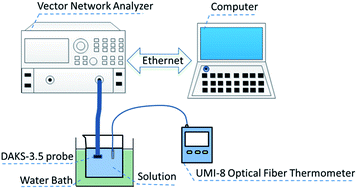
The solutions used in these experiments are ethanol (99.5%, analytical reagent) and pyridine (99.5%, analytical reagent), and all of them have been purchased from Chengdu Kelong Chemical Reagent Factory without further purification. All the pyridine–ethanol mixed solutions (the volume fraction of pyridine V(pyridine)% is 0–100%) were prepared. The permittivity of the pyridine–ethanol mixed solutions was measured by Vector Network Analyzer (ZVA50) and a DAKS-3.5 probe as shown schematically in Fig. 1. The calibration of the measure system was performed by air, an Agilent standard short circuit and pure water at 293.15 K. Every sample was measured at least four times on different occasions, and the measurement error kept within 5%.
image file: c6ra11038j-f1.tif
Fig. 1 The schematic of the experimental system.

At 2.45 GHz, the dielectric spectrum of pyridine–ethanol mixed solutions at 293.15 K, 303.15 K and 313.15 K are plotted in Fig. 2(a)–(c), respectively. In Fig. 2, it can be seen that the real part ε′′r of the permittivity with the increase of pyridine has a tendency of ascending first and descending in succession at three different temperatures. Surprisingly, it is found an exceptional behaviour of the real part εr of the mixed solution permittivity which is larger than those of their pure components at certain concentration. Likewise, the imaginary part ε′′r has the same inverted U-shaped tendency with increasing pyridine at 293.15 K and 303.15 K. It also appears the unusual phenomenon that the imaginary part ε′′r is larger than those of their pure components at certain concentration. However, when the temperature rises to 313.15 K, the exceptional behavior of ε′′r has disappeared. In addition, the real part ε′′r of pure pyridine/ethanol solution permittivity has been measured at 293.15 K covering a frequencies range from 0.2 GHz to 10 GHz as plotted in Fig. 3. The comparison with our current work has also been plotted in Fig. 3.16–18 The good agreement with the previous works16–18 provides confidence in our experimental system to measure the effective permittivity of pyridine–ethanol mixed solutions.


image file: c6ra11038j-f2.tif
Fig. 2 The effective permittivity of pyridine–ethanol mixed solutions at 2.45 GHz as a function of the volume fraction of pyridine V(pyridine)%. (a) 293.15 K, (b) 303.15 K, (c) 313.15 K.

image file: c6ra11038j-f3.tif
Fig. 3 The real part εr of pure solutions permittivity as a function of the frequency f (GHz).

3. Theoretical calculations

To explain the permittivity of pyridine–ethanol mixed solutions, a systematical theoretical study on the molecular clusters ((C5H5N)m(C2H5OH)n) has been given using DFT calculations. The structure predication of the initial molecular clusters is based on the ABCluster software.19 The ABCluster software can be successful in global searching and finding the geometry of a cluster with the lowest energy inspired by the artificial bee colony (ABC) algorithm.20,21 The structure predictions of the (C5H5N)m(C2H5OH)n molecular clusters have reached seven molecules in current work. Further calculations were performed using Gaussian 03 program package22 and Multiwfn programs.23 The local structure optimizations of all molecular clusters are performed using the M06-2X approach in conjunction with the 6-311G(d,p) basis set.24 Harmonic vibrational frequencies are calculated to ensure that the clusters are local minima. The dipole moments are obtained by using the M06-2X functional with a more flexible def2-TZVPD.

The stable structures of the molecular clusters (C5H5N)m(C2H5OH)n (m = 0–4; n = 0–6) have been shown in Fig. 4. The relative energies and the structures of the molecular clusters (such as (C5H5N)(C2H5OH), (C5H5N)(C2H5OH)2, (C5H5N)(C2H5OH)3 and so on) are shown in the ESI Fig. 1–7. From Fig. 4, one can clearly see that the structures of the binary clusters (C5H5N)m(C2H5OH)n (m = 1–3; n = 1–6) exhibit hydrogen bonded winding chains, and the structures of the pure molecular clusters ((C5H5N)m, m = 1–4 and (C2H5OH)n, n = 1–6) normally are in circular or sphere. Moreover, the dipole moments and cluster radii of the (C5H5N)m(C2H5OH)n molecular clusters have been listed in Table 1.


image file: c6ra11038j-f4.tif
Fig. 4 Structures of (C5H5N)m(C2H5OH)n (m = 0–4; n = 0–6) molecular clusters.
Table 1 Dipole moment (Debye) and cluster radii (Å) of the binary molecular clusters (C5H5N)m(C2H5OH)n (m = 0–4; n = 0–6)
m n
0 1 2 3 4 5 6
0   1.596 D 2.955 D 1.206 D 0.120 D 2.219 D 0.004 D
  3.460 Å 5.167 Å 6.224 Å 6.155 Å 6.523 Å 6.952 Å
1 2.256 D 4.082 D 3.328 ​D 3.897 ​D 2.721 ​D 3.565 ​D 2.325 ​D
3.875 Å 5.841 ​Å 6.728 ​Å 6.955 ​Å 7.418 ​Å 6.898 ​Å 7.357 ​Å
2 0.0014 ​D 3.001 ​D 2.536 ​D 3.683 ​D 3.104 ​D    
6.549 Å 7.126 ​Å 7.455 ​Å 7.035 ​Å 7.647 ​Å    
3 2.009 D 2.540 ​D 3.356 ​D 1.412 ​D      
6.923 Å 8.042 ​Å 7.844 ​Å 8.269 ​Å      
4 0.137 D            
6.926 Å            


To test the reliability of the structure of (C5H5N)m(C2H5OH)n molecular clusters obtained by using Gaussian 03 software, our results have been made a comparison with the structures reported by former researches. By contrast, the small clusters structure is the same as that of previous reports, such as the ethanol dimer (C2H5OH)2,25 the pyridine dimer (C5H5N)2,11 and the binary clusters (C5H5N)(C2H5OH),10–12 (C5H5N)(C2H5OH)2,10,11 (C5H5N)(C2H5OH)2.11 Therefore, the credibility has been established about the other structure of the pyridine–ethanol molecular clusters obtained in the paper. Of course, our results about the structure prediction of the (C5H5N)m(C2H5OH)n molecular clusters need to be verified by further experiments and theoretical calculations.

4. Discussion

For the pyridine–ethanol system, on the one hand, the permittivity of the pyridine–ethanol mixed solutions has been measured; on the other hand, the theoretical calculation about the structure prediction of the binary clusters (C5H5N)m(C2H5OH)n (m = 0–4; n = 0–6) has also been given. Therefore, it is important to explain the dielectric properties of the pyridine–ethanol mixed solutions with the view of the theoretical calculation at present. By theoretical simulation, it was found that pyridine and ethanol molecules mixed together can form new molecular clusters (C5H5N)m(C2H5OH)n. In analogy with the explanation of the DMSO–water system,26–28 pyridine can also break the hydrogen bonding interaction within the ethanol molecular cluster (C2H5OH)n, and form new molecular clusters (C5H5N)m(C2H5OH)n by the hydrogen bonding interaction between pyridine and ethanol molecules.

In Fig. 3, the change in the real part εr of pure pyridine solution permittivity is gradually trending down with the increase of the frequency. Compared with pure ethanol solution, the changed tendency of pure pyridine solutions is relatively flat with the change of frequency. The reason is that the pyridine molecules form pure molecular clusters by the dipole–dipole interaction, but the ethanol molecules are by the hydrogen bonding interaction. In general, the dipole–dipole interaction is weaker than the hydrogen bonding interaction. Hence, we speculate that the size of the pyridine clusters is not very big so that only the small pyridine clusters ((C5H5N)m, m = 1–4) have been studied in the paper.

To some extent, the real part ε′′r of the material permittivity can be judged by the polarity of materials, and different molecular number ratios of the binary molecular clusters can give expression to the different concentrations of pyridine–ethanol mixed solutions. In Fig. 2(a), the permittivity of the pyridine–ethanol mixed solution clearly depends on the volume fraction of pyridine in mixed solution. On the one hand, when V(pyridine)% is less than about 60%, the real part εr of the mixed solution permittivity increases gradually with pyridine increasing in Fig. 2(a). On the other hand, the dipole moments of the molecular clusters (C5H5N)(C2H5OH)n (n = 1–6) decrease with the increasing of the number n in Table 1. i.e., the polarity of the pyridine–ethanol mixed solutions increases gradually with the pyridine compounds increasingly. The results are consistent with the change tendency of the real part εr in Fig. 2(a) when V(pyridine)% is less than about 60%. Furthermore, at certain concentration, Fig. 2(a) shows an unusual phenomenon that the real part εr of the mixed solution permittivity is larger than that of their pure components. From Table 1, the dipole moments of the binary molecular clusters ((C5H5N)m(C2H5OH)n, m = 1–3; n = 1–6) are larger than that of the pure molecular clusters ((C5H5N)m, m = 1–4 and (C2H5OH)n, n = 1–6) when the number of molecules in binary molecular clusters is the same as that in the pure molecular clusters. The dipole moments listed in Table 1 can reasonable explain the unusual behavior of the real part εr in Fig. 2(a). In analogy with the explanation of Fig. 2(a), we can provide a reasonable interpretation about the dielectric spectrum of pyridine–ethanol mixed solutions plotted in Fig. 2(b) and (c).

For the imaginary part ε′′r of the mixed solution permittivity, it represents the energy dissipation of the relaxation process, which is related to the some properties of molecular clusters existing in mixed solutions, such as the molecular cluster radii, the molecular velocity. The bigger the cluster radius is, the more energy dissipates. In Fig. 2(a), it appears the specific phenomenon that the imaginary part ε′′r is larger than those of their pure components at certain concentration. Meanwhile, the cluster radii listed in Table 1 demonstrates that the cluster radii of the binary molecular clusters ((C5H5N)m(C2H5OH)n, m = 1–3; n = 1–6) are larger than that of the pure molecular clusters ((C5H5N)m, m = 1–4 and (C2H5OH)n, n = 1–6) when the number of molecules in binary molecular clusters is equal to that in the pure molecular clusters. The results provide the reason of the exceptional phenomenon on the imaginary part ε′′r. Moreover, the exceptional phenomenon on the imaginary part ε′′r becomes less distinct with the increase of temperature. When the temperature rises to 313.15 K, the exceptional phenomenon on the imaginary part ε′′r has even disappeared.

5. Conclusion

In conclusion, for the pyridine–ethanol system, the permittivity has been measured over the whole range of concentrations at 293.15 K, 303.15 K and 313.15 K. The results show an unusual phenomenon that the real part εr and the imaginary part ε′′r of the mixed solution permittivity are larger than those of each of the components at certain concentration. To clearly understand and interpreted the permittivity of pyridine–ethanol mixed solutions, a systematical investigation on the molecular clusters (C5H5N)m(C2H5OH)n (m = 0–4; n = 0–6) has been given using DFT calculations. Comparing the dipole moments and cluster radii of the binary clusters ((C5H5N)m(C2H5OH)n, m = 1–3; n = 1–6) with that of the pure clusters ((C5H5N)m, m = 1–4 and (C2H5OH)n, n = 1–6), the results have given an reasonable explanation of the unusual phenomenon of the mixed solution permittivity, respectively. Moreover, the real part εr of pure pyridine/ethanol solution permittivity has been measured at 293.15 K covering a frequencies range from 0.2 GHz to 10 GHz are plotted, and our work is in good agreement with the previous works.

Acknowledgements

This work was supported by the National Key Basic Research Program of China (No. 2013CB328900 and No. 2013CB328905).

References

  1. A. C. Metaxas and R. J. Meredith, Industrial Microwave Heating, Peter Peregrinus, London, 1983 Search PubMed.
  2. G. Roussy and J. A. Pearce, Foundations and industrial applications of microwave and radio frequency fields: physical and chemical processes, John Wiley & Sons Inc, 1995 Search PubMed.
  3. C. Gabre, S. Gabriel, E. H. Grant, B. J. Halstead and D. M. Mingosb, Chem. Soc. Rev., 1998, 27, 213–244 RSC.
  4. T. Zhao, C. Hou, H. Zhang, R. Zhu, S. She, J. Wang, T. Li, Z. Liu and B. Wei, Sci. Rep., 2014, 4, 1–6 Search PubMed.
  5. Y. Zhang, Y. Luo, Y. Zhang, Y. J. Yu, Y. M. Kuang, L. Zhang and J. G. Hou, Nature, 2016, 531(7596), 623–626 CrossRef CAS PubMed.
  6. B. P. Asthana, H. Takahashi and W. Kiefer, Chem. Phys. Lett., 1983, 94, 41 CrossRef CAS.
  7. M. Kreyenschmidt, H. H. Eysel and B. P. Asthana, J. Raman Spectrosc., 1993, 24, 645 CrossRef CAS.
  8. E. Zoidis, J. Yarwood, Y. Danten and M. Besnard, Mol. Phys., 1995, 85(373), 385 CrossRef CAS.
  9. A. Dkhissi, L. Adamowicz and G. Maes, J. Phys. Chem. A, 2000, 104, 2112 CrossRef CAS.
  10. V. Deckert, B. P. Asthana, P. C. Mishra and W. Kiefer, J. Raman Spectrosc., 1996, 27, 907–913 CrossRef CAS.
  11. S. Coussan, V. Brenner, J. P. Perchard and W. Q. Zheng, J. Chem. Phys., 2000, 113(18), 8059–8069 CrossRef CAS.
  12. M. Koné, B. Illien, C. Laurence and J. Graton, J. Phys. Chem. A, 2011, 115, 13975–13985 CrossRef PubMed.
  13. A. Chaudhari and S. C. Mehrotra, Mol. Phys., 2002, 100(24), 3907–3913 CrossRef CAS.
  14. K. V. Berezin, V. V. Nechaev and S. N. Zotov, J. Struct. Chem., 2004, 45(3), 388–394 CrossRef CAS.
  15. P. Nieto, M. Letzner, T. Endres, G. Schwaaba and M. Havenith, Phys. Chem. Chem. Phys., 2014, 16(18), 8384–8391 RSC.
  16. T. Sato, A. Chiba and R. Nozaki, J. Chem. Phys., 1999, 110(5), 2508–2521 CrossRef CAS.
  17. J. Z. Bao, M. L. Swicord and C. C. Davis, J. Chem. Phys., 1996, 104(12), 4441–4450 CrossRef CAS.
  18. C. Gabriel, S. Gabriel, E. H. Grant, E. H. Grant, B. S. J. Halstead and D. M. P. Mingos, Chem. Soc. Rev., 1998, 27(3), 213–224 RSC.
  19. J. Zhang and M. Dolg, Phys. Chem. Chem. Phys., 2015, 17, 24173–24181 RSC.
  20. D. Karaboga, Technical report-tr06, Erciyes University, 2005 Search PubMed.
  21. J. Zhang and M. Dolg, Phys. Chem. Chem. Phys., 2016, 18(4), 3003–3010 RSC.
  22. M. J. Frisch and G. W. Trucks, et al., GAUSSIAN 03 (Revision E.01), Gaussian, Inc., Wallingford, CT, 2004 Search PubMed.
  23. T. Lu and F. W. Chen, J. Comput. Chem., 2012, 33, 580–592 CrossRef CAS PubMed.
  24. Y. Zhao and D. G. Truhlar, Theor. Chem. Acc., 2008, 120, 215–241 CrossRef CAS.
  25. G. S. Tschumper and K. Morokuma, J. Mol. Struct.: THEOCHEM, 2002, 592(1), 137–147 CrossRef CAS.
  26. A. Bertoluzza, S. Bonora, M. A. Battaglia and P. Monti, J. Raman Spectrosc., 1979, 8, 231–235 CrossRef CAS.
  27. M. I. S. Sastry and S. Singh, J. Raman Spectrosc., 1984, 15, 80–85 CrossRef CAS.
  28. A. Luzar, J. Chem. Phys., 1989, 91, 3603–3613 CrossRef CAS.

Footnote

Electronic supplementary information (ESI) available. See DOI: 10.1039/c6ra11038j

This journal is © The Royal Society of Chemistry 2016
Click here to see how this site uses Cookies. View our privacy policy here.