Sihui Zhan*a,
Qiang Shia,
Yu Zhanga,
Yi Li*b and
Yang Tianc
aCollege of Environmental Science and Engineering, Nankai University, Tianjin 300071, P. R. China. E-mail: sihuizhan@nankai.edu.cn
bDepartment of Chemistry, Tianjin University, Tianjin 300072, P. R. China. E-mail: liyi@tju.edu.cn
cDepartment of Chemistry, Capital Normal University, Beijing 100048, P. R. China
First published on 13th June 2016
A series of novel Mo doped CeO2 hollow microspheres have been successfully synthesized using carbon microspheres as templates, which were characterized by XRD, SEM, TEM, BET and used to selective catalytic reduction (SCR) of NOx with ammonia at lower temperature. Compared with pure CeO2 hollow microspheres, Mo doped CeO2 hollow microspheres showed a better catalytic performance from 200–400 °C. The optimal molar ratios of Mo/Ce and surface active sites to remove NOx were also investigated, which can significantly affect the catalytic performances. Among all the hollow microspheres with different molybdenum doping ratios, the obtained CeMo(0.3) hollow microspheres showed not only the best SCR performance at lower temperature but also excellent stability and H2O resistance, which was attributed to the higher Brønsted acid sites and reasonable Ce3+ content and chemisorbed oxygen species, and the synergic effect between CeO2 and MoO3 based on the XPS, NH3-TPD, H2-TPR and in situ DRIFTS results. Additionally, according to the reactivity of adsorbed NH3 and NOx species based on in situ DRIFTS, the excellent low-temperature NH3-SCR activity of CeMo(0.3) hollow microspheres was resulted from the reactivity of the more active NH4+ ions with gaseous NO2 molecules (i.e., the “fast SCR” reaction).
Recently, ceria oxides (CeO2) nanomaterials have become an ideal SCR catalyst candidates owing to its high oxygen storage capacity, excellent redox property, non-toxicity and low cost.9–11 To promote their catalytic performance, many CeO2-based catalysts have been doped with special metal oxides, such as SnOx–CeO2, TiO2–CeO2, Nb2O5–CeO2 and so on.12–14 Nevertheless, these catalysts still have several defects, such as the narrow temperature window, weak thermal stability at higher temperature and poor SO2 resistance. As “chemical” and “structural” promoters, MoO3 was a common activator in the SCR reaction. Several reports have proved that Mo species could promote the catalytic activity, thermal stability and SO2/H2O durability of the catalysts.15,16 It was also investigated that MoO3 can promote the adsorption and activation of NH3 thus improve the catalytic activity.17 Therefore, the combination of CeO2 and MoO3 was prepared and applied for eliminating NOx by NH3-SCR just as reported by Peng et al.18
Furthermore, “structure and morphology effect” of nanomaterials have attracted a lot of attentions recently.19–21 Among numerous of structures (nanospheres, nanowire, nanosheet, mesoporous and hollow spheres), the hollow microspheres have attracted much attention particularly, which can offer short diffusion length of reaction gases and efficient channels for mass transport.22,23 Zhang et al. reported that the hollow MnxCo3−xO4 nanocages exhibited better low-temperature catalytic activity, higher stability, and SO2 tolerance than conventional MnxCo3−xO4 nanoparticles in deNOx process attributed to the hollow and porous architectures.20 Moreover, Ca-doped FeOx hollow microspheres have been synthesized for catalytic oxidation of 1,2-dichlorobenzene (o-DCB) and exhibited excellent activity.21 To the best of our knowledge, there were few studies about the catalytic properties of Mo doped CeO2 hollow microspheres in the NH3-SCR reaction until now.
In our present study, a series of CeMo(x) (x = 0, 0.1, 0.2, 0.3, 0.4, 0.5) hollow microspheres have been synthesized successfully by using carbon microspheres as template to remove NOx. The as-prepared hollow microspheres have been tested systematically, including XRD, TEM, BET, XPS, TPR, TPD and XPS. With these CeMo(x) hollow microspheres, the NOx conversion ratio can be improved obviously from 200 to 400 °C with a gas hourly space velocity (GHSV) of 30
000 h−1. Furthermore, several key performance indicators were also investigated, such as the stability, H2O resistance and SO2 tolerance. Finally, the reaction mechanism of Mo-doped CeO2 hollow microspheres was proposed based on the results of in situ DRIFTS.
To prepare Mo doped CeO2 hollow microspheres, 0.2 g carbon microspheres were dispersed in 50 mL N,N-dimethylformamide (DMF) homogeneously under ultrasonication for 1 h. At the same time, Ce(NO3)3·6H2O and H3[P(Mo3O10)4]·xH2O with required ratio were dissolved in 50 mL DMF solution and stirred for 1 h. Then the above mixture was added drop by drop to the above carbon solution with magnetic stirring, then 3 mL distilled water was added dropwise. After that, the mixture was treated under ultrasonication for another 1 h and then aged at room temperature for 24 h. The next step was to collect the sample by centrifugation and wash it with distilled water and ethanol for five times until the supernatant matter was limpid, followed by dried at 80 °C in air. Finally, the obtained product was calcined in air at 400 °C for 10 h to produce hollow microspheres. The nominal molar ratio of Mo/Ce was 0, 0.1, 0.2, 0.3, 0.4 and 0.5 and the corresponding samples were denoted as CeO2, CeMo(0.1), CeMo(0.2), CeMo(0.3), CeMo(0.4) and CeMo(0.5). As a comparison, pure MoO3 hollow microspheres were also prepared under the same condition. What's more, the bulk CeMo(0.3) samples were prepared by conventional coprecipitation method using NH4HCO3 as precipitant.
000 h−1. The concentration variation of NO, NO2, and SO2 were detected by a KM-940 flue gas analyzer (Kane International Limited, UK) and N2O and NH3 were measured by Thermo Nicolet iS50 FTIR spectrometer. NOx conversion ratio and N2 selectivity were calculated in a steady state according to the following equations:To further study the catalytic activity of CeMo(0.3) hollow microspheres, the stability, H2O resistance and SO2 tolerance were also investigated. As shown in Fig. 2a, the NOx conversion ratio of CeMo(0.3) maintained steady at either 200 or 250 °C for 40 h. Fig. 2b showed that after the addition of 10 vol% H2O, the NOx conversion ratio merely reduced from 100% to 97.6%. And when H2O was shut off, the NOx conversion ratio recovered quickly. In addition, the influence of different SO2 concentrations on CeMo(0.3) hollow microspheres was also discussed at 250 °C. Under 100 ppm SO2 the NOx conversion ratio decreased from 100% to 88.6%, while with 200 ppm SO2 the NOx conversion ratio reduced from 100% to 75.7% after 18 h. And after stopping SO2, NOx conversion ratio nearly regenerated to the previous level. Moreover, the co-effect of H2O and SO2 were also performed. The SCR activity was down to 84.5% one hour later and gradually decreased to 69.8% after 18 h when introducing 10 vol% H2O and 100 ppm SO2. When it came to 10 vol% H2O and 200 ppm SO2, the NOx conversion ratio decreased to 65.1% after 1 h and a tiny rebound to 70.6% was found after 2 h, and then the conversion ratio was on a gentle downward slide to 58.6%. And for comparison, bulk CeMo(0.3) was also tested the stability, H2O resistance and SO2 tolerance at 250 °C. It is shown in Fig. S3† that bulk CeMo(0.3) sample showed a good stability but poor H2O resistance and SO2 tolerance. Moreover, CeMo(0.3) hollow microspheres possessed a better H2O resistance and SO2 tolerance than the commercial WO3–V2O5/TiO2 catalysts at 300 °C (Fig. S4, ESI†).
| Materials | SBETa (m2 g−1) | Pore volumeb (cm3 g−1) | Pore diameterc (nm) | Crystallite sized (nm) |
|---|---|---|---|---|
| a BET specific surface areas.b BJH desorption pore volume.c Average pore diameters.d CeO2 crystallite size calculated by the Scherrer equation from the XRD results.e “h”-represented “hollow microspheres”, “b”-represented “bulk”. | ||||
| h-CeO2 | 58.1 | 0.19 | 14.8 | 7.2 |
| h-CeMo(0.1) | 41.7 | 0.13 | 12.8 | 6.2 |
| h-CeMo(0.2) | 24.3 | 0.10 | 17.4 | 5.9 |
| h-CeMo(0.3) | 20.2 | 0.11 | 26.8 | 5.2 |
| h-CeMo(0.4) | 21.8 | 0.12 | 26.2 | 4.9 |
| h-CeMo(0.5) | 23.5 | 0.11 | 20.8 | 4.5 |
| h-MoO3 | 2.8 | 0.012 | 20.5 | 28.2 |
| b-CeMo(0.3) | 44.9 | 0.09 | 11.4 | 6.1 |
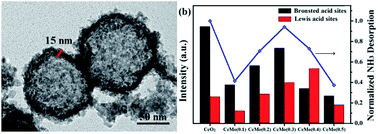
The morphology and microstructure of the CeMo(x) hollow microspheres were investigated by FESEM. From Fig. S3a,† the particle size of CeO2 hollow microspheres was about 200–300 nm. While diameter of different CeMo(x) hollow microspheres are of 100–200 nm after doping Mo (Fig. S6b–4f, ESI†). As is well known, the hollow structure can provide more active sites to adsorb and activate reaction gases, which could benefit for the catalytic activity.27 Obviously it is easy to verify its hollow structure from the broken part on SEM images. In addition, the CeMo(0.3) hollow microspheres was further verified by TEM images. As shown in Fig. 4b, the wall thickness of CeMo(0.3) was approximate 15 nm. On the HRTEM image, several lattice fringes of 0.27 nm can be observed clearly, which was in good agreement with the crystal plane (200) of CeO2. And the lattice fringes of 0.21 nm were attributed to the crystal plane (141) of MoO3, confirming the existence of Mo species. Meanwhile, it is easy to find that MoO3 is coupled with CeO2 from the energy-dispersive X-ray spectroscopy (EDS) elemental mapping of CeMo(0.3) hollow microspheres (Fig. 2d–f), indicating that MoO3 is highly dispersed on the surface of CeMo(0.3) hollow microspheres.28 Moreover, the energy-dispersive X-ray spectroscopy inside Fig. 2a confirmed the coexistence of Ce and Mo.
Moreover, N2 adsorption–desorption performance of CeMo(x) hollow microspheres were carried out to observe its textural properties, and all the isotherms can be classified as type IV (Fig. 5).29–31 The BET specific surface area, BJH desorption pore volume and average pore diameter of the prepared materials are tabulated in Table 1. Because of the MoO3’s smaller specific surface area (2.8 m2 g−1), their specific surface area decreased from 58 to 20 m2 g−1 with the increase of Mo/Ce ratio.15,32 In addition, the isotherm of bulk CeMo(0.3) sample was also classified to type IV as Fig. S8† depicted.
It is noted that the element valence state is very important during NH3-SCR progress. To take a look at the metal oxidation states and the content in the surface layer, XPS measurements of hollow microspheres were performed and the results were shown in Fig. 6a and b. The sub-bands of Ce 3d peak labeled as u, u2, u3, v, v2 and v3 were ascribed to the 3d104f0 state of Ce4+, and u1 and v1 represented the 3d104f1 initial electronic state corresponding to Ce3+. The ratios of Ce3+/(Ce3+ + Ce4+) and SCR activities (250 and 200 °C) of CeMo(x) hollow microspheres were shown in Table 2. As we can see, the Ce3+ ratio increased to 19.34% when the least Mo content was doped to pure CeO2 and decreased gradually with increasing Mo loading. It is reported that Ce3+ species could make the surface chemisorbed oxygen increased by inducing a charge imbalance, the vacancies and unsaturated chemical bonds on the surface of catalysts.9 And Kwon et al. proved that Ce4+ could facilitate the adsorption of NH3, and the adsorbed NH3 can switch to NH2, which can react with gaseous NO to generate N2 and H2O.33,34 By compared with bulk CeMo(0.3) sample, the CeMo(0.3) hollow microspheres possessed more Ce3+ (see Fig. S9†).
![]() | ||
| Fig. 6 XPS spectra of the prepared CeMo(x) hollow microspheres, (a) Ce 3d and (b) O 1s [(1) CeO2, (2) CeMo(0.1), (3) CeMo(0.2), (4) CeMo(0.3), (5) CeMo(0.4) and (6) CeMo(0.5)]. | ||
| Materials | Mo/Ce | O 1S (eV) | Oα ratio (%) | Ce3+ ratio (%) | NOx conversion at 250 °C (%) | NOx conversion at 200 °C (%) | |
|---|---|---|---|---|---|---|---|
| Oα | Oβ | ||||||
| h-CeO2 | 0 | 531.18 | 529.39 | 40.40 | 12.08 | 44.2 | 27.9 |
| h-CeMo(0.1) | 0.28 | 531.17 | 529.98 | 42.42 | 19.34 | 88.9 | 41.4 |
| h-CeMo(0.2) | 0.44 | 531.12 | 529.91 | 33.51 | 17.75 | 96.1 | 53.4 |
| h-CeMo(0.3) | 0.56 | 531.50 | 530.19 | 27.41 | 16.72 | 99.0 | 88.4 |
| h-CeMo(0.4) | 0.63 | 531.96 | 530.27 | 22.47 | 14.27 | 93.4 | 47.9 |
| h-CeMo(0.5) | 0.65 | 532.35 | 530.43 | 19.17 | 12.88 | 93.9 | 36.2 |
| h-MoO3 | — | 531.82 | 530.96 | 25.28 | — | 13.0 | 14.0 |
| b-CeMo(0.3) | 0.33 | 531.60 | 529.90 | 21.10 | 12.92 | 97.6 | 83.2 |
The O 1s XPS of the pure and Mo doped CeO2 hollow samples were shown in Fig. 6b. The peak at 531.18 eV corresponds to chemisorbed oxygen (Oα) and the peak of pure CeO2 at 529.439 eV sample can be assigned to lattice oxygen (Oβ). After doping Mo element, both of the peaks shifted to lower binding energy side, and the Oα content decreased.35 As we all know, active surface oxygen (Oα) is beneficial to the activation of adsorbed NH3 molecules on catalyst surfaces.36 And Oα also plays a significant role in oxidation reactions, which can not only oxidize NO into NO2 to facilitate the “fast SCR” process, but excessive Oα can also consume NH3 to produce nitrogen oxide byproducts to narrow the operating window, which was verified by NO or NH3 oxidation reaction (Fig. S10†).37 Thus it is very important to find the optimal doping ratio to generate favorable Oα concentration. According to the SCR activity, CeMo(0.3) hollow microspheres possess the suitable Oα ratio (27.41%). From the analysis of O 1s XPS of bulk CeMo(0.3) sample, there was much more Oα on CeMo(0.3) hollow sample (Fig. S12†).
The redox behaviors of catalysts were characterized by H2-TPR (Fig. 7a). The H2-TPR profile of pure CeO2 exhibits two small broad peaks at 475 and 750 °C. As is known to all, the low temperature peak between 400 and 600 °C can be ascribed to the reduction of surface oxygen and high temperature peak between 600 and 800 °C is assigned to the reduction from Ce4+ to Ce3+.38,39 When doping less Mo to CeO2 (Mo/Ce < 0.3), there is a smaller shift to lower temperature for the reduction peak, and when the ratio increased to 0.3, the interaction between Ce and Mo species was so strong that there was only one reduction peak at 580 °C. With increasing Mo/Ce molar ratios from 0.3 to 0.5, the reduction peaks shifted to higher temperatures, which might be caused by the coverage of Mo species or the surface aggregation, which can be confirmed by Peng et al.15,18 Transition metals (such as Mo) doped on CeO2 could result in low reducibility, because of the decrease of labile surface oxygen and defect sites. It was shown in Fig. S14† that MoO3 can be reduced at high temperature, from MoO3 to MoO2 at 770 °C and further reduced to Mo at 1000 °C, which was in accordance with the literature.26 Although bulk CeMo(0.3) sample showed lower reduction temperature (Fig. S15†), it seems that the stronger interaction between Ce and Mo species came into being compared to CeMo(0.3) hollow microspheres.
The surface acid strength and amount were measured by NH3-TPD and the calculation results of the obtained profiles (Fig. S16†) are shown in Fig. 7b. The TPD profile of CeO2 shows a major peak centered at 110 °C and a minor peak centered at 338 °C. As is well known that the coordinated NH3 molecular bound to the Lewis acid sites is more thermally stable than the NH4+ ions fixed on the Brønsted acid sites, it could be speculate that the lower peaks are due to NH4+ ions originating from the Brønsted acid sites. In addition, the desorption peak area increased with acid amount.29 Generally, with enhancing the acid sites, more NH3 species could be absorbed on the surface of hollow microspheres, then their NH3-SCR performance was promoted.40 It is quite clear that at lowest Mo content, a remarkable decline of total acid sites was founded, and the total acid sites rised up from CeMo(0.1) to CeMo(0.3) and then decreased in CeMo(0.4) and CeMo(0.5). Among the hollow materials containing Mo, CeMo(0.3) hollow microspheres possess the most Brønsted acid sites, which is responsible for the best SCR activities below 250 °C. Furthermore, the more acid sites over the CeMo(0.3) hollow microspheres led to the better H2O resistance ability, because it is easy absorb more NH3 than H2O. It has been reported that the adsorbed NH3 is very important for not only Eley–Rideal but also Langmuir–Hinshelwood mechanisms in NH3-SCR reaction.41,42 Compared to bulk CeMo(0.3) sample as shown Fig. S17,† CeMo(0.3) hollow microspheres possessed more Brønsted acid sites, which was the main reason for increased deNOx activity.
The NH3 or NO + O2 adsorption performance of CeO2 and CeMo(0.3) hollow microspheres were presented in Fig. 8. At the high wavenumber range of Fig. 8a and b, the band at 3685 cm−1 on CeO2 and the 3642 cm−1 band on CeMo(0.3) were due to the adsorption of NH4+ onto –OH. A small band at 3542 cm−1 appeared on CeO2, while on CeMo(0.3) a broad band from 3542 cm−1 to 3178 cm−1 came into being, which were ascribed to NH3 bonded on Lewis acid.33,42 Within the range of 1800–1000 cm−1, more bands were obtained on CeO2, the 1621, 1566, 1307, 1174 cm−1 bands were attributed to coordinatively adsorbed NH3 on Lewis acid sites,2,26,39 the band at 1470 cm−1 was assigned to NH4+ bonded on Brønsted acid site and a small shoulder peak at 1528 cm−1 was attributed to amide species (–NH2) with Brønsted acid sites.43 However, for CeMo(0.3) hollow microspheres, small peaks vanished and three main peaks can be ascribed to symmetric deformation of coordinated ammonia on Lewis acid sites (1605 and 1180 cm−1) and NH4+ peak at 1412 cm−1 can be coordinated to Brønsted acid sites in the range of 1800–1000 cm−1.32,39,43 It was shown in Fig. S18† that CeMo(0.3) hollow microspheres gave rise to much more Brønsted acid sites than pure CeO2 hollow microspheres for the peak at 1412 cm−1 on CeMo(0.3) hollow microspheres was much higher than that at 1470 cm−1 on pure CeO2. With increasing temperature, the intensities of all of the bands decreased, nevertheless the bands on CeMo(0.3) were stronger than CeO2 hollow microspheres, indicating that the doping Mo could enhance the adsorption of NH3 on both Lewis acid sites and Brønsted acid sites, which is consistent with NH3-TPD result. Moreover, the bands of NH4+ ions (1412 and 3642 cm−1) almost faded, while the coordinated NH3 (1605 cm−1) still can be observed at 300 °C. Therefore, the coordinated NH3 on Lewis acidic sites are much more stable than NH4+ species on the Brønsted acidic sites at high temperatures.44
![]() | ||
| Fig. 8 In situ DRIFTS of NH3 adsorption on (a) CeO2 and (b) CeMo(0.3) hollow microspheres; NO + O2 adsorption on (c) CeO2 and (d) CeMo(0.3) hollow microspheres. | ||
Similar with NH3 adsorption, more peaks were detected on CeO2. And the peak at 1611 cm−1 was ascribed to asymmetric frequency of gaseous NO2 molecules, while the corresponding peak of CeMo(0.3) hollow spheres shifted to 1607 cm−1. For CeO2 hollow microspheres, three bands (1543, 1526, 1305 cm−1) can be attributed to monodentate nitrate, the bands of 1543 and 1526 cm−1 strengthened with an increase in temperature while the 1305 cm−1 band became weaker and overlapped with the 1255 cm−1 band (corresponding to NOx species).38,42,44 And the bands at 1472 and 1222 cm−1 on CeO2 sample were assigned to the NO2− and nitrate species.41 For CeMo(0.3) hollow microspheres, the peak at 1888 cm−1 was assigned to weakly adsorbed mononitrosyls (–NO) on the surface of the sample and a shoulder peak (1509 cm−1) was assigned to nitrates. Two close peaks at 1182 and 1178 cm−1 on CeO2 and CeMo(0.3) hollow microspheres respectively were attributed to NO− ad-species.44 From comparison of the intensity of all peaks on CeO2 and CeMo(0.3) hollow microspheres, it is indicated that much more gaseous NO2 molecules can be adsorbed on the surface of CeMo(0.3) hollow microspheres, which was beneficial to “fast SCR” reaction to enhance the low-temperature SCR reaction.
After CeMo(0.3) hollow microspheres was pretreated by NO + O2 for 30 min followed by N2 purging for 20 min, several bands related to NOx species (1607, 1509, 1267, and 1030 cm−1) was detected. Then the gas was changed to NH3. At 150 °C (Fig. 9c), gaseous NO2 molecules (1607 cm−1) on the surface of CeMo(0.3) were reduced by NH3 gradually, while NO2− (1267 cm−1) and nitrate (1509 cm−1) species still existed after 30 min. Nevertheless, when the temperature increased to 350 °C all the bands assigned to NOx species decreased sharply (Fig. 9d). The above results indicated that gaseous NO2 molecules can react with NH3 at low temperature and all the NOx species (including gaseous NO2 molecules, nitrite and nitrate) can be reduced by NH3 at high temperature.
In summary, the proposed reaction mechanism of NH3-SCR reaction to remove NOx was exhibited in Fig. 10. The NH3 adsorbed on the surface of CeMo(0.3) hollow microspheres to form NH4+ ions bonded on Brønsted acidic sites and coordinated NH3 related to Lewis acidic sites, and NOx adsorbed mainly in the form of gaseous NO2 molecules, nitrite and nitrate. At a lower temperature, it is mainly the NH4+ ions on Brønsted acidic sites react with gaseous NO2 molecules (i.e. the so-called “fast SCR” reaction).45 Nevertheless, all the gaseous NO2, nitrite and nitrate can participate in the reaction with both ionic NH4+ and coordinated NH3 to generate N2 at high temperature.46,47 Furthermore, the reactions between NH3 and preadsorbed NO + O2 species over CeMo(0.3) hollow microsphere was completed almost in 2 minutes, which was much shorter than the reactions between NO + O2 species and preadsorbed NH3. Therefore, the adsorbed behaviour of NH3 played an important role in the SCR reactions.
Footnote |
| † Electronic supplementary information (ESI) available. See DOI: 10.1039/c6ra10720f |
| This journal is © The Royal Society of Chemistry 2016 |