Arpita Paul Chowdhurya,
Baban H. Shambharkar*a,
Sachin G. Ghugalb,
Suresh S. Umareb and
Ashok G. Shendeb
aChemistry Department, National Institute of Technology, Silchar-788 010, Assam, India. E-mail: baban.shambharkar@gmail.com
bChemistry Department, Visvesvaraya National Institute of Technology, Nagpur-440 010, Maharashtra, India
First published on 7th November 2016
SnS (tin sulfide) quantum dots (QDs) were synthesized by a chemical coprecipitation method using ethylene glycol as a solvent and capping agent and thiourea as a sulfur source at a temperature of 160 °C, 4 h. The as synthesized SnS QDs were characterized by X-ray diffraction (XRD), transmission electron microscopy (TEM), UV-Vis-NIR spectroscopy and FT-Raman spectroscopy. XRD patterns show the formation of single phase SnS QDs with rhombohedral structure. Ethylene glycol mediated synthesis resulted 2.5–3 nm SnS QDs. The UV-Vis-NIR optical absorption spectra of the SnS QDs displayed that the SnS QDs possess an absorption profile across the whole visible-light and near-infrared region. The direct band gap and indirect band gap energy for SnS QDs are found to be 1.17 eV and 1.11 eV, respectively. FT-Raman spectra of SnS QDs demonstrate vibrational modes at 73, 97, 162, 188, 222 cm−1. The Brunauer–Emmett–Teller (BET) surface area of SnS QDs was found to be 5.63 m2 g−1. SnS QDs showed powerful photodegradation activity towards degradation of eosin yellow and brilliant green dyes under sunlight. The enhanced photocatalytic activity of SnS QDs is attributed to improved visible light absorption and efficient separation of photogenerated charge carriers. In addition, the quenching effects of different quenchers suggest that superoxide radicals play a major role in the photodegradation process.
The IV–VI series of semiconducting materials like CdS, CdSe, PbS, SnS, PbSe and SnTe etc. are of interest primarily because of their narrow band gap and potential applications in solar cells, detectors as a optically active components in the near-infrared and infrared spectral region.10 These materials show efficient multiple exciton generation which is the ability to generate more than one electron–hole pair per high energy photon absorbed and provide a way to overcome the Shockley–Queisser efficiency.11
SnS (tin sulfide) is an important binary chalcogenide. It is a layered semiconductor and possess an orthorhombic crystal structure. It is an inexpensive, environmentally benign and has good chemical stability. Tin sulfide exist in different phases12,13 such as SnS, SnS2, Sn2S3, Sn3S4 and Sn4S5. Among these, SnS is p-type and SnS2 is n-type semiconductor.14 SnS has both a direct optical gap located at 1.3 eV and indirect optical band gap located at 1.09 eV. The absorption coefficient of SnS is 104 cm−1 and possess high conductivity.15 SnS have been used as a light absorber in photovoltaics, anode material in lithium ion batteries, sensors, capacitors, near-infrared detector and holographic recording and a visible light driven photocatalyst.16,17
Quantum dots (QDs) have unique advantages18,19 of having simple synthesis, tunable band gap energy by controlling the particle size, multiple exciton generation from single photon absorption and large intrinsic dipole moment. To our knowledge, there are a very few reports that present synthetic methodologies to forming SnS QDs and their application in the photocatalysis. Muthuvinayagam et al.17 prepared SnS QDs (2–5 nm) by one-pot hydrothermal approach using SnCl2·2H2O and thiourea at 200 °C, 8 h. Prastani et al.11 prepared SnS QDs with a size of ∼4 nm using colloidal route. The synthesis was carried out using precursors such as SnCl2·2H2O, triethanolamine, sodium sulphide, ethylene glycol and trioctylphosphine oxide at room temperature under nitrogen atmosphere. Xu et al.20 prepared SnS QDs using triethanolamine ligand, SnBr2 and sodium sulfide. Deepa and Nagaraju21 prepared SnS QDs by SILAR method. Tang et al.22 synthesized SnS nanoparticles (5 nm) using starting materials like SnCl2·2H2O, octadecene, trioctylphosphine, oleic acid, oleyamine and thioacetamide at 135 °C and reported their photocatalytic activity towards rhodamine B under halogen lamp. Das and Dutta23 prepared SnS nanorods by using mercaptoacetic acid as capping agent and proved to be an efficient photocatalyst for dye degradation of trypan blue dye under sunlight.
In the present study, we report facile synthesis of SnS QDs by chemical coprecipitation method using ethylene glycol as a solvent and complexing agent and thiourea as a sulfur source at 160 °C, 4 h. This method is a simple, economical route and requires low reaction temperature and short reaction time to synthesize SnS QDs. By using this route spherical SnS QDs were obtained. For the first time, we evaluated the photodegradation activity of as-synthesized SnS QDs in the degradation of eosin yellow and brilliant green under solar irradiation. Our results indicate that the formed SnS QDs showed the enhanced photodegradation for eosin yellow and brilliant green because of improved visible light absorption and efficient separation of photogenerated charge carriers.
Sn2+ ions form a complex with EG. Upon addition of thiourea into preformed Sn–EG complex, a competition between the thiourea and EG is introduced. The strong complexation between Sn2+ ions and thiourea leads to the formation of Sn–thiourea complex in the precipitation method which prevent the production of a large number of free S2− in the solution. SnCl2 and thiourea both easily dissolves in ethylene glycol solvent which indicates the formation of [Sn(SCN2H4)n]2+ complex. The produced complex serve as both the tin source and the sulfur source. On heating at 160 °C, Sn–thiourea complex undergo thermal decomposition to produce EG capped tin sulfide QDs due to the rupture of coordinate bonds between Sn2+ and thiourea. EG acts as the stabilizing ligand. Hydroxyl groups on EG control the size of SnS QDs. EG has two hydroxyl groups to bind more strongly to the QDs as they grow.
| SnCl2 + n(EG) → [Sn(EG)n]2+ |
| [Sn(EG)n]2+ + SCN2H4 → [Sn(SCN2H4)n]2+ |
25 mg and 100 mg of SnS particles was dispersed in a beaker containing 100 ml of eosin yellow and brilliant green solution, respectively (pH = 7.5). The mixture was continuously stirred using a magnetic stirrer at ambient temperature in the dark for 15 min in order to attain adsorption–desorption equilibrium prior to light irradiation. 5 ml of the aliquot was withdrawn at regular time intervals. The aliquot was centrifuged and quantitative determination of eosin yellow was performed by measuring its absorbance at λ = 509 nm and for brilliant green at λ = 624 nm. The photodegradation efficiency of SnS QDs was determined by equation, % degradation = [(C0 − Ct)/C0] × 100. Where C0 is the initial concentration of dye and Ct is the concentration of dye after “t” minutes visible light irradiation. The degradation profiles19 were fitted in first order equation ln(C0/C) = kt, where C is the concentration after degradation and C0 is the concentration of the dye after dark adsorption, respectively, k is rate constant and t is time for light irradiation. The rate constant (k) was calculated from slope of straight line obtained by plotting ln(C0/C) versus time (t).
cos
θ where, β full width at half maximum of the strongest peak, λ is the X-ray wavelength and θ is the angle of diffraction and was found to be 15 nm.
| 2[theta] (°) | d-Spacing (Å) | h k l values |
|---|---|---|
| 16.57 | 5.34 | (2 0 0) |
| 22.15 | 4.01 | (1 0 1) |
| 26.15 | 3.40 | (2 0 1) |
| 27.57 | 3.23 | (2 1 0) |
| 30.57 | 2.92 | (0 1 1) |
| 31.62 | 2.82 | (1 1 1) |
| 32.00 | 2.79 | (3 0 1) |
| 39.09 | 2.30 | (3 1 1) |
| 44.77 | 2.02 | (4 1 1) |
| 45.53 | 1.99 | (0 2 0) |
| 48.68 | 1.87 | (3 0 2) |
| 50.35 | 1.81 | (2 1 2) |
| 51.30 | 1.78 | (5 1 1) |
| 54.29 | 1.68 | (6 1 0) |
| 56.6 | 1.62 | (4 2 0) |
| 64.24 | 1.44 | (5 1 2) |
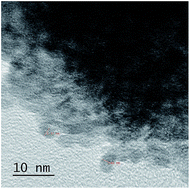
Fig. 2(a) and (b) shows TEM image of SnS QDs. TEM images showed the formation of spherical SnS QDs with size of 2.5–3 nm. The selected area electron diffraction (SAED) pattern of SnS QDs (Fig. 2(c)) obtained from spherical particles revealed the formation of circular diffraction rings, which reflects the polycrystalline nature of SnS QDs. The size distribution of SnS QDs is uniform and average particle size is 5.1 nm (the histogram in Fig. 2(d)). Energy dispersive X-ray spectroscopy (EDX) measurement was done to know the chemical composition of SnS QDs. The EDX spectrum revealed the characteristic L X-ray peak of Sn and the K X-ray peak of S (Fig. 3). The atomic concentrations of Sn and S were measured as 54.69% and 45.31% respectively.
![]() | ||
| Fig. 2 TEM image of SnS QDs (a and b) and (c) SAED pattern of SnS QDs and (d) histogram of SnS QDs size distribution. | ||
Fig. 4(a) and (b) shows the UV-Vis-NIR optical reflectance and absorption spectra of SnS QDs, respectively. The spectra displayed a continuous absorption from the UV-Vis region to near infra-red region. The broad spectrum allows SnS QDs to act as a good visible light-sensitive photocatalyst to drive photocatalytic degradation of organic pollutants. The optical band gap of the prepared SnS QDs was obtained from the UV-Vis-NIR optical absorption curve (Fig. 4(b)) using the tangent line extrapolation technique on the curve. The band gap energy (Ebg) was calculated by using simple equation: Ebg = 1240/λ (absorption edge), assuming that the prepared SnS QDs are direct crystalline semiconductor. The as-synthesized SnS QDs exhibits an absorption onset at 1070 nm, which corresponds to band gap energy of 1.15 eV. In order to get more precise values of the optical band gaps, the values of Eg were calculated with the help of the Tauc equation,26 (αhν) = A(hν − Eg)n, where α is the absorption coefficient. hν and A are the photon energy and a constant relative to the material, respectively and n is either 2 for a direct allowed electronic transition (direct band gap) or 1/2 for an indirect allowed electronic transition (indirect band gap). For this purpose, (αhν)1/2 was plotted as a function of photon energy hν (eV) for the indirect gap and (αhν)2 against photon energy hν (eV) for the direct gap. Fig. 4(c) and (d) are presentation of these plots. The linear intercept at hν on x-axis gives the value of optical band gap. The direct band gap and indirect band gap energy for SnS QDs are found to be 1.17 eV and 1.11 eV, respectively. The direct band gap is very close to that of silicon (1.11 eV).27 The band gap energy varies with synthetic temperature of reaction according to previous reported results.28 The optical direct band gap and indirect band gap16 in SnS nanoparticles are 3.6 eV and 1.6 eV, respectively and in bulk SnS, the direct band gap and the indirect band gap are 1.3 eV and 1.09 eV respectively. Band gap energy values of as prepared SnS QDs are compared with nanoparticles, it is seen that direct and indirect transition of SnS QDs are shifted towards lower energy values. Compared to bulk SnS, blue shift of 0.13 eV is observed for direct transition. This is because of enhancement of quantum confinement effect resulting from the decrease in the size of nanoparticles.
![]() | ||
| Fig. 4 UV-visible-NIR (a) reflectance and (b) absorbance spectrum of as-prepared SnS QDs. Tauc plots for direct band gap (c) and indirect band gap (d). | ||
Raman spectroscopy (RS) is used to probe the detailed structure of materials. It is a scattering technique based on Raman effect, i.e., frequency of a small fraction of scattered radiation is different from frequency of monochromatic incident radiation. It is based on the inelastic scattering of incident radiation through its interaction with vibrating molecules. The 24 vibrational modes29 for orthorhombic structure of SnS are represented as Γ = 4Ag + 2B1g + 4B2g + 2B3g + 2Au + 4B1u + 2B2u + 4B3u.
Among them, SnS has 21 optical phonons, of which 12 are Raman active modes (4Ag + 2B1g + 4B2g and 2B3g), seven infrared active modes (3B1u + 1B2u and 3B3u) and two are inactive (2Au). Fig. 5 shows the FT-Raman spectra of the as-synthesized SnS QDs. SnS QDs shows vibrational modes at 73, 97, 162, 188, 222 cm−1. The peak at 73 cm−1, 97 cm−1 and 162 cm−1 are corresponding to B1g or B2g mode, Ag mode and B3g mode, respectively. The peaks at 188 cm−1 and 222 cm−1 can be assigned to the Ag mode. It has been reported that vibrational modes14,30 for SnS nanoparticles was detected at 77, 95, 163, 191, and 220 cm−1. Vibrational modes of as prepared SnS QDs shows a slight shift towards lower wave number in comparison to SnS nanoparticles. This is attributed to phonon confinement. FT-Raman results indicate that the formation of SnS QDs from the present process.
Fig. 8(a) shows the absorbance spectra of brilliant green dye solution in presence of SnS QDs under sunlight irradiation. The maximum absorbance of brilliant green dye exhibits at 624 nm which disappears completely in presence of solar irradiation. The photodegradation efficiency of brilliant green using SnS QDs is represented by Fig. 8(b). From the graph, it is evident that 88.82% of brilliant green dye degraded using SnS QDs as a photocatalyst within 90 min of sunlight irradiation. The photodegradation rate constant of brilliant green was calculated from Fig. 8(c) and was found to be 0.0158 min−1.
The photodegradation activity of SnS QDs was compared with commercial P25 TiO2. The rate of degradation of eosin yellow using P25 TiO2 is found be same as that of SnS QDs, while P25 TiO2 decomposes only 68.36% of brilliant green within 90 min under sunlight irradiation. The enhanced photocatalytic activity of SnS QDs is attributed to improved visible light absorption and efficient separation of photogenerated charge carriers.
The used catalysts was regenerated by centrifugation and washing with methanol and finally dried in air oven.
To elucidate the active species responsible for the visible light photocatalytic degradation, various quenchers were added to aqueous solution containing dyes: eosin yellow (20 mg L−1) and 25 mg SnS, brilliant green (10 mg L−1) and 100 mg SnS and the photodegradation activity were studied. Quenchers are certain chemicals which hinder the action of certain specific species for the degradation reaction by trapping them during the course of photocatalytic experiment. The quenchers31 employed were 5 ml isopropanol (Pr) for hydroxyl radicals, 0.1 g ammonium oxalate (AO) for holes, 10−3 M 1,4-benzoquinone (BQ) for superoxide radical. Fig. 7(d) and 8(d) shows the effect of different quenchers on the photocatalytic activity of SnS. On adding isopropanol no distinct changes in the performance of SnS were observed. This indicates that bulk hydroxyl radicals do not take part in the degradation process. When AO is added to the solution the decolorization rate of eosin yellow is also increased. That means that holes (h+) do not take part in the degradation process. When BQ was added into the reaction solution, photocatalytic efficiency SnS QDs was decreased indicating superoxide radicals (O2˙−) are responsible for degrading eosin yellow under solar light irradiation. Similar kind of reaction was also observed with brilliant green dye degradation when BQ was added in the solution in presence of solar light irradiation (Fig. 8(d)). It is obvious that addition of BQ shows a major effect on the photodegradation process, manifesting that (O2˙−) played a significant role in photodegradation of dyes: eosin yellow and brilliant green. On addition of BQ, there has been 29.17% and 43.73% decrease in degradation efficiency of eosin yellow and brilliant green occurred, respectively. On the basis of above results, a possible reaction mechanism occurring during the photocatalytic degradation process of eosin yellow and brilliant green over SnS QDs are given below.
| SnS + hν → SnS(hVB+ + eCB−) |
| eCB− + hVB+ → energy |
| eCB− + O2 → O2˙− |
| O2˙− + H+ → ˙OOH |
| ˙OOH + ˙OOH → H2O2 + O2 |
| O2˙− + eosin yellow, brilliant green → intermediates → CO2 + H2O |
| ˙OOH + eosin yellow, brilliant green → CO2 + H2O |
In the presence of visible light, electrons in the valence band (VB) of SnS QDs are promoted to the conduction band (CB). As a result of this, a high amount of negative-electron (e−) and positive-hole (h+) pairs are generated. Both e− and h+ pairs can migrate to the catalyst surface, where they can enter in a redox reaction with dyes present on the surface. eCB− can react with O2 to produce superoxide radical anion of oxygen which have a powerful oxidation ability to degrade eosin yellow and brilliant green dyes. The stability of SnS QDs photocatalyst was checked by running the degradation experiment for three repeated cycles using the same catalyst. From Fig. 7(e) and 8(e), it is clear that photocatalytic activity is same for three repeated cycles indicating that the catalyst is stable and can be reused.
| This journal is © The Royal Society of Chemistry 2016 |