Bo Jianga,
Xin Zhanga,
Yuanhui Zhengb,
Gui Yub,
Jiannian Yaoa and
Chuanlang Zhan*a
aBeijing National Laboratory for Molecular Sciences, CAS Key Laboratory of Photochemistry, Institute of Chemistry Chinese Academy of Sciences, Beijing, 100190, P. R. China. E-mail: clzhan@iccas.ac.cn
bBeijing National Laboratory for Molecular Sciences, CAS Key Laboratory of Organic Solids, Institute of Chemistry Chinese Academy of Sciences, Beijing, 100190, P. R. China
First published on 25th April 2016
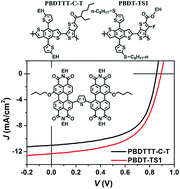
Herein, we synthesized a perylene diimide dimer as an efficient non-fullerene acceptor, which gives a promising efficiency of 5.24% and 6.36% with PBDTTT-C-T and PBDT-TS1 as the donor, respectively. A comparative study on the photovoltaic performance of the non-fullerene and fullerene based solar cells clearly demonstrates that relatively stronger recombination loss of the free carriers, lower electron mobility and larger phase size account for the lower short-circuit current density of the non-fullerene based solar cell.
Very recently, the power conversion efficiency (PCE) from the state-of-the-art non-fullerene based solar cell (NF-SC) has been fast raised over 5%.15–19 Such a rapid advance makes the NF-SC competitive to the fullerene based one. However, the photovoltaic performance of the NF-SC still lags behind the fullerene counterparts. To research the origins of this issue, we herein synthesized a PDI dimer, 1,1′-bis(n-butoxyl)-7,7′-(2,5-thienyl)bis-PDI (Bis-PDI-T-BuO) (Fig. 1A). The dimer is bridged with a thienyl unit, resulting in a highly twisted configuration to avoid the aggregation tendency from the perylene backbone, which is proved to be quite effective in obtaining efficient PDI accetpors.9,20–23 Twisted PDI configuration can also be obtained by substituting the bay positions with sterically hindered groups.24,25 On another aspect, n-butoxyl is linked on the bay-region to adjust the intermolecular interactions with the blend donor molecules because the side-chains have significant effects on the molecular aggregation and nano-morphology of the blend film, and thus the final photovoltaic performance.26–29 The n-butoxyl side-chains have been used in the design of efficient PDI based small molecule acceptors.30
![]() | ||
| Fig. 1 Chemical structure (A), optimal conformation (B), HOMO (C) and LUMO (D) of the PDI dimer, respectively. | ||
The PDI dimer, Bis-PDI-T-BuO, was synthesized by Stille coupling of 1-(n-butoxyl)-7-brominated PDI with 2,5-bis(tributylstannyl)thiophene. The yield is 81%. The product was fully characterized with 1H NMR, 13C NMR, TOF-MS, and elemental analysis (ESI†). 1-(n-Butoxyl)-7-brominated PDI was synthesized according to our reported literature.9 The detailed synthesis procedure is exhibited in ESI.†
Bis-PDI-T-BuO shows a highly twisted configuration, evaluated by Gaussian 09 at the B3LYP/6-31G* level of theory in the gas phase (Fig. 1B and S1, ESI†). The dihedral angle between two PDI planes is 19.08° and that between the PDI and the thienyl plane is 54.55°. Meanwhile, the two naphthalene rings in each PDI unit also exhibit distortion with a dihedral angle of 20.59°, resulted from the bay-substitution. The highly twisted configuration will be favourable to decrease the domain size in blend films.
The lowest unoccupied molecular orbital (LUMO) and highest occupied molecular orbital (HOMO) energies of the dimer were estimated from cyclic voltammetry (CV) (Fig. S2†). The LUMO energy is −3.86 eV calculated from onset reduction potential, which is higher than that of fullerene (−3.91 eV), indicating that a higher open-circuit voltage (Voc) can be obtained. The HOMO value is estimated to be −5.65 eV obtained from the onset oxidation potential. The theory calculation shows that the π-electrons of the perylene core are conjugated with the n-electrons of the ether oxygen atoms (Fig. 1C and D). This dimer has a strong absorption between 450 and 650 nm in dilute chloroform solution with a maximum absorptivity of 54
600 M−1 cm−1 around 554 nm, and the absorption is broadened with the long-wavelength edge extending to 700 nm in solid film (Fig. 2).
![]() | ||
| Fig. 2 UV-vis absorption spectra of Bis-PDI-T-BuO and PBDTTT-C-T in the dilute solution (A) and in the thin film (B), respectively. | ||
The electron mobility (μe) of Bis-PDI-T-BuO in pure film was measured by bottom-contact organic thin-film-transistor (OTFT). The PDI dimer shows typical n-channel semiconducting properties under air condition with clear current modulations and well-defined saturation regions (Fig. 3). The μe is estimated as 5.2 × 10⁻⁵ cm2 V−1 s−1.
The conjugated polymer of PBDTTT-C-T31 was chosen as the bulk-heterojunction blended donor since this D–A combination has matched LUMO and HOMO levels (Fig. S3†) and complementary absorption spectra (Fig. 2), beneficial for the efficient separation of the excitons generated by the donor and acceptor phases and usage of photons. The device structure is ITO/PEDOT:PSS (30 nm)/donor:acceptor/Ca (20 nm)/Al (80 nm). 1,2-Dichlorobenzene (o-DCB) and 1,8-diiodooctane (DIO) were used as the host and additive solvent, respectively. Table S1 (ESI†) shows the detailed photovoltaic parameters, which were obtained under AM 1.5 G illumination with an intensity of 100 mW cm−2. The optimal results were produced when the donor to acceptor ratio (D/A) was 1
:
1 with 2% (v/v) DIO as the additive.
Fig. 4A displays the current density–voltage (J–V) curves of the best device and Table 1 lists the corresponding cell parameters. The best device shows a PCE value of 5.24% with a Voc of 0.83 V, a short-circuit current density (Jsc) of 11.04 mA cm−2 and a fill factor (FF) of 57.02%. As Fig. 4B shows, the external quantum efficiency (EQE) response of the best device covers a wavelength range from 400 to 800 nm, reflecting the contributions from both the donor and acceptor components.
![]() | ||
| Fig. 4 The J–V (A) and EQE (B) plots of the optimal devices with PBDTTT-C-T as the donor, respectively. | ||
| Acceptor | Voc (V) | Jsc (mA cm−2) | FF (%) | PCEf (%) | μe (cm2 V−1 s−1) |
|---|---|---|---|---|---|
a Donor is PBDTTT-C-T. The D/A is 1 : 1, with 2% (v/v) DIO as the additive and solvent vapor annealing (SVA) for 8 h. Cathode: Ca/Al.b Donor is PBDT-TS1. SVA for 1 h. Cathode: Ca/Al.c Donor is PBDT-TS1. Cathode: PDINO/Al.d The optimal PC71BM : PBDTTT-C-T devices.e The optimal PC71BM : PBDT-TS1 devices.f The values in bracket are average values obtained from over 10 devices. |
|||||
| Dimer | 0.83a | 11.04 | 57.02 | 5.24 (5.12) | 2.3 × 10⁻⁵ |
| 0.89b | 11.11 | 55.99 | 5.50 (5.36) | 1.2 × 10⁻⁵ | |
| 0.89c | 12.28 | 58.17 | 6.36 (6.18) | — | |
| PC71BM | 0.76d | 14.99 | 65.70 | 7.48 (7.32) | 3.6 × 10⁻⁴ |
| 0.81e | 17.43 | 61.94 | 8.73 (8.52) | 1.5 × 10⁻⁴ | |
Compared to the PBDTTT-C-T/PC71BM based device, as shown in Table 1, which has an identical Ca/Al device structure, the PDI dimer gives a higher Voc (0.83 vs. 0.76 V) and a lower FF (57.02 vs. 65.70%). The PCE based on Bis-PDI-T-BuO is about 70% (5.24% vs. 7.48%) of that based on PC71BM, which is close to the ratio of Jsc (74%, 11.04 vs. 14.99 mA cm−2). These results indicate that the Jsc is the main factor limiting the NF-SC performance.
The Jsc is closely related to the light harvesting of organic components, the charge separation at the donor–acceptor interfaces, and the recombination and transportation of the mobile carriers. Fig. 5A exhibits the absorption spectra of the two blend films with PC71BM and PDI as the acceptor, respectively. The thicknesses of the two blend films were ∼100 nm. This figure clearly indicates that more photons are captured by the PC71BM based blend film. Following the absorption of the photons, excitons form and dissociate. The exciton dissociation is determined by the film-morphology. To qualitatively see the film-morphology, we collected the transmission electron microscopy (TEM) image of the Bis-PDI-T-BuO blend film. As Fig. 5B shows, the phase size is of 27 nm, which is larger than the size (5–10 nm) of the PC71BM blend film.31 The smaller phases mean a more intimately mixed morphology and enhanced interface area for exciton dissociation. Comparisons of the absorption and morphology indicate that the non-fullerene PDI based solar cell blend should generate less mobile charge carriers.
![]() | ||
| Fig. 5 (A) UV-vis absorption spectra of the PBDTTT-C-T/Bis-PDI-T-BuO and PBDTTT-C-T/PC71BM based blend films. (B) TEM image of PBDTTT-C-T/Bis-PDI-T-BuO based blend film, the scale bar is 200 nm. | ||
After generation of the mobile carriers, the recombination loss and transportation is another two factors affecting the amount of the carriers collected by the electrodes. To get insight into the recombination loss, light intensity dependence of current–voltage characteristics from the optimal devices (Ca/Al based devices) for two systems were investigated by varying the incident light intensity ranging from 20 to 100 mW cm−2. The recombination mechanism at short-circuit can be reflected by Jsc ∝ Pα, and that at the open-circuit can be expressed by the equation Voc ∝ nkT/q
ln(P).18 As shown in Fig. 6, both the n and α values from the PC71BM based device are closer to unit than those from the Bis-PDI-T-BuO, suggesting that less monomolecular and bimolecular recombination loss occur for the fullerene system.32,33
![]() | ||
| Fig. 6 Plots of Voc (A) and Jsc (B) versus light intensity together with linear fits to the data, respectively. | ||
The electron and hole mobilities were estimated using space-charge-limited-current (SCLC) method with a device structure of ITO/ZnO/donor:acceptor/Ca/Al (electron-only) and ITO/PEDOT:PSS/donor:acceptor/Au (hole-only), respectively. Fig. S4 and S5† are the plots of ln(J) vs. ln(V), which are extracted from the experimental electron-only and hole-only J–V data. The estimated hole mobilities (μh) for the two blend films are both on the same order of magnitude (2.5 × 10⁻⁴ vs. 4.5 × 10⁻⁴ cm2 V−1 s−1), while the μe for Bis-PDI-T-BuO is one order of magnitude lower (1.2 × 10⁻⁵ vs. 1.5 × 10⁻⁴ cm2 V−1 s−1) (Table 1).
Taken together, with the same donor PBDTTT-C-T, the lower generation, stronger recombination loss and lower electron mobility account for the lower photocurrent for the PDI based NF-SC than the PC71BM based solar cell.
Compared with PBDTTT-C-T, PBDT-TS1
34 exhibits red-shifted absorption (Fig. S6†) and lower HOMO energy level (Fig. S7†), so larger Jsc and Voc are expected when PBDT-TS1 is used as the donor with Bis-PDI-T-BuO as the acceptor. Fig. S8† displays the J–V curves of the best device and Table S2† lists the corresponding cell parameters. The optimal device (Table 1) shows a PCE value of 5.50% with a Voc of 0.89 V, a short-circuit current density (Jsc) of 11.11 mA cm−2 and a fill factor (FF) of 55.99%. PDINO was used as electron extraction layer to replace Ca, because of its high conductivity, appropriate energy level, and work function tuning effect.35,36 Compared with the Ca/Al devices, PDINO/Al devices show improved Jsc (12.28 mA cm−2) and FF (58.17%), giving a high PCE of 6.36%. However, compared to the PC71BM based Ca/Al device, the PDI dimer gives a PCE only about 63% (5.50% vs. 8.73%) of that based on PC71BM, which is close to the ratio of Jsc (64%, 11.11 vs. 17.43 mA cm−2). When PDINO was used, the PCE ratio (73%) is still close to the Jsc ratio (70%).
Footnote |
| † Electronic supplementary information (ESI) available: Synthesis and characterization, quantum chemical calculations, device fabrication and procedures. See DOI: 10.1039/c6ra08827a |
| This journal is © The Royal Society of Chemistry 2016 |