Qian Sunab,
Fei-Fei Liabc,
Di Wangab,
Jie Wuab,
Guo-Dong Yaod,
Xue Lie,
Ling-Zhi Liab,
Qing-Bo Liuab,
Xiao-Xiao Huangab and
Shao-Jiang Song*ab
aSchool of Traditional Chinese Materia Medica, Shenyang Pharmaceutical University, Shenyang 110016, People's Republic of China. E-mail: songsj99@163.com; Fax: +86-24-23986088; Tel: +86-24-23986510
bKey Laboratory of Structure-Based Drug Design & Discovery (Ministry of Education), Shenyang Pharmaceutical University, Shenyang 110016, People's Republic of China
cYangtze River Pharmaceutical (Group) Co., Ltd., Taizhou 225300, People's Republic of China
dChina-Japan Research Institute of Medical Pharmaceutical Sciences, Shenyang Pharmaceutical University, Shenyang 110016, People's Republic of China
eSchool of Life Sciences and Biopharmaceutics, Shenyang Pharmaceutical University, Shenyang 110016, People's Republic of China
First published on 6th June 2016
Thirteen new flavan compounds named daphnegiravans A–M (1–13) and eight known analogues (14–21) were isolated from the stem and root bark of Daphne giraldii. Their structures were established by comprehensive analysis of NMR data and CD spectra. Five human cancer cell lines (MCF-7, Bcap37, HepG2, Hep3B and A549) were used to evaluate the antitumor activity of all the isolates and their structure–activity relationships were also discussed. Interestingly, prenylated and some methoxy flavans exhibited the highest activities against Hep3B compared with the other cell lines, especially 3 and 9–12 with IC50 values ranging from 5.15 to 9.66 μM. Furthermore, flow cytometry analysis indicated that 3 and 9–11 possessing a 2,2-dimethylpyran moiety in ring B induced G2/M phase arrest in Hep3B cells, while 12 with different structural features effectively inhibited cell proliferation by evoking apoptotic cell death. The reactive oxygen species (ROS) generation might be responsible for the induction of arrest and apoptosis.
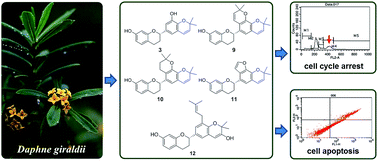
The genus Daphne (Thymelaeaceae) is distributed widely around the world, and it comprises approximately 90 species, 44 of which are native to China.8 Previous phytochemical investigations into this genus have led to the isolation of many promising constituents. Some of them such as coumarins, flavonoids and daphnane diterpenoids have been found to possess marked cytotoxic activities,9–12 which has made Daphne especially attractive in a search to discover lead compounds. Daphne giraldii Nitsche. is a toxic shrub which belongs to the genus Daphne.13 Its rhizome bark, generally called ‘ZuShima’ in Chinese, is reported to have exhibit anti-inflammatory, anti-tumor, anti-malarial and anti-fertility effects.14,15 Flavonoids including characteristic flavans and biflavones are the main types of compounds in D. giraldii.16,17 In our ongoing search for cytotoxic natural products from the genus Daphne, a series of flavan derivatives were isolated from the stem and root bark of D. giraldii and found to inhibit cancer cell proliferation in cell-based assays.
Here, we report the isolation and structural elucidation of thirteen new flavans daphnegiravans A–M (1–13) along with eight known ones (14–21), as well as measuring the in vitro cytotoxicities of all the isolates against five human cancer cell lines. Moreover, compounds 3 and 9–12 were also evaluated for further cell cycle distribution, apoptosis and ROS level of Hep3B cells.
| No | 1a | 2b | 3a | 4b | 5c | 6b | 7d | 8d | 9b | 10b | 11a | 12c | 13a |
|---|---|---|---|---|---|---|---|---|---|---|---|---|---|
| a Data were measured in DMSO-d6 at 100 MHz.b Data were measured in DMSO-d6 at 150 MHz.c Data were measured in methanol-d4 at 150 MHz.d Data were measured in CDCl3 at 75 MHz. | |||||||||||||
| 2 | 76.6 | 77.0 | 76.6 | 74.6 | 75.8 | 74.6 | 75.0 | 74.9 | 73.7 | 73.6 | 75.4 | 79.4 | 76.1 |
| 3 | 29.2 | 29.8 | 29.3 | 29.7 | 30.9 | 29.6 | 29.5 | 28.5 | 29.0 | 28.4 | 28.8 | 31.8 | 29.2 |
| 4 | 23.8 | 23.7 | 23.8 | 24.0 | 26.1 | 24.6 | 25.5 | 25.3 | 24.2 | 24.5 | 24.0 | 25.4 | 23.7 |
| 5 | 129.8 | 129.8 | 129.8 | 129.8 | 131.0 | 129.8 | 130.2 | 130.1 | 129.9 | 129.9 | 129.8 | 131.0 | 129.8 |
| 6 | 108.0 | 108.1 | 107.9 | 108.0 | 109.3 | 108.0 | 107.9 | 108.0 | 108.1 | 108.0 | 108.1 | 109.1 | 108.1 |
| 7 | 156.5 | 156.5 | 156.4 | 156.4 | 157.6 | 156.5 | 154.9 | 155.0 | 156.4 | 156.4 | 156.5 | 157.6 | 156.5 |
| 8 | 102.8 | 102.8 | 102.7 | 102.8 | 104.1 | 102.8 | 103.7 | 103.7 | 102.8 | 102.8 | 102.7 | 104.0 | 102.8 |
| 9 | 155.4 | 155.3 | 155.4 | 155.8 | 157.3 | 155.8 | 156.6 | 156.4 | 155.5 | 155.7 | 155.4 | 157.1 | 155.2 |
| 10 | 112.1 | 112.1 | 112.2 | 112.1 | 114.1 | 112.2 | 114.3 | 114.3 | 112.3 | 112.3 | 112.2 | 114.3 | 112.1 |
| 1′ | 133.9 | 136.5 | 133.7 | 135.5 | 134.2 | 135.7 | 130.7 | 129.6 | 128.6 | 130.9 | 125.9 | 138.1 | 132.7 |
| 2′ | 124.2 | 118.6 | 114.1 | 121.9 | 134.7 | 121.8 | 110.1 | 116.6 | 119.7 | 120.0 | 127.3 | 117.2 | 126.4 |
| 3′ | 120.7 | 127.7 | 145.2 | 139.0 | 145.4 | 139.3 | 143.7 | 140.6 | 140.4 | 142.1 | 142.6 | 129.6 | 121.9 |
| 4′ | 151.9 | 153.7 | 139.4 | 143.4 | 148.9 | 143.5 | 140.9 | 142.8 | 140.1 | 140.5 | 137.0 | 154.1 | 160.4 |
| 5′ | 115.6 | 110.9 | 121.4 | 126.7 | 119.4 | 126.2 | 119.8 | 124.8 | 121.6 | 119.1 | 116.5 | 125.9 | 117.4 |
| 6′ | 127.0 | 122.6 | 114.7 | 109.1 | 114.7 | 109.1 | 128.9 | 118.1 | 115.8 | 114.4 | 118.8 | 122.8 | 134.3 |
| 1′′ | 24.6 | 26.2 | 24.0 | 74.9 | 73.1 | ||||||||
| 2′′ | 76.1 | 72.8 | 75.7 | 123.8 | 123.4 | 123.8 | 74.6 | 74.9 | 131.8 | 31.9 | 146.3 | 69.9 | |
| 3′′ | 131.2 | 160.4 | 131.2 | 129.9 | 132.7 | 129.9 | 33.2 | 32.8 | 118.7 | 19.1 | 106.1 | 165.2 | |
| 4′′ | 121.8 | 104.1 | 122.2 | 25.4 | 25.9 | 25.4 | 20.3 | 19.3 | 26.9 | 26.3 | 101.7 | ||
| 5′′ | 27.6 | 25.0 | 27.4 | 17.7 | 18.1 | 17.7 | 26.4 | 26.9 | 27.2 | 26.7 | 29.1 | ||
| 6′′ | 27.6 | 25.0 | 27.4 | 27.3 | 26.9 | 29.1 | |||||||
| 1′′′ | 26.9 | 28.4 | 29.2 | ||||||||||
| 2′′′ | 72.8 | 81.3 | 145.3 | 123.2 | 122.6 | 75.9 | 75.7 | 76.9 | 123.0 | ||||
| 3′′′ | 159.2 | 49.7 | 107.2 | 131.6 | 132.4 | 131.6 | 130.2 | 129.3 | 133.9 | ||||
| 4′′′ | 104.6 | 194.8 | 25.7 | 25.9 | 122.3 | 122.4 | 122.1 | 25.9 | |||||
| 5′′′ | 25.0 | 26.7 | 18.1 | 17.9 | 27.4 | 27.5 | 27.6 | 18.0 | |||||
| 6′′′ | 25.0 | 26.7 | 27.5 | 27.7 | 27.6 | ||||||||
| OCH3-3′′ | 50.3 | 50.2 | |||||||||||
| CHO-3′ | 191.3 | ||||||||||||
| No | 1a | 2b | 3a | 4b | 5c | 6b | 7d | 8d |
|---|---|---|---|---|---|---|---|---|
| a Recorded in DMSO-d6 and 400 MHz.b Recorded in DMSO-d6 and 600 MHz.c Recorded in methanol-d4 and 600 MHz.d Recorded in CDCl3 and 300 MHz. o: the abbreviation for overlapped. | ||||||||
| 2 | 4.89 dd (10.0, 1.7) | 5.12 dd (10.1, 1.8) | 4.83 dd (9.8, 1.7) | 5.08 dd (10.2, 1.7) | 5.04 dd (10.2, 1.7) | 5.09 dd (10.0, 1.6) | 5.09 dd (9.9, 3.0) | 5.05 m |
| 3 | 2.05 m, 1.91 m | 2.12 m, 1.98 m | 2.03 m, 1.86 m | 2.07 m, 1.86 m | 2.11 m, 1.93 m | 2.09 m, 1.89 m | 2.09 m, 2.05 m | 2.14 m, 2.11 m |
| 4 | 2.80 m, 2.59 m | 2.84 m, 2.60 m | 2.79 m, 2.58 m | 2.83 m, 2.66 m | 2.88 m, 2.73 m | 2.83 m, 2.66 m | 2.90 m, 2.78 m | 2.92 m, 2.79 m |
| 5 | 6.85 d (8.1) | 6.86 d (8.2) | 6.84 d (8.2) | 6.88 d (8.2) | 6.89 d (8.2) | 6.88 d (8.2) | 6.93 d (8.0) | 6.94 d (8.4) |
| 6 | 6.29 dd (8.1, 2.4) | 6.30 dd (8.2, 2.3) | 6.27 dd (8.2, 2.4) | 6.29 dd (8.2, 2.4) | 6.33 dd (8.2, 2.3) | 6.29 dd (8.2, 2.3) | 6.38 dd (8.0, 2.4) | 6.39 dd (8.4, 2.4) |
| 8 | 6.20 d (2.4) | 6.22 d (2.3) | 6.18 d (2.4) | 6.19 d (2.4) | 6.26 d (2.3) | 6.19 d (2.3) | 6.36 o | 6.37 o |
| 2′ | 7.10 d (2.0) | 7.64 d (1.7) | 6.71 d (1.8) | 6.97 s | ||||
| 5′ | 6.73 d (8.1) | 7.56 d (8.5) | ||||||
| 6′ | 7.13 dd (8.1, 2.0) | 7.33 dd (8.5, 1.7) | 6.57 d (1.8) | 7.13 s | 7.45 s | 7.18 s | 6.81 s | |
| 1′′ | 3.49 dd (15.1, 7.0), 3.41 dd (15.0, 6.5) | 3.53 dd (14.7, 7.0), 3.44 o | 3.50 dd (15.1, 7.0), 3.42 dd (15.0, 6.7) | |||||
| 2′′ | 5.06 o | 5.10 t 7.0 | 5.07 o | |||||
| 3′′ | 5.74 d (9.8) | 5.72 d (9.8) | 1.84 t (6.6) | 1.84 t (7.0) | ||||
| 4′′ | 6.41 d (9.8) | 6.87 s | 6.35 d (9.8) | 1.62 s | 1.68 s | 1.62 s | 2.69 t (6.8) | 2.89 m, 2.72 m |
| 5′′ | 1.37 s | 1.55 s | 1.36 s | 1.68 s | 1.72 s | 1.68 s | 1.33 s | 1.36 s |
| 6′′ | 1.37 s | 1.55 s | 1.36 s | 1.37 s | 1.37 s | |||
| 1′′′ | 3.36 dd (15.6, 6.6), 3.22 dd (15.6, 5.7) | 3.34 d (7.0) | ||||||
| 2′′′ | 7.92 d (2.0) | 4.98 t (6.6) | 5.33 m | |||||
| 3′′′ | 2.76 o | 6.88 d (2.0) | ||||||
| 4′′′ | 6.78 s | 1.67 s | 1.72 s | |||||
| 5′′′ | 1.56 s | 1.50 s | 1.70 s | 1.72 s | ||||
| 6′′′ | 1.56 s | 1.50 s | ||||||
| OH-7 | 9.19 br s | 9.38 br s | 9.16 br s | 9.17 br s | 9.24 br s | |||
| OCH3-3′′ | 2.99 s | 3.00 s | ||||||
Compound 2 possessed the molecular formula C21H22O4, as determined from a sodiated molecular ion in the positive HRESIMS at m/z 361.1411 [M + Na]+ combined with its NMR data. The 1H and 13C spectroscopic data of 2 were similar to those of 1 except for the presence of an additional methoxy group, suggesting that 2 was a 3′′-OCH3 derivative of 1, which was further supported by the downfield shift of C-3′′ (δC 160.4) and the HMBC long range correlations of OCH3-3′′/C-2′′ and CH3-5′′,6′′/C-3′′, OCH3-3′′. Its absolute 2S configuration was determined by CD spectroscopy. Based on these examinations, compound 2 was given the name daphnegiravan B.
The molecular formula of daphnegiravan C (3) was established as C20H20O4 by HRESIMS (m/z 347.1260 [M + Na]+) which showed that the molecule had eleven degrees of unsaturation. A comparison of the NMR spectroscopic data of 3 with those of 1 revealed that the only difference between them was the typical NMR signals of a symmetric 1′,3′,4′,5′-tetrasubstituted phenyl moiety in 3 rather than the 1′,3′,4′-trisubstituted phenyl groups in 1, as confirmed by the presence of a hydroxy group at C-3′ [δH 8.93 (1H, brs, OH-3′)] and two meta-coupling signals belonging to ring B [δH 6.71 (1H, d, J = 1.8 Hz, H-2′); 6.57, (1H, d, J = 1.8 Hz, H-6′)] in the 1H NMR spectrum (Table 2). In addition, these findings were supported by the HMBC correlations of H-6′/C-2, C-2′, C-4′′. The stereochemistry of C-2 involved an S-configuration from the negative CE. Thus, the structure of 3 was determined assigned as daphnegiravan C.
Compound 4 was isolated as a yellow solid with the molecular formula C26H30O5 (HRESIMS, m/z 445.1993 [M + Na]+). Comparison of the 1H and 13C NMR data of 4 with those of 1 and 3 showed that it had a similar flavan skeleton, the major difference being the presence of a prenyl group [δH 3.49 (1H, dd, J = 15.1, 7.0 Hz, Ha-1′′); 3.41 (1H, dd, J = 15.0, 6.5 Hz, Hb-1′′); 5.06 (1H, overlapped, H-2′′); 1.62 (3H, s, CH3-4′′) and 1.68 (3H, s, CH3-5′′)] (Table 2) at C-2′ in 4. This was further supported by the key HMBC correlations of H-2′′/C-1′, C-2′, C-3′ and H-6′/C-2, C-2′, C-4′′′. From the negative CE at 283 nm in its CD spectrum, compound 4 was confirmed to have an S configuration, and was named daphnegiravan D.
The HRESIMS spectra of 5 and 6 exhibited quasimolecular ion peaks at m/z 409.2002 [M + H]+ and 373.1418 [M + Na]+ corresponding to molecular formulae of C25H28O5 and C22H22O4, respectively. Their NMR data (Tables 1 and 2) were found to be structurally similar to that of 4, whereas the 2,2-dimethyl-3-methoxylpyran group present in 4 was replaced by a 4-carbonyl-2,2-dimethyldihydropyran moiety [δH 2.76 (2H, overlapped, H-3′′′); 1.50 (6H, s, CH3-5′′′, 6′′′)] in 5 and a furan group [δH 7.92 (1H, d, J = 2.0 Hz, H-2′′′); 6.88 (1H, d, J = 2.0 Hz, H-3′′′)] in 6. Besides, the respective HMBC cross-peaks of H-6′/C-2, C-2′, C-4′′′ (δC 194.8) for 5 (Fig. 2) and H-6′/C-2, C-2′, C-3′′′ (δC 107.2) for 6 both supported the idea that the functional groups above were fused with the C-4′ and 5′ of ring B. The absolute configurations at C-2 were deduced to be S from CD measurements (Δε287 −0.83 of 5; Δε282 −0.77 of 6). As a result, compounds 5 and 6 were named daphnegiravans E and F.
Compounds 7 and 8 displayed the same molecular formula of C25H30O4 as inferred from the [M + Na]+ ion peak (m/z 417.2034 in 7; m/z 417.2037 in 8) suggestive of eleven indices of hydrogen deficiency. The 1H and 13C spectroscopic data (Tables 1 and 2) of 7 and 8 showed that they shared the same 7-hydroxyflavan skeleton with a phenolic hydroxyl group, a 2,2-dimethyldihydropyran ring and a prenyl group in ring B. However, they were found to differ in terms of the substitution pattern of the aromatic ring according to 2D NMR. The HMBC spectrum of 7 displayed correlations of OH-3′/C-2′, C-3′, C-4′, H-4′′/C-4′, C-5′, C-6′ and H-1′′′/C-1′, C-5′, C-6′, which indicated that the hydroxyl, 2,2-dimethyldihydropyran and prenyl groups were linked at C-3′, C-4′,5′ and C-6′, respectively. In contrast, the position of the 2,2-dimethyldihydropyran ring of 8 changed to C-2′,3′, also the hydroxyl and prenyl groups were located at C-4′, C-5′ as deduced from the HMBC signals for H-4′′/C-1′, C-2′, C-3′ and H-1′′′/C-4′, C-5′, C-6′. The absolute configurations at C-2 were confirmed as S by comparison of the CD data with literature values (Δε284 −0.64 of 7; Δε286 −0.60 of 8). Based on the above analysis, compounds 7 and 8 were named daphnegiravans G and H.
Compounds 9–11 were obtained as yellow amorphous solid. Their molecular formulae were assigned as C25H26O4, C25H28O4 and C22H20O4 by HRESIMS analysis (m/z 413.1717 [M + Na]+ in 9; m/z 415.1878 [M + Na]+ in 10; m/z 371.1259 [M + Na]+ in 11). The NMR data of 9–11 exhibited the signal patterns characteristic of a 7-hydroxyflavan with a 2,2-dimethylpyran moiety connected to C-4′,5′ very similar to those of 1. In addition, 9–11 had a 2,2-dimethylpyran [δH 5.79 (1H, d, J = 9.9 Hz, H-3′′), 6.62 (1H, d, J = 9.9 Hz, H-4′′), 1.37 (3H, s, CH3-5′′) and 1.39 (3H, s, CH3-6′′)], a 2,2-dimethyldihydropyran [δH 1.76 (1H, t, J = 6.9 Hz, H-3′′), 2.78, 2.66 (each 1H, m, H-4′′), 1.26 (3H, s, CH3-5′′) and 1.29 (3H, s, CH3-6′′)] and a furan [δH 7.94 (1H, d, J = 2.0 Hz, H-2′′) and 7.00 (1H, d, J = 2.0 Hz, H-3′′)] group, respectively (Table 3). In the HMBC spectra, correlations of H-4′′/C-1′, C-2′, C-3′ for 9 (Fig. 2), H-4′′/C-1′, C-2′, C-3′ for 10 and H-3′′/C-1′, C-2′, C-3′ for 11 indicated that the attachments of these groups were all at the C-2′,3′ in ring B. Analysis of the CD data (ESI Fig. S9.8, S10.8 and S11.7†) of 9–11 revealed that they had the same S absolute configuration at C-2. Consequently, compounds 9–11 were named daphnegiravans I–K.
| No | 9a | 10a | 11b | 12c | 13b |
|---|---|---|---|---|---|
| a Recorded in DMSO-d6 and 300 MHz.b Recorded in DMSO-d6 and 400 MHz.c Recorded in methanol-d4 and 300 MHz. | |||||
| 2 | 5.12 dd (10.0, 2.0) | 5.00 dd (10.0, 1.5) | 5.23 dd (10.1, 1.9) | 5.04 dd (9.9, 2.1) | 5.00 dd (10.0, 1.8) |
| 3 | 2.04 m, 1.90 m | 2.08 m, 1.88 m | 2.10 m, 2.00 m | 2.16 m, 2.02 m | 2.07 m, 1.90 m |
| 4 | 2.89 m, 2.62 m | 2.85 m, 2.64 m | 2.90 m, 2.65 m | 2.87 m, 2.65 m | 2.81 m, 2.59 m |
| 5 | 6.87 d (8.1) | 6.87 d (8.1) | 6.89 d (8.2) | 6.86 d (8.1) | 6.86 d (8.2) |
| 6 | 6.29 dd (8.1, 2.4) | 6.28 dd (8.1, 2.4) | 6.31 dd (8.2, 2.2) | 6.32 dd (8.1, 2.4) | 6.29 dd (8.2, 2.4) |
| 8 | 6.19 d (2.4) | 6.18 d (2.4) | 6.21 d (2.2) | 6.28 d (2.4) | 6.20 d (2.4) |
| 2′ | 7.40 d (1.5) | 7.68 d (2.2) | |||
| 5′ | 7.02 d (8.6) | ||||
| 6′ | 6.70 s | 6.67 s | 7.03 s | 7.08 d (1.5) | 7.56 dd (8.6, 2.2) |
| 2′′ | 7.94 d (2.0) | ||||
| 3′′ | 5.79 d (9.9) | 1.76 t (6.9) | 7.00 d (2.0) | ||
| 4′′ | 6.62 d (9.9) | 2.78 m 2.66 m | 6.61 s | ||
| 5′′ | 1.37 s | 1.26 s | 1.63 s | ||
| 6′′ | 1.39 s | 1.29 s | 1.63 s | ||
| 1′′′ | 3.60 d (7.4) | ||||
| 2′′′ | 5.39 m | ||||
| 3′′′ | 5.74 d (9.9) | 5.65 d (9.6) | 5.73 d (9.8) | ||
| 4′′′ | 6.36 d (9.9) | 6.34 d (9.6) | 6.52 d (9.8) | 1.73 s | |
| 5′′′ | 1.36 s | 1.35 s | 1.45 s | 1.79 s | |
| 6′′′ | 1.38 s | 1.35 s | 1.45 s | ||
| OH-7 | 9.01 brs | 9.06 brs | 9.17 brs | 9.19 brs | |
| CHO-3′ | 10.28 s | ||||
The molecular formula of compound 12 was determined as C25H28O4 based on HRESIMS analysis (m/z 415.1878 [M + Na]+, calcd 415.1880). Its 13C NMR spectrum (Table 1) was consistent with that of a flavan, with fifteen signals attributed to fifteen carbons of the flavan skeleton, with five signals assigned to the prenyl group and four to the 2,2-dimethylpyran ring. Apart from these characteristic signals, the absence of olefinic protons and a downfield shift of C-3′′ (δC 165.2) were also observed in the 1D NMR suggesting that a hydroxyl group was attached at C-3′′. Resonances for two meta-coupling protons [δH 7.40 (1H, d, J = 1.5 Hz, H-2′) and 7.08 (1H, d, J = 1.5 Hz, H-6′)], as well as the HMBC cross-peaks of H-4′′/C-2′, C-3′, H-1′′′/C-4′, C-5′, C-6′ implied that the positions of the 2,2-dimethylpyran ring and the prenyl group were C-3′,4′ and C-5′ respectively (Fig. 2). Accordingly, a planar structure was established for 12, and the negative CE at 286 nm (Δε −0.77) supported the 2S-configuration. Compound 12 was then named daphnegiravan L.
Compound 13, a brown solid, was deduced to have the molecular formula C16H14O4, as determined by the observed ion at m/z 293.0773 [M + Na]+ (calcd 293.0784) in its HRESIMS. The 1H and 13C NMR spectra (Tables 1 and 3) displayed the presence of an aldehyde group at δH 10.28 (1H, s) and the corresponding carbon signal at δC 191.3, with the remaining signals being a simple 7,4′-dihydroxyflavan. Moreover, the HMBC correlations of the aldehyde proton CHO-3′/C-2′, C-3′ and the aromatic proton H-2′ [δH 7.68 (1H, d, J = 2.2 Hz)]/CHO-3′ (δC 191.3) indicated that the aldehyde group was located at C-3′. Using the same methods as those used for 1–12 permitted the assignment of the absolute configuration of 13, which was named daphnegiravan M.
In addition, eight previously reported compounds were assigned as (2S)-7,4′-dihydroxy-3′-prenylflavan (14),19 (2S)-kazinol I (15),20 (2S)-7,4′-dihydroxyflavane (16),21 (2S)-7,4′-dihydroxy-3′-methoxyflavan (17),22 (2S)-7,3′-dihydroxy-4′-methoxyflavan (18),22 (2S)-7-hydroxy-3′,4′-dimethoxyflavan (19),23 (2S)-4′-hydroxy-7-methoxyflavan (20)24 and (2S)-7,3′-dimethoxy-4′-hydroxyflavan (21).24 They were all obtained from genus Dapnhe for the first time.
| Compound | MCF-7 | Bcap37 | HepG2 | Hep3B | A549 |
|---|---|---|---|---|---|
| a Results are expressed as IC50 means ± SD in μM, 5-fluorouracil was used as the positive controls. The experiments were performed three times. | |||||
| 1 | 47.09 ± 1.24 | 70.42 ± 3.25 | 22.36 ± 0.66 | 19.34 ± 0.12 | 48.18 ± 1.11 |
| 2 | >100 | >100 | >100 | 46.12 ± 1.96 | >100 |
| 3 | 67.45 ± 2.16 | >100 | 34.18 ± 1.11 | 7.97 ± 0.51 | 37.74 ± 0.45 |
| 4 | >100 | >100 | 89.46 ± 4.28 | 12.94 ± 0.93 | >100 |
| 5 | >100 | >100 | >100 | 92.25 ± 4.56 | >100 |
| 6 | >100 | >100 | >100 | 47.08 ± 1.17 | >100 |
| 7 | 29.11 ± 0.88 | 27.62 ± 0.33 | 27.22 ± 0.51 | 22.23 ± 0.89 | 23.94 ± 0.93 |
| 8 | >100 | >100 | 51.99 ± 2.82 | 44.85 ± 1.62 | >100 |
| 9 | 20.93 ± 0.32 | 33.13 ± 0.93 | 21.92 ± 0.38 | 5.15 ± 0.11 | 17.39 ± 0.23 |
| 10 | 88.29 ± 4.76 | >100 | 36.99 ± 1.24 | 9.29 ± 0.55 | 45.18 ± 0.76 |
| 11 | 24.68 ± 0.58 | 37.38 ± 0.87 | 18.14 ± 0.50 | 9.66 ± 0.28 | 32.77 ± 0.99 |
| 12 | 17.78 ± 0.41 | 38.41 ± 0.11 | 20.91 ± 0.19 | 5.63 ± 0.23 | 39.39 ± 1.88 |
| 13 | 51.79 ± 2.51 | >100 | 73.35 ± 1.89 | 31.04 ± 0.84 | 18.27 ± 0.62 |
| 14 | 52.41 ± 3.67 | 90.08 ± 4.95 | 33.54 ± 0.44 | 28.25 ± 0.39 | 56.67 ± 2.21 |
| 15 | >100 | >100 | >100 | 31.34 ± 0.40 | >100 |
| 16 | >100 | >100 | >100 | >100 | >100 |
| 17 | >100 | >100 | >100 | 49.17 ± 1.81 | >100 |
| 18 | >100 | >100 | >100 | 44.65 ± 1.95 | >100 |
| 19 | >100 | >100 | >100 | 91.46 ± 4.88 | >100 |
| 20 | >100 | >100 | >100 | >100 | >100 |
| 21 | >100 | >100 | >100 | 60.33 ± 2.21 | >100 |
| 5-Fu | 42.78 ± 0.99 | 47.09 ± 1.44 | 49.71 ± 1.02 | 10.53 ± 0.22 | 34.26 ± 0.78 |
With regard to non-prenylated flavans (16–21), they displayed the inhibitory effects on the growth of Hep3B cells associated with the substituent pattern of hydroxyl and methoxyl groups. Comparison of the cytotoxic activities between 17–19 and 16, 21 and 20 suggested that the methoxyl added in ring B could lead to a slightly increased inhibition of Hep3B proliferation. Neither compound 16 nor 20 were cytotoxic, which demonstrated that the type of substituent groups at C-7 had no influence on their activities. Moreover, the hydroxyl was more effective than the methoxyl in terms of increasing the inhibitory effect on Hep3B in comparison with 17–18 and 19.
ROS is an important regulatory factor in cellular signaling pathways close related to development and dissemination of cancer cells.30 Excessive ROS generation has been reported to cause irreversible injury including DNA damage, cell cycle arrest and apoptosis.31 Therefore, ROS levels of Hep3B cells induced by the two most active compounds 9 and 12 were detected using the fluorescent probe DCFH-DA. As shown in Fig. 6, significant increases in the ROS formation were both observed after treatment for 48 h. These data showed that 9 and 12 were good candidates for the promotion of ROS level in cells. Moreover, intracellular ROS was considered to be associated with G2/M phase cell cycle arrest and apoptosis induced by 9 and 12, respectively.
:
1 to 0
:
100) to get fractions A–D. Fraction B (280.0 g) was separated into B1–B5 by repeated silica gel eluted with PE–EtOAc (50
:
1 to 0
:
100), and B3 (65.3 g) followed by an MCI gel column (MeOH–H2O, 40
:
60 to 100
:
0) to yield B3a–B3d. Then fraction B3b (10.6 g) was subjected sequentially on reversed-phase C18 silica gel CC (MeOH–H2O, 40
:
60 to 100
:
0) and silica gel (PE–EtOAc, 8
:
1 to 1
:
1), finally by semipreparative HPLC (MeCN–H2O, 30
:
70) at a flow rate of 5 mL min−1 to yield 16 (11.5 mg, tR 24.5 min), 17 (29.0 mg, tR 26.7 min) and 18 (20.6 mg, tR 29.1 min), respectively. Fraction B3c (24.0 g) was chromatographed over ODS silica gel using MeOH–H2O (50
:
50 to 80
:
20) as an eluent to produce five fractions (B3c-1–B3c-5), and separation of B3c-2 (2.7 g) on silica gel (PE–EtOAc, 10
:
1 to 1
:
1) obtained ten subfractions named B3c-2-1–B3c-2-10 based on TLC monitoring. Fr. B3c-2-2 (168.4 mg) was further purified by semipreparative HPLC (MeCN–H2O, 65
:
35, 5 mL min−1) to afford 8 (25.2 mg, tR 12.3 min), 9 (7.1 mg, tR 17.1 min) and 10 (8.9 mg, tR 18.4 min). Fr. B3c-2-4 (94.6 mg) was applied to HPLC eluted with MeCN–H2O (60
:
40, 5 mL min−1) to obtain 7 (11.3 mg, tR 20.7 min). Similarly, Fr. B3c-2-7 (92.1 mg) was purified through HPLC chromatography (MeCN–H2O, 40
:
60, 5 mL min−1) to give 5 (5.3 mg, tR 15.4 min) and 12 (9.0 mg, tR 21.9 min). Fraction B3c-3 (8.2 g) was subjected to silica gel CC (PE–EtOAc, 20
:
1 to 1
:
1) to give ten fractions (B3c-3-1–B3c-3-10). Fr. B3c-3-2 (142.6 mg) was purified by HPLC (MeCN–H2O, 40
:
60, 3 mL min−1) to yield 20 (4.6 mg, tR 28.5 min) and 21 (4.4 mg, tR 30.8 min). Likewise, Fr. B3c-3-3 (186.6 mg) was purified in the same way to afford 1 (35.6 mg, tR 34.7 min), 11 (12.5 mg, tR 37.1 min) and 6 (2.5 mg, tR 40.5 min), respectively. The Fr. B3c-3-4 (0.7 g) was run through CC over ODS silica gel (MeOH–H2O, 70
:
30), followed by semipreparative HPLC (MeCN–H2O, 50
:
50, 3 mL min−1) to give 3 (9.1 mg, tR 19.4 min), 14 (46.0 mg, tR 23.3 min), 19 (11.0 mg, tR 34.0 min) and 13 (7.3 mg, tR 35.6 min), respectively. Besides, compounds 2 (3.4 mg, tR 9.7 min), 4 (2.8 mg, tR 11.4 min) and 15 (16.0 mg, tR 16.1 min) were discovered from Fr. B3c-3-6 by means of ODS (MeOH–H2O, 70
:
30) and semipreparative HPLC (MeOH–H2O, 70
:
30, 3.0 mL min−1).
ε) 229 (4.27), 284 (3.65), 315 (3.45); IR (KBr) νmax 3418, 2919, 2850, 1621, 1461, 1384, 1148, 1032 cm−1; 1H NMR and 13C NMR spectroscopic data, see Tables 1 and 2; HRESIMS m/z 309.1479 [M + H]+ (calcd for C20H21O3, 309.1485).
ε) 229 (4.09), 274 (3.62), 284 (3.61); IR (KBr) νmax 3424, 2919, 2850, 1618, 1447, 1384, 1146 cm−1; 1H NMR and 13C NMR spectroscopic data, see Tables 1 and 2; HRESIMS m/z 361.1411 [M + Na]+ (calcd for C21H22O4Na, 361.1410).
ε) 228 (4.22), 270 (3.83), 282 (3.85), 317 (3.02); IR (KBr) νmax 3424, 2919, 2850, 1621, 1460, 1383, 1144 cm−1; 1H NMR and 13C NMR spectroscopic data, see Tables 1 and 2; HRESIMS m/z 347.1260 [M + Na]+ (calcd for C20H20O4Na, 347.1254).
ε) 223 (4.35), 284 (3.73) nm; IR (KBr) νmax 3395, 2922, 2851, 1622, 1597, 1458, 1383, 1152, 1114 cm−1; 1H NMR and 13C NMR spectroscopic data, see Tables 1 and 2; HRESIMS m/z 445.1993 [M + Na]+ (calcd for C26H30O5Na, 445.1985).
ε) 220 (4.43), 283 (3.94) nm; IR (KBr) νmax 3424, 2920, 2850, 1626, 1461, 1384, 1130, 1032 cm−1; 1H NMR and 13C NMR spectroscopic data, see Tables 1 and 2; HRESIMS m/z 409.2002 [M + H]+ (calcd for C25H29O5, 409.2010).
ε) 220 (4.09), 284 (3.65) nm; IR (KBr) νmax 3417, 2920, 2850, 1621, 1596, 1459, 1383, 1152, 1115 cm−1; 1H NMR and 13C NMR spectroscopic data, see Tables 1 and 2; HRESIMS m/z 373.1418 [M + Na]+ (calcd for C22H22O4Na, 373.1410).
ε) 220 (4.12), 284 (3.64) nm; IR (KBr) νmax 3424, 2972, 2927, 1621, 1597, 1482, 1157, 1114 cm−1; 1H NMR and 13C NMR spectroscopic data, see Tables 1 and 2; HRESIMS m/z 417.2034 [M + Na]+ (calcd for C25H30O4Na, 417.2036).
ε) 224 (4.04), 285 (3.51); IR (KBr) νmax 3438, 2973, 2926, 1621, 1594, 1508, 1444, 1160, 1116 cm−1; 1H NMR and 13C NMR spectroscopic data, see Tables 1 and 2; HRESIMS m/z 417.2037 [M + Na]+ (calcd for C25H30O4Na, 417.2036).
ε) 218 (4.28), 304 (3.82); IR (KBr) νmax 3462, 2969, 1721, 1621, 1508, 1395, 1145, 1026 cm−1; 1H NMR and 13C NMR spectroscopic data, see Tables 1 and 3; HRESIMS m/z 413.1717 [M + Na]+ (calcd for C25H26O4Na, 413.1723).
ε) 231 (4.13), 284 (3.55); IR (KBr) νmax 3457, 2972, 1622, 1457, 1384, 1377, 1115 cm−1; 1H NMR and 13C NMR spectroscopic data, see Tables 1 and 3; HRESIMS m/z 415.1878 [M + Na]+ (calcd for C25H28O4Na, 415.1880).
ε) 233 (4.02), 284 (3.49), 316 (3.17); IR (KBr) νmax 3376, 2976, 2922, 2850, 1622, 1595, 1508, 1461, 1154, 1111, 1039, 1001 cm−1; 1H NMR and 13C NMR spectroscopic data, see Tables 1 and 3; HRESIMS m/z 371.1259 [M + Na]+ (calcd for C22H20O4Na, 371.1254).
ε) 278 (3.77), 285 (3.63); IR (KBr) νmax 3412, 2923, 1620, 1595, 1458, 1383, 1151, 1112 cm−1; 1H NMR and 13C NMR spectroscopic data, see Tables 1 and 3; HRESIMS m/z 415.1878 [M + Na]+ (calcd for C25H28O4Na, 415.1880).
ε) 213 (4.07), 256 (3.52), 283 (3.27); IR (KBr) νmax 3422, 2920, 2850, 1657, 1623, 1460, 1384, 1278, 1151, 1113, 1002 cm−1; 1H NMR and 13C NMR spectroscopic data, see Tables 1 and 3; HRESIMS m/z 293.0773 [M + Na]+ (calcd for C16H14O4Na, 293.0784).Footnote |
| † Electronic supplementary information (ESI) available: NMR, HRESIMS, UV, IR, CD spectrum and HMBC correlations of compounds 1–13, cell cycle arrest, apoptosis and ROS level flow cytometry analysis of 3 and 9–12, NMR data of known compounds 14–21. See DOI: 10.1039/c6ra08537g |
| This journal is © The Royal Society of Chemistry 2016 |