Rashba spin–orbit coupling enhanced anomalous Hall effect in MnxSi1−x/SiO2/Si p–i–n junctions

A. C. Yanga, S. S. Yana, K. Zhanga, H. H. Lia, J. Peia, L. M. Hea, Y. F. Tiana, Y. F. Qinb, S. S. Kanga and S. Q. Xiao*a
aSchool of Physics, State Key Laboratory of Crystal Materials, Shandong University, Jinan, Shandong 250100, People's Republic of China. E-mail: xsq@sdu.edu.cn
bDepartment of Applied Physics, School of Information Science and Engineering, Shandong Agricultural University, Taian, Shandong 271018, People's Republic of China

Received 29th February 2016 , Accepted 23rd May 2016

First published on 25th May 2016


Abstract

Rashba spin–orbit coupling, which allows the manipulation of electron spins in semiconductor heterostructures, has attracted great interest due to its potential applications in spintronic devices. But it is still not clear whether the Rashba spin–orbit coupling in a p–n junction can have a significant effect on the anomalous Hall effect of a p-type ferromagnetic semiconductor film grown on an n-type semiconductor substrate. Here MnxSi1−x/SiO2/Si p–i–n junctions were formed by sputtering p-type MnxSi1−x magnetic semiconductor films on near-intrinsic n-type Si substrates with about 1 nm SiO2 native oxide layer. Although Mn0.48Si0.52/SiO2/Si p–i–n junctions and Mn0.48Si0.52 magnetic semiconductor films grown on insulating glass substrates almost show the same positive anomalous Hall effect at low temperature below 150 K, Mn0.48Si0.52/SiO2/Si p–i–n junctions show a greatly enhanced negative anomalous Hall effect around the temperature of 200 K. On further analysis of the in-plane resistance of Mn0.48Si0.52 films and the IV curves of the p–i–n junctions, the enhanced negative anomalous Hall effect is attributed to the interfacial Rashba spin–orbit coupling in Mn0.48Si0.52/SiO2/Si p–i–n junctions.

1. Introduction

Spin–orbit coupling (SOC), which allows the manipulation of electron spins in semiconductor heterostructures, has attracted great interest due to its potential applications in spintronic devices such as spin field-effect-transistors,1–3 spin-interference devices,4,5 and spin filters.6,7 Two mechanisms of SOC have been found, i.e., Dressalhaus SOC originating from the broken inversion symmetry of a crystal, and Rashba SOC arising from the structure inversion asymmetry. The intrinsic Rashba effect is well known for surfaces and interfaces8–12 and the extrinsic Rashba effect allows tuning of its strength by applying a voltage.13,14 In particular, the anomalous Hall effect (AHE), which is usually observed in ferromagnetic materials, is essentially determined by SOC and spin polarization of the carriers.15,16 Three mechanisms of the AHE, i.e., intrinsic origin due to the topological band structure, extrinsic skew scattering, and extrinsic side-jump scattering, have been studied experimentally and theoretically for a long period.17 All the above three mechanisms of the AHE are based on spin–orbit coupling of the conducting carriers. However, most researches of the AHE were focused on single ferromagnetic films as a whole,15–17 and therefore the interfacial effect on the AHE due to the Rashba SOC was seldom considered.

Recently, the SOC and/or AHE have been extensively studied in many heterojunction systems such as the oxide interface of LaAlO3/SrTiO3,18,19 the Ge space-charge layer in Pb/Ge,20 and a modulation-doped single quantum well,21 where the SOC or AHE was even greatly tuned by the gate-voltage18,21 and electrical current.19 But a more common case is a p–n junction which is formed at the interface when a p-type ferromagnetic semiconductor film is grown on an n-type semiconductor substrate. The strong built-in electrical field in the p–n junction may produce very strong Rashba spin–orbit coupling. Moreover, the potential or electrical field of the p–n junction can be easily tuned by the applied voltage, carrier density, inserted insulating layer, temperature and so on. However, we do not know whether the Rashba spin–orbit coupling in the p–n junction can have a significant effect on the AHE of the p-type ferromagnetic semiconductor films grown on the n-type semiconductor substrates.

In this paper, we report that MnxSi1−x/SiO2/Si p–i–n junctions, which were formed by sputtering p-type MnxSi1−x magnetic semiconductor films on near-intrinsic n-type Si substrates with about 1 nm SiO2 native oxide layer, show greatly enhanced negative anomalous Hall effect around the temperature of 200 K, although the same MnxSi1−x magnetic semiconductor films grown on insulating glass substrates only show positive anomalous Hall effect. The enhanced negative anomalous Hall effect is attributed to the interfacial Rashba spin–orbit coupling in MnxSi1−x/SiO2/Si p–i–n junctions.

2. Experimental

The p-type MnxSi1−x magnetic semiconductor films were synthesized by co-sputtering high purity Mn (99.99%) and Si (99.999%) onto rotating substrates (0.5 mm thick) of near-intrinsic n-type Si (100) to ensure the uniformity of the films. The near-intrinsic n-type Si substrates show the resistivity ρ = 3500 Ω cm and conducting electron density n = 1.3 × 1012 cm−3 at room temperature, and have about 1 nm SiO2 native oxide layer at the top polished surface. As a result, the MnxSi1−x/SiO2/Si p–i–n junctions were formed by sputtering p-type MnxSi1−x magnetic semiconductor films on near-intrinsic n-type Si substrates with about 1 nm SiO2 native oxide layer. In this case, when the electrical current is applied in the plane of MnxSi1−x layer, the electrical shunt effect of the Si substrate with 1 nm SiO2 native oxide layer is negligible as compared with the 20 nm Mn0.48Si0.52 film. Without special mentions, all the Si substrates here have about 1 nm SiO2 native oxide layer at the top polished surface. The temperature of the substrates was fixed at 20 °C by using water cooling. The base pressure before deposition was better than 3.0 × 10⁻⁵ Pa. During deposition, the Ar pressure was kept at 1.6 Pa. The growth rates of Si and Mn were in the range 0.266–0.489 Å s−1 and 0.113–0.305 Å s−1, respectively, which were controlled by changing the sputtering power or the distance between the Si (Mn) target and the substrates. By tuning the relative growth rate of Si and Mn, the concentration of Mn in MnxSi1−x films has been controlled in the range of 27% ≤ x ≤ 65%. The reference MnxSi1−x films were grown on the insulating glass substrates22 under the same conditions for comparison. X-ray diffraction with Cu Kα radiation was employed to detect the crystal structure of the films. No any diffraction peak except Si (200) and Si (400) of the Si substrates was detected, indicating that MnxSi1−x films have an amorphous structure. Superconducting quantum interference device (SQUID) was used to characterize the magnetic and transport properties, and the electrical transport properties were measured in the van der Pauw configuration with a Keithley 2400 source meter and a Keithley 2182 nanovolt meter.

3. Results and discussion

Fig. 1(a) shows the magnetization hysteresis loops of the 300 nm MnxSi1−x films with various Mn concentrations from 27% to 65% on the near-intrinsic n-type Si substrates, which form MnxSi1−x/SiO2/Si p–i–n junctions. The background signal of the Si substrates has been deducted directly by measuring the clean substrates themselves. With increasing the Mn concentration, the magnetization first increases and reaches a maximum of 118 emu cm−3 in the Mn0.48Si0.52 films. As the Mn concentration further increases from x = 0.48, the magnetization decreases due to the short-range anti-ferromagnetic coupling between Mn ions. Moreover, the magnetization hysteresis is observed at the temperature of 5 K in the low magnetic field range, suggesting the existence of a weak ferromagnetic phase. Since the magnetization increases gradually with increasing magnetic field and does not saturate up to 60 kOe, this means that a superparamagnetism phase dominates over the magnetic properties. The MH curves of the Mn0.48Si0.52 films at different temperatures are shown in Fig. 1(b). As the temperature increases, the magnetization of the Mn0.48Si0.52 films decreases obviously and both the coercive force and residual magnetization become zero above 50 K, indicating superparamagnetism of the Mn0.48Si0.52 films above 50 K. Almost the same magnetic properties were observed in the reference MnxSi1−x films22 grown on the insulating glass substrates. Moreover, the magnetic properties of the Mn0.48Si0.52 films do not depend on the thicknesses above 20 nm.
image file: c6ra05340h-f1.tif
Fig. 1 (a) Magnetization hysteresis loops of the 300 nm MnxSi1−x films with various Mn concentrations on near-intrinsic n-type Si substrates measured at 5 K. (b) The MH curves of the 300 nm Mn0.48Si0.52 films on near-intrinsic n-type Si substrates measured at different temperatures. The applied magnetic field is parallel to the film plane.

Fig. 2(a)–(d) show various Hall resistivity loops ρxyH for Mn0.48Si0.52 films with different thicknesses, measured at different temperatures, and grown on different substrates. The common features can be seen from Fig. 2(a)–(d) that the positive Hall resistivity of all Mn0.48Si0.52 films are almost the same in low temperature range, which decreases gradually with increasing temperature from 5 K and almost disappears up to 150 K. It is clear that the positive Hall resistivity below 150 K almost does not depend on the thickness of the films (above 20 nm) and substrate (Si or glass). Our previous studies22 indicate that the observed positive Hall resistivity of Mn0.48Si0.52 films is mainly contributed by anomalous Hall resistivity and the ordinary Hall resistivity of the p-type charge carriers is negligible at low temperature below 150 K.


image file: c6ra05340h-f2.tif
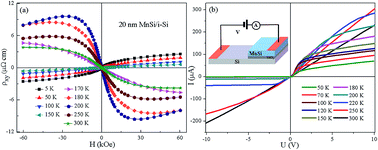
Fig. 2 (a)–(c) Various Hall resistivity loops ρxyH measured at different temperatures for the Mn0.48Si0.52 films with the thickness of 20 nm, 100 nm and 300 nm grown on near-intrinsic n-type Si substrates. (d) Hall resistivity loops ρxyH measured at different temperatures for the reference 20 nm Mn0.48Si0.52 film grown on the glass substrates.

However, as compared with the reference Mn0.48Si0.52 films grown on glass substrates in Fig. 2(d), the Hall resistivity of the 20 nm Mn0.48Si0.52 films grown on near-intrinsic n-type Si substrates (i.e., Mn0.48Si0.52/SiO2/Si p–i–n junctions) in Fig. 2(a) shows quite different behavior. Fig. 2(a) indicates that the sign of the Mn0.48Si0.52/SiO2/Si p–i–n junctions is positive and the magnitude of the Hall resistivity gradually decreases as the temperature increases from 5 to 150 K, but above 170 K, the sign of the Hall resistivity becomes negative and the magnitude of the Hall resistivity increases rapidly to a maximum of 10 μΩ cm around 200 K, which is much stronger than the Hall resistivity at 5 K. Further increasing temperature from 200 to 300 K, the magnitude of the Hall resistivity gradually decreases again. Moreover, it is clear that the negative Hall resistivity around the temperature of 200 K is mainly due to the contribution of the anomalous Hall resistivity in the low field range below 30 kOe. And the positive slope of the Hall resistivity loops in the high field range above 30 kOe indicates that the ordinary Hall resistivity is significantly strong and the conducting charge carriers are p-type (holes) in the Mn0.48Si0.52 layer of the Mn0.48Si0.52/SiO2/Si p–i–n junctions. It is worthy to mention that the electrical shunt effect of the 0.5 mm thick near-intrinsic n-type Si substrate with 1 nm SiO2 native oxide layer is negligible as compared with the 20 nm Mn0.48Si0.52 film. Furthermore, Fig. 2(b) and (c) indicate that almost the same positive Hall resistivity was observed in the low temperature range for Mn0.48Si0.52 films of 100 nm and 300 nm in thickness, which means that the positive Hall resistivity is a bulk effect (independent on the thickness of Mn0.48Si0.52 films). But as the thickness of Mn0.48Si0.52 films increases, the magnitude of the negative Hall resistivity obviously decreases, which means that the negative Hall resistivity of the Mn0.48Si0.52 films is related to the interface of the MnxSi1−x/SiO2/Si p–i–n junctions.

In order to verify the interfacial effects of the Mn0.48Si0.52/SiO2/Si p–i–n junctions on the electrical transport, Fig. 3(a)–(c) show the temperature dependence of the longitudinal conductivity σxx for Mn0.48Si0.52 films on different substrates with various thicknesses. With increasing temperature, the longitudinal conductivity σxx for all the Mn0.48Si0.52 films increases very slowly. This is the typical electrical transport behavior on the metallic side of the metal-insulator transition,23 which can be described by the following equation

 
σxx = σ0 + c1T1/2 + c2T. (1)


image file: c6ra05340h-f3.tif
Fig. 3 The temperature dependence of conductivity σxx for the Mn0.48Si0.52 films on different substrates with various thicknesses. (a) 20 nm Mn0.48Si0.52 film on the near-intrinsic n-type Si substrate. The red solid line is fitted by σxx = σ0 + c1T1/2 + c2T, with σ0 = 637.92 (Ω cm)−1, c1 = 23.20 (Ω cm)−1 K−1/2 and c2 = −0.42 (Ω cm K)−1. (b) 300 nm Mn0.48Si0.52 film on the near-intrinsic n-type Si substrate. The red solid line is fitted, using σ0 = 471.30 (Ω cm)−1, c1 = 14.92 (Ω cm)−1 K−1/2 and c2 = −0.25 (Ω cm K)−1. (c) 20 nm Mn0.48Si0.52 film on glass substrate. The red line is fitted by using σ0 = 592.30 (Ω cm)−1, c1 = 24.07 (Ω cm)−1 K−1/2 and c2 = −0.42 (Ω cm K)−1.

Here, the first term σ0 is the conductivity at T = 0 K, the second one c1T1/2 arises from the Coulomb interaction of carriers, and the third one c2T originates from the inelastic electron-phonon scattering of the weakly localized carriers.23–26 As illustrated in Fig. 3(a)–(c), the longitudinal conductivity σxx of the single Mn0.48Si0.52 films can be well fitted by eqn (1) in the whole experimental temperature range from 5 to 300 K except Fig. 3(a). It is clear in Fig. 3(a) that the experimental conductivity of 20 nm Mn0.48Si0.52 films grown on the near-intrinsic n-type Si substrate begins to deviate from the fitting line from 150 to 300 K and becomes 2.5% more than the fitting value at 200 K. On the other hand, as compared with the Mn0.48Si0.52 films in Fig. 3(b) and (c), we did not observe any difference in microstructure and magnetism for the Mn0.48Si0.52 films in Fig. 3(a). However, it is very important to notice that the enhanced conductivity in the temperature range from 150 to 300 K in Fig. 3(a) corresponds to the enhanced negative Hall resistivity in Fig. 2(a) in the same temperature range. Therefore, we conclude that the enhanced conductivity in Fig. 3(a) is due to the decrease of the depletion layer in the MnxSi1−x/SiO2/Si p–i–n junctions as the temperature increases from 150 to 300 K. Obviously, this interfacial effect becomes relatively weak as the Mn0.48Si0.52 films become thick, as shown in Fig. 2(a)–(c), 3(a) and (b).

To gain more insight into the enhanced negative AHE due to the interfacial effect for Mn0.48Si0.52/SiO2/Si p–i–n junctions, we seek to analyze the current–voltage IV characteristics of the Mn0.48Si0.52/SiO2/Si p–i–n junction at various temperatures in the forward and reverse bias conditions as shown in Fig. 4. The IV curves of the junction exhibit rectification characteristics. The junction is on turn-on state in the forward bias and is on turn-off state in the reverse bias below about 150 K. Comparing Fig. 4 with 3(a) and 2(a), we can derive that there exist no conducting carriers (electrons or holes) in the depletion layer of the MnxSi1−x/SiO2/Si p–i–n junction below 150 K without enough bias voltage. This means that when the longitudinal conductivity and the Hall resistivity were measured by applying an in-plane current in the Mn0.48Si0.52 layer, the Mn0.48Si0.52 layer just behaves like a single film grown on the insulating substrate due to the existence of the interfacial depletion layer at low temperature (see Fig. 2 and 3).


image file: c6ra05340h-f4.tif
Fig. 4 The current–voltage (IV) characteristic curves of the Mn0.48Si0.52/SiO2/Si p–i–n junctions at different temperatures. The inset is the schematic illustration of Mn0.48Si0.52/SiO2/Si p–i–n junctions.

On the other hand, as the temperature increases, more carriers are excited to the conducting states and their kinetic energy becomes big. At the same time, both the barrier height and depletion layer thickness of Mn0.48Si0.52/SiO2/Si p–i–n junctions decrease with increasing temperature. In this case, the rectification effect gradually decays with increasing the temperature from 150 to 300 K as shown in Fig. 4, where significant current can be observed at the small forward and reverse bias voltage. This means that when the longitudinal conductivity and the Hall resistivity were measured by applying an in-plane current in the Mn0.48Si0.52 layer at high temperature, the conducting carriers can easily cross the thin and low barrier of the Mn0.48Si0.52/SiO2/Si p–i–n junctions. As a result, the interfacial Rashba spin–orbit coupling will act on the tunneling carriers across the barrier, which can be written as image file: c6ra05340h-t1.tif, where p is the momentum of the conducting carrier with the effective mass m, σ is the vector of Pauli matrices, and ∇V is the potential gradient at the interface.27,28 As the first order approximation, the AHE is proportional to the spin–orbit coupling,17 and therefore the enhanced negative AHE of Mn0.48Si0.52/SiO2/Si p–i–n junctions in the high temperature range can be well explained by the Rashba spin–orbit coupling in the Mn0.48Si0.52/SiO2/Si p–i–n junction interface.

In order to further check the potential effects of the p–n junction, the SiO2 native oxide layer of the near-intrinsic n-type Si substrate was corroded, and the Mn0.48Si0.52/Si p–n junctions under the same sputtering conditions were prepared. Fig. 5(a) shows Hall resistivity loops ρxyH of the 20 nm Mn0.48Si0.52 films grown on the near-intrinsic n-type Si substrates. As we mentioned before, the positive Hall resistivity of the Mn0.48Si0.52 films is almost the same below 150 K, which does not depend on the types of substrates. But the negative Hall resistivity gets to the maximum around 215 K, which is greatly enhanced as compared with that of Mn0.48Si0.52/SiO2/Si p–i–n junctions shown in Fig. 2(a). This means that the interfacial Rashba spin–orbit coupling can be further enhanced without the SiO2 native oxide interlayer, and therefore the negative Hall resistivity is greatly enhanced. Fig. 5(b) and (c) show the Hall resistivity loops ρxyH of the same Mn0.48Si0.52 films of 20 nm but grown on n-type Si and p-type Si substrates, respectively. For the 20 nm Mn0.48Si0.52 films grown on n-type Si substrates in Fig. 5(b), the negative Hall resistivity at high temperature mainly comes from the ordinary Hall effect of the n-type substrate due to the strong shunting effect, and only very weak nonlinear component of the negative Hall resistivity originates from the anomalous Hall effect of the Mn0.48Si0.52 films due to the interfacial Rashba spin–orbit coupling. However, for the 20 nm Mn0.48Si0.52 films grown on p-type Si substrates in Fig. 5(c), we did not see any sign of the negative Hall resistivity, since both the Mn0.48Si0.52 films and the Si substrate are p-type. Therefore, Fig. 2 and 5 indicate that the enhanced negative anomalous Hall effect of the 20 nm Mn0.48Si0.52 films originates from the interfacial Rashba spin–orbit coupling.


image file: c6ra05340h-f5.tif
Fig. 5 Various Hall resistivity loops ρxyH measured at different temperatures for the 20 nm Mn0.48Si0.52 films grown on near-intrinsic n-type Si (a), n-type Si (b), and p-type Si (c), respectively. Here, the SiO2 native oxide layer of all Si substrates was corroded.

It is also well known that the relationship Rs = xxp between anomalous Hall coefficient RS and the longitudinal resistivity ρxx is usually used to distinguish intrinsic, side-jump and skew scattering contributions.17 For the 20 nm Mn0.48Si0.52 films, the anomalous Hall resistivity originates from skew scattering mechanism, which is determined by the exponent p = 1 in the low temperature range. However, in the high temperature range above 150 K, the enhanced AHE itself does not saturate even up to the applied magnetic field of 60 kOe. Therefore, we could not well separate the ordinary Hall and anomalous Hall signals in the high temperature range. As a result, we could not give the relationship Rs = xxp above 150 K.

Finally we measured the magnetoresistance (MR) to check the possible effects of the Rashba spin–orbit coupling at the interface. Fig. 6 shows the magnetoresistance of the 20 nm Mn0.48Si0.52 films grown on the near-intrinsic n-type Si substrates. Both the electric current and magnetic field are applied in the film plane, and the magnetic field is perpendicular to (marked as ⊥) or parallel to (marked as ∥) the current. The MR is negative and does not saturate up to 60 kOe below 100 K. Moreover, the MR curves do not show any hysteresis and anisotropy for the magnetic field parallel to (perpendicular to) the current direction. The non-hysteresis negative magnetoresistance can be explained by the spin-dependent scattering between conducting carriers and local magnetic moments.


image file: c6ra05340h-f6.tif
Fig. 6 The magnetoresistance of the Mn0.48Si0.52 films measured at different temperatures. Both the electric current and magnetic field are in the film plane, and the magnetic field is perpendicular to (marked as ⊥) or parallel to (marked as ∥) the current.

An obvious anisotropy of the magnetoresistance is observed around 200 K and the magnetoresistance becomes positive. This corresponds to the temperature range where the negative and enhanced AHE is observed. The anisotropy of the positive magnetoresistance can be explained by the Lorentz force which was felt by the conducting carriers in magnetic field. However, we could not observed the conventional anisotropic magnetoresistance of the ferromagnetic films from 5 to 300 K within the experimental errors, although there exist significant AHE and ferromagnetism in the low temperature range below 50 K.

4. Conclusions

In conclusion, it is found that the Mn0.48Si0.52/SiO2/Si p–i–n junctions show greatly enhanced negative anomalous Hall effect in the high temperature range from 150 to 300 K, although the same Mn0.48Si0.52 films grown on the insulating glass substrates only show the positive anomalous Hall effect at low temperature below 150 K. The enhanced negative anomalous Hall effect is explained by the interfacial Rashba spin–orbit coupling in Mn0.48Si0.52/SiO2/Si p–i–n junctions.

Acknowledgements

We gratefully acknowledge the financial support by the National Basic Research Program of China (Grant No. 2013CB922303), the National Science Foundation of China (NSFC) (Grant No. 11174184, 11204164, and 11434006), and 111 project No. B13029 of China.

References

  1. S. Datta and B. Das, Appl. Phys. Lett., 1990, 56, 665 CrossRef CAS .
  2. R. Jansen, AAPPS Bull., 2008, 18, 21 CAS .
  3. V. Sverdlov and S. Selberherr, Phys. Rep., 2015, 585, 1 CrossRef CAS .
  4. J. Nitta, F. E. Meijer and H. Takayanagi, Appl. Phys. Lett., 1999, 75, 695 CrossRef CAS .
  5. L. Diago-Cisneros and F. Mireles, J. Appl. Phys., 2013, 114, 193706 CrossRef .
  6. T. Koga, J. Nitta and H. Takayanagi, Phys. Rev. Lett., 2002, 88, 126601 CrossRef PubMed .
  7. A. Aharony, Y. Tokura, G. Z. Cohen, O. Entin-Wohlman and S. Katsumoto, Phys. Rev. B: Condens. Matter Mater. Phys., 2011, 84, 035323 CrossRef .
  8. S. LaShell, B. A. McDougall and E. Jensen, Phys. Rev. Lett., 1996, 77, 3419 CrossRef CAS PubMed .
  9. Y. M. Koroteev, G. Bihlmayer, J. E. Gayone, E. V. Chulkov, S. Blügel, P. M. Echenique and P. Hofmann, Phys. Rev. Lett., 2004, 93, 046403 CrossRef PubMed .
  10. A. N. Chantis, K. D. Belashchenko, E. Y. Tsymbal and M. V. Schilfgaarde, Phys. Rev. Lett., 2007, 98, 046601 CrossRef PubMed .
  11. B. Gu, I. Sugai, T. Ziman, G. Y. Guo, N. Nagaosa, T. Seki, K. Takanashi and S. Maekawa, Phys. Rev. Lett., 2010, 105, 216401 CrossRef CAS PubMed .
  12. S. Mathias, A. Ruffing, F. Deicke, M. Wiesenmayer, I. Sakar, G. Bihlmayer, E. V. Chulkov, Y. M. Koroteev, P. M. Echenique, M. Bauer and M. Aeschlimann, Phys. Rev. Lett., 2010, 104, 066802 CrossRef CAS PubMed .
  13. J. Schliemann, J. C. Egues and D. Loss, Phys. Rev. Lett., 2003, 90, 146801 CrossRef PubMed .
  14. J. Nitta, T. Akazaki and H. Takayanagi, Phys. Rev. Lett., 1997, 78, 1335 CrossRef CAS .
  15. N. Manyala, Y. Sidis, J. F. Ditusa, G. Aeppli, D. P. Young and Z. Fisk, Nat. Mater., 2004, 3, 255 CrossRef CAS PubMed .
  16. B. A. Aronzon, V. V. Rylkov, S. N. Nikolaev, V. V. Tugushev, S. Caprara, V. V. Podolskii, V. P. Lesnikov, A. Lashkul, R. Laiho, R. R. Gareev, N. S. Perov and A. S. Semisalova, Phys. Rev. B: Condens. Matter Mater. Phys., 2011, 84, 075209 CrossRef .
  17. N. Nagaosa, J. Sinova, S. Onoda, A. H. MacDonald and N. P. Ong, Rev. Mod. Phys., 2010, 82, 1539 CrossRef .
  18. S. Banerjee, O. Erten and M. Randeria, Nat. Phys., 2013, 9, 626 CrossRef CAS .
  19. K. Narayanapillai, K. Gopinadhan, X. Qiu, A. A. Ariando, T. Venkatesan and H. Yang, Appl. Phys. Lett., 2014, 105, 162405 CrossRef .
  20. C. H. Lin, T. R. Chang, R. Y. Liu, C. M. Cheng, K. D. Tsuei, H. T. Jeng, C. Y. Mou, I. Matsuda and S. J. Tang, New J. Phys., 2014, 16, 045003 CrossRef .
  21. J. Cumings, L. Moore, H. Chou, K. Ku, G. Xiang, S. Crooker, N. Samarth and D. Goldhaber-Gordon, Phys. Rev. Lett., 2006, 96, 196404 CrossRef PubMed .
  22. A. C. Yang, K. Zhang, S. S. Yan, S. S. Kang, Y. F. Qin, J. Pei, L. M. He, H. H. Li, Y. Y. Dai, S. Q. Xiao and Y. F. Tian, J. Alloys Compd., 2015, 623, 438 CrossRef CAS .
  23. F. Hellman, M. Q. Tran, A. E. Gebala, E. M. Wilcox and R. C. Dynes, Phys. Rev. Lett., 1996, 77, 4652 CrossRef CAS PubMed .
  24. Y. F. Qin, S. S. Yan, S. Q. Xiao, Q. Li, Z. K. Dai, T. T. Shen, S. S. Kang, Y. Y. Dai, G. L. Liu, Y. X. Chen and L. M. Mei, J. Appl. Phys., 2011, 109, 083906 CrossRef .
  25. P. A. Lee and T. V. Ramakrishnan, Rev. Mod. Phys., 1985, 57, 287 CrossRef CAS .
  26. W. Teizer, F. Hellman and R. C. Dynes, Solid State Commun., 2000, 114, 81 CrossRef CAS .
  27. A. V. Vedyayev, M. S. Titova, N. V. Ryzhanova, M. Y. Zhuravlev and E. Y. Tsymbal, Appl. Phys. Lett., 2013, 103, 032406 CrossRef .
  28. S. J. Gong, H. C. Ding, W. J. Zhu, C. G. Duan, Z. Q. Zhu and J. H. Chu, Sci. China: Phys., Mech. Astron., 2012, 56, 232 CrossRef .

This journal is © The Royal Society of Chemistry 2016
Click here to see how this site uses Cookies. View our privacy policy here.