Ali Sephar Shikoha,
Zubair Ahmad*a,
Farid Touatia,
R. A. Shakoorb,
N. J. Al-Thanib,
Zhaozhao Zhuc,
Trent Mankowskic,
Mohieddine A. Benammarb,
Masud Mansuripurc and
Charles M. Falcoc
aDepartment of Electrical Engineering, College of Engineering, Qatar University, P. O. Box 2713, Doha, Qatar. E-mail: zubairtarar@qu.edu.qa; Tel: +974 66461595
bCenter for Advanced Materials (CAM), Qatar University, P. O. Box 2713, Doha, Qatar
cCollege of Optical Sciences, The University of Arizona, Tucson, Arizona 85721, USA
First published on 26th May 2016
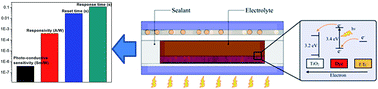
We demonstrate, a newly developed, inexpensive transparent conducting electrode (TCE) based on copper nanowires (CuNWs) combined with reduced graphene oxide (rGO) and poly(3,4-ethylenedioxythiophene) polystyrene sulfonate (PEDOT:PSS) as a cathode for Dye Sensitized Photo Sensors (DSPSs). CuNWs were synthesized and deposited in the form of a layer on glass substrates, followed by deposition of rGO and PEDOT:PSS layers, to fabricate hybrid transparent conducting electrodes (TCEs). The hybrid electrodes exhibited an average sheet resistance of 20 Ω cm−2. These TCEs have been successfully integrated with the DSPSs, which were later evaluated for their performance in terms of photo-conductive sensitivity and responsivity. A significant increase in the current and voltage was observed as a function of elevated light intensity. The average response time and reset time of the DSPSs was found to be 118 ms and 28 ms, respectively. Hence it can be said that the CuNWs/rGO/PEDOT:PSS based transparent conducting electrode could potentially be a viable alternative to the expensive ITO/Pt based cathode, in DSPSs.
Typically, a counter electrode contains a metal oxide as a conductive layer and Pt film as a catalyst. Such counter electrodes show high performance in terms of conduction and electron transfer when integrated with Indium Tin Oxide (ITO).7 However, there are a couple of drawbacks associated with this combination. First, indium and platinum used in the fabrication ITO/PT based electrodes, are rare and thus expensive.8 Further, ITO is brittle, making it unsuitable for incorporation in devices requiring flexibility such as wearable technology devices. Other metal oxide such as FTO are also not a viable option since the cost of FTO is estimated to be >20–60% of the cost of the dye sensitized photo-electric devices.9 Significant efforts have been made, to find alternative materials that could match or even surpass the characteristics of ITO, in terms of conductivity, transparency and mechanical performance. Currently the most promising materials are metal nanogrids, carbon nanotube (CNT) films, random networks of metallic nanowires (NWs) and graphene films.10 In the past, silver nanowires (AgNWs) have attained high transparency along with a sheet resistance that is lower than ITO; yet mass production of AgNWs based optoelectronic devices is a big challenge because the high cost of silver.11 Copper nanowires (CuNWs) offer a viable alternative because of their flexibility, inexpensiveness (100 times less expensive than their silver counter parts) and high transparency.10,12 In addition to that copper is as conductive as silver, with a bulk resistivity of 1.67 nΩ m as compared to 1.59 nΩ m for silver.13 These features make CuNWs based electrodes a promising candidate for the incorporation in DSPSs.
Copper nanowires (CuNWs) have attracted a lot of attention because of their flexibility, relatively low cost, high conductivity and high transmittance, and hence have found applications in various optoelectronic devices, such as solar cells.12 However, problems like oxidation and tarnishing, leading towards the instability of CuNWs, pose a serious threat to the wide spread of this technology and thus are needed to be addressed.14 One of the ways to prevent the above mentioned issues is to add an extra layer of material such as graphene that could prevent the CuNWs from oxidation and also provide added strength to the CuNW network.
Integration of CuNWs based TCEs within DSPSs is supposed to provide us encouraging results, since photo sensors applications don't require high power conversion efficiency and focus is rather paid on the sensitivity of the device, cost effectiveness and versatility. Therefore, alternative CuNWs based counter electrode configuration can be incorporated in DSPSs, even when the power conversion efficiency is compromised. In the past, DSPSs employing various materials and layer configurations, have been reported. In 2014, Qadir et al. described DSPSs incorporating water soluble organic photo sensitizer, nickel(II) phthalocyanine-tetrasulfonic acid tetrasodium salt (NiTsPc), along with a ITO/Pt based counter electrode.2 The highest reported response and reset times were 200 ms and 300 ms, respectively. In 2015, Qadir et al. reported DSPSs based on a binary blend of two polymers, i.e., PCPDTBT and MEH-PVV as a sensitizer. The counter electrode used was based on ITO and graphite.3 The highest response time reported turned out to be ∼382 ms, along with a photo-conductive sensitivity of 2.02 × 10⁻⁵ S m W−1 and responsivity of 4.22 × 10⁻⁵ A W−1. Although the research work mentioned in both the publications proved to be promising, yet the operation of DSPSs needs further optimization.
The aim of our work is to demonstrate the successful integration of the inexpensive cathode for DSPSs that could replace ITO/Pt based counter electrodes. In the current study, we present a new counter electrode configuration that is based on copper nanowires (CuNWs) covered with reduced graphene oxide (rGO) and PEDOT:PSS. CuNWs were synthesized and deposited in the form of a layer on glass substrates, followed by deposition of rGO and PEDOT:PSS layers, to fabricate transparent conducting electrodes (TCEs). The fabricated TCEs were used as a counter electrode, in DSPS assembly.
The synthesized CuNWs were used for the deposition of a conductive layer on a glass substrate. Initially glass substrates were plasma cleaned for 5 minutes. For the formation of a percolating CuNWs network, the copper nanowires were separated from toluene and shifted into isopropyl alcohol (IPA) solution containing 1 wt% PVP (polyvinylpyrrolidone). The solution was centrifuged in order to wash off excess PVP and the resultant nanowires were transferred into IPA. During the CuNWs layer deposition via spray coating, the substrates were laid on the horizontal hot plate kept at 70 °C in order to prevent the coffee stain effect and undermining the homogeneous film deposition. After the deposition the slides were plasma cleaned for 2 minutes, for the removal of organics.
Following the deposition of CuNWs, a layer of rGO was deposited. Market purchased GO platelets contained in aqueous solution were separated and diluted in IPA and later sprayed onto the substrate. The fabricated electrodes were annealed at 180 °C in forming gas environment, to restore the conductivity of CuNWs and reduce graphene oxide. Thermal annealing process is known to improve the structure of rGO by restacking graphene sheets, thereby enhancing the conductivity of the sheet.17 Lastly, a sheet of PEDOT:PSS was deposited by heating the polymer to 70 °C and then spin coating it onto the sample substrates, while spinning at 6000 rpm.
The fabricated counter electrodes were characterized using FESEM and Raman Spectrophotometer (which has been described in the discussion section). Later the TCEs were integrated within DSPSs and characterized using solar simulator.
For the EPD deposition, the ITO/glass slides were cut into 3.75 cm × 2 cm sizes. Two of the slides were put into the specially designed EDP vessel, with one acting as a cathode and the other one acting as an anode. The solution (containing the TiO2 suspension and the charging solution) was added to the EPD vessel. A voltage bias of 5 V was applied for 60 s using a power supply, while keeping the current to the minimum. A layer of TiO2 nanoparticles was observed to be deposited on the anode. The anode was taken out, dried in ambient environment and later sintered at 450 °C, in order to remove all the organic materials, achieve better optical properties and strong adhesion of TiO2 films with ITO.19 The annealed TiO2 layer having an active area of 1 cm2 was sensitized using N719 dye dissolved in ethanol. After sensitization, the DSPS fabrication process was initiated. The 100 μm thick sealant has been used which also acted as a spacer between the two electrodes of a DSPS. Few drops of HI-30 containing I−/I3− ion species was used as an electrolyte. Fig. 1, illustrates the deployed photo electrode and counter electrode configurations, along with the complete DSPS assembly.
![]() | ||
| Fig. 1 Cross-sectional view showing photo electrode and counter electrode configurations, along with the complete DSPS assembly. | ||
High peaks occur (see Fig. 2(b)) at the point where nanowires intersect each other. This inflation in height increases the likeliness of shortening the subsequent layers, thus hindering the operation of the fabricated device.22 Hence it is important to attain a uniform thickness over the whole electrode surface. In the current study PEDOT:PSS has been utilized to minimize the roughness of the deposited layers. Fig. 2(c) shows the CuNWs/rGO sample with a PEDOT:PSS layer on the top. As seen from the image taken at a tilted angle of 10 degrees, PEDOT:PSS completely covers up the copper nanowires and reduced graphene oxide layers, thus making the surface smoother. The deposited rGO and PEDOT:PSS layers also prevented the annealed intersection between CuNWs from loosening up. The average sheet resistance of the fabricated hybrid electrodes, when checked using four probe method, turned out to be less than 20 Ω cm−2. The fabricated CuNWs have also been analyzed for their internal structure using TEM. The CuNWs appeared to be solid from inside as shown in Fig. 2(d).
Fig. 3 shows the optical transmission spectra and the variation in sheet resistance of the CuNWs and CuNWs/rGO TCEs. The transmittance spectra (Fig. 3(a)) for both the TCE configurations depicted a flat transmittance over the visible and NIR wavelength range. A decrease of 3.2% was noted in the transmittance (at 550 nm) after the deposition of an rGO layer on the CuNWs. In order to access the life longevity of the fabricated samples, the TCEs were exposed to both ambient and harsh environmental conditions. When exposed to ambient environment the sheet resistance for the CuNWs/rGO electrode configuration tend to remain stable over the course of 30 days. On the other hand, the sheet resistance of CuNWs samples was constantly increasing. A similar test was run in harsh environment (80 °C and 80% RH) for 48 hours. No change in the sheet resistance of the CuNWs/rGO electrodes was noted, whereas the sheet resistance of the CuNWs electrodes was almost doubled at the end of the experiment. These tests highlight the effectiveness of the rGO coating to protect the CuNWs from degradation under varied environmental conditions.
The fabricated hybrid TCEs were integrated as counter electrode in DSPS devices as shown in the schematic diagram (Fig. 1). The DSPSs produced, were evaluated for their performance in terms of photoconductivity and sensitivity, using Sunlite Solar Simulator, manufactured by Abet Technologies. Initially, the DSPSs were subjected to varied illumination levels (ranging from ∼10
000 Lux to 100
000 Lux) and the subsequent generated current and voltages were measured. Fig. 4 shows current–voltage characteristics of the DSPSs, as a function of different illumination levels. It can be seen that the photocurrent increases logarithmically with the elevated irradiance levels. The increase in light intensity resulted in an upsurge in the number of excited molecules, which has led to increased transfer of electrons to the covalently bonded TiO2 nanoparticles, hence enhancing the photocurrent generation.3 This trend followed on, until a saturation point was reached, i.e. maximum number of electrons were being excited and transferred to ITO via TiO2 semiconductor layer. Hence, the photo current remained almost constant, irrespective of light intensity. A logarithmic increase with respect to irradiance levels was also observed in case of voltage. The inset image in Fig. 4 depicts the variation in the voltage generated (for seven samples) when multiple measurements were carried out. The average standard deviation of all the measurements turned out to be 6.51 mV.
![]() | ||
| Fig. 4 The current and voltage versus illumination intensity characteristic of the DSPSs. Inset shows variation in open circuit voltage versus light intensity, represented by error bars. | ||
The absorption of a light photon leads to the excitation of the N719 dye molecules from S to S* (LUMO energy level of the N719 dye is 3.4 eV). The excited dye molecule then transfers the LUMO band electron to the conduction band (3.2 eV) of the covalently bonded TiO2 nanoparticle. Hence the dye molecule gets into an oxidized state S+. The collected electron is passed down to the anode, by skipping through the conduction bands of a series of TiO2 nanoparticles. The electron eventually reaches the counter electrode by passing through the external circuit. At the dye electrolyte interface, the oxidized dye gets an electron from the I− ion species and gets reduced, to its original stage S. The I− ion species gets converted into I3− ion species, which heads over to the counter electrode. At the counter electrode/electrolyte interface, the I3− ion species gains an electron (passed on to it by the CuNWs, rGO and PEDO:PSS layers) and gets converted back into I− state. At the end of the reaction cycle, all the components of the DSPS get regenerated. As the light intensity increases, a more photons are absorbed by the dye molecules in order to get excited. After a certain light intensity the photo current starts to saturate. Increasing the light intensity beyond that point will result in a fewer number of additional excitions.
Parameters like response time (tr), recovery time (tc) and temporal photo sensitivity are the main figures of merit for the behavioral evaluation of photo-sensors in practical applications. The tr and tc are generally defined as the time required for the photo-current to increase to the final settled value and vice versa. The photo-response characteristics of the fabricated DSPSs, demonstrate the change in the photocurrent's magnitude as a function of periodic pulses of the simulated solar light. 100 mW cm−2 solar simulator was employed to measure the response and recovery time of the fabricated DSPSs. A light pulse having an approximate width of 0.5 seconds was applied and the average response (in terms current generated) towards light was measured (with a forward biased voltage of 1 V), Fig. 5. The average response time and reset time turned out to be 118 ms and 28 ms respectively, making reset time 4 times faster as compared to the response time. This is due to the fact that the number of excited dye molecules steadily rises, when the light is incident upon the DSPSs whereas the DSPS respond immediately to the absence of light. Overall, tr and tc show that the sensor exhibits rapid changes in states of photocurrent as a function of stepped light input.
The responsivity (R) of a photo diode is the ratio of the photo-current to illumination power and can be expressed in term of A W−1, when the device is being used in photo-conductive mode. The average responsivity of the DSPSs is found to be 4.0 × 10⁻⁴ A W−1. The photo-conductive sensitivity of a photo diode can be determined by the expression:2
Hysteresis is considered as an important factor, which needs to be taken into account when calibrating a sensor. Fig. 6, shows the hysteresis curve of open circuit voltage (Voc) of the DSPS. The average hysteresis value of the curve shown in Fig. 6 is found to be 0.011 V over the whole illumination range (100
00 Lux to 100
000 Lux). The hysteresis effect in Voc started diminishing away when measurements were carried out after a prolonged exposure of DSPSs, under a certain light intensity.
![]() | ||
| Fig. 6 Hysteresis curve: Voc as a function of light intensity. The normalized “Voc” was obtained by “Voc/Voc max”. Where “Voc max” is the value of “Voc” at 100 K Lux. | ||
Table 1 establishes a comparison of the values obtained for key DSPS parameters, as mentioned in various studies. As seen, the CuNWs/rGO/PEDOT:PSS based DSPSs exhibit a superior performance in terms of response time, reset time and responsivity. From the results it is evident that the hybrid TCEs are conductive and provide a catalytic interface for transferring electrons to oxidized ion species of the electrolyte. Hence the fabricated TCEs are performing capably when integrated with DSPSs as a counter electrode.
| This journal is © The Royal Society of Chemistry 2016 |