DOI:
10.1039/C6RA06642A
(Paper)
RSC Adv., 2016,
6, 49724-49729
Synthesis of a dihydroquinoline based fluorescent cyanine for selective, naked eye, and turn off detection of Fe3+ ions†
Received
13th March 2016
, Accepted 13th May 2016
First published on 16th May 2016
Abstract
A cyanine dye was synthesized by condensing 6-formylated 1,2,2,4-tetramethyl-1,2-dihydroquinoline (TMDQ) and 1,7-dimethyl-2-phenylimidazo[1,2-a]pyridin-1-ium iodide. The probe was a selective sensor for ferric ions in aqueous ethanolic solution. The sensor was fluorescent and the fluorescence was quenched by Fe3+ ions. The decrease in the fluorescence was quick and linear with respect to Fe3+ ions. The quenching was selective and no other metal ions tested showed this effect. The colour change could be detected visually and hence it is a naked eye and turn-off fluorescence detector for Fe3+ ions.
Introduction
In industrial, environmental, medical, and biological applications, quantitative measurement and real-time monitoring are necessary for analytes such as metal ions,1 and toxic chemicals. For this sake, fluorescence detection is very useful as it has high sensitivity, selectivity, and a fast response time. Furthermore, fluorescence detection does not lead to any photodamage of cells and hence has recently attracted substantial bio-analytical interest.
In biology, metals play a vital role. A key element for electron transport in the respiratory system is iron.2 Iron is a necessary component in hemes, many enzymatic reactions, and iron sulfur clusters. In ensuring the quality of water, measuring the level of ferric ions (Fe3+) is important. The major portion of bioiron is firmly connected with enzymes and specialized transport and storage proteins.3 A minor fraction of bioiron is bound relatively loosely to species like organic anions (phosphates and carboxylates), polyfunctional ligands (chelates, siderophores, and polypeptides), or extracellular matrix (glycans and sulfonates).4 The latter is labile iron and associated with important functions such as a source of iron for incorporation into proteins, target for chelators or metal scavengers. Labile bioiron is chelatable and therefore metal-sensing devices bearing chelating moiety can detect them.4
In human being, iron level should be balanced. If the iron content increases, it spoils the biological system by catalyzing the generation of highly reactive oxygen species. This is called as iron poisoning, with symptoms such as diarrhea, vomiting, stomach pain, and heart/liver damage.5 On the other hand, iron deficiency leads to anemia.6 Hence quantification of iron is very important in biology. Techniques like ICP-MS7 and FAAS8 and spectrophotometric detection using organic dyes9 or quantum dots10 are used for iron quantification. These techniques have disadvantages like sophisticated instrumentation, complicated synthetic procedures for the fluorescent detecting probe, tiresome buffer making procedures etc. Fluorescent probes are preferred over others since they are rapid and reliable and can offer on-site and real-time detection of the analyte which is under investigation. There are numerous reports on ferric ion sensing.11–23 But only few are on fluorescent probes for ferric ion.
Cyanines have conjugated structure and were initially used in photography as developers. Later on they have been used for varied applications.24 Many cyanines contain quinoline moiety.25 Recently, we reported a dihydroquinoline based merocyanine which is a probe for highly toxic hydrazine.26 Our continued work on cyanines led to a new dihydroquinoline based cyanine which is a rapid, selective, and sensitive probe for Fe3+.
Herein we would like to report the synthesis of (E)-1-methyl-2-phenyl-7-(2-(1,2,2,4-tetramethyl-1,2-dihydroquinolin-6-yl)vinyl)imidazo[1,2-a]pyridin-1-ium iodide (8) which is a new cyanine dye. It is a conjugate of 1,2,2,4-tetramethyldihydroquinoline and 1,7-dimethyl-2-phenylimidazo[1,2-a]pyridin-1-ium iodide. The cyanine effectively and proficiently senses ferric ions. It acts as a fluorescent sensor for ferric ion in an aqueous alcoholic medium. It is easy to synthesize, eco-friendly, sensitive, and selective. The sensing can be done simply in an ethanol–water system. It does not involve any complicated buffer-making.
Results and discussion
2-Amino-4-picoline (1) and phenacyl bromide (2) were condensed in ethanol in the presence of concentrated HCl to obtain 7-methyl-2-phenylimidazo[1,2-a]pyridine (3). 3 was quaternized using methyl iodide under microwave irradiation to obtain 1,7-dimethyl-2-phenylimidazo[1,2-a]pyridin-1-ium iodide (4). Aniline was condensed with acetone to obtain 1,2,2,4-tetramethyl-1,2-dihydroquinoline (5). It was methylated using methyl iodide in DMF to obtain 6 which was formylated using DMF/POCl3 according to the reported procedure to 1,2,2,4-tetramethyl-1,2-dihydroquinoline-6-carbaldehyde (7).27,28 4 and 7 were condensed in the presence of piperidine in n-butanol to obtain probe 8 in 65% yield (Scheme 1). The structure of probe 8 was confirmed by 1H NMR and 13C NMR as well as by ESI-MS. It was an orange coloured powder and soluble in many organic solvents.
 |
| | Scheme 1 Synthesis of (E)-1-methyl-2-phenyl-7-(2-(1,2,2,4-tetramethyl-1,2-dihydroquinolin-6-yl)vinyl)imidazo[1,2-a]pyridin-1-ium iodide (8). | |
Fluorescence study
The cyanine probe 8 offered longer electronic conjugation together with rigid structure. A solution of the probe in aqueous ethanolic medium was highly fluorescent. The advantage with the probe was that it could detect ferric ions in an aqueous solution; biological systems need aqueous medium. It was completely soluble in ethanol–water (9
:
1 v/v) medium and the sensing studies could be done in the same.
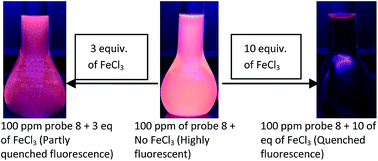
A 100 ppm solution of probe 8 was highly fluorescent in UV (365 nm). When FeCl3 was added to probe 8 in aqueous ethanolic medium, fluorescence quenching was observed. With 10 equivalents of FeCl3, complete quenching took place (Fig. 1). The quenching was selective to Fe3+ ions and did not occur with any other metal ions. This change in fluorescence was monitored by using fluorescence spectrometer.
 |
| | Fig. 1 Visible fluorescence change of probe 8 inside UV chamber by the addition of Fe3+ ions. | |
When aq. Fe3+ solution was added to a solution of probe 8 in aq. ethanol, the fluorescence of probe 8 was lost. We studied the fluorescence quenching effect of Fe3+ using fluorescence spectroscopy. The excitation wavelength was 460 nm. To a fixed concentration (9.13 × 10⁻⁷ M) of probe 8 in aq. ethanol, aq. solutions with increasing concentration of Fe3+ ions were added (Fig. 2a). Fluorescence of probe 8 decreased with addition of Fe3+ ions and the decrease was linear with respect to concentration of Fe3+ ions; complete quenching took place with 7 equivalents of Fe3+ ions. Fluorescence quenching happened immediately after mixing Fe3+ ions with the probe. Initial fluorescence studies were done at two instants; one immediately after addition of Fe3+ and the other 2 h after addition of Fe3+ ions. There was negligible change in the emission pattern. Hence, all further fluorescence studies were done immediately after addition of ferric ions.
 |
| | Fig. 2 (a) Fl. spectra of probe-8 (9.13 × 10⁻⁷ M or 50 ppm) with increasing conc. of Fe3+ (0.2 to 10 equiv.) and (b) corresponding (I0599–I599)/I0599 vs. Fe3+ concentration with the linear equation and R2 value calculated till 7.0 equivalents of Fe3+; error bars are shown using standard deviations from the mean. | |
The ratiometric change in the fluorescence intensity of probe 8 reached a point of negligible deviation with 7 equivalents (6.5 μM) of Fe3+ (Fig. 2b). A linear relationship was found between the emission intensity at 599 nm and the Fe3+ concentration over 1.8 × 10⁻⁷ M (0.2 equiv. of Fe3+) to 7.38 × 10⁻⁶ M (7 equiv. of Fe3+) range (Fig. 2) with a correlation coefficient of 0.9897.
The turning-off of the fluorescence of probe 8 by Fe3+ ions was due to complexation of Fe3+ ions with probe 8. Stern–Volmer plot was drawn for understanding the quenching process (Fig. 3). A non-linear Stern–Volmer plot was obtained consistent with the static fluorescence quenching rather than dynamic quenching. This is a kind of static fluorescence quenching in which the probe acted as an iron chelator resulting in loss of fluorescence properties. Such non-linear Stern–Volmer plots are reported in the literature.29–31
 |
| | Fig. 3 Stern–Volmer plot of the fluorescence response of probe-8 to increasing concentrations of ferric ions. | |
The maximum level of Fe3+ permitted in drinking water by the U.S. Environmental Protection Agency (EPA) is 0.3 mg l−1.32 To establish the detection limit of our probe, a graph of minimum equivalents of Fe3+ versus fluorescence intensity was plotted (ESI†). The detection limit33 of probe 8 for Fe3+ ions was estimated to be of 0.3 mg l−1 or 18.3 × 10⁻⁹ M which is equal to the permitted level of Fe3+ ions by US EPA.
The selectivity towards Fe3+ ions was investigated by recording the fluorescence spectrum of the probe 8 by mixing the solutions of different metal ions. The metals tested were from the corresponding compounds of AgNO3, AlCl3, BaCl2·2H2O, CaCl2, CdCl2·5H2O, CoCl2·2H2O, CrCl3·6H2O, CsCl, CuCl, CuCl2, FeCl2·4H2O, HgCl2, InCl3, KCl, LiCl, MgCl2·6H2O, MnCl2·2H2O, NaCl, NiCl2·6H2O, PbCl2, SbCl3, SnCl2·2H2O, SrCl2·6H2O, and ZnCl2. Even if the ferric ion sensing happened immediately after addition, for selectivity study, the fluorescence spectra were recorded after 5.0 min of incubation with other metal ions. The data presented in Fig. 4 were obtained with probe 8 concentration of 9.13 × 10⁻⁷ M and 10 equivalents of all metal ions. This study confirmed high selectivity of the probe towards Fe3+ among selected set of metals. Other metal ions had insignificant quenching effect on the fluorescence of the probe 8.
 |
| | Fig. 4 Fluorescence response of probe-8 (9.13 × 10⁻⁷ M) to 10 equivalents of various metal ions and ferric. Excitation wavelength = 460 nm. | |
UV-vis study
There was instantaneous visual colour change from orange to brown upon addition of ferric ions to probe 8 (Fig. 5a). Thus, 8 is a ‘naked-eye’ colorimetric sensor for ferric ion. To understand the absorbance pattern, we did UV-vis study for probe 8. The probe showed two absorption bands at 287 nm and 477 nm (Fig. 5b). There was slight increase in absorbance with increasing quantity of ferric ions into a fixed concentration (9.13 × 10⁻⁷ M) of 8. A new peak at 357 nm appeared which might be due to complexation of the ferric ions with probe 8. This led to a change in the absorbance of the probe. This happened only with the ferric ions and hence 8 is selective to ferric ion (ESI†).
 |
| | Fig. 5 (a) Visual colour change upon adding 10 equivalents of Fe3+ into probe 8 (9.13 × 10⁻⁷ M) (b) UV absorption spectrum of probe 8 with increasing concentrations of Fe3+. | |
DFT studies
For better understanding of the chromo/fluorophore, DFT study was done for probe 8. All theoretical calculations were carried out using the Gaussian 09 program.34 The B3LYP exchange correlation functional under 6-31G +, p, d basis set was performed to calculate HOMO and LUMO levels. The geometries were optimized, and electron distribution in the FMOs was calculated (Fig. 6). The MO contours were plotted using Gauss view 5.0.8. The HOMO–LUMO orbital distribution showed that the electron cloud was spread from the quinoline moiety to the imidazopyridine moiety. The major contribution for HOMO was from the quinoline moiety whereas in case of LUMO the contribution was from quinoline as well as imidazopyridine moieties.
 |
| | Fig. 6 HOMO, LUMO orbital energies and the optimized structures for probe 8. | |
Conclusions
We describe a cyanine probe that gives very good sensitivity for detecting ferric ions without needing any advanced, complex readout equipment or complex buffer making procedure. The detection limit of the probe for ferric ion is 0.3 ppm and shows a linear relationship in the Fe3+ concentration range of 1.8 × 10⁻⁷ M (0.2 equiv. of Fe3+) to 7.38 × 10⁻⁶ M (7 equiv. of Fe3+). The probe is a selective ‘naked eye’ detector for the ferric ion. The synthesis of the probe is easy.
Experimental section
General information
All chemicals were commercially available. They were obtained from S.D. Fine Chem. All solvents were directly used from commercial sources without further purification. Nuclear magnetic resonance spectra were recorded on Bruker 400 MHz or Varian 300 MHz spectrometer. Fluorescence was measured using Shimadzu spectrofluorimeter RF-5301. UV-vis absorption spectra were recorded with a Shimadzu UV-Vis spectrophotometer – 1650.
Preparation of 1,2,2,4-tetramethyl-1,2-dihydroquinoline (6)
A mixture of TDQ (10.0 g), potassium carbonate (10.0 g) and iodomethane (5.5 ml) in 80 ml of DMF was maintained at 110 °C under inert atmosphere for 24 hours. The reaction mixture was cooled to room temperature and poured into water, and extracted with ethyl acetate. After removal of solvent, the product was purified silica column using hexane/ethyl acetate as mobile phase. Yield of 6 was 82%. 1H-NMR (400 MHz, CDCl3): δH 7.20 (t, J = 7.2 Hz, 1H), 7.1 (d, J = 7.6 Hz, 1H), 6.7 (t, J = 7.2 Hz, 1H), 6.5 (d, J = 8.0 Hz, 1H), 5.3 (s, 1H), 2.8 (s, 3H), 1.98 (s, 3H), 1.3 (s, 6H).
Preparation of 1,2,2,4-tetramethyl-1,2-dihydro-6-quinoline carbaldehyde (7)
POCl3 (8.1 ml) was slowly added to dry DMF (100 ml) at 5–10 °C under inert atmosphere and heated at 50–60 °C for 30 min. 6 (10 g) in dry DMF (50 ml) was added slowly over 10 min. The temperature was raised to 90 °C and maintained overnight under nitrogen. The mass was cooled to 30 °C, poured into ice water (400 ml), and basified with aq. NaOH. It was extracted with ethyl acetate and the organic layer was washed with water and dried over anhydrous Na2SO4. After removal of solvent, the product was purified on silica column using hexane/ethyl acetate as mobile phase. Yield of 7 is 60%. 1H-NMR (300 MHz, CDCl3): δ 9.80 (s, 1H), 7.6 (d, J = 8.7 Hz, 1H), 7.6 (s, 1H), 6.5 (d, J = 8.4 Hz, 1H), 5.3 (s, 1H), 2.9 (s, 3H), 2.0 (s, 1H), 1.37 (s, 6H).
Preparation of 7-methyl-2-phenylimidazo[1,2-a]pyridine (3)
4-Methylpyridin-2-amine (1) (0.02 m) and bromoaceto phenone (2) (0.02 m) were dissolved in ethanol (30 ml) and refluxed for 5 h. 2 ml of conc. HCl was added and refluxed further for 3 h. The solution was concentrated and aq. NaHCO3 was added to basify the mass (pH = 10). White solid was filtered, and washed aq. ethanol, and dried under vacuum to obtain 3 (80%). 1H-NMR (400 MHz, CDCl3): δH 7.90 (m, 3H), 7.77 (s, 1H), 7.28–7.46 (m, 4H), 6.59 (d, J = 6.8 Hz, 2H), 2.40 (s, 3H). 13C-NMR (400 MHz, CDCl3): 146.1, 145.5, 135.6, 133.9, 128.7, 127.8, 126.0, 124.8, 115.9, 115.07, 107.5, 21.4.
Preparation of 1,7-dimethyl-2-phenylimidazo[1,2-a]pyridin-1-ium iodide (4)
3 (1.0 g) and iodomethane (0.85 g) were dissolved in dioxan (10 ml) in a microwave vial. It was heated under microwave conditions at 120 °C for 30 min, cooled to 30 °C, filtered and the solid was washed with dioxan followed by diethyl ether. The yield of 4 was 70%. 1H-NMR (400 MHz, CDCl3): δH 9.25 (d, J = 8 Hz, 1H), 8.66 (s, 1H), 7.92 (s, 1H), 7.56–7.62 (m, 5H), 7.22 (d, J = 8.0 Hz, 1H), 4.03 (s, 3H), 2.65 (s, 3H). 13C-NMR (400 MHz, CDCl3): 146.9, 140.2, 137.7, 131.0, 130.0, 129.5, 128.9, 124.7, 120.0, 112.6, 110.2, 33.1, 22.3.
Protocol for the synthesis of (E)-1-methyl-2-phenyl-7-(2-(1,2,2,4-tetramethyl-1,2-dihydroquinolin-6-yl)vinyl)imidazo[1,2-a]pyridin-1-ium iodide (8)
A solution of 4 (500 mg), piperidine (20 mg), and 7 (338 mg) were mixed in n-butanol (10 ml) was refluxed for 16 h and cooled to 30 °C. The solution was allowed to stand at 10 °C for 20 h. The orange red solid was filtered, washed with isopropyl alcohol, and dried in vacuum at 60 °C for 3 h to obtain 8 (yield = 65%). 1HNMR (400 MHz, CDCl3): δH 9.12 (d, J = 4.0 Hz, 1H), 8.45 (s, 1H), 7.96 (s, 1H), 7.37–7.54 (m, 8H), 7.30 (s, 1H), 7.00 (d, J = 16 Hz, 1H), 6.50 (d, J = 8.0 Hz, 1H), 5.35 (s, 1H), 4.01 (s, 3H), 2.87 (s, 3H), 2.08 (s, 3H), 1.37 (s, 6H). 13C-NMR (400 MHz, CDCl3): 147, 144.8, 140.9, 137.8, 137.5, 130.9, 130.1, 129.7, 129.5, 128.9, 127.5, 124.8, 122.8, 122.7, 118.0, 115.2, 112.4, 110.5, 104.9, 57.1, 33.2, 31.0, 28.2, 18.9. MS (ESI MS): (m/z, %): 547 [M+, 100%].
Acknowledgements
The authors are thankful to CIL-GJUS&T, Hisar, India for providing NMR spectra. KV is thankful for CSIR, New Delhi, India for a fellowship.
Notes and references
- J. a. Annie Ho, H. C. Chang and W. T. Su, Anal. Chem., 2012, 84, 3246–3253 CrossRef CAS PubMed.
- J. Anastassopoulou and T. Theophanides, Bioinorganic Chemistry, Springer, Netherlands, 1995, pp. 209–218 Search PubMed.
- R. M. Roat-Malone, Bioinorganic Chemistry, John Wiley & Sons, Inc., 2007, pp. 343–476 Search PubMed.
- B. P. Esposito, S. Epsztejn, W. Breuer and Z. I. Cabantchik, Anal. Biochem., 2002, 304, 1–18 CrossRef CAS PubMed.
- F. O. Omara and B. R. Blakley, J. Nutr., 1993, 123, 1649–1655 CAS.
- L. H. Allen, J. Nutr., 2002, 132, 813S–819S CAS.
- L. S. Huang and K. C. Lin, Spectrochim. Acta, Part B, 2001, 56, 123–128 CrossRef.
- R. Ajlec and J. Stupar, Analyst, 1989, 114, 137–142 RSC.
- E. Chinoporos, Anal. Chem., 1962, 34, 437–438 CrossRef CAS.
- P. Wu, Y. Li and X. P. Yan, Anal. Chem., 2009, 81, 6252–6257 CrossRef CAS.
- J. a. Annie Ho, H. C. Chang and W. T. Su, Anal. Chem., 2012, 84, 3246–3253 CrossRef CAS PubMed.
- J. Yao, W. Dou, W. Qin and W. Liu, Inorg. Chem. Commun., 2009, 12, 116–118 CrossRef CAS.
- R. Senthilnithy, M. D. P. De Costa and H. D. Gunawardhana, Luminescence, 2009, 24, 203–208 CrossRef CAS PubMed.
- E. Hao, T. Meng, M. Zhang, W. Pang, Y. Zhou and L. Jiao, J. Phys. Chem. A, 2011, 115, 8234–8241 CrossRef CAS PubMed.
- P. Kumar, V. Kumar and R. Gupta, RSC Adv., 2015, 5, 97874–97882 RSC.
- M. Niwa, T. Hirayama, K. Okuda and H. Nagasawa, Org. Biomol. Chem., 2014, 12, 6590–6597 CAS.
- C. S. Wu, Y. J. Lin and Y. Chen, Org. Biomol. Chem., 2014, 12, 1419–1429 CAS.
- K. Wu, H. Xiao, L. Wang, G. Yin, Y. Quan and R. Wang, RSC Adv., 2014, 4, 39984–39990 RSC.
- L. Qiu, C. Zhu, H. Chen, M. Hu, W. He and Z. Guo, Chem. Commun., 2014, 50, 4631–4634 RSC.
- C. R. Lohani, J. M. Kim and K. H. Lee, Bioorg. Med. Chem. Lett., 2009, 19, 6069–6073 CrossRef CAS PubMed.
- J. M. Liu, Q. Y. Zheng, J. L. Yang, C. F. Chen and Z. T. Huang, Tetrahedron Lett., 2002, 43, 9209–9212 CrossRef CAS.
- P. Kaur, H. Kaur and K. Singh, RSC Adv., 2013, 3, 64–67 RSC.
- P. Wei, D. Li, B. Shi, Q. Wang and F. Huang, Chem. Commun., 2015, 51, 15169–15172 RSC.
- A. Mishra, R. K. Bahera, P. K. Bahera, B. K. Mishra and G. B. Bahera, Chem. Rev., 2000, 100, 1973–2011 CrossRef CAS PubMed.
- T. G. Deligeorgiev, S. Kaloyanova and J. J. Vaquero, Recent Pat. Mater. Sci., 2009, 2, 1–26 CrossRef CAS.
- K. Vijay, C. Nandi and S. D. Samant, RSC Adv., 2014, 4, 30712–30717 RSC.
- V. B. Kovalska, M. Y. Losytskyy, D. V. Kryvorotenko, A. O. Balanda, V. P. Tokar and S. M. Yarmoluk, Dyes Pigm., 2006, 68, 39–45 CrossRef CAS.
- K. Tian, D. Hu, R. Hu, S. Wang, S. Li, Y. Li and G. Yang, Chem. Commun., 2011, 47, 10052–10054 RSC.
- S. K. Sahoo, D. Sharma, R. K. Bera, G. Crisponi and J. F. Callan, Chem. Soc. Rev., 2012, 41, 7195–7227 RSC.
- J. R. Lakowicz, Principles of Fluorescence Spectroscopy, Springer, US, Boston, MA, 2006, pp. 277–330 Search PubMed.
- Y. Ma, W. Luo, P. J. Quinn, Z. Liu and R. C. Hider, J. Med. Chem., 2004, 47, 6349–6362 CrossRef CAS PubMed.
- S. Mirlohi, A. M. Dietrich and S. E. Duncan, Environ. Sci. Technol., 2011, 45, 6575–6583 CrossRef CAS PubMed.
- G. L. Long and J. D. Winefordner, Anal. Chem., 1983, 55, 712A–724A CrossRef CAS.
- M. J. Frisch, G. W. Trucks, H. B. Schlegel, G. E. Scuseria, M. A. Robb, J. R. Cheeseman, G. Scalmani, V. Barone, B. Mennucci, G. A. Petersson, H. Nakatsuji, M. Caricato, X. Li, H. P. Hratchian, A. F. Izmaylov, J. Bloino, G. Zheng, J. L. Sonnenberg, M. Hada, M. Ehara, K. Toyota, R. Fukuda, J. Hasegawa, M. Ishida, T. Nakajima, Y. Honda, O. Kitao, H. Nakai, T. Vreven, J. A. Montgomery, J. E. Peralta, F. Ogliaro, M. Bearpark, J. J. Heyd, E. Brothers, K. N. Kudin, V. N. Staroverov, R. Kobayashi, J. Normand, K. Raghavachari, A. Rendell, J. C. Burant, S. S. Iyengar, J. Tomasi, M. Cossi, N. Rega, J. M. Millam, M. Klene, J. E. Knox, J. B. Cross, V. Bakken, C. Adamo, J. Jaramillo, R. Gomperts, R. E. Stratmann, O. Yazyev, A. J. Austin, R. Cammi, C. Pomelli, J. W. Ochterski, R. L. Martin, K. Morokuma, V. G. Zakrzewski, G. A. Voth, P. Salvador, J. J. Dannenberg, S. Dapprich, A. D. Daniels, O. Farkas, J. B. Foresman, J. V. Ortiz, J. Cioslowski and D. J. Fox, Gaussian 09, Gaussian, Inc., 2009, Ref Type: Computer Program Search PubMed.
Footnote |
| † Electronic supplementary information (ESI) available. See DOI: 10.1039/c6ra06642a |
|
| This journal is © The Royal Society of Chemistry 2016 |
Click here to see how this site uses Cookies. View our privacy policy here.