
Bing Wang*ab,
Johannes Lehmannbc,
Kelly Hanleyb,
Rachel Hestrinb and
Akio Endersb
aState Key Laboratory of Environmental Geochemistry, Institute of Geochemistry, Chinese Academy of Sciences, Guiyang 550081, China. E-mail: wangbing@vip.gyig.ac.cn; Tel: +86 851 85891611
bDepartment of Crop and Soil Sciences, Cornell University, 909 Bradfield Hall, Ithaca, NY 14853, USA. E-mail: cl273@cornell.edu; klh54@cornell.edu; rh482@cornell.edu; ae55@cornell.edu
cAtkinson Center for a Sustainable Future, Cornell University, Ithaca, NY, USA
First published on 20th April 2016
In order to investigate the effects of pyrolysis conditions and oxidation on the retention potential of ammonium by biochar in aqueous solution, biochars were produced from mixed maple wood at different pyrolysis temperatures (300, 400, 500, 600, 700 °C) and residence times (5, 60, 120, 400, 800 min) and adsorption and desorption was determined. Hydrogen peroxide was used to oxidize the biochars with pH values ranging from 7.6 to 2.7, with one set being adjusted to a pH of 7 afterwards. Without oxidation, varying either pyrolysis temperatures or residence times did not have a relevant effect on ammonium adsorption. When oxidized, however, ammonium adsorption was up to 3.6 and 1.6 times greater at lower higher pyrolysis temperatures and shorter longer residence times, respectively. Neutralizing the oxygen-containing surface functional groups on oxidized biochar to pH 7 further increased ammonium adsorption three to four-fold for biochars originally at a temperature of 500 °C and residence time of 5 min, but did not change adsorption of biochars pyrolyzed at 600 °C and above and residence times at 400 min and above. Adjusting the pH of unoxidized biochars had no effect on ammonium adsorption. Both pyrolysis temperature and residence time significantly influence the way oxidation changes the charge properties with respect to ammonium adsorption by woody biochar.
Recently, interest in biochar as a soil amendment has steadily increased and biochar has attracted wide research interest. Biochar has been touted as a soil amendment to improve degraded soils and increase agronomic yield by potentially changing the soil pH, cation exchange capacity (CEC), reducing leaching of nutrients, and supplying nutrients to plants.5–8 Various pyrolysis conditions can result in biochars with different physical and chemical properties, nutritional and agricultural value. Among all these factors, biochar pyrolysis temperature and residence time have been considered to be the greatest overall factors that influence the final characteristics of biochar, such as porous structure, specific surface area and adsorption capacity as well as the retention of nutrients.9–12
A lot of research has been carried out to study the effects of pyrolysis condition on the quality and properties of biochar.10,13–17 Although several studies have investigated the adsorption of ammonium, phosphate and nitrate of different biochars,18–20 few research has been conducted with regard to the oxidation effect on ammonium adsorption of biochar having different properties. Some studies found that biochar can be used for recovering excess nitrogen20 and slowly release essential nutrients to soil in order to improve agricultural properties,19 improve N use efficiency,21 and reduce leaching losses of N.22 Key chemical and physical properties of biochar are greatly affected both by choice of feedstock and process conditions (mainly temperature, residence time, heating rate and feedstock preparation). These properties affect the interactions of biochar with the soil as well as its fate in the environment. This underlines the importance of evaluating the effect of pyrolysis conditions on the nitrogen retention potential before land application.
Biochar is expected to be highly oxidized after long-term exposure to natural oxidation processes through the formation of oxygen-containing functional groups which can increase the surface acidity and CEC,23–26 which influences the nutrient retention capacity of biochar. Ammonium retention by biochar may be readily explained by electrostatic adsorption to negatively charged surface functional groups.19,24 However, there has been little experimental evidence that this oxidation can be replicated by short-term abiotic oxidation in the laboratory under different pyrolysis conditions, which may inform post-production manipulation of biochars. In addition, it is unclear whether the adsorption found with aged biochars in soil is influenced by pyrolysis conditions. Therefore, in order to develop a framework for the selection of biochars, the effects of pyrolysis temperature and residence time on ammonium nitrogen retention by oxidized biochar from aqueous solution need to be better understood.
The objectives of this study were to: (1) examine the retention potential of ammonium by biochars that have been oxidized to different extents; (2) establish the optimum pyrolysis temperature and residence time at which oxidized biochars adsorb the most ammonium in aqueous solution.
:
10 (w/v), which we found to result in significant changes in surface charge of biochar produced at 500 °C for 30 min (Wang et al., 2015). H2O2 was chosen in order to minimize precipitation, complexation or analytical interference which have been observed with other oxidants (e.g., H2SO4, HNO3).28 After oxidation, the H2O2 was removed by filtration under suction using a Büchner funnel, fitted with Whatman no. 1 filter paper, attached to a Büchner flask connected to a Welch Duo-Seal 1400 vacuum pump and the oxidized biochars were rinsed with DI water. The pH values of biochars were determined using a glass electrode (detection limit is 0.01 pH units) with a biochar-to-water ratio of 1
:
20 (w/v) (Orion 3-Star pH Benchtop; Thermo Electron Corporation, Beverly, MA, USA). After determining the initial pH values of the oxidized biochar samples, the biochars were dried under 60 °C for 48 h, and then separated into two identical batches. One batch was utilized as it remained after oxidation and drying; for the other, hydrochloric acid (1.0 M) or sodium hydroxide solution (1.0 M) was used to adjust the pH values to 7.00 ± 0.01, respectively. The pH values were adjusted every 24 h until they reached equilibrium, then suspensions were filtered through Whatman no. 1 filter paper.
| Process conditions | pH | Proximate analysis (wt% dry) | Elemental contents | Surface area (m2 g−1) | CEC (cmol kg−1) | |||||||
|---|---|---|---|---|---|---|---|---|---|---|---|---|
| Pyrolysis temperature (°C) | Residence time (min) | Volatile matter | Ash content | Fixed carbon | Ctota (w%) | H (w%) | O (w%) | H/Ctot (mol mol−1) | O/Ctot (mol mol−1) | BET CO2 | ||
| a Ctot is the total carbon of biochar.b P-value for a linear regression of the effect of pyrolysis temperature and residence time. | ||||||||||||
| Original biochar | ||||||||||||
| 300 | 30 | 6.94 | 68.5 | 0.54 | 31.0 | 58.9 | 5.22 | 32.9 | 1.06 | 0.42 | 72.4 ± 1.5 | 117.2 ± 2.3 |
| 400 | 30 | 7.60 | 30.3 | 1.75 | 67.9 | 78.8 | 3.53 | 17.0 | 0.54 | 0.16 | 182 ± 1.9 | 98.6 ± 1.6 |
| 500 | 30 | 8.90 | 21.1 | 2.16 | 76.7 | 91.5 | 2.81 | 9.51 | 0.37 | 0.08 | 250 ± 2.0 | 78.1 ± 1.4 |
| 600 | 30 | 9.09 | 13.4 | 2.29 | 84.3 | 88.9 | 2.34 | 5.56 | 0.32 | 0.05 | 298 ± 2.0 | 72.5 ± 0.9 |
| 700 | 30 | 10.2 | 8.44 | 2.59 | 89.0 | 94.9 | 1.33 | 3.92 | 0.17 | 0.03 | 337 ± 2.1 | 47.1 ± 0.7 |
| P-value | 0.003 | 0.034 | 0.029 | 0.034 | 0.042 | 0.005 | 0.023 | 0.027 | 0.049 | 0.004 | 0.002 | |
| 500 | 5 | 8.82 | 24.3 | 1.65 | 74.0 | 83.3 | 2.98 | 11.9 | 0.43 | 0.11 | 222 ± 2.0 | 122.7 ± 1.8 |
| 500 | 60 | 8.84 | 18.5 | 1.93 | 79.6 | 88.8 | 2.89 | 9.18 | 0.39 | 0.08 | 266 ± 2.1 | 114.1 ± 1.1 |
| 500 | 120 | 8.67 | 17.7 | 2.04 | 80.2 | 86.2 | 2.79 | 8.23 | 0.39 | 0.07 | 272 ± 2.1 | 104.1 ± 0.7 |
| 500 | 400 | 8.70 | 14.5 | 2.34 | 83.2 | 91.6 | 2.67 | 7.96 | 0.35 | 0.07 | 294 ± 2.1 | 93.0 ± 0.6 |
| 500 | 800 | 9.08 | 14.4 | 2.58 | 83.0 | 84.5 | 2.54 | 7.06 | 0.36 | 0.06 | 274 ± 1.9 | 70.7 ± 0.4 |
| P-valueb | 0.227 | 0.129 | 0.016 | 0.150 | 1.000 | 0.013 | 0.140 | 0.133 | 0.169 | 0.355 | 0.004 | |
![]() |
||||||||||||
| Oxidized biochar | ||||||||||||
| 300 | 30 | 2.87 | — | — | — | 49.4 | 5.23 | 44.3 | 1.27 | 0.67 | 61.5 ± 1.9 | 143.2 ± 1.9 |
| 400 | 30 | 2.69 | — | — | — | 59.5 | 3.03 | 34.6 | 0.61 | 0.44 | 132 ± 1.8 | 125.8 ± 1.5 |
| 500 | 30 | 4.01 | — | — | — | 73.4 | 2.80 | 19.7 | 0.46 | 0.20 | 243 ± 2.0 | 122.7 ± 1.6 |
| 600 | 30 | 7.00 | — | — | — | 84.0 | 2.02 | 8.36 | 0.29 | 0.07 | 287 ± 1.9 | 117.8 ± 2.1 |
| 700 | 30 | 7.63 | — | — | — | 93.3 | 1.32 | 5.33 | 0.17 | 0.04 | 319 ± 2.0 | 110.9 ± 2.8 |
| P-value | 0.017 | 0.000 | 0.015 | 0.003 | 0.024 | 0.008 | 0.004 | 0.013 | ||||
| 500 | 5 | 3.10 | — | — | — | 67.3 | 2.53 | 25.6 | 0.45 | 0.28 | 174 ± 1.8 | 131.4 ± 3.1 |
| 500 | 60 | 3.94 | — | — | — | 76.2 | 2.61 | 18.6 | 0.41 | 0.18 | 246 ± 1.9 | 124.6 ± 2.9 |
| 500 | 120 | 4.45 | — | — | — | 77.1 | 2.50 | 15.8 | 0.39 | 0.15 | 255 ± 2.0 | 113.4 ± 1.4 |
| 500 | 400 | 7.12 | — | — | — | 80.5 | 2.47 | 12.6 | 0.37 | 0.12 | 267 ± 1.9 | 96.7 ± 1.1 |
| 500 | 800 | 6.99 | — | — | — | 83.4 | 1.95 | 10.1 | 0.28 | 0.09 | 269 ± 1.9 | 84.9 ± 0.7 |
| P-valueb | 0.046 | 0.089 | 0.021 | 0.074 | 0.007 | 0.104 | 0.251 | 0.011 | ||||
The specific surface area (SSA) and pore size distribution of the biochars were evaluated using the ASAP 2020 – Physisorption Analyzer (BET) CO2 adsorption technique at 273.15 K. Determination of the CEC of biochar is based on the method by Page.29 Elemental H, O, C of biochars were determined on a Temperature Conversion Elemental Analyzer (TC/EA). Proximate analysis was conducted using ASTM D1762-84 Chemical Analysis of Wood Charcoal after modification to accommodate biochar reactivity.16
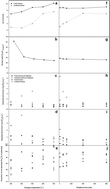
In contrast to pyrolysis temperature, increasing the residence time from 5 min to 800 min at 500 °C had no significant effect on pH values of the unoxidized biochar, which ranged from 8.82 at 5 min to 9.08 at 800 min (Fig. 1f). Interestingly, oxidation significantly reduced the pH of biochars with short residence times, but had little effect on pH of biochar pyrolyzed for 400 min or longer. When oxidized, varying the residence time from 5 min to 80 min at a pyrolysis temperature of 500 °C had almost identical effects on pH as varying the pyrolysis temperature from 300 °C to 700 °C at a residence time of 30 min. This may be explained by the aromatization level of biochar. The high temperature and long residence time makes the carbon highly aromatic.
Ash contents significantly increased with higher pyrolysis temperature and residence time. In contrast to ash, volatile contents decreased significantly with higher pyrolysis temperature, when the residence time increased from 60 min to 800 min, the change of volatile contents was not obvious. Fixed carbon contents of biochars significantly increased with increasing pyrolysis temperature, but no significant increase was observed when prolonging pyrolysis. The surface area also increased significantly with increasing pyrolysis temperatures, but there was no alteration when pyrolyzed continuously at 500 °C. Both pyrolysis temperature and residence time had significant effects on the CEC of biochar. With the increase in pyrolysis temperature, the CEC of biochar decreased from 117.15 cmol kg−1 to 47.11 cmol kg−1. Total C contents increased while total H and O decreased with increasing temperature (Table 1).
Biochar yields decreased with increasing pyrolysis temperatures and residence times increasing the pyrolysis temperature resulted in a significant decrease in biochar yield, and the highest yield was obtained at a temperature of 300 °C. For instance, the yield of biochar at 300 °C was 62% of the dry feedstock, while at 400 °C, the yield decreased to 32% of the dry feedstock. At temperatures of 500, 600 and 700 °C, the yield of biochar was reduced to 27%, 26% and 24% of the initial weight, respectively (Fig. 1b). The largest yield loss occurs within the first 120 min of residence time during pyrolysis. Increasing the residence time from 120 min to 800 min decreased the biochar yield only slightly (Fig. 1g).
There was no significant difference in ammonium adsorption for fresh biochars among different residence times. However, neutralizing the oxygen-containing surface functional groups on oxidized biochars to pH 7 increased ammonium adsorption two to three-fold for biochars pyrolyzed from 5 min to 120 min (Fig. 1h).
Abiotic oxidation with peroxide generated oxygen-containing functional groups, which largely improve ammonium adsorption capacity. Another reason for the enhanced ammonium adsorption capacity is the increase of negative charges on the surface of the biochar.31 Higher pyrolysis temperatures and longer residence times result in higher degrees of biochar aromaticity. Elemental H/C and O/C ratios can be used to estimate the degree of aromaticity of the carbon structure. Biochars produced at low temperatures had higher H/C ratios, and biochars produced at high temperatures had lower H/C ratios. Previous studies have shown that biochar amendment can increase CEC in soil32 and that when aging and weathering of the biochar occurs the CEC can be further increased.33 Therefore, the oxygen-containing functional groups and negative charges in the oxidized biochar pyrolyzed under low temperatures and short residence times are higher than those pyrolyzed under high temperatures and long residence times. Previous studies have also pointed out that, initially, biochars produced at high pyrolysis temperatures (800 °C) had greater exchangeable cations and CEC than those produced at lower temperatures. However, after 8 weeks of oxidation the CEC of low temperature biochars was significantly higher,34 which is consistent with the results of this study.
However, the lack of change in ammonium adsorption to unoxidized biochars as a function of pyrolysis temperature is more difficult to explain, as pH, O/C ratios, and surface areas suggested a change in biochar properties. It is possible that the decrease in acid functional groups with increasing pyrolysis temperatures is compensated by an increase in surface area, canceling any temperature effects for the biochars studied here. Increases in surface area with higher pyrolysis temperature are typically observed,14 as are lower O/C ratios.16
Interestingly, when biochars were oxidized, both residence time and pyrolysis temperature affected ammonium adsorption, and did so to a much greater extent than if they were not oxidized. The much greater adsorption to oxidized biochars produced at lower temperatures and shorter residence times may be the result of greater oxidation, shown by a greater pH drop and increases in the O/C ratios. Greater oxidation with shorter pyrolysis times and lower temperatures upon exposure to H2O2 may be explained by the lower degree of fused aromatic C structures typically found under those conditions,35,36 also indicated by the higher H/C ratios found in our study. This probably also means that those biochars produced at lower temperatures and shorter residence times will develop cation retention capacity more quickly when added to soil. This may pose a tradeoff with an intent to produce biochars with long turnover times in soil, which are typically produced at higher pyrolysis temperatures.37
| This journal is © The Royal Society of Chemistry 2016 |