Gun-Hee Kima,
Byung-Hyun Leea,
Hwon Ima,
Seung-Bae Jeona,
Daewon Kima,
Myeong-Lok Seola,
Hyundoo Hwangb and
Yang-Kyu Choi*a
aSchool of Electrical Engineering, KAIST, 291 Daehak-ro, Yuseong-gu, Daejeon 34141, Republic of Korea. E-mail: ykchoi@ee.kaist.ac.kr
bSchool of Engineering and Sciences, Tecnológico de Monterrey, Av. Eugenio Garza Sada 2501 Sur, Monterrey, NL 64849, Mexico
First published on 22nd April 2016
The anisotropic wetting characteristics of scalloped nanogrooves (SNGs) were investigated for the first time. SNGs with various scallop edge angles were fabricated by Bosch deep reactive ion etching (DRIE). The wetting properties of the nanopatterned surfaces were studied in dynamic and static regimes. The anisotropic wettability of the SNGs was successfully employed to control fluid flows in microfluidic channels.
There are two primary approaches to controlling the anisotropic wetting properties of solid surfaces: chemical modification;9–12 and physical modification using nanostructures.13,14 Chemically modifying surfaces to produce chemical inhomogeneities is relatively simple to achieve, and produces excellent anisotropic wetting properties, however, they typically lack long-term reliability. In order to control the degree of anisotropy over a wider range, it is also often necessary to make structural modifications to control the air trapped in the cavities between the structures.15–18 Re-entrant structures are some of the most well-known approaches for efficiently keeping air in the cavities. The wetting characteristics of liquids on re-entrant structures have been explained via energy19,20 and force balance models.21–23
Here we demonstrate tunable anisotropic wettability using nanogrooves with multiple re-entrant structures (i.e. scalloped patterns). The scalloped patterns were introduced to control the trapped air more efficiently. They were fabricated by the Bosch deep reactive ion etching (DRIE) of silicon substrate.24 The fabrication parameters were meticulously adjusted to generate scallop patterns with various edge sharpnesses. The static and dynamic wetting properties of the fabricated nanostructures were also investigated. The nanoscallops were then applied to control flows in microfluidic channels, showing the potential application of the scalloped nanogrooves (SNGs) for microfluidic devices.
The process of fabricating the scalloped structures was primarily based on the Bosch DRIE. The detailed process flow is described in Fig. 1(a). A bulk silicon wafer was prepared, and then the non-grooved region was defined by the photolithography process. An oxide mask defined the region on which the grooves were to be made. Then a C4F8-based polymer passivation layer was conformally deposited on the region. Subsequent reactive ion etching based on SF6 gas followed C4F8 passivation. Since the etch process shows an anisotropic etching tendency and the C4F8-based polymer protects the sidewall, a scalloped structure can be formed without any separation between adjacent scallops. Iterating the polymer passivation and plasma etching steps allows multiple scallops to be formed. Optimization of the main parameters, namely the flux of the gas, the polymer passivation and plasma etching times, the chuck temperature, and the plasma power, was conducted to ensure the best uniformity and reproducibility.25 If the parameters of the DRIE are non-optimized it can cause separation between the scalloped patterns. The sample that was prepared without nanoscalloping was fabricated by Cl2 gas-based plasma etching. Silicon etching using Cl2 gas is a completely anisotropic process, thus a structure without sidewall patterns can be generated.
To observe how anisotropic wetting properties depend on the sharpness of the scallop edge, two kinds of SNGs were fabricated. One of them had a relatively small scallop edge angle of (θ1 = 30°) (Fig. 1(b)) and the other had a relatively large edge angle (θ2 = 45°) (Fig. 1(c)). A nanogroove structure which did not have scalloping was also fabricated as a control group (Fig. 1(d)). The structures shown Fig. 1(b), (c), and (d) are named samples 1, 2, and 3, respectively.
Droplets on those surfaces having the anisotropic nanostructures were distorted, as shown in Fig. 2. Droplet distortion is defined as the ratio of the major axis to the minor axis (L/W) of the distorted droplet.26 The droplet distortion increases as the angle of the scallop edges (θ) increases (Fig. 2(d), (g), and (j)). The static contact angles along a line perpendicular to the nanogrooves (Fig. 2(b)) and parallel to the nanogrooves (Fig. 2(c)) were also measured. In all cases, the contact angles measured along the direction perpendicular to the grooves (θ⊥) was larger than angles observed along the line parallel to the grooves (θ∥), implying a more hydrophilic characteristic along the line parallel to the grooves.27,28 These anisotropic wetting properties became more evident as the edge of the scallop became less sharp. θ⊥ was similar for all types of nanogrooves, while θ∥ clearly decreased as the edge angle of the scallops increased. In other words, the surface became relatively more hydrophilic as the edge angles increased.
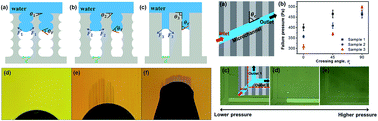
It has been reported that scallops on fabricated structures limit the motion of water.20 When water penetrates between the grooves, the water tends to be pinned at the most highly protruding parts of the scallops (Fig. 3(a) and (b)).19 The pinned water is in a stable state, which means that more energy is required to push the water downward. As the edge of the scallop becomes sharper, the water in the pinned state becomes more stable. In other words, when the angle of the scallop is small, the net force on the liquid–vapor interface is upward. The traction directed upward prevents water movements downward, allowing a composite state. When θ1 = 30°, the water hardly entered the empty space among the structures, and no line-shaped water marks were observed (Fig. 3(d)). However, when θ2 = 45°, some of the water permeated the spaces among the nanostructures, and water lines were observed (Fig. 3(e)). When θ3 = 90°, the water permeated the empty space easily and the contact angle of the water droplet along the nanogrooves significantly decreased.
These results are consistent with the measurements of contact angle hysteresis (CAH) (Table 1). Over time, the water on the structures tended to permeate the grooves. The permeated water slowly propagated through the gaps via capillary effect. This permeated and propagated water greatly affected the advancing angle (θA) and receding angle (θB).
| samples | Parallel | Perpendicular | ||||
|---|---|---|---|---|---|---|
| θA (deg) | θR (deg) | CAH (deg) | θA (deg) | θR (deg) | CAH (deg) | |
| Sample 1 | 112.8 | 108.4 | 4.4 | 158.2 | 99.7 | 58.5 |
| Sample 2 | 108.7 | 95.1 | 11.6 | 157.2 | 99 | 58.7 |
| Sample 3 | 90 | 47.9 | 42.1 | 162.2 | 41.5 | 120.7 |
Fig. 4 explains the phenomena above in detail. Fig. 4 shows the results of dynamic sessile drop experiments along the line parallel to the grooves. As Fig. 4 shows, the water droplet propagates parallel to the groove line. In the experiment, water was added at a constant rate through a needle connected to the droplet on the structures. The addition rate was constant but the contact lines of the droplets moved differently. The water contact line of sample 1 moved faster than any other samples. As observed in Fig. 3, water hardly permeates the empty space between the grooves, so it does not affect droplet propagation greatly. However, the droplet propagation on sample 2 is slightly affected by the permeated water, and the droplet moves slower than that of sample 1. The propagation on sample 3 is the slowest. The water line underneath the droplet makes the structure sticky so the droplet apparently does not move in Fig. 4(c).
Dynamic sessile drop experiments were also conducted to observe the lines perpendicular to the grooves (Fig. S1†). The contact lines of the droplets perpendicular to the grooves are strongly pinned without shifts.
Based on the anisotropic wetting characteristics analyzed above, it's possible to utilize the SNG in various applications. For example, biomedical devices29–32 and microfluidics applications3,33–35 have been demonstrated using anisotropic wettability. Recently, S. Wang et al. reported a microfluidic valve that uses anisotropic wetting properties.35 This unconventional valve regulates liquid flow using directional wetting of the surface, rather than applying any complex mechanical motions. The proposed grooved structure can be also used as a kind of microfluidic valve.
To prove its potential as a microfluidic valve, this study designed three sets of simple channel experiments. As Fig. 5(a) shows, a single polydimethylsiloxane (PDMS) microchannel was aligned on the grooved surface. The channel width was 175 μm and the height was 43 μm (Fig. S2†). The single channel was 5 mm in length. The angle between the groove lines and microchannel is called the crossing angle (θC). By altering θC to 0°, 45°, and 90°, water was injected through the inlet of the device. This study used a gravity pump to inject the water. As the water went through the channel, the failure pressure, which is a characteristic parameter that describes how well a fluid flows in one direction, was measured for each device.35 High failure pressure indicates that the fluid has a strong tendency to flow in one direction and low failure pressure indicates a weak tendency to flow in the preferred direction. In this experiment, the failure pressure was defined as the pressure below which the water entered through the inlet and instantly reached the outlet.
The measured failure pressures are shown in Fig. 5(b). The overall results indicate that the failure pressure increases as the scallop edge angle becomes smaller. Specifically, the tendency becomes less apparent when θC is increased. This result is attributed to the clear difference in wettability of the direction parallel to the groove lines. Sample 3 is the most easily wettable under the same conditions (fixed channel width and height) when the channel is aligned parallel to the groove line. The difference in wettability between the samples becomes unclear when θC is increased and reaches 90°. In sample 3, the tendency of the water to wet along the groove lines is so strong that it hinders the water propagation along the direction perpendicular to the groove lines. Thus the failure pressure of sample 3 is the only recognizable value when θC = 90°. A detailed explanation for the described tendency is provided in Fig. S4.†
Since the failure pressure can be tuned by altering the edge angle and θC, the failure pressure of the microvalve can also be adjusted. A Y-shaped microchannel was used for the microvalve, as in the previous study. The failure pressure was defined as the pressure which causes the water to fill outlet 1 completely, and fills 1/5 of outlet 2 (Fig. 5(c)). Fig. 5(c–e) presents time-lapsed images of the water propagating in the microvalve. At first the water fills the channel parallel to the groove line, and then it slowly fills the channel perpendicular to the groove line. In other words, the valve was initially a one-way channel and it became a two-way channel after the failure pressure. The failure pressure of the Y-shaped valve is quite similar to that of single channel along the groove line (Fig. S3†). The failure pressure was successfully controlled by the proposed Bosch nanostructures.
In summary, anisotropic wettability was observed in nanogrooves fabricated with scalloped sidewalls. Both static and dynamic anisotropy was successfully controlled by altering the angle of the scallop edge. As the edge angle became larger, the anisotropic characteristic became increasingly apparent. These phenomena were analyzed based on a force balance model. As the scallop angle became smaller, the force between the grooves and the water was directed upward. The upward traction prevented the water from entering the cavities. Microscopic images confirmed the theoretical analyses. To demonstrate the applicability of the proposed structure, microfluidic experiments were conducted. The failure pressures of single channels aligned with different crossing angles were well tuned by controlling the edge angle of the scallop. The dependency of the failure pressure on the crossing angle became apparent when the edge angle of the structure was large. Finally, a microvalve was aligned on the nanostructure, and the experiment proved that the microvalve operation could be successfully controlled by the shape of the scallops.
Footnote |
| † Electronic supplementary information (ESI) available: Droplet propagation along the direction perpendicular to the nanogrooves, fabrication of microchannel, and failure pressure of Y-shaped microchannel. See DOI: 10.1039/c6ra06379a |
| This journal is © The Royal Society of Chemistry 2016 |