
Chuan Ding,
Yanwei Zeng*,
Liangliang Cao,
Rongjie Li,
Yuan Zhang and
Longfei Zhao
State Key Laboratory of Materials-oriented Chemical Engineering, School of Materials Science and Engineering, Nanjing Tech University, Nanjing 210009, PR China. E-mail: stephen_zeng@njtech.edu.cn; stephen_zeng@163.com; Fax: +86 25 83587254; Tel: +86 25 83587254
First published on 25th May 2016
Monodisperse MnxFe3−xO4 (x = 0, 0.3, 0.6) polyhedrons enclosed by {100}/{111} facets with different area ratios were synthesized through the thermolysis of Fe(acac)3 and Mn(acac)2 by effectively tuning the Mn/Fe ratio to mediate the adsorption properties of oleic acid (OA) on crystal surfaces after annealing treatment in N2, and studied as high rate (≥1 A g−1) anode materials for lithium ion batteries (LIBs). The electrochemical results show that Mn0.6Fe2.4O4 octahedra possess the best rate cycling performance compared to that of Mn0.3Fe2.7O4 cuboctahedra and Fe3O4 cubes, characterised by a 500th discharge capacity of 803.5 mA h g−1 at 1 A g−1 and a rate capability of 661.5 mA h g−1 when cycled at 4 A g−1, as a result of high electrochemical activity of {111} facets with the highest Fe atom surface density. The present results prove that the substitution of Fe by Mn in the spinel-type anode materials can result in better cycle stability and it would be helpful for the further understanding of Fe3O4 based anode materials and provide a simple and practical route to design high rate anode materials for lithium-ion batteries.
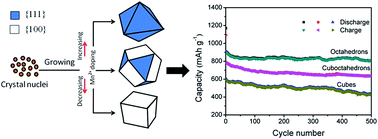
In the work reported here, monodisperse MnxFe3−xO4 (x = 0, 0.3, 0.6) polyhedrons enclosed by different area proportions of {100}/{111} facets were synthesized by utilizing Mn2+ metal ions as structure-directing agents during the thermal decomposition process, in which Fe(acac)3 and Mn(acac)2 were employed as the precursor, benzyl ether as reaction media, and OA as surfactant. In the meantime, the binding characteristics of OA molecules with different metal ions play significant roles in the shape determination of MxFe3−xO4 (M = Mn2+, Ni2+, Zn2+, Co2+) NCs. Besides, the high-rate electrochemical performance of MnxFe3−xO4 polyhedrons with different facets was investigated as anode materials for lithium ion battery. Some new insights into the morphology/component-electrochemical properties relationship of Mn doped Fe3O4 anodes have been achieved, which would be helpful for the further understanding of Fe3O4 based anode materials and the future development of high-performance electrodes.
:
1 by volume). After assembled in the glove box at ≤1 ppm of moisture and oxygen, the cells were tested on a NEWARE BTS-5V 50 mA computer-controlled battery test station at different current densities within a voltage range from 0.01 to 3 V at 25 °C. Electrochemical impedance measurements were conducted over the 0.1 Hz to 100 kHz frequency range with a perturbation amplitude of 5 mV on a Princeton 2273 electrochemical system.
![]() | ||
| Fig. 1 FESEM images of (A) Fe3O4 cubes without Mn2+, (B) Mn0.3Fe2.7O4 cuboctahedrons with 10 mol% of Mn dopant, (C) Mn0.6Fe2.4O4 octahedrons with 20 mol% of Mn dopant. | ||
Fig. 2A shows the X-ray diffraction diagrams of the as-synthesized products obtained with different amount of Mn dopant, which are in a good agreement with that of the inverse spinel Fe3O4 with a face-centered cubic structure (JCPDS no. 19-0629). The diffraction peaks with 2θ at 30.0°, 35.5°, 37.0°, 43.0°, 53.0°, 57.0° and 62.6° may be well ascribed to the crystallographic planes (220), (311), (222), (400), (422), (511) and (440) of normal magnetite Fe3O4, respectively. No impurity phases can be identified. The divalent Mn2+ (ri = 96 pm) ions tend to occupy the tetrahedral sites because of larger size compared to smaller Fe3+ ions (ri = 69 pm), which occupy the octahedral sites. The lattice parameter value of the compounds was calculated by using Jade software. The lattice parameter, a = 8.3915 Å, calculated for Fe3O4 cubes is close to the reported values (JCPDS no. 19-0629). On doping Mn2+, the lattice parameter increases slightly from 8.3915 Å to 8.3994 Å and 8.4002 Å as the amount of Mn2+ was increased to 10 mol% and 20 mol%, respectively, because of the slightly bigger size of Mn2+ ions. In addition, taking advantage of the diffraction-lines fitting results, the crystal size of MnxFe3−xO4 nanoparticles was also calculated as 89.7, 95.4, 102.4 nm by Scherrer's equation, which are quite close to the value measured on the FESEM images. The Raman measurements in the range 200–800 cm−1 of the MnxFe3−xO4 polyhedrons have been made at room temperature and the results are shown in Fig. 2B. For Fe3O4 nanocubes, five Raman active modes are identified as: T2g(1) = 206.6, Eg = 347.0, T2g(2) = 493.5, T2g(3) = 578.8, A1g = 675.3 cm−1 according to group theory assignment and consistent with the previous reports.22 Usually, the motion of oxygen at tetrahedral sites in the spinel compounds give bands above 600 cm−1 that are of the A1g type. The A1g modes for MnxFe3−xO4 correspond to motion of oxygen in the MO4 (M = Mn, Fe) tetrahedra. Upon doping, the single band splits into two at ∼671.9 and 721.1 cm−1 due to the environmental change of the tetrahedrons, and therefore it confirms the substitution of Fe by Mn in Fe3O4.9,16 On the other hand, FTIR spectroscopy is also an important technique to identify the stretching and bending vibrations of different materials. IR spectra of the MnxFe3−xO4 polyhedrons were recorded in the range of 1000–400 cm−1, as shown in Fig. 2C. In general, stretching vibration due to metal cations present at the tetrahedral site shows a band around 600 cm−1, while the cation present at the octahedral site shows a band around 400 cm−1, which varies slightly depending on the strength of metal–oxygen bond.9,17 Fe3O4 nanocubes show a broad band at 551.7 cm−1 characteristic of Fe–O vibration. When Mn2+ ions are introduced into Fe3O4 polyhedrons with amounts of 10 and 20 mmol%, the bands shift to higher wavenumbers of 561.8 and 575.4 cm−1, respectively, which may be attributed to stronger Mn–O bond. Besides, to verify the composition of all the phases, elemental analyses of Mn doped Fe3O4 were carried out by Inductively Coupled Plasma (ICP). The ICP results of the samples are shown in Table 1, which indicate x = 0, 0.32, and 0.61 for MnxFe3−xO4 cubes, cuboctahedrons, and octahedrons, respectively, and are close to the theoretical values.
| Compound | Lattice parameter (Å) | Crystal size (nm) | Surface area (m2 g−1) | Mn (mg L−1) | Fe (mg L−1) |
|---|---|---|---|---|---|
| Fe3O4 | 8.3915 | 89.7 | 9.96 | 0 | 142.5 |
| Mn0.3Fe2.7O4 | 8.3994 | 95.4 | 9.85 | 14.2 | 130.2 |
| Mn0.6Fe2.4O4 | 8.4002 | 102.4 | 9.61 | 32.0 | 168.4 |
It is well known that the crystal shape is determined by the realistic growth rate ratio of different directions in a synthesis, which could be changed by selective adsorption of surfactants on the facets.18,19 In recent years, ion doping showed attractive effect on the shape and size of nanostructures. Typically, it was found that the different adsorption properties to different metal ions of the different planes of α-Fe2O3 would lead to the formation of α-Fe2O3 nanostructures with different exposed surfaces.20 Therefore, take above progresses into the consideration of different cohesive energies between metal ions and carboxylate group,21 it can be deduced that the changed adsorption characteristic of OA molecules on MnxFe3−xO4 facets with the adjustment of Mn2+ doping content may be the key factor for the formation of different shaped MnxFe3−xO4 NCs. The above mechanism was partly confirmed by a set of experiments using the standard procedure, except that different doping ion species were used. The result shows that the Zn0.6Fe2.4O4 cubes (Fig. 3A), Ni0.6Fe2.4O4 truncated cubes (Fig. 3B) and Co0.6Fe2.4O4 cuboctahedrons (Fig. 3C) can be obtained by using 0.4 mmol zinc acetylacetonate, nickel acetylacetonate and cobalt acetylacetonate, respectively with fixed 1.6 mmol ferric acetylacetonate as precursors, suggesting that the substitution of Fe by transition metal ions is responsible for the formation of different shaped MxFe3−xO4 NCs (M = Mn2+, Zn2+, Ni2+, Co2+).
![]() | ||
| Fig. 3 FESEM images of (A) Zn0.6Fe2.4O4 cubes, (B) Ni0.6Fe2.4O4 truncated cubes, (C) Co0.6Fe2.4O4 cuboctahedrons. | ||
In order to evaluate the relationship between crystal planes/component and high-rate electrochemical properties of MnxFe3−xO4 polyhedrons, these polyhedrons were tested as anode materials for LIBs. Before that, the specific surface areas of the three kinds of MnxFe3−xO4 polyhedrons have been measured by the Brunauer–Emmett–Teller (BET) method and are shown in Fig. 4. The measured specific surface areas for cubes, cuboctahedrons, and octahedrons are 9.96, 9.85 and 9.61 m2 g−1, respectively.
![]() | ||
| Fig. 4 N2 adsorption–desorption isotherms of Fe3O4 cubes, Mn0.3Fe2.7O4 cuboctahedrons and Mn0.6Fe2.4O4 octahedrons, whose specific surface areas are 9.96, 9.85 and 9.61 m2 g−1, respectively. | ||
Fig. 5A displays the 1st, 2nd, 100th, 300th and 500th discharge/charge voltage profiles of Mn0.6Fe2.4O4 octahedrons at a current density of 1 A g−1 in the voltage range of 0.01–3.0 V versus Li/Li+. It can be seen that in the first cycle, Mn0.6Fe2.4O4 octahedrons exhibit an initial discharge capacity of 1169.6 mA h g−1, equivalent to a consumption of 10.1 moles of Li per mole, and a charge capacity of 900.6 mA h g−1 corresponding to 7.8 moles of Li, with an initial coulombic efficiency of 77.0%. The irreversible capacity of 269.0 mA h g−1, as the difference between discharge and charge capacities, is observed for the first cycle and it may be attributed to the irreversible processes such as the formation of amorphous Li2O, solid electrolyte interphase (SEI) layer and the decomposition of electrolyte, which are quite common to the systems involved in those LIB's redox reactions.22–25 After the first discharge–charge process, the reversible discharge capacity shows an initial decrease from 907.6 mA h g−1 (7.8 moles of Li) at the 2nd cycle to 837.6 mA h g−1 (7.2 moles of Li) at the 100th cycle and 836.8 mA h g−1 (7.2 moles of Li) at the 300th cycle, but then a slight decrease to 803.5 mA h g−1 (6.9 moles of Li) after the 500th cycle, which show a high available capacity and cycle stability for the Mn0.6Fe2.4O4 octahedrons at a high current density of 1 A g−1.
To better understand the charge–discharge behavior of the Mn0.6Fe2.4O4 octahedrons, a differential capacity dQ/dV vs. voltage plot for each cycle is derived from its normal discharge–charge curve and shown in Fig. 5B. It can be seen clearly from the inset diagram that the initial discharge process is characterized by one strong reduction peak at ∼0.85 V, which can be ascribed to the reductive reaction Mn0.6Fe2.4O4 + Li+ → Mn0 + Fe0 + Li2O and, possibly, along with the irreversible reactions of electrolyte to form a solid electrolyte interface (SEI) layer.26,27 For the charge process, in contrast, two diffusive oxidation peaks may be found at ∼1.62 V and 1.81 V, corresponding to the oxidation reactions of Mn0, Fe0 to Mn2+, Fe2+ and Fe3+, respectively during the anodic process.28,29 As to the 2nd cycle, the initial discharge peak appear to gradually split into three consequent peaks: two small peaks of them appearing at ∼0.84 and 1.25 V, and the third strong peak occurring at ∼1.01 V, suggesting a nonuniform electrochemical reaction occurring on the anode as a possible result of incomplete electrochemically activation of Mn0.6Fe2.4O4 octahedrons after the first cycle. Interestingly, the discharge peaks show a continuous intensity increase and slight voltage drop during the following 500 cycles, and a high discharge voltage of 0.87 V can be retained after 500 cycles. Obviously, this voltage stability and intensity increase of discharge peak for the Mn0.6Fe2.4O4 octahedrons should demonstrate a superior cycle stability of the anode materials during the repeated lithiation/delithiation process, which in nature should be originated from its initial composition and morphology features.
In comparison with Mn0.6Fe2.4O4 octahedrons, as shown in Fig. 5C and E, Mn0.3Fe2.7O4 cuboctahedrons and Fe3O4 cubes exhibit lower initial discharge and charge capacities of 1092.0/785.6 mA h g−1 (9.4/6.8 moles of Li) and 910.5/595.8 mA h g−1 (7.9/5.2 moles of Li), respectively, with the corresponding coulombic efficiencies of 71.9% and 65.4%. The improvement of initial capacity and coulombic efficiency of Mn0.6Fe2.4O4 octahedrons may be ascribed to the enhanced electrochemical reactivity, and therefore, utilization of Mn0.6Fe2.4O4.30 Moreover, both of Mn0.3Fe2.7O4 cuboctahedrons and Fe3O4 cubes show a conspicuous deterioration of discharge–charge capacity after the initial cycle. In particular, a serious discharge capacity decline of 19.1% and 27.9% can be observed from the second to 500th cycles for the Mn0.3Fe2.7O4 cuboctahedrons and Fe3O4 cubes, respectively, indicating a low charge–discharge reversibility of Mn0.3Fe2.7O4 cuboctahedrons and Fe3O4 cubes anodes. In addition, as shown in Fig. 5D and F, the main discharge peaks in the first cycle for Mn0.3Fe2.7O4 cuboctahedrons and Fe3O4 cubes appear at 0.81 V and 0.73 V, respectively, which are both lower than that of Mn0.6Fe2.4O4 octahedrons and therefore reveal their poor reaction kinetics. Thus, it is believed that such relatively poor electrochemical performances of Mn0.3Fe2.7O4 cuboctahedrons and Fe3O4 cubes should be closely associated with their component and morphological details. And this discharge–charge behavior would be worsened as the current density is further increased. Furthermore, the discharge peaks of Mn0.3Fe2.7O4 cuboctahedrons and Fe3O4 cubes both exhibit more serious voltage drop and intensity reduction as the cycle test proceeds, which suggests some cycle degradations with the Mn0.3Fe2.7O4 cuboctahedrons and Fe3O4 cubes as anode materials while in discharge/charge at 1 A g−1. So, in general, it is believed that such electrochemical performances of Mn0.6Fe2.4O4 NCs, in terms of capacity performance and cycling stability, should be associated with their component and exposed crystal planes.
As regards the cycling capacities of Mn0.6Fe2.4O4 octahedrons, Mn0.3Fe2.7O4 cuboctahedrons and Fe3O4 cubes, the experimental results measured at 1 A g−1 are presented in Fig. 6A. It can be seen that the Mn0.6Fe2.4O4 octahedrons show a slight capacity decrease during the initial 100 cycles. Moreover, a stable charge–discharge process can be observed in the extended cycles and a discharge capacity up to 803.5 mA h g−1 (6.9 moles of Li) is achieved at 500th cycle, corresponding to 88.5% of the discharge capacity at the 2nd cycle, indicating an outstanding available capacity and cycling stability for the Mn0.6Fe2.4O4 octahedrons anode. In contrast, Mn0.3Fe2.7O4 cuboctahedrons exhibit a continuous capacity decline to 667.5 mA h g−1 (5.8 moles of Li+) in the initial 250 cycles and finally to 637.8 mA h g−1 (5.5 moles of Li+) after 500 cycles. Similarly, the discharge capacity of Fe3O4 cubes is abruptly decreased from 601.7 mA h g−1 (5.2 moles of Li+) to 490.2 mA h g−1 (4.2 moles of Li+) after 250 cycles and then falls to 433.8 mA h g−1 (3.8 moles of Li+) after 500 cycles. These facts clearly demonstrate the significant effects of the component and morphology of MnxFe3−xO4 NCs on their high rate electrochemical performance.
To gain further insights into the component and morphology-dependent electrochemical characteristics of MnxFe3−xO4 NCs, impedance measurements were carried out in the frequency range from 0.1 Hz to 100 kHz at room temperature. The impedance spectra of MnxFe3−xO4 NCs with the fully charged state after the 500th cycle are shown in Fig. 6B, which consist of a depressed semicircle in the high to medium frequency region and an inclined line in the low-frequency region that is associated with the charge transfer process and diffusion of lithium ions into the electrode materials, respectively.31 The impedance data were analyzed with ZSimpWin software by fitting to an equivalent electrical circuit (see the insert of Fig. 6B) composed of electrolyte (Re) and charge-transfer (Rct) resistances, constant-phase element (CPEi) (due to the depressed semicircle observed in the spectra), diffusional components like Warburg impedance (Ws) and the intercalation capacitance (Cint), similar to the circuit employed for other oxide electrodes.32,33 The symbols are the experimental data whereas the continuous lines represent the fitted spectra, and the derived parameters are presented in Table 2. It can be found that the value of the charge transfer resistance (Rct) is 106.4 Ω for Mn0.6Fe2.4O4 octahedrons, which is obviously lower than that of Mn0.3Fe2.7O4 cuboctahedrons (141.5 Ω) and Fe3O4 cubes (199.9 Ω), indicating that the Mn0.6Fe2.4O4 octahedrons anode has a faster charge-transfer process than Mn0.3Fe2.7O4 cuboctahedrons and Fe3O4 cubes anode. Thus, Mn0.6Fe2.4O4 octahedrons are proved to be beneficial for improving anode electric conductivity and hence the cycle stability and rate capability of Mn0.6Fe2.4O4 anodes. Besides, the lithium ion diffusion coefficient can be calculated from the formula as following:
| DLi+ = R2T2/(2A2n4F4C2σω2) | (1) |
486 C mol−1), C is shuttle concentration of Li+ ions (7.69 × 10⁻³ mol cm−3), and the value of Warburg coefficient σω is the slope of line fitted to the plot of Z′–ω−1/2 (Fig. 6C).34 It can be observed that the Warburg coefficients σω of octahedrons, cuboctahedrons and cubes anodes after the 500th cycle are 51.2, 117.2, 160.3 Ω s−0.5, respectively. Thus, according to eqn (1), the DLi+ for Mn0.6Fe2.4O4 octahedrons can be calculated as 1.7 × 10⁻¹³ cm2 s−1, which is about 5.2 times that of Mn0.3Fe2.7O4 cuboctahedrons (3.3 × 10⁻¹⁴ cm2 s−1) and 9.4 times higher than that in Fe3O4 cubes (1.8 × 10⁻¹⁴ cm2 s−1), indicating the faster Li-ion diffusivity of Mn0.6Fe2.4O4 anodes during electrochemical cycles. These results agree well with above analysis and confirm that the electrons and Li+ can transfer more effectively in the interface of active materials and electrolyte by increasing the proportion of {111} facets and Mn2+ doping content, thus resulting in the enhanced electrode reaction kinetics and better electrochemical performance of the Mn0.6Fe2.4O4 octahedrons during the high rate charge/discharge process.
| Anode | Re (Ω) | Rct (Ω) | CPE (μF) | n | σω (Ω s−0.5) | DLi+ (cm2 s−1) |
|---|---|---|---|---|---|---|
| Mn0.6Fe2.4O4 | 8.312 | 106.4 | 5.6 | 0.8 | 51.2 | 1.7 × 10⁻¹³ |
| Mn0.3Fe2.7O4 | 7.686 | 141.5 | 4.8 | 0.8 | 117.2 | 3.3 × 10⁻¹⁴ |
| Fe3O4 | 4.543 | 199.9 | 4.2 | 0.8 | 160.3 | 1.8 × 10⁻¹⁴ |
To evaluate the electrochemical performance of the MnxFe3−xO4 NCs at higher current densities, the rate performances of Mn0.6Fe2.4O4 octahedrons, Mn0.3Fe2.7O4 cuboctahedrons and Fe3O4 cubes electrodes were studied at different rates from 1 to 4 A. As shown in Fig. 7, it can be seen that there are a series of discharge capacity drops in response to the step-wise increases of current density. As expected, Mn0.6Fe2.4O4 octahedrons electrode exhibits relative high discharge capacities of 920.0 (8.0 moles of Li+), 840.3 (7.3 moles of Li+), 747.5 (6.5 moles of Li+), and 661.5 (5.7 moles of Li+) at the current densities of 1, 2, 3 and 4 A g−1 after 10 cycles, respectively. Furthermore, after the deep charge/discharge for 10 cycles at 4 A g−1, a high capacity of 906.6 mA h g−1 (7.8 moles of Li+) is recovered over 10 cycles at 0.5 A g−1 as a result of reduced electrochemical polarization, indicating stable kinetic features and good reversibility of Mn0.6Fe2.4O4 octahedrons. Compared to the Mn0.6Fe2.4O4 octahedrons, Mn0.3Fe2.7O4 cuboctahedrons deliver much lower specific capacities of 768.0–423.6 mA h g−1 (6.6–3.7 moles of Li+) at current rates of 1–4 A g−1 and 735.5 mA h g−1 (6.4 moles of Li+) after the extended 10 cycles at 0.5 A g−1 as a result of inefficient electron and lithium-ion transportation in Mn0.3Fe2.7O4 cuboctahedrons. As for Fe3O4 cubes, the reversible capacity continuously decayed with cycling, and exhibited a capacity as low as 218.9 mA h g−1 (1.9 moles of Li+) at the current density of 4 A g−1 and 512.8 mA h g−1 (4.4 moles of Li+) after the 10 cycles at 0.5 A g−1. The above data strongly prove the excellent redox reaction kinetics and superior cycling stability of Mn0.6Fe2.4O4 octahedrons at high current densities.
To further explore the effects of component and exposed planes on the electrochemical properties of MnxFe3−xO4 NCs, the morphology change of MnxFe3−xO4 NCs during electrochemical cycles was analyzed at 1 A g−1. Different from previous reports,35,36 it can be found from Fig. 8 that the morphology of MnxFe3−xO4 NCs was significantly changed during cycling, indicating the inevitable destruction of MnxFe3−xO4 active materials. Compared with the morphology before discharge and charge (Fig. 8A), more rough surface of refined Mn0.6Fe2.4O4 particles (Fig. 8B) can be observed with the repeated insertion and extraction of Li+ after initial 250 cycles. And after the extended 250 cycles, Mn0.6Fe2.4O4 octahedrons were completely transformed into porous agglomerates of nano-sized Fe3O4 particles (Fig. 8C) as a result of repeated electrochemical grinding, indicating the complete electrochemical activation of Mn0.6Fe2.4O4 octahedrons at the high current density of 1 A g−1. In contrast, the pristine (Fig. 8D) and cycled (Fig. 8E) Mn0.3Fe2.7O4 cuboctahedrons (after 250 cycles) indicate clearly that many Mn0.3Fe2.7O4 cuboctahedrons could be survived after initial 250 cycles and residual unreacted Mn0.3Fe2.7O4 nanoparticles can also be observed even after 500 cycles, revealing poorer reaction kinetics of Mn0.3Fe2.7O4 cuboctahedrons compared to Mn0.6Fe2.4O4 octahedrons at high current density. Even worse, Fe3O4 cubes showed distorted cubic morphology with a greatly increased dimension after 500 cycles at 1 A g−1, which reveals the poor reaction kinetics of Fe3O4 cubes and even possible incomplete electrochemical reaction of internal Fe3O4 with Li+. These results offer an explanation for the above distinctly different electrochemical performance (especially high-rate capacity) of different shaped MnxFe3−xO4 polyhedrons, and prove that the original morphology has a significant effect on the reaction kinetics of MnxFe3−xO4 polyhedrons during high-rate cycling, which shows great potential for the improvement of high-rate electrochemical performances through control of well-defined crystal plane structure of MnxFe3−xO4 anode materials.
![]() | ||
| Fig. 8 FESEM images of the MnxFe3−xO4 electrodes on Cu foil and after 0, 250 and 500 discharge/charge cycles. (A–C) Mn0.6Fe2.4O4 octahedrons; (D–F) Mn0.3Fe2.7O4 cuboctahedrons; (G–I) Fe3O4 cubes. | ||
It has been found that the first lithiation reaction is very important for subsequent electrochemical performance of redox based anode materials, and therefore, it is a key problem to improve the utilization of electrode materials in the initial cycles.37,38 In our case, the electrochemical activity of MnxFe3−xO4 polyhedrons was successfully enhanced by increasing the content of Mn and high discharge capacity was achieved for Mn0.6Fe2.4O4 octahedrons at high current density of 1 A g−1. As illustrated in Fig. 9, the {100} plane of Fe3O4 contains only 2 Fe3+, but the {111} plane contains 3.75 Fe3+, indicating that the {111} plane has more Fe3+ than the {100} plane.10 The {111} plane with more metal ions is believed to be beneficial for the electronic conduction and reaction of Fe3+ with Li+. Therefore, Mn0.6Fe2.4O4 octahedrons with {111} facets can react with Li+ more easily and can be fully activated in initial cycles even under high current densities of 1 A g−1. Moreover, the particles could be simultaneously fragmented to a certain extent due to the highly uneven reaction frontiers since the active sites on the nanocrystals' facets are greatly fluctuated either in spatial distribution or in chemical activity. In this case, consequently, the fragmented nanoparticles would offer larger reaction interfacial area and render a larger utilization of electrode materials during and after the initial cycle, which should be responsible for the good long cycle performance of Mn0.6Fe2.4O4 octahedrons. In contrast, the poor reaction kinetics of Mn0.3Fe2.7O4 cuboctahedron and Fe3O4 cubes would allow only a slow and even electrochemical reaction of Mn0.3Fe2.7O4/Fe3O4 particles with Li+ ions and result in a lower utilization of electrode materials due to the shroud of reaction product on the unreacted materials. Besides, it is interesting to note that Mn0.6Fe2.4O4 octahedrons generate significant increased capacity retention as compared to Mn0.3Fe2.7O4 cuboctahedrons and Fe3O4 cubes, which shows no relationship to the original exposed facets as the morphology was already destroyed during cycles. Based on the previous works on the electrochemical reversibility of metal oxides, the enhanced cycle stability of Mn0.6Fe2.4O4 octahedrons may be ascribed to the great reversibility of MnO within the MnxFe3−xO4 spinel.9 The above insights obtained will be of benefit in the design of future high-rate anode materials for lithium ion batteries.
| This journal is © The Royal Society of Chemistry 2016 |