
DOI:
10.1039/C6RA05646F
(Paper)
RSC Adv., 2016,
6, 34428-34433
A unified approach to pyrrole-embedded aza-heterocyclic scaffolds based on the RCM/isomerization/cyclization cascade catalyzed by a Ru/B-H binary catalyst system†
Received
3rd March 2016
, Accepted 21st March 2016
First published on 24th March 2016
Abstract
An easy and straightforward preparation of pyrrole-embedded aza-heterocyclic scaffolds employing a Ru/B-H binary catalyst system has been developed. The strategy generates a diverse array of privileged scaffolds from 2-aminophenyl group appended pyrroles that can be prepared by a two-step process from corresponding aminoaryl-substituted pyrroles. The technique of incorporating 2-aminoaromatic groups in the heterocycles and their subsequent ring-closing-metathesis (RCM) isomerization followed by subsequent Pictet–Spengler type reaction should also be applicable to other heterocycles for generating a library of multi-ring compounds in an efficient manner.
Introduction
The development of catalytic cascade reactions by integrating multiple catalytic cycles in one-pot is of prime importance in organic chemistry.1 The reaction catalyzed by two different catalysts at the same time (cooperative or relay fashion2) can provide access to products otherwise not possible by the use of a single catalyst alone. Increased focus has recently been placed on the development of multiple-catalyst systems for organic transformations that allow rapid construction of highly functionalized molecules from simple and readily available starting materials.1 Out of the various catalyst combinations, the use of metal and phosphoric acid has gained significant interest.3 Among them, one of the interesting approaches would be the tandem isomerization/carbon–carbon bond forming relay catalyzed by a ruthenium complex/Brønsted acid binary catalyst systems.4 For the first time, in 2008, Terada and coworkers have shown that ruthenium catalyst can be combined with Brønsted acid catalyst for a tandem isomerization/carbon–carbon bond formation sequence to generate imines from allylamides.5 Later, an analogous enantioselective version of the reaction was reported under the catalysis of Ru/chiral Brønsted acid binary catalyst system by the same research group.6 In 2011, Nielsen et al. realized that tandem RCM/isomerization/N-acyliminium cyclization cascade can be very important tool for the synthesis of variety of heterocycles.7 Very interestingly, the use of Brønsted acid was not necessary for their purpose and the only Ru-catalyst was found to be capable of catalyzing the whole reaction cascades. In 2012, You and co-workers devised a strategy to access enantioenriched tetrahydro-β-carbolines through a RCM/isomerization/Pictet–Spengler cascade catalyzed by Ru/chiral Brønsted acid catalysts.8 Pioneering work from the same group recently revealed the RCM/isomerization/Mannich reaction cascade for accessing enantioenriched γ-lactams.9 Analogous to nitrogen heterocycles, oxacycles can also be constructed utilizing related tandem isomerization/carbon–carbon bond formation reactions of allylic ethers. In this regards, Nielsen10 and Scheidt,11 independently utilized the readily available allylic ethers for the sequential isomerization of allyl ethers (Ru/Ir catalysis) to generate oxocarbenium ions which were amenable by the attack of tethered nucleophiles (TsOH/Bi(OTf)3 catalysis).
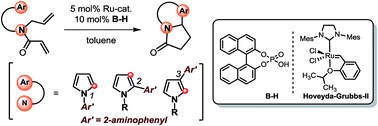
Recently, we reported the synthesis of pyrrole-embedded aza-heterocyclic scaffolds via catalytic enantioselective hydroamination–hydroarylation of alkynes under the catalysis of (R3P)-Au-Me/(S)-TRIP (Scheme 1).12 Encouraged by our results and inspired by the above reports,5–11 we envisaged that pyrrole based N-allyl acrylamide A would undergo RCM/isomerization/cyclization13,14 tandem catalyzed by Ru/B-H15 binary catalyst system 3 as depicted in Scheme 2. The proposed reaction would afford pyrrole-embedded aza-heterocyclic scaffolds; namely, dihydrodipyrrolo[1,2]quinoxalin-3-(2H)-ones, tetrahydro-6H-dipyrrolo[1,2]quinolin-6-ones and tetrahydro-9H-dipyrrolo[1,2]quinolin-9-ones – a promising class of biologically active molecules.16 The technique of incorporating 2-aminophenyl group at various positions of pyrrole is supposed to be very important because one can access pyrrole-based scaffold diversity.17 The technique is expected to be applicable not only for pyrroles but also for other heterocycles. Since several heterocycles (furan, thiophene, indole, benzofuran, benzothiophene etc.) are available and it is relatively easy to introduce 2-aminophenyl groups at various positions of heterocycles, the designed strategy should have clear-cut potential for generating a diverse library of aza-heterocyclic scaffolds which could have application in medicinal chemistry research. To the best of our knowledge, such a technique has not yet been reported in the history of RCM/isomerization/Pictet–Spengler reactions catalyzed by Ru/Brønsted acid catalysts.
 |
| | Scheme 1 Synthesis of pyrrole-embedded aza-heterocyclic scaffolds via Au/B*-H binary catalytic system – previous work. | |
 |
| | Scheme 2 Synthesis of pyrrole-embedded aza-heterocyclic scaffolds via Ru/B-H binary catalytic system – present work. | |
Results and discussions
We began our study by using N-(2-(1H-pyrrol-1-yl)phenyl)-N-allylacrylamides 1a as a model substrate. The reaction of 1a in the presence of 5 mol% Grubbs-I and 10 mol% Brønsted acid (B-H) catalysts was conducted at 80 °C in toluene as a solvent. Gratifyingly, the RCM/isomerization/Pictet–Spengler reaction proceeded and the desired product 2a was obtained in 12% yield (Table 1, entry 1). The use of Grubbs-II catalyst gave slightly better result affording 2a in 23% yield (entry 2). Next, we screened Hoveyda–Grubbs-II catalyst for this transformation and we were pleased to find that the reaction proceeded smoothly and the desired product 2a was obtained in 83% yield (entry 3). Screening of Brønsted acids such as TFA, p-TSA, CSA and BF3·OEt2 identified phosphoric acid (B-H) as the best catalyst (entries 3–7). The reaction is found to be strongly dependant on the use of solvent used (entries 3, 8–12). For instance, in the case of m-xylene and benzene (entry 8 and 9), a drastic reduction in yield of 2a was noted; while, the chlorinated solvents DCM (entry 10), DCE (entry 11), CHCl3 (entry 12) completely shuts down the reactions. Lowering the catalyst loading from 5 mol% to 2 mol% results in incomplete conversion which leads to poor yield of product 2a (entry 13).
Table 1 Optimization of the reaction conditionsa

|
| Entry |
Ru-catalyst |
Brønsted acid |
Solvent |
Temp (°C) |
Yieldb (%) |
| Reaction conditions: 0.080 mmol 1a, 5 mol% Ru-cat., 10 mol% B-H, solvent (0.152 M), 80 °C, 8 h. Isolated yields. 2 mol% cat. was used. Reaction was run for 24 h. Yield refer to C. |
| 1 |
Grubbs-I |
B-H |
Toluene |
80 |
12 |
| 2 |
Grubbs-II |
B-H |
Toluene |
80 |
23 |
| 3 |
Hoveyda–Grubbs-II |
B-H |
Toluene |
80 |
83 |
| 4 |
Hoveyda–Grubbs-II |
TFA |
Toluene |
80 |
22 |
| 5 |
Hoveyda–Grubbs-II |
CSA |
Toluene |
80 |
34 |
| 6 |
Hoveyda–Grubbs-II |
BF3·OEt2 |
Toluene |
80 |
15 |
| 7 |
Hoveyda–Grubbs-II |
p-TSA |
Toluene |
80 |
28 |
| 8 |
Hoveyda–Grubbs-II |
B-H |
m-Xylene |
80 |
64 |
| 9 |
Hoveyda–Grubbs-II |
B-H |
Benzene |
80 |
48 |
| 10 |
Hoveyda–Grubbs-II |
B-H |
DCM |
80 |
NR |
| 11 |
Hoveyda–Grubbs-II |
B-H |
DCE |
80 |
8 |
| 12 |
Hoveyda–Grubbs-II |
B-H |
CHCl3 |
80 |
6 |
| 13 |
Hoveyda–Grubbs-II |
B-H |
Toluene |
80 |
42c |
| 14 |
Hoveyda–Grubbs-II |
B-H |
Toluene |
50 |
12d |
| 15 |
Hoveyda–Grubbs-II |
— |
— |
80 |
80e |
| 16 |
— |
B-H |
Toluene |
80 |
NR |
 |
Lowering the reaction temperature to 50 °C had deleterious effect on the yield of the reaction even if the reaction continued for 24 h (entry 14). Next, controlled experiments were carried out to know the precise role of catalysts. In the absence of B-H, the RCM product C was solely obtained in 80% yield and further isomerization followed by Pictet–Spengler reaction was not observed even after prolonged reaction time (entry 15). In the absence of Hoveyda–Grubbs-II catalyst, the reaction did not generate product at all (entry 16); the starting material 1a was recovered quantitative amount. This observation clearly indicated that both the catalysts are essential for the reaction to proceed giving desired product 2a in good yields.
With the optimized conditions in hand, we explored the generality of the RCM/isomerization/Pictet–Spengler reaction by using various N-(2-(1H-pyrrol-1-yl)phenyl)-N-allylacrylamides 1 bearing a variety of electron-deficient as well as electron-rich substituents (Table 2). The reaction proceeded well to give cyclization products 2 in good to excellent yields ranging from 67–97% through N1 → C2 cyclizations. In the case of electron-rich groups such as 6-Me, 4-OMe, 4-OEt, 3-morphonyl, 4-pyrrolyl and 4-NEt2 proceeded well to give cyclization products 2 in good to excellent yields (2b, 2d, 2e, 2h, 2i and 2j). Similarly, the substrates bearing electron-deficient substituents; e.g. –Cl and –F, also reacted well to give products in good yields (2f and 2g). In the case of di-methylated substrate, a product 2c was obtained in moderate yield (67%). The structure of 2i was confirmed unequivocally through X-ray diffraction studies.18
Table 2 Reactions of N-(2-(1H-pyrrol-1-yl)phenyl)-N-allylacrylamides 1a,b

|
| Reaction conditions: 0.15 mmol 1, 5 mol% Hoveyda–Grubb-II, 10 mol% B-H, toluene (0.152 M), 80 °C, 8 h. Isolated yields. |
 |
Next, we turned our attention to N-allyl-N-(2-(1-methyl-1H-pyrrol-2-yl)phenyl)acrylamides 3 bearing a variety of electron-deficient as well as electron-rich substituents on the phenyl core (Table 3). The reaction proceeded well to give cyclization products 4 with good to excellent yields ranging from 78–94% through C2 → C3 cyclizations. It was observed that the increase of the bulk on pyrrole nitrogen has significant impact on the outcome of the reaction. For instance, when 3a, 3b and 3c treated under standard conditions, cyclization products 4a, 4b and 4c were obtained in 76, 85 and 93% yields, respectively. However, substitution pattern on phenyl rings does not hamper the efficiency of the reaction and in all the cases the reaction proceeded well regardless of the substituent's nature and position. The X-ray crystallography data for 4e has been obtained which unequivocally confirms the structure.18
Table 3 Reaction of N-allyl-N-(2-(1-methyl-1H-pyrrol-2-yl)phenyl)acrylamides 3a,b

|
| Reaction conditions: 0.15 mmol 3, 5 mol% Hoveyda–Grubb-II, 10 mol% B-H, toluene (0.152 M), 80 °C, 8 h. Isolated yields. |
 |
Next, to know whether the present strategy is applicable to seven-membered ring formation from appropriate precursors. To this end, N-(2-((1H-pyrrol-1-yl)methyl)phenyl)-N-allylacrylamide 7 was prepared18 and subjected under standard reaction conditions. Gratifyingly, the desired product 8 was obtained in 78% yields (Scheme 3).
 |
| | Scheme 3 Reaction of N-(2-((1H-pyrrol-1-yl)methyl)phenyl)-N-allylacrylamide 7. | |
We were curious to know the effect of substituents on the olefins and therefore substrates 9 and 10 were prepared and subjected to standard reaction conditions. As described in Scheme 4, the reaction of N-(2-(1H-pyrrol-1-yl)phenyl)-N-allylcinnamamide 9 gave cyclization products 2a only in 34% yield even after being heated for prolonged time (24 h) (Scheme 4a). No product observed when N-(2-(1H-pyrrol-1-yl)phenyl)-N-cinnamylcinnamamide 10 was used as a starting material; the starting material was recovered in quantitative amount (Scheme 4b).
 |
| | Scheme 4 Reaction of N-(2-(1H-pyrrol-1-yl)phenyl)-N-allylcinnamamide 9/N-(2-(1H-pyrrol-1-yl)phenyl)-N-cinnamylcinnamamide 10. | |
To shed light on the mechanism of this RCM/isomerization/Pictet–Spengler cascade reaction catalyzed by Ru/Brønsted acid catalysts, a few controlled experiments were conducted (Scheme 5). When α,β-unsaturated lactam C (Table 1, entry 11) (Scheme 5a) was treated with B-H (10 mol%) in toluene at 80 °C, the cyclization product 2a was obtained in 85% yield (Scheme 5b). Next, we endeavoured to study the applicability of the N-allyl-N-(2-(1-methyl-1H-pyrrol-3-yl)phenyl)acrylamides 5 for the RCM/isomerization/Pictet-Spengler cascade reaction (Table 4). When 5a was treated under standard conditions, the desired C3 → C2 cyclization product 6a was obtained in 62% yield. Similarly, the substrate 5b, wherein pyrrole nitrogen is protected with TIPS group, under Ru/B-H catalysis gave exclusively C3 → C2 cyclization product 6b in 73% yield. This observation is slightly different than the one reported by Jacobsen et al. wherein they have shown that a sterically demanding protecting group, in particular triisoproylsilyl (TIPS) group, on the pyrrole nitrogen, effectively shields the C2 position leading to C4 cyclization. In similar lines, substrate 5c, 5d, 5e and 5f reacted smoothly to provide the 6c, 6d, 6e and 6f in 67, 70, 65 and 64% yields, respectively (Table 4).
 |
| | Scheme 5 Controlled experiments. | |
Table 4 Reaction of N-allyl-N-(2-(1-methyl-1H-pyrrol-3-yl)phenyl)acrylamides 5a,b

|
| Reaction conditions: 0.15 mmol 5, 10 mol% Hoveyda–Grubb-II, 20 mol% B-H, toluene (0.152 M), 80 °C, 8 h. Isolated yields. |
 |
Next, we endeavoured to make the reactions enantioselective utilizing Hoveyda–Grubbs-II and chiral BINOL-derived phosphonic acids (B*-H). As outlined in Table 5, RCM/isomerization/cyclization cascade was investigated with 1a, 3a and 5a in the presence of Hoveyda–Grubbs-II catalyst and chiral phosphoric acid bearing various types of substituents at the 3,3′-position on the binaphthyl backbone.15 Unfortunately, in almost all the cases 2a, 4a and 6a were obtained in poor to moderate yields and enantioselectivity was found to be very low. The outcome of the reaction did not improve though we extensively studied the effect of the solvents, catalyst loading and temperature.
Table 5 Enantioselective version – an attempta
| Entry |
B-H* |
2a yieldb (ee)% |
4a yieldb (ee)% |
6a yieldb (ee)% |
| Reaction conditions: 0.15 mmol 1a/3a/5a, 5 mol% Hoveyda–Grubbs-II, 10 mol% B-H*, toluene (0.152 M), 50 °C, 48 h. Isolated yields. |
| 1 |
BH1 |
20(1) |
38(2) |
16(1) |
| 2 |
BH2 |
46(2) |
50(1) |
23(2) |
| 3 |
BH3 |
32(2) |
58(4) |
45(6) |
| 4 |
BH4 |
54(4) |
67(18) |
58(10) |
| 5 |
BH5 |
56(2) |
48(11) |
64(12) |
| 6 |
BH6 |
18(1) |
12(1) |
12(2) |
| 7 |
BH7 |
10(1) |
8(2) |
15(1) |
 |
Conclusions
In conclusion, we have developed efficient synthesis of pyrrole-embedded aza-heterocyclic scaffolds from easily available starting material using a Ru/B-H binary catalytic system. The technique involves Ru-triggered intramolecular RCM and subsequent isomerization/N-acyliminium ion cyclization cascade catalysed by B-H. Taking pyrrole as an example, we showed that it is possible to capitalize the reaction keeping 2-aminophenyl group at various positions. Since several heterocycles (furan, thiophene, indole, benzofuran, benzothiophene etc.) are available and it is relatively easy to introduce 2-aminophenyl groups at various positions in the heterocycles, the designed strategy should have great potential in diversity oriented synthesis19 for the generation of library of small molecules.20 This approach especially would cover a large chemical space21 by generating novel, natural product related and therapeutically important ring systems. Studies addressing the enantioselective version with chiral imine activators are currently under investigation in our laboratory.
Acknowledgements
Generous financial support by the Department of Science and Technology (DST), New Delhi (grant number SB/S1/OC-17/2013) and the Council of Scientific and Industrial Research (CSIR), New Delhi (grant number CSC0108 and CSC0130) is gratefully acknowledged. Author also thanks Dr Rajesh G. Gonnade, CSIR-NCL for the crystallographic analysis. S. M. I. thanks CSIR-New Delhi and I. C. thanks UGC-New Delhi for the research fellowships.
Notes and references
-
(a) S. M. Inamdar, V. S. Shinde and N. T. Patil, Org. Biomol. Chem., 2015, 13, 8116 RSC;
(b) N. T. Patil, Angew. Chem., Int. Ed., 2011, 50, 1759 CrossRef CAS PubMed;
(c) S. Piovesana, D. M. S. Schietroma and M. Bella, Angew. Chem., Int. Ed., 2011, 50, 6216 CrossRef CAS PubMed;
(d) P. de Armas, D. Tejedor and F. García-Tellado, Angew. Chem., Int. Ed., 2010, 49, 1013 CrossRef CAS PubMed;
(e) A. S. K. Hashmi and C. Hubbert, Angew. Chem., Int. Ed., 2010, 49, 1010 CrossRef CAS PubMed;
(f) N. Shindoh, Y. Takemoto and K. Takasu, Chem.–Eur. J., 2009, 15, 12168 CrossRef CAS PubMed;
(g) A. Duschek and S. F. Kirsch, Angew. Chem., Int. Ed., 2008, 47, 5703 CrossRef CAS PubMed;
(h) C. J. Chapman and C. G. Frost, Synthesis, 2007, 1 CAS;
(i) A. M. Walji and D. W. C. MacMillan, Synlett, 2007, 1477 CAS;
(j) D. Enders, C. Grondal and M. R. M. Httül, Angew. Chem., Int. Ed., 2007, 46, 1570 CrossRef CAS PubMed;
(k) J.-C. Wasilke, S. J. Obrey, R. T. Baker and G. C. Bazan, Chem. Rev., 2005, 105, 1001 CrossRef CAS PubMed;
(l) J. M. Lee, Y. Na, H. Han and S. Chang, Chem. Soc. Rev., 2004, 33, 302 RSC;
(m) S. Kamijo and Y. Yamamoto, in Multimetallic Catalysis in Organic Synthesis, ed. M. Shibasaki and Y. Yamamoto, Wiley-VCH, Weinheim, 2004, ch. 1 Search PubMed;
(n) A. Ajamian and J. L. Gleason, Angew. Chem., Int. Ed., 2004, 43, 3754 CrossRef CAS PubMed;
(o) D. E. Fogg and E. N. D. Santos, Coord. Chem. Rev., 2004, 248, 2365 CrossRef CAS.
- N. T. Patil, V. S. Shinde and B. Gajula, Org. Biomol. Chem., 2012, 10, 211 CAS.
- Reviews:
(a) S. M. Inamdar, A. Konala and N. T. Patil, Chem. Commun., 2014, 50, 15124 RSC;
(b) A. Parra, S. Reboredo, A. M. Martín Castro and J. Alemán, Org. Biomol. Chem., 2012, 10, 5001 RSC;
(c) C. C. J. Loh and D. Enders, Chem.–Eur. J., 2012, 18, 10212 CrossRef CAS PubMed;
(d) M. Rueping, R. Koenigs and I. Atodiresei, Chem.–Eur. J., 2010, 16, 9350 CrossRef CAS PubMed;
(e) J. Zhou, Chem.–Asian J., 2010, 5, 422 CrossRef CAS PubMed;
(f) C. Zhong and X. Shi, Eur. J. Org. Chem., 2010, 2999 CrossRef CAS;
(g) Z. Shao and H. Zhang, Chem. Soc. Rev., 2009, 38, 2745 RSC.
- M. Ishoey and T. E. Nielsen, Chem.–Eur. J., 2014, 20, 8832 CAS.
- K. Sorimachi and M. Terada, J. Am. Chem. Soc., 2008, 130, 14452 CrossRef CAS PubMed.
- Y. Toda and M. Terada, Synlett, 2013, 24, 752 CrossRef CAS.
-
(a) E. Ascic, J. F. Jensen and T. E. Nielsen, Angew. Chem., Int. Ed., 2011, 50, 5188 CrossRef CAS PubMed; also see:
(b) M. T. Petersen and T. E. Nielsen, Org. Lett., 2013, 15, 1986 CrossRef CAS PubMed;
(c) E. Ascic, C. L. Hansen, S. T. Le Quement and T. E. Nielsen, Chem. Commun., 2012, 48, 3345 RSC;
(d) E. Ascic, S. T. Le Quement, M. Ishoey, M. Daugaard and T. E. Nielsen, ACS Comb. Sci., 2012, 14, 253 CrossRef CAS PubMed.
-
(a) Q. Cai, X.-W. Liang, S.-G. Wang, J.-W. Zhang, X. Zhang and S.-L. You, Org. Lett., 2012, 14, 5022 CrossRef CAS PubMed; also see:
(b) Q. Cai, X.-W. Liang, S.-G. Wang and S.-L. You, Org. Biomol. Chem., 2013, 11, 1602 RSC.
- Y.-C. Shi, S.-G. Wang, Q. Yin and S.-L. You, Org. Chem. Front., 2014, 1, 39 RSC.
- E. Ascic, R. G. Ohm, R. Petersen, M. R. Hansen, C. L. Hansen, D. Madsen, T. Tanner and T. E. Nielsen, Chem.–Eur. J., 2014, 20, 3297 CrossRef CAS PubMed.
- V. M. Lombardo, C. D. Thomas and K. A. Scheidt, Angew. Chem., Int. Ed., 2013, 52, 12910 CrossRef CAS PubMed.
-
(a) V. S. Shinde, M. V. Mane, K. Vanka, A. Mallick and N. T. Patil, Chem.–Eur. J., 2015, 21, 975 CrossRef CAS PubMed; for related report from our laboratory, see:
(b) P. N. Bagle, V. S. Shinde and N. T. Patil, Chem.–Eur. J., 2015, 21, 3580 CrossRef CAS PubMed.
- Selected reviews on the Pictet–Spengler reaction, see:
(a) T. E. Nielsen and M. Meldal, Curr. Opin. Drug Discovery Dev., 2003, 6, 801 CAS;
(b) J. Stöckigt, A. P. Antonchick, F. Wu and H. Waldmann, Angew. Chem., Int. Ed., 2011, 50, 8538 CrossRef PubMed;
(c) E. D. Cox and J. M. Cook, Chem. Rev., 1995, 95, 1797 CrossRef CAS;
(d) E. L. Larghi and T. S. Kaufman, Eur. J. Org. Chem., 2011, 5195 CrossRef CAS;
(e) E. L. Larghi and T. S. Kaufman, Synthesis, 2006, 187 CAS.
- Reviews on nucleophilic additions to iminium species, see:
(a) S. T. Le Quement, R. Petersen, M. Meldal and T. E. Nielsen, Biopolymers, 2010, 94, 242 CrossRef CAS PubMed;
(b) B. E. Maryanoff, H.-C. Zhang, J. H. Cohen, I. J. Turchi and C. A. Maryanoff, Chem. Rev., 2004, 104, 1431 CrossRef CAS PubMed;
(c) J. Royer, M. Bonin and L. Micouin, Chem. Rev., 2004, 104, 2311 CrossRef CAS PubMed;
(d) W. N. Speckamp and M. J. Moolenaar, Tetrahedron, 2000, 56, 3817 CrossRef CAS;
(e) W. N. Speckamp and H. Hiemstra, Tetrahedron, 1985, 41, 4367 CrossRef CAS.
- Reviews on BINOL based Brønsted acid catalysis, see:
(a) D. Parmar, E. Sugiono, S. Raja and M. Rueping, Chem. Rev., 2014, 114, 9047, DOI:10.1021/cr5001496-cor1;
(b) N. T. Patil and A. K. Mutyala, Org. Chem. Front., 2014, 1, 582 RSC;
(c) A. Zamfir, S. Schenker, M. Freund and S. B. Tsogoeva, Org. Biomol. Chem., 2010, 8, 5262 CAS;
(d) T. Akiyama, Chem. Rev., 2007, 107, 5744 CrossRef CAS PubMed;
(e) M. Terada, Chem. Commun., 2008, 4097 RSC;
(f) M. Terada, Bull. Chem. Soc. Jpn., 2010, 83, 101 CrossRef CAS;
(g) D. Kampen, C. M. Reisinger and B. List, Top. Curr. Chem., 2010, 291, 395 CrossRef CAS PubMed;
(h) G. Adair, S. Mukherjee and B. List, Aldrichimica Acta, 2008, 41, 31 CAS.
-
(a) S. Alleca, P. Corona, M. Loriga, G. Paglietti, R. Loddo, V. Mascia, B. Busonera and P. La Colla, Farmaco, 2003, 58, 639 CrossRef CAS PubMed;
(b) J. Guillon, P. Dallemagne, P. Pfeiffer, P. Renard, D. Manechez, A. Kervran and S. Rault, Eur. J. Med. Chem., 1998, 33, 293 CrossRef CAS;
(c) E. J. Jacobsen, L. S. Stelzer, K. L. Belonga, D. B. Carter, W. B. Im, V. H. Sethy, A. H. Tang, P. F. VonVoigtlander and J. D. Petke, J. Med. Chem., 1996, 39, 3820 CrossRef CAS PubMed;
(d) V. Colotta, L. Cecchi, D. Catarzi, G. Filacchioini, C. Martini, P. Tacchi and A. Lucacchini, Eur. J. Med. Chem., 1995, 30, 133 CrossRef CAS;
(e) D. D. Davey, P. W. Erhardt, E. H. Cantor, S. S. Greenberg, W. R. Ingebretsen and J. Wiggins, J. Med. Chem., 1991, 34, 2671 CrossRef CAS PubMed.
-
(a) D. Morton, S. Leach, C. Cordier, S. Warriner and A. Nelson, Angew. Chem., Int. Ed., 2009, 48, 104 CrossRef CAS PubMed;
(b) G. L. Thomas, R. J. Spandl, F. G. Glansdorp, M. Welch, A. Bender, J. Cockfield, J. A. Lindsay, C. Bryant, D. F. J. Brown, O. Loiseleur, H. Rudyk, M. Ladlow and D. R. Spring, Angew. Chem., Int. Ed., 2008, 47, 2808 CrossRef CAS PubMed.
- See ESI† for details.
- S. L. Schreiber, Science, 2000, 287, 1964 CrossRef CAS PubMed.
-
(a) A. H. Bansode, A. C. Shaikh, R. D. Kavthe, S. Thorat, R. G. Gonnade and N. T. Patil, Chem.–Eur. J., 2015, 21, 2319 CrossRef CAS PubMed;
(b) N. T. Patil, V. S. Shinde and B. Sridhar, Angew. Chem., Int. Ed., 2013, 52, 2251 CrossRef CAS PubMed.
- Reviews:
(a) A. Tavassoli, A. D. Hamilton and D. R. Spring, Chem. Soc. Rev., 2011, 40, 4269 RSC;
(b) T. W. J. Cooper, I. B. Campbell and S. J. F. Macdonald, Angew. Chem., Int. Ed., 2010, 49, 8082 CrossRef CAS PubMed;
(c) W. R. J. D. Galloway, A. Isidro-Llobet and D. R. Spring, Nat. Commun., 2010, 1, 80 Search PubMed;
(d) K. Grabowski, K.-H. Baringhaus and G. Schneider, Nat. Prod. Rep., 2008, 25, 892 RSC;
(e) M. Kaiser, S. Wetzel, K. Kumar and H. Waldmann, Cell. Mol. Life Sci., 2008, 65, 1186 CrossRef CAS PubMed;
(f) D. R. Spring, Chem. Soc. Rev., 2005, 34, 472 RSC;
(g) C. M. Dobson, Nature, 2004, 432, 824 CrossRef CAS PubMed;
(h) B. R. Stockwell, Nature, 2004, 432, 846 CrossRef CAS PubMed;
(i) C. Lipinski and A. Hopkins, Nature, 2004, 432, 855 CrossRef CAS PubMed.
Footnotes |
| † Electronic supplementary information (ESI) available. CCDC 1451741 and 1451742. For ESI and crystallographic data in CIF or other electronic format see DOI: 10.1039/c6ra05646f |
| ‡ These authors contributed equally. |
|
| This journal is © The Royal Society of Chemistry 2016 |
Click here to see how this site uses Cookies. View our privacy policy here.