Rapid size-dependent separation of CdTe quantum dots with prion protein

Lingyan Zhangab, Yijuan Longa and Huzhi Zheng*a
aKey Laboratory of Luminescent and Real-Time Analytical Chemistry (Southwest University), Ministry of Education, College of Chemistry and Chemical Engineering, Southwest University, Chongqing, 400715, P. R. China. E-mail: zhenghz@swu.edu.cn
bSchool of Public Health, Baotou Medical College, Baotou, 014060, P. R. China

Received 1st March 2016 , Accepted 5th April 2016

First published on 6th April 2016


Abstract

Prion proteins (PrP) were successfully used to separate CdTe quantum dots (QDs) of different size based on the size-dependent aggregation. Even though the size disparity was only 0.8–2 nm, red-, yellow- and green-emitting QDs could be separated from one another by addition of different concentrations of PrP. This novel separation method allows controllable, rapid and simple separation of QDs without requiring large amounts of expensive reagents and complicated technology, which can be developed into a versatile method for separating diversiform nanoparticles.

1. Introduction

Nanoparticles possessing unique optical, electronic and magnetic properties are attracting increasing interest for application in biological labeling,1 sensors2 and diagnostics.3 Because of the size or geometric dependence of their properties, a variety of separation methods have been explored to obtain particle fractions with extremely narrow shape and size distributions. Differential centrifugation can be used to remove large and unstable particles from colloidal systems, but lacks precise control over particle size.4 Other conventional methods that can produce particle fractions with narrow shape and size distributions include magnetic separation,5 filtration/diafiltration,6 electrophoresis,7 and chromatography,8 but these require expensive chromatography supports, time-consuming processes, and cannot separate large quantities of nanoparticles.

Prion protein (PrP) plays a critical role in many neurodegenerative diseases including Alzheimer's and Parkinson's and the transmissible spongiform encephalopathies (prion diseases).9–11 This inherently unstable protein can misfold and self-assemble into oligomeric, protofibril, and amyloid fibril structures.12–14

Herein, we report a new method that can be used to separate quantum dots (QDs) based on size-selective precipitation induced by a recombinant PrP with a mutation at codon 180. By adding adjustable amounts of PrP as a “biological separation reagent” into QD systems, QDs of different size were successfully separated. This method allows controllable, rapid and simple separation of QDs without requiring large amounts of expensive reagents.

2. Experimental

2.1 Chemicals and reagents

All regents used for purification of PrP were purchased from Genview. Analytical grade CdCl2·2.5H2O was purchased from Chengdu Chemical Reagent Factory (Chengdu, China). Tellurium was purchased from Sinopharm Chemical Reagent Co. Ltd. (Beijing, China). Mercaptoacetic acid (MAA) was purchased from Shanghai Qiangshun Chemical Co. Ltd. (Shanghai, China). Other commercial reagents such as sodium dihydrogen phosphate and disodium hydrogen phosphate were analytical reagent grade and were used without further purification.

2.2 Synthesis of CdTe QDs

CdTe QDs of different size were synthesized as described in the literature.15,16 Briefly, a CdCl2 precursor solution was prepared by dissolving CdCl2·2.5H2O (0.0685 g) and MAA (0.72 mmol) in Milli-Q water (250 mL), followed by adjustment of the pH of the solution to 9.0 by addition of NaOH solution (1.0 mol L−1). NaHTe was prepared by adding excess NaBH4 to a flask containing tellurium powder (0.0191 g) and Milli-Q water (10 mL) under a N2 atmosphere. Finally, H2SO4 (0.50 mol L−1) was added dropwise to the NaHTe solution to generate H2Te gas, which was directly bubbled into the CdCl2 precursor solution under vigorous stirring, followed by heating at 100 °C for different times to control the size of the resulting CdTe QDs.

2.3 Characteristic measurement

Fluorescence spectra were recorded on an F-4500 spectrofluorometer (Hitachi, Japan). The excitation wavelength was 360 nm, and the excitation and emission slits were set to 5.0 nm. Transmission electron micrographs (TEM) were taken with an FEI Tecnai G2 20 field emission TEM (FEI, U.S.A). Zeta potential data were recorded using a Zetasizer Nano (Malvern Instruments, United Kingdom).

2.4 Purification of prion protein

Recombinant prion protein with a mutation at codon 180 was separated from freshly transformed Escherichia coli BL21 (DE3) (Novagen) containing the plasmid pET-rPrP (a gift from Professor Geng-Fu Xiao, Wuhan Institute of Virology, Chinese Academy of Science) and purified according to a reported procedure.17,18 The bacteria were cultured overnight in LB medium with kanamycin (Genview), transferred into 2 × YT medium with an inoculation volume of 1%, and induced by isopropyl β-D-1-thiogalactopyranoside (IPTG) (Genview). After expression for 6 h, the cells were harvested and purified using nickel-nitrilotriacetic acid (Ni-NTA) agarose resin (Invitrogen, Germany). The concentration of prion protein was determined with a Bradford protein excretion kit (TianGen, Beijing).

2.5 Separation of CdTe QDs

Red-emitting QDs (R QDs, 1.0 × 10⁻⁶ mol L−1) and green-emitting QDs (G QDs, 1.0 × 10⁻⁶ mol L−1) were added to a phosphate-buffered saline (PBS) solution, then an appropriate concentration of PrP solution was added to the mixture; the ultimate volume of the mixture was 1.0 mL. After incubating for 0.5 h at room temperature, the mixture was separated by centrifugation at 10[thin space (1/6-em)]000 rpm for 10 min. The precipitate was dissolved in NaOH (0.50 mol L−1), and fluorescence spectra of the supernatant and dissolved precipitate were recorded. A similar procedure was followed for each separation experiment.

3. Results and discussion

3.1 Characteristics of QDs

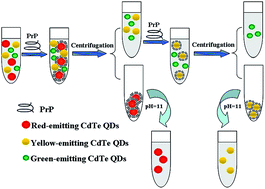
The process of PrP-based size-selective separation of QDs is shown schematically in Scheme 1. CdTe QDs possessing three different diameters of 1.5, 2.7, and 3.5 nm that exhibit luminescence peaks at 524 nm (green-emitting QDs, G QDs), 551 nm (yellow-emitting QDs, Y QDs), and 597 nm (red-emitting QDs, R QDs), respectively, were used in the study (Fig. S1 and S2, ESI). TEM images of the three sizes of QD also revealed that the average particle diameters were consistent with the diameters calculated using a published method (Fig. S3, ESI).19
image file: c6ra05419f-s1.tif
Scheme 1 PrP size-selective separation of CdTe QDs. Upon addition of PrP, R QDs precipitated and were separated from the solution by centrifugation. Then, continuous addition of PrP into the supernatant precipitated Y QDs, which were separated from the supernatant by centrifugation. Eventually, only G QDs remained in solution.

3.2 PrP separation of red-emitting QDs and green-emitting QDs

To confirm the feasibility of separation, R QDs (3.5 nm) and G QDs (1.5 nm) were first separated using PrP as a separation reagent. After R and G QDs (1.0 × 10⁻⁶ mol L−1) were mixed in a PBS solution (pH 7.0), different concentrations of PrP were added. After swirling to ensure thorough distribution of the materials, the solutions were incubated for 30 min at room temperature. The solutions were then centrifugated at 10 000 rpm for 10 min. As the concentration of PrP was increased, an interesting phenomenon occurred: the intensity of the fluorescence of the supernatant at 597 nm, corresponding to the R QDs in the mixture, decreased gradually (Fig. 1). More importantly, the decrease in the intensity of fluorescence of the supernatant at 597 nm suggested that larger QDs may precipitate preferentially at lower concentrations of PrP. When precipitation of the larger R QDs and PrP was completed, the smaller G QDs began to precipitate, as evidenced by a decrease in the intensity of fluorescence of the supernatant at 524 nm.
image file: c6ra05419f-f1.tif
Fig. 1 Change in the intensity of fluorescence of a mixture of R and G QDs upon addition of PrP. The concentration of R and G QDs was 1.0 × 10⁻⁶ mol L−1 each. The concentration of PrP was 0, 170, 340 and 510 nmol L−1 from top to bottom along the red arrow. The excitation wavelength was 360 nm.

When the concentration of PrP was increased to 480 nmol L−1, all of the R QDs precipitated with PrP, leaving the G QDs in solution. Hence, the fluorescence spectrum of the supernatant coincided with that of the pure G QDs. When the precipitate containing the R QDs and PrP was dissolved in NaOH (0.50 mol L−1), the charge of the PrP changed from positive to negative, which inhibits PrP from interacting with QDs by electrostatic repulsion. Consequently, the R QDs dissociated from PrP, and the fluorescence spectrum coincided with that of the pure R QDs (Fig. 2a). PrP also could be removed by adding Ni-NTA agarose resin. Either method allows simple separation of the QDs from PrP.


image file: c6ra05419f-f2.tif
Fig. 2 Fluorescence spectra obtained from the separation of (a) R and G QDs, (b) Y and G QDs, and (c) R and Y QDs. image file: c6ra05419f-u1.tif = pure R QDs, image file: c6ra05419f-u2.tif = R QDs obtained after separation, image file: c6ra05419f-u3.tif = pure G QDs, image file: c6ra05419f-u4.tif = G QDs obtained after separation, image file: c6ra05419f-u5.tif = pure Y QDs, image file: c6ra05419f-u6.tif = Y QDs obtained after separation. The concentration of QDs is 1.0 × 10⁻⁶ mol L−1 in each case. The excitation wavelength was 360 nm.

3.3 PrP separation of yellow-emitting QDs and green-emitting QDs

Using a similar method, Y QDs (2.7 nm) and G QDs (1.5 nm) (1.0 × 10⁻⁶ mol L−1) could also be separated from each other by adding 570 nmol L−1 PrP (Fig. 2b). The fluorescence spectrum of the Y QD precipitate coincided with that of the pure Y QDs. Moreover, the fluorescence spectrum of the G QD supernatant was narrower than that of the pure G QDs because the larger particles in the pure G QDs were removed.

3.4 PrP separation of red-emitting QDs and yellow-emitting QDs

The separation of a mixture containing R QDs (3.5 nm) and Y QDs (2.7 nm) was more difficult than the previous separations because these QDs were more similar in diameter. However, when the concentration of PrP was 520 nmol L−1, R QDs could be separated by partial precipitation, while a higher concentration of PrP may cause the coprecipitation of Y QDs in the supernatant. Moreover, a proportion of the Y QDs could be obtained in the supernatant by adding PrP to a concentration of 670 nmol L−1. A lower concentration of PrP may result in the retention of R QDs in the supernatant (Fig. 2c).

3.5 PrP separation of green-emitting QDs, yellow-emitting QDs and red-emitting QDs

To our pleasant surprise, a mixture containing the three kinds of QDs could also be separated, even though the size disparity was only 0.8–2 nm (Fig. 3). When PrP was added so that its concentration was 380 nmol L−1, the majority of R QDs precipitated with PrP, leaving Y QDs, G QDs and a small proportion of R QDs in the supernatant. To remove the vestigial R QDs, an additional 190 nmol L−1 of PrP was added to the supernatant, which was then separated by centrifugation. Adjusting the concentration of PrP to 810 nmol L−1 allowed Y QDs to be separated from G QDs by precipitation and centrifugation. Pure G QDs remained in the supernatant. It was found that the PrP separation caused almost no change in maximal emission peak or full width at half maximum (FWHM) of QDs (Fig. 3 and Table S1, ESI). This result indicates the size of QDs don't change during the separation.
image file: c6ra05419f-f3.tif
Fig. 3 Fluorescence spectra obtained from the separation of R, Y and G QDs. image file: c6ra05419f-u7.tif = pure R QDs, image file: c6ra05419f-u8.tif = R QDs obtained after separation, image file: c6ra05419f-u9.tif = pure G QDs, image file: c6ra05419f-u10.tif = G QDs obtained after separation, image file: c6ra05419f-u11.tif = pure Y QDs, image file: c6ra05419f-u12.tif = Y QDs obtained after separation. The concentration of each type of QD was 1.0 × 10⁻⁶ mol L−1. The excitation wavelength was 360 nm.

3.6 The recoveries of QDs from the separation experiments

The recoveries of QDs from the separation experiments were calculated and are presented in Table 1. The higher recovery of Y QDs from the mixture of R and Y QDs suggested that a fraction of the smaller R QDs may remain in the supernatant. Meanwhile, both the R and Y QDs of smaller size were present in the supernatant containing G QDs, which explained the higher recovery of G QDs in the mixture containing all three sizes of QDs.
Table 1 Recoveriesa of R, Y and G QDs
Experiment Recovery of R QDs Recovery of Y QDs Recovery of G QDs
a Recoveries were calculated from the ratio I/I0, where I is the fluorescent intensity of QDs obtained after separation, and I0 is the fluorescent intensity of the pure QDs.
R And G QDs 94% 87%
Y And G QDs 53% 54%
R And Y QDs 41% 107%
R, Y and G QDs 45% 75% 106%


3.7 The mechanism of separation

The process of precipitation and the mechanism of the specific precipitation sequence may be complicated. Under the experimental conditions (pH 7.0), we found that adding positively charged PrP (pI 10) into a solution containing negatively charged CdTe QDs modified with mercaptoacetic acid may result in coprecipitation (Fig. S4, ESI). It appeared that aggregation may be caused by electrostatic interaction between the PrP and QDs. However, when we incubated another positively charged protein, chicken egg white lysozyme (pI 11), with the QDs for one day,20 no aggregation was observed. When lysozyme fibrils were mixed with QDs, aggregation occurred immediately. In addition, it was also found that aggregation between proteins and QDs was very selective. More than 10 kinds of proteins, most of the amino acids and metal ions, and even lysate from wild type Escherichia coli (did not contain PrP) did not cause the QDs to aggregate.20 Meanwhile, fibrils and amyloid plaques were found in QD aggregates induced by PrP.20 As confirmed by Sara et al.,21 nanoparticles can act as a critical nucleus for nucleation of protein fibrils because of both their surface charge and enormous surface area. After PrP is added to a solution of CdTe QDs, firstly, PrP adheres onto the surface of the QDs. Then, the QDs catalyze the formation of fibrils of PrP, and finally the fibrils of PrP selectively induce aggregation of the QDs.

The average zeta potential of the R, Y and G QDs were −14.8, −22.0 and −26.1 mV, respectively (Table 2). Hence, positively charged PrP may induce electrostatic neutrality of the R QDs first, then the Y QDs, and the G QDs last. Because the uncharged QDs do not exist stably in solution, the rate of precipitation of the QDs will follow the order R > Y > G. As a result, we can separate R, Y and G QDs using PrP.

Table 2 Zeta potentials of R, Y and G QDs. The concentration of each type of QD was 1.0 × 10⁻⁶ mol L−1. The degree of confidence is 0.90
Sample R QDs Y QDs G QDs
Zeta potential 1 (mV) −15.1 −22.5 −25.7
Zeta potential 2 (mV) −13.7 −19.7 −25.1
Zeta potential 3 (mV) −15.6 −23.9 −27.5
Population mean of zeta potential (mV) −14.8 ± 1.7 −22.0 ± 3.6 −26.1 ± 2.1


4. Conclusions

In conclusion, we have developed a new method for separating QDs of different size based on the size-dependent aggregation of QDs induced by PrP. QDs of different size can be separated from each other simply by mixing with PrP and subsequent centrifugation, removing the need for expensive, complicated technology. The results of the separation experiments were directly detected by fluorometry, showing satisfactory recoveries of QDs of specific size. This method shows potential to allow the separation of QDs of different composition and different functional reagents.

Acknowledgements

This study was supported financially by the National Key Scientific Program-Nanoscience and Nanotechnology (Grant No. 2011CB933600), National Natural Science Foundation of China (No. 21175110), and the Fundamental Research Funds for the Central Universities (No. XDJK2013A022).

References

  1. X. Y. Wu, H. J. Liu, J. Q. Liu, K. N. Haley, J. A. Treadway, J. P. Larson, N. F. Ge, F. Peale and M. P. Bruchez, Nat. Biotechnol., 2003, 21, 41–46 CrossRef CAS PubMed.
  2. B. Y. Han, J. P. Yuan and E. K. Wang, Anal. Chem., 2009, 81, 5569–5573 CrossRef CAS PubMed.
  3. W. R. Algar, M. Massey and U. J. Krull, TrAC, Trends Anal. Chem., 2009, 28, 292–306 CrossRef.
  4. X. Wang and Y. D. Li, Chem. Commun., 2007, 2901–2910 RSC.
  5. C. T. Yavuz, J. T. Mayo, W. W. Yu, A. Prakash, J. C. Falkner, S. Yean, L. Cong, H. J. Shipley, A. Kan, M. Tomson, D. Natelson and V. L. Colvin, Science, 2006, 314, 964–967 CrossRef PubMed.
  6. S. F. Sweeney, G. H. Woehrle and J. E. Hutchison, J. Am. Chem. Soc., 2006, 128, 3190–3197 CrossRef CAS PubMed.
  7. M. Hanauer, S. Pierrat, I. Zins, A. Lotz and C. Sonnichsen, Nano Lett., 2007, 7, 2881–2885 CrossRef CAS PubMed.
  8. X. Tu and M. Zheng, Nano Res., 2008, 1, 185–194 CrossRef CAS.
  9. S. B. Prusiner, Science, 1982, 216, 136–144 CAS.
  10. S. B. Prusiner, Science, 1997, 278, 245–251 CrossRef CAS PubMed.
  11. A. Aguzzi and M. Polymenidou, Cell, 2004, 116, 313–327 CrossRef CAS PubMed.
  12. M. Morillas, D. L. Vanik and W. K. Surewicz, Biochemistry, 2001, 40, 6982–6987 CrossRef CAS PubMed.
  13. C. Soto and G. P. Saborío, Trends Mol. Med., 2001, 7, 109–114 CrossRef CAS PubMed.
  14. X. J. Lu, P. L. Wintrode and W. K. Surewicz, Proc. Natl. Acad. Sci. U. S. A., 2007, 104, 1510–1515 CrossRef CAS PubMed.
  15. M. Y. Gao, S. Kirstein, H. Mohwald, A. L. Rogach, A. Kornowski, A. Eychmuller and H. Weller, J. Phys. Chem. B, 1998, 102, 8360–8363 CrossRef CAS.
  16. D. W. Deng, J. S. Yu and Y. Pan, J. Colloid Interface Sci., 2006, 299, 225–232 CrossRef CAS PubMed.
  17. S. M. Yin, Y. Zheng and P. Tien, Protein Expression Purif., 2003, 32, 104–109 CrossRef CAS PubMed.
  18. P. P. Hu, L. Q. Chen, C. Liu, S. J. Zhen, S. J. Xiao, L. Peng, Y. F. Li and C. Z. Huang, Chem. Commun., 2010, 46, 8285–8287 RSC.
  19. W. W. Yu, L. H. Qu, W. Z. Guo and X. G. Peng, Chem. Mater., 2003, 15, 2854–2860 CrossRef CAS.
  20. L. Y. Zhang, H. Z. Zheng, Y. J. Long, C. Z. Huang, J. Y. Hao and D. B. Zhou, Talanta, 2011, 83, 1716–1720 CrossRef CAS PubMed.
  21. S. Linse, C. Cabaleiro-Lago, W. F. Xue, I. Lynch, S. Lindman, E. Thulin, S. E. Radford and K. A. Dawson, Proc. Natl. Acad. Sci. U. S. A., 2007, 104, 8691–8696 CrossRef CAS PubMed.

Footnote

Electronic supplementary information (ESI) available. See DOI: 10.1039/c6ra05419f

This journal is © The Royal Society of Chemistry 2016
Click here to see how this site uses Cookies. View our privacy policy here.