
Zongkun Chena,
Dandan Heab,
Xiujuan Xua,
Zhenzhen Liub,
Minghua Huang*a,
Xin Wang*a and
Heqing Jiangb
aInstitute of Materials Science and Engineering, Ocean University of China, Qingdao 266100, P. R. China. E-mail: huangminghua@ouc.edu.cn; wangxinhd@ouc.edu.cn
bInstitute of Biomass Energy and Processing, Chinese Academy of Sciences, Qingdao 266101, P. R. China
First published on 30th March 2016
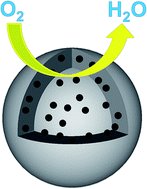
The design of a non-noble-metal electrocatalyst for the oxygen reduction reaction (ORR) is crucial for the renewable energy technologies related to electrochemical energy conversion and storage. Herein, we demonstrate a facile one-pot protocol for the highly selective growth of nanosized cobalt oxide on hollow carbon spheres. The unique structural features enable them to be an efficient non-precious catalyst for the ORR and offer potential applications in the fields of alkaline fuel cells.
Recently, transition metal oxide/carbon composite nanomaterials have been successfully used as an efficient alternative to Pt, as a result of the advantages associated with their high activity and low cost.8–13 Co3O4, one of transition metal oxides, exhibits low activity for ORR by itself, albeit high electrocatalytic activity toward OER.11 Dai's group first revealed that Co3O4 nanoparticles grown on reduced mildly oxidized graphene oxide (N-rmGO) exhibited unexpected high ORR activity, due to the synergetic covalent coupling between them, as well as the unique property of N-rmGO.11 Up to now, some carbon materials including carbon nanotube (CNT),12 carbon nanosheet,14 reduced graphene oxide,15 mesoporous carbon,16 and N-doped carbon,17 have been utilized as the carbon precursors to construct the various Co3O4/carbon composites. However, the preparation process is relatively complicated. In most of the cases, the carbon precursors need to be pre-oxidized with oxygen-containing functional groups which can be used nucleating and anchoring sites to couple metal oxide and the carbon precursors with strong interaction.11–14 Moreover, many features including the structural integrity, high electrical conductivity of the carbon materials and a desirable property for charge transport during electrocatalysis may be reduced in the harsh oxidation conditions.18 It would therefore be necessary to develop new and simple strategies to couple Co3O4 and the carbon materials to generate the carbon-based composites.
Among a variety of the carbon materials, hollow carbon sphere (HCS) has attracted significant attention in catalysis, owing to its good conductivity, large surface-to-volume ratios and more accessible active sites on the shell.19–21 It has recently been reported that heteroatom N-, Co–N-, Fe–N-doped HCS could be efficient ORR catalysts.19,21–23 However, the synthetic methods are mainly based on the use of the silica sphere as the hard template to obtain the hollow sphere, which is relatively fussy and time-consuming. To the best of our knowledge, to date metal oxide have not yet exploited to be coupled with the hollow carbon structure for promising ORR catalysts via a facile one-pot method.
Herein we report a simple and useful route to prepare Co3O4 nanoparticles encapsulated inside HCS (denoted as Co3O4/HCS) as ORR electrocatalyst by annealing a hydrothermally treating mixture of non-ionic triblock copolymer P123 (EO20PO70EO20), sodium oleate (SO), Co(NO3)2·6H2O, 2,4-dihydroxybenzoic acid (DA), and hexamethylenetetramine (HMT) at 600 °C in Ar atmosphere.19 The as-prepared Co3O4 nanoparticles are highly selectively grown into the composite due to the presence of the oxygen-containing groups of P123, SO and DA, which could achieve the intimate attachment between Co3O4 and HCS. These features could endow the as-synthesized catalysts with efficient electrocatalytic activities for ORR.
The procedures for HCS were conducted as described above except without addition of Co(NO3)2·6H2O in the solution A.
:
1
:
0.1). Before cyclic voltammetry or rotating disk electrode (RDE) experiments, the as-obtained suspension was applied to the GCE with a catalyst loading of 0.25 mg cm−2. The reference commercial Pt/C catalyst ink was prepared to reach 1 mg mL−1 by ultrasonically stirring in a mixture of solvents containing water, isopropanol, and Nafion (5%) (v/v/v = 4
:
1
:
0.1). The loading of the commercial Pt/C catalyst is 0.042 mg cm−2.
X-ray photoelectron spectroscopy (XPS) was first employed to identify the composition of HCS and Co3O4/HCS. The XPS survey spectra of HCS mainly reveals the presence of carbon and oxygen (Fig. 1A), whereas Co3O4/HCS mainly shows the signals of cobalt, carbon and oxygen (Fig. 1C). XPS results show the N content is as low as to be 0.63% for HCS and 0.84% for Co3O4/HCS. It is possible that most of N species from HMT are lost in the calcination process. The Co2p XPS spectra of Co3O4/HCS present two characteristic peaks (780.9 and 796.4 eV) of a Co3O4 phase, indicating the successful formation of Co3O4 nanoparticles (Fig. S1A†).14 As shown in Fig. 1B and D, the high-resolution C1s of both HCS and Co3O4/HCS exhibit four single peaks that are assigned to sp2-hybridized C–C (284.5 eV), C–OH groups (286 eV), C
O groups in carbonyl or quinine groups (287.5 eV), and COOH groups (289 eV), respectively.24,25 The presence of the oxygen-containing functional groups may arise from P123, SO and DA, which may provide the nucleating site to anchor Co3O4 nanoparticles. It can be seen that for Co3O4/HCS, the intensity of the peak at 289 eV is lower than that of HCS, indicating the oxygen-containing groups are possibly consumed as anchoring site to couple Co3O4 nanoparticles. Such interaction between them could enable the selective growth of Co3O4 nanoparticles into HCS without any agglomeration. The total content of Co3O4 was calculated to be ca. 4.79 wt% by thermogravimetry under air (Fig. S1B†).
![]() | ||
| Fig. 1 (A) XPS survey spectra and (B) C1s spectra of HCS. (C) XPS survey spectra and (D) C1s spectra of Co3O4/HCS. | ||
Scanning electron microscopy (SEM) was used to investigate the morphology of the hollow carbon-based materials. SEM images of HCS and Co3O4/HCS show the typical sphere structure with a diameter of ca. 200 nm (Fig. S1C and D†). Transmission electron microscopy (TEM) was also used to confirm the successful growth of Co3O4 nanoparticles into HCS. Fig. 2A shows TEM image of HCS. It can be seen that the formation of the hollow carbon structure is clearly observed for HCS, which has a diameter of ca. 200 nm and a shell thickness of ca. 30 nm. To some extent, the obtained HCS structure is disintegrated. Interestingly, upon the growth of Co3O4 nanoparticles into the HCS, the Co3O4/HCS sample highlights the perfect hollow morphology with a diameter of ca. 200 nm and a shell thickness of ca. 30 nm (Fig. 2B–D). Many small Co3O4 nanoparticles with a diameter of ca. 3–5 nm are uniformly encapsulated into HCS. It is notable that there are no individual cobalt oxide nanoparticles or carbon sphere, indicating Co3O4 nanoparticles have been selectively grown into the hollow carbon structures. Another interesting phenomenon is that, even after ultrasonication for half an hour to prepare TEM sample, the morphology are well kept, also indicating the strong interaction between Co3O4 and HCS.
![]() | ||
| Fig. 2 TEM images of HCS (A) and Co3O4/HCS (B–D). Scale bar: (A–D): 50 nm, 200 nm, 50 nm, and 10 nm, respectively. | ||
The structure of Co3O4 nanoparticles into the hollow carbon was characterized by X-ray diffraction (XRD). Fig. 3A presents XRD patterns of HCS and Co3O4/HCS. Both HCS and Co3O4/HCS show two broad diffraction peaks at 24.5 and 43.1°, which are attributed to the (002) and (100) reflection of graphitic carbon, respectively.22 This result indicates that the graphitic carbon structure has been successfully synthesized, and the obtained carbon species are amorphous and consist of disorder area with low degree of crystallinity.26 For Co3O4/HCS, no cobalt oxide signals is detected upon the encapsulation of Co3O4, indicating the size of cobalt oxide may be comparably small, which is in agreement with TEM results. With increasing the calcination temperature to prepare Co3O4/HCS, it can be expected that the size of Co3O4 nanoparticles will become bigger. XRD patterns of Co3O4/HCS obtained 900 °C shows the typical peaks at 37.5, 45 and 65° assigned to Co3O4 crystalline phase (JCPDS no. 42-1467), as shown in Fig. S2.† Therefore, all of these above-mentioned results support the successful growth of Co3O4 nanoparticles into the hollow carbon structures.
![]() | ||
| Fig. 3 (A) XRD patterns, (B) Raman spectra of HCS and Co3O4/HCS, and (C, D) fitted Raman spectra of HCS and Co3O4/HCS. | ||
The microstructure of the hollow carbon-based materials was further investigated by Raman spectroscopy analysis. Compared to that of HCS, the Raman peak at 682 cm−1 associated with Co3O4 can be only observed for the Co3O4/HCS,27 indicating the successful growth of Co3O4 into the HCS (Fig. 3B), which is consistent with TEM, XPS and XRD results. Both HCS and Co3O4/HCS exhibit the characteristic peaks arising from the carbon materials in the range from 800 to 2000 cm−1 (Fig. 3B).28 The fitting of the spectra are shown in Fig. 3C and D. Both of them show four main peaks corresponding to the disordered graphitic lattice at 1200 cm−1, the disorder-induced D-band at 1335 cm−1, the amorphous carbon structure A-band at 1490 cm−1 and the ideal graphitic lattice G-band at 1595 cm−1, respectively.28 Generally, the intensity ratio value of D- and G-band (IG/ID) is an indicator of the degree of the graphitic ordering in the carbon materials.14 According to the fitting results, the integrated intensity ratio of G- and D-bands (IG/ID) value of Co3O4/HCS is 1.48, which is higher than that of HCS (1.3), indicating Co3O4/HCS exhibits a more ordered graphitic structure than HCS. It is possible that the catalytic effect of cobalt at high temperature can induce such graphitization degree, which is similar to that of other carbon materials promoted by transition metals.29 Such higher degree of graphitization indicates that the composite may serve as a good conductive network for efficient electron transport, which is beneficial for electrocatalysis.
The catalytic activity of the different catalysts is further confirmed by recording the linear sweep voltammetry (LSV) curves on a rotating disk electrode (RDE), which presents the same sequence of the ORR activity as the above-mentioned catalysts. Fig. 4B shows the ORR polarization curves obtained at a rotation speed of 1600 rpm for HCS, Co3O4/HCS and Pt/C. Compared to HCS, Co3O4/HCS has a more sharp current increase and reach plateau more quickly with a better diffusion-limited current, suggesting better ORR activity for Co3O4/HCS. Moreover, Co3O4/HCS clearly displays more positive onset potential and half-wave potential than HCS, indicating an enhanced ORR activity has been obtained for Co3O4/HCS. It also exhibits higher limiting current density. It was also noted that the onset potential and half-wave potential for ORR at Co3O4/HCS were better than that of cobalt–N-doped HCS by hard template method,21 although lower than that at the commercial Pt/C and those at the few state-of-the-art Co3O4/N-rmGO and cobalt oxide/CNT.11,12 In comparing these results, it becomes evident that the well-behaved electrocatalysis behaviour of Co3O4/HCS should originate from the uniform dispersion of Co3O4 nanoparticles, high graphitization of HCS, and strong interaction between Co3O4 and HCS.
In order to obtain further information on the electrocatalytic system, RDE voltammetry technique was used for HCS and Co3O4/HCS at different rotation speeds. It can be seen that for Co3O4/HCS, the limiting current density increase gradually with increasing the rotation rate and the potential-independent plateau currents are present at all rotation rate (Fig. 5A). As expected, the good linearity and parallelism are obtained between the inverse of the limiting current and the inverse of the square root of the rotating rate at different potential values (Fig. 5B, Koutecky–Levich plot). The calculated number of electrons involved in the reduction of O2 from the slope of the Koutecky–Levich plot is found to be 3.7–3.8 in the potential range of −0.5 to −0.7 V. It is obvious that this number is close to theoretical value 4 and the ORR is dominated by a 4e reduction process to OH−. In the control experiment, HCS exhibits low ORR activity with a slow current increase and no current plateau (Fig. S3A†). As seen from the corresponding Koutecky–Levich plot (Fig. S3B†), the number of electron transfer is calculated to be 2.7 at −0.7 V, thus suggesting the HCS catalyst without Co3O4 favour a dominated two-electron reduction pathway to HO2−. According to these above results, Co3O4/HCS is more favourable than that of HCS for ORR.
A rotating disk-ring electrode (RRDE) measurement was employed to determine the quantity of peroxide species (HO2−) that was generated by a two-electron reduction process of O2 at the disk electrode, which provides further supports for the effectiveness of Co3O4/HCS for the proposed four-electron reduction of oxygen. Fig. 5C and D shows the ORR polarization curves recorded on the RRDE at a rotation speed of 1600 rpm for HCS and Co3O4/HCS. It can be seen that Co3O4/HCS exhibits higher disk current and lower ring current than that of HCS, indicating the enhanced ORR activity for the composite materials. For Co3O4/HCS, its ring current from HO2− oxidation is much smaller than the disk current from oxygen reduction, which indicates a small percentage of HO2− were produced in the ORR process catalyzed by the catalyst. The yield of HO2− is calculated to be 21.5% at −0.65 V. The calculated number of electrons involved in the reduction of O2 was found to be about 3.6 for Co3O4/HCS and 2.7 for HCS, which is almost identical to that acquired from the Koutecky–Levich plot (vide supra). This result indicates that the reduction of oxygen at Co3O4/HCS mainly supports the four-electron pathway to produce a low yield of HO2−.
The poisoning effect of methanol for ORR has been conducted. As shown in Fig. S4,† the curves for the Co3O4/HCS present no obvious change in the absence and presence of 1.0 M methanol in O2-saturated 0.1 M KOH. In contrast, the typical inverse methanol oxidation peaks can be observed for Pt/C with the addition of methanol in O2-saturated 0.1 M KOH. These results reveal that Co3O4/HCS has a better methanol tolerance towards ORR than the commercial Pt/C. The durability of the Co3O4/HCS catalyst was evaluated by conducting the repeated potential dynamic cycling durability tests for 3500 cycles in O2-saturated 0.1 M KOH solution. As presented in Fig. S5,† after 3500 cycles, about 30 mV negative shift of half-wave potential is shown for Co3O4/HCS which is close to that of a commercial Pt/C. Although the current densities for both Co3O4/HCS and Pt/C decrease with time, Co3O4/HCS shows a slower decrease, indicating a higher stability for Co3O4/HCS, which further confirms Co3O4/HCS is an efficient catalyst for ORR.
Footnote |
| † Electronic supplementary information (ESI) available: Rotating disk electrode (RDE) and rotating-ring disk electrode (RRDE) experiment; additional XPS spectrum, XRD patterns and RDE results. See DOI: 10.1039/c6ra04714a |
| This journal is © The Royal Society of Chemistry 2016 |