
Jin Pan,
Guiyin Xu,
Bing Ding,
Zhi Chang,
Aixiu Wang,
Hui Dou* and
Xiaogang Zhang*
Jiangsu Key Laboratory of Materials and Technology for Energy Conversion, Nanjing University of Aeronautics and Astronautics, Nanjing, 210016, P. R. China. E-mail: azhangxg@163.com; dh_msc@nuaa.edu.cn
First published on 13th April 2016
Lithium–sulfur (Li–S) batteries as lithium secondary batteries have drawn tremendous interest due to their high theoretical specific capacity and energy density. However, the low practical specific capacity and poor cycling life keep them from large scale usage. Herein, a novel binder based on a mixture of polyacrylic acid (PAA) and poly(3,4-ethylenedioxythiophene):poly(styrenesulfonate) (PEDOT:PSS) is designed to significantly improve the specific capacity and cycling stability of Li–S batteries via the synergistic effect of the different functional groups. The conductive PEDOT:PSS successfully facilitates electron transfer and prevents polysulfide dissolution. PAA improves the solvent system for sulfur cathodes and promotes lithium-ion transfer. The sulfur cathode with PAA/PEDOT:PSS binder in a ratio of 2
:
3 exhibits an initial specific capacity of 1121 mA h g−1 and 830 mA h g−1 after 80 cycles at 0.5C. The electrochemical performance of the sulfur cathode with the composite binder is better than either of the single-component binders.
Polyvinylidene fluoride (PVDF) is one kind of conventional binder used in the process of electrode preparation. Many studies have pointed out that PVDF binder is not suitable for electrode materials with serious volume expansion, such as silicon and sulfur, because of the relatively weak bond strength. On the other hand, the organic solvent N-methyl-2-pyrrolidone (NMP) with a high boiling point is toxic and not conducive for industrial production and environmental protection.14,15
According to previous research experience, a suitable binder for Li–S batteries should have the following characteristics: (i) good adhesive strength.16 An ideal binder should have the ability to maintain the structural stability of the electrode material with a large volume change during cycling. Novel binders, such as LA132,17 SBR + CMC18 have been developed to create a more robust network for the entire sulfur cathode. (ii) Suitable swelling capacity.19 For sulfur cathodes, proper electrolyte absorption of the binders can improve the rate performance of the batteries. Lacey et al.19 used PEO in Li–S batteries as a binder to investigate the capacity improvement, and found that PEO locally modifies the electrolyte system, improving reaction kinetics. Furthermore, they demonstrated that binders reduce the porosity in carbon/sulfur composite cathodes, which is harmful towards electrolyte immersion. A binder which is more susceptible to swelling like PEO will admit a large amount of electrolyte into its volume and suppress cathode passivation during discharge. In other words, swelling of the binder leads to an improved solvent system for the electrochemistry of sulfur species.20 (iii) Effective adsorption of multi-lithium sulfide.21 The most serious problem that restricts the development of Li–S batteries is the dissolution of Li2Sn (4 ≤ n ≤ 8). Cui et al.22 demonstrated the strong Li–O interaction between poly(vinylpyrrolidone) (PVP) and Li2Sn (1 ≤ n ≤ 8) with theoretical calculations. Li2S cathodes with PVP binder exhibited a stable cycling performance. Yang23 prepared a novel multifunctional binder (β-CDp-N+) with a quaternary ammonium cation originating from β-cyclodextrin. The introduced quaternary ammonium cations play an important role in immobilizing polysulfides and suppressing the shuttling effect. The β-CDp-N+ based cathode demonstrated an improved cycling performance and rate capability. From the above discussion, the binder should be considered as an active component in Li–S batteries. However it is difficult to meet the requirements for application with a single binder. Rational use of different functional binders is an effective strategy to improve the electrochemical performance of Li–S batteries.
PAA, which has already been used in sulfur cathodes, is a kind of water-soluble binder and is prone to swell in electrolytes like dimethoxyethane (DME).24 PEDOT:PSS, a conductive polymer, is widely used in photovoltaic and photoelectronic devices with good film-forming properties, and it has also recently been used in sulfur cathodes as a coating and binder. The interaction between Li2Sn (4 ≤ n ≤ 8) and PEDOT:PSS has been confirmed by Cui.25,26 In this paper, we aim to investigate the use of polyacrylic acid (PAA) and poly(3,4-ethylenedioxythiophene):poly(styrenesulfonate) (PEDOT:PSS) as a composite binder for Li–S batteries. To the best of our knowledge, there is no report on this compound binder in sulfur cathodes. We look to take advantage of the swelling property of PAA with electronic conductivity and the chemical absorption ability (with Li2Sn) of PEDOT:PSS to improve the electrochemical performance of Li–S batteries. The results demonstrate that Li–S batteries with a PAA/PEDOT:PSS binder in a mass ratio of 2
:
3 have a stable cycling performance and high specific capacity.
000, Sigma-Aldrich) were first dissolved in de-ionized water with 5 wt% dimethyl sulphoxide (DMSO).27,28 Then PEDOT:PSS and PAA were mixed in different weight ratios (2
:
3, 3
:
2) using magnetic stirring to obtain the composite binders. The ketjenblack-sulfur (KJC/S) composite with a sulfur content of 70 wt% was prepared using a melt-diffusion method described in a previous report.29 The polysulfide electrolyte was prepared by weighing an appropriate amount of stoichiometric Li2S and S and stirring together in dimethoxyethane (DME) at room temperature for 24 h.30
:
1, v/v). Galvanostatic charge–discharge cycles were performed on a CT2001A cell test instrument (LAND Electronic Co.) in the potential window of 1.7 to 3.0 V. Cyclic voltammetry (CV) measurements were performed between cutoff potentials of 1.7 to 3.0 V (vs. Li/Li+) at a scan rate of 0.1 mV s−1 with a CHI 660A electrochemical workstation (Chenhua, China).
:
3 or 3
:
2), the electrochemical performance is better than either of the single-component binders. With a ratio of 2
:
3 of PAA and PEDOT:PSS, the sulfur cathode exhibited a high specific capacity of 1121 mA h g−1 for the initial cycle and was maintained at 833 mA h g−1 after 80 cycles. The improved electrochemical performance of the sulfur cathode may be attributed to the synergistic effect of PAA and PEDOT:PSS and needs further investigation.
![]() | ||
| Fig. 1 Cycling performance of the sulfur cathodes with different binders at a constant rate of (a) 0.5C and (b) 1C. | ||
The cycling performance of the three binders of principal interest in this study, i.e., PAA, PEDOT:PSS and PAA/PEDOT:PSS (2
:
3), were further studied at a high rate (1C). The PAA/PEDOT:PSS (2
:
3) cathode exhibited a specific capacity of 610 mA h g−1 after 100 cycles, much higher than the PAA-based cathode. The discharge specific capacity of the PEDOT:PSS-based cathode increased during the first ten cycles and then decreased, which indicated that there is an activation process in the electrode, and the rate performance of the battery is unsatisfactory.
Fig. 2 exhibits the galvanostatic discharge–charge curves of Li–S batteries with the three typical binders at 0.5C. All the discharge–charge profiles show two apparent plateaus in the discharge curves and one plateau in the charge curves. The discharge plateau around 2.3 V can be assigned to the formation of soluble high-order lithium polysulfides (Li2Sn, 4 ≤ n ≤ 8). The plateau at 2.0 V suggests a strong reduction of the soluble lithium polysulfide to insoluble Li2S2/Li2S.31 In particular, the sulfur cathode with PAA binder shows a high initial capacity and a serious capacity fading before the 10th cycle (2.7% per cycle). The specific capacity declines to 550 mA h g−1 after 50 cycles, indicating a poor cycling life (Fig. 2a). The sulfur cathode with PAA/PEDOT:PSS (2
:
3) exhibits an improved specific capacity in the first cycle due to the electronic conductivity of PEDOT:PSS and is 900 mA h g−1 after 50 cycles. The capacity decline during the initial 10 cycles is significantly suppressed to 0.8% per cycle. When just PEDOT:PSS is used as the binder (Fig. 2c), the second discharge plateau at around 2.0 V is distorted at the initial cycle. Since this plateau corresponds to the transformation from Li2S4 to Li2S2/Li2S, which is a diffusion controlled reaction, this phenomenon means a poor Li-ion transfer ability in the PEDOT:PSS-based electrode.
![]() | ||
Fig. 2 Galvanostatic discharge–charge curves of the sulfur cathodes with different binders at 0.5C: (a) PAA, (b) PAA/PEDOT:PSS (2 : 3) and (c) PEDOT:PSS. | ||
Fig. 3 shows the cyclic voltammetry (CV) curves of the PAA/PEDOT:PSS (2
:
3) cathode at a scan rate of 0.1 mV s−1. The curves show the typical characteristics of sulfur during the discharge–charge process. The reduction peak at around 2.3 V corresponds to the reduction of elemental S to long-chain lithium polysulfides (Li2Sn, 4 ≤ n ≤ 8). The peak at about 2.03 V can be attributed to the reduction of these long-chain lithium polysulfides to short-chain lithium polysulfides (Li2S2/Li2S). The strong oxidation peak at 2.4 V is assigned to the conversion of Li2S2/Li2S into Li2Sn (4 ≤ n ≤ 8) and S8. Furthermore, from the second and third cycle, the position and intensity of the CV peaks remain nearly unchanged, suggesting good reaction reversibility and cycling stability of the PAA/PEDOT:PSS (2
:
3) cathode.32
We can attempt to explain the effect of the PEDOT:PSS content on the electrochemical performance of the sulfur cathodes by considering its strong interaction with lithium polysulfides, as previously predicted by Cui et al., and so the ability of PEDOT:PSS to adsorb Li2Sn was evaluated. DME electrolyte with 0.02 M Li2Sn (4 ≤ n ≤ 8) was prepared in bottles A and B (1 mL). When PEDOT:PSS (10 mg) was added to bottle B, the colour of the DME electrolyte turned lighter immediately, as shown in the inset of Fig. 4. The supernatant liquors in the two bottles were further investigated in detail using UV-vis absorption spectroscopy. The results show that both of the two samples exhibit an absorption band at around 250–300 nm attributed to Li2S6,33 while the absorption peak of sample B decreases more sharply compared with sample A, indicating a lower concentration of Li2Sn in DME. Based on these tests, interactions exist between PEDOT:PSS and the lithium polysulfides.
![]() | ||
| Fig. 4 UV-vis spectra of (A) Li2Sn-containing DME and (B) Li2Sn-containing DME with PEDOT:PSS (the inset shows the comparison between A and B). | ||
After PEDOT:PSS was treated with the Li2Sn-DME solution by immersing for a period of time, the PEDOT:PSS with absorbed Li2Sn (Li2Sn–PEDOT:PSS) was then obtained after separation and vacuum drying. FT-IR and Raman tests were conducted to further examine the chemical interactions between Li2Sn and PEDOT:PSS. Fig. 5a presents the FT-IR spectra of PEDOT:PSS, Li2Sn–PEDOT:PSS and Li2Sn–PEDOT:PSS which was exposed to air for a long time (Li2Sn–PEDOT:PSS–air). There are three peaks at 831, 1523 and 1191 cm−1 for PEDOT:PSS, which can be attributed to C–S bond vibrations, C
C stretching in the thiophene ring and symmetric vibrations of the –SO3 groups in the PSS chains, respectively.34,35 However, the symmetric vibrations of the –SO3 groups shift to 1208 cm−1 in the Li2Sn–PEDOT:PSS spectrum. What’s more, after Li2Sn–PEDOT:PSS is exposed to air for a long time, the symmetric vibrations of the –SO3 groups reappear at 1194 cm−1, and may be effected by reactions between Li2Sn and air (H2O, O2). This indicates that interactions between Li2Sn and PEDOT:PSS exist. As shown in Fig. 5b, the C–C inter-ring stretching vibration at 1267 cm−1 and the C
C symmetrical stretching vibration at 1435 cm−1 demonstrate the existence of PEDOT:PSS. After the PEDOT:PSS is treated with Li2Sn, the C
C symmetrical stretching vibration peak shifts to 1447 cm−1. These results demonstrate the presence of chemical interactions between Li2Sn and PEDOT:PSS,36 which confine the dissolution of S species into the electrolyte and facilitate the cycling stability of the active materials.37,38
![]() | ||
| Fig. 5 (a) FT-IR spectra of PEDOT:PSS, Li2Sn–PEDOT:PSS and Li2Sn–PEDOT:PSS–air. (b) Raman spectra of PEDOT:PSS and Li2Sn–PEDOT:PSS. | ||
To further investigate the effect of the binder on the electrochemical performance, the swelling in the electrolyte solvent is a key consideration. Generally speaking, if a binder is seriously swollen in the electrolyte, the bond strength of the cathode material with other particles and with the current collector declines, which will lead to an increased contact resistance and a fast capacity fading. From another point of view, given the ionic insulation of sulfur, a good electrolyte immersion is of great significance. Since binders exist on the surface and in the pores of the active material, a binder which is susceptible to swelling will have a good electrolyte immersion.13 As shown in Fig. 6, the swelling ratios of the PEDOT:PSS film and its sulfur cathode are about 20.3% and 15.6%, respectively, much lower than that of PAA and its sulfur cathode (78.5% and 59.1%). The cathode with PAA/PEDOT:PSS (2
:
3) shows a moderate solvent uptake (38.1%). These experimental results confirm the contribution of the PAA content to the sulfur cathodes, that is, the PAA binder locally modifies the electrolyte system and improves the reaction kinetics. In addition, the poor rate performance of the PEDOT:PSS-based cathode (Fig. 1b and 2c) may be attributed to the weak electrolyte absorption ability of PEDOT:PSS.
The morphology of the sulfur cathodes with different binders before discharge and after 80 cycles were observed using SEM. Before discharge, the cathode with PAA binder displayed a porous and rough structure, which was in agreement with previous reports (Fig. 7a).24 The cathode with PAA/PEDOT:PSS (2
:
3) shows a smoother surface and retains a porous structure. However, the surface of the PEDOT:PSS-based sulfur cathode is compact.39 After 80 cycles, a solid precipitate is observed in the PAA cathode (Fig. 7d) and the surface becomes denser. The solid materials are Li2S and Li2S2 which are formed from the deep discharge of sulfur and the strong reduction of soluble polysulfides in the electrolyte. The inactive Li2S/Li2S2 not only leads to the loss of active materials, but also blocks the electronic and ionic transport, both of which will result in capacity fading. For the cathode with PEDOT:PSS only (Fig. 7f), massive particles appear on the surface. This may be due to the strong film-forming properties of PEDOT:PSS, leading to agglomeration of the sulfur materials and the non-uniform deposition of Li2S2/Li2S. In contrast, the PAA/PEDOT:PSS (2
:
3) cathode still displays a homogeneous distribution of the cathode material and no serious solid film can be observed. Therefore, the composite binder which covers the active materials could significantly suppress the dissolution of the lithium polysulfides in the organic electrolyte and restrain the aggregation of insulated Li2S2/Li2S on the cathode surface during cycling (Fig. 7e).
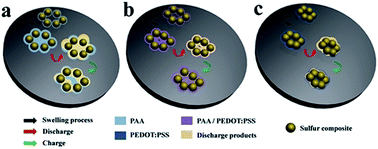
A schematic diagram of the mechanism of the different binders is shown in Fig. 8. Fig. 8a represents the cathode prepared using PAA. After infiltration of the electrolyte, the PAA binder is in a gel state and the particles in the electrode become loose. During the discharge process, the sulfur species start to react and diffuse into the external electrolyte, and the final discharge products cover the surface of the conductive carbon matrix. In the charging process, the damage to the conductive structure and the decrease in reaction sites lead to a dense irreversible deposited layer and a poor cycling life. The cathode material with PAA/PEDOT:PSS (Fig. 8b) guarantees a good electronic and ionic conductivity. The adsorption ability of PEDOT:PSS slows down the diffusion of intermediate products in the electrolyte. In the process of charging/discharging, the composite binder provides more reaction sites for the reversible reaction, which can inhibit the accumulation of Li2S/Li2S2 and lead to an improved electrochemical performance. In the PEDOT:PSS-based cathode (Fig. 8c), the particles are dense and cannot be fully exposed to the electrolyte because of the strong film forming effect and weak electrolyte affinity of PEDOT:PSS. The sulfur cathode shows a good cycling performance but low capacity. To sum up, the synergistic effect of PAA and PEDOT:PSS is the key factor to achieve a good electrochemical performance of Li–S batteries.
![]() | ||
| Fig. 8 Schematic diagram of the sulfur cathodes with different binders: (a) PAA; (b) PAA/PEDOT:PSS and (c) PEDOT:PSS. | ||
:
3, we have demonstrated a relatively improved performance of Li–S batteries which reaches an initial capacity of 1121 mA h g−1 and 833.8 mA h g−1 after 80 cycles at 0.5C and is better than either of the single-component binders. In conclusion, binders with various functional groups have a great influence on the interfacial properties of the sulfur cathodes. Rational manipulation of binders with different functionalities is a significant complementary strategy to improve the electrochemical performance of Li–S batteries.
| This journal is © The Royal Society of Chemistry 2016 |