Elena Cini,
Elena Petricci,
Giuseppina I. Truglio,
Marialaura Vecchio and
Maurizio Taddei*
Dipartimento di Biotecnologie, Chimica e Farmacia, Università di Siena, Via A. Moro 2, 53100 Siena, Italy. E-mail: maurizio.taddei@unisi.it
First published on 22nd March 2016
The mono-alkylation of 1,3-diketones using alcohols is possible in the presence of catalytic amounts of Ru(CO)(PPh3)3HCl and 10% mol of the Hantzsch ester. The borrowing hydrogen process between the catalyst and the dihydropyridine/pyridine couple prevents the common double alkylation of the Knoevenagel adduct without the need of stoichiometric reducing agents or sacrificial nucleophiles. The reaction was applied to the synthesis of a lactone intermediate for the preparation of the anti-obesity drug orlistat. Moreover, under the same Ru catalysis, a Friedländer reaction occurred with o-amino benzyl alcohols giving access to different 3-keto-substituted quinolines.
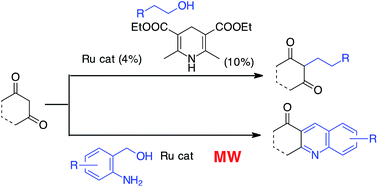
Unquestionably, the alkylation of β-dicarbonyl compounds with an alcohol would provide an attractive salt-free, environmentally friendly and atom-economic alternative to known protocols (Scheme 1, path c).
Recent demonstrations of Lewis and Brønsted acid catalysed alkylation of 1,3-dicarbonyl compounds with benzyl-, allyl- and propargyl-alcohols have been reported.4 However, these procedures often suffer from low versatility being the alcohol scope limited to the very reactive substrates previously mentioned. A valuable alternative is the metal catalysed alkylation with alcohols through the red-ox ‘borrowing hydrogen’5–7 strategy that has been already successfully applied to ketonitriles,8,9 and cyanoacetates.10
Engaged in a total synthesis of orlistat, a powerful gastrointestinal lipase inhibitor contained in anti-obesity drugs, we were interested in a suitable protocol for the preparation of key intermediate lactone 2 (Scheme 2).11,12 Unfortunately, direct base mediated alkylation of 1 produced a mixture of compound 2 and O-alkylated enol ether 3. Attempts to react hexanal with 1 gave almost exclusively the bis-adduct 5. Consequently, the investigation of a possible alkylation of 1,3-dicarbonyl compounds with primary alcohols in the presence of homogeneous Ru catalysts was investigated (Scheme 1, path c).
| Entry | Ru Catalyst | Reaction conditionsa | 8b (%) |
|---|---|---|---|
| a Reaction conditions: 6 (0.5 mmol), 7 (0.5 mmol), catalyst (4 mol%) in solvent (1 mL) under nitrogen, sealed vial at 160 °C for 16 h.b Yields of pure product isolated by flash chromatography.c Xantphos (6 mol%).d 3 eq. of 6.e 3 eq. of 7. | |||
| 1c | Ru3(CO)12 | Toluene, 160 °C | 21 |
| 2 | Ru3(CO)12 | Toluene, 160 °C | — |
| 3c | [Ru(p-cymene) Cl2]2 | Toluene, 160 °C | 18 |
| 4c | [Ru(CO)(PPh3)3HCl] | Toluene, 160 °C | 20 |
| 5 | [Ru(CO)(PPh3)3HCl] | Toluene, 160 °C | 23 |
| 6 | [Ru(CO)(PPh3)3HCl] | Toluene, reflux 24 h | <5 |
| 7d | [Ru(CO)(PPh3)3HCl] | Toluene, 160 °C | 25 |
| 8e | [Ru(CO)(PPh3)3HCl] | Toluene, 160 °C | 22 |
| 9 | [Ru(CO)(PPh3)3HCl] | Dioxane 160 °C | 22 |
| 10 | [Ru(CO)(PPh3)3HCl] | THF 160 °C | 15 |
| 12 | [Ru(CO)(PPh3)3HCl] | TAA, 160 °C | 19 |
| 13 | [Ru(CO)(PPh3)3HCl] | Toluene, MW 160 °C, 1 h | <5 |
| 14 | [Ru(CO)(PPh3)3HCl] | Toluene, t-BuOK (1 eq.), 160 °C | 15 |
| 15 | [Ru(CO)(PPh3)3HCl] | Toluene, 160 °C, 9 (1 eq.) | 58 |
| 16 | [Ru(CO)(PPh3)3HCl] | Toluene, 160 °C, 9 (0.5 eq.) | 57 |
| 17 | [Ru(CO)(PPh3)3HCl] | Toluene, 160 °C, 9 (0.1 eq.) | 58 |
As in principle the Hantzsch ester could be regenerated during the overall process, we explored the reaction in the presence of catalytic amounts of 9, founding that 10% molar was enough to carry out the transformation without affecting isolated yields of 8 (Table 1, entries 16–17).
The scope and generality of the overall process was further examined by treating different 1,3-dicarbonyl compounds with several primary alcohols carrying different functional groups under the previously optimized reaction conditions. A series of alkylated 1,3-dicarbonyl compounds was obtained in moderate to good yields as shown in Scheme 3. In any case, in the crude reaction mixture we observed different amounts of the starting 1,3-diketones and, with compounds 11 and 12, small amounts of the O-alkylated products (<5%). The mono-alkylation products obtained from 1,3 indandione 6 are formed in higher yield with respect to the products derived from the simple 1-3-cyclohexandione 10 or 1,3-cyclopentandione 11, suggesting probably a (stereo)electronic effect of the aromatic ring. The remarkable effect of the cyclic 1-3 dicarbonyl compound on the reaction was confirmed by the observation that no reaction occurred with acyclic 1,3-diketones as acetylacetone or 1-phenyl-1,3-butandione.
![]() | ||
| Scheme 3 Alkylation of 1,3-dicarbonyl compounds with alcohols: reaction scope. 10 = 1,3-cyclohexandione; 11 = 1,3-cycopentandione. | ||
Carbamates are well tolerated by this transformation giving previously unreported Cbz protected amino diketones 16–17 in satisfactory yields. Also lactone 1 was alkylated in acceptable yields giving the amino derivative 23 and also the orlistat intermediate 2 was obtained in 50% isolated yields (Scheme 3). However, using acyclic β-keto esters such as ethyl acetoacetate or even t-butyl acetoacetate, the product coming from a transesterification reaction between the alcohol and the ester was formed in large amounts. Only using the N-Cbz-3-amino-1-propanol 25 a moderate amount of the alkylated product 27 was obtained, although the transesterification derivative 26 was again the major product (Scheme 4).
![]() | ||
| Scheme 4 Reaction with acyclic β-keto esters and Cbz removal followed by intramolecular reductive amination. | ||
Probably the result observed on this substrate can be related to a coordinative effect of the carbamate on the ruthenium catalyst. To investigate the synthetic potential of the new Cbz derivatives synthesized, the removal of Cbz was attempted. Treating 16 with H2 and Pd/C in AcOH a domino deprotection reductive amination occurred to form the tricyclic 3,4,4a,9b-tetrahydro H-indeno[1,2-b]pyridine-5-one 29 (Scheme 4). This new product,16 obtained as a 9
:
1 diastereomeric mixture after 16 h of reaction, was isolated as a single diastereomer in 47% yield after purification by flash chromatography. Finally, using secondary alcohols (e.g. 2-propanol or cyclopentanol), very low yield of the alkylated product was obtained.
For this Ru catalysed mono-alkylation of 1,3-diketones mediated by catalytic amount of the Hantzsch ester, a possible mechanism was hypothesized (Scheme 5). The alcohol 7 is oxidized by the Ru catalyst17 to the corresponding aldehyde 7a that reacts with the β-diketone 6 to give the Knoevenagel product 8a. The conjugated alkene is then reduced to the monoalkylated 1,3-dicarbonyl compound 8 by the Hantzsch ester,14 while the contemporary formed pyridine 29 is reduced again by the Ru[H2], regenerating the Hantzsch ester 9 and the Ru catalyst. Thus, through this double borrowing hydrogen process between the alcohol and the couple dihydropyridine/pyridine, a catalytic alkylation of β-diketones with alcohol is possible.
The potential use of o-amino-benzyl alcohol 30 with 1,3-diketones (as 10) was investigated in order to explore the possibility of a ruthenium catalysed Friedländer cyclisation (Table 2). Although modified quinoline synthesis via ruthenium-catalysed coupling of 2-aminobenzyl alcohols and 2-nitrobenzyl alcohols with alcohols or ketones has been previously reported,18–25 to our knowledge, the only example of 3-carbonyl-quinolines synthesis involves the reaction of β-keto esters with formation of α-carbocation intermediate generated by the red-ox catalytic couple FeCl3/SnCl2.26
| Entry | Conditionsa | Yield (%) |
|---|---|---|
| a 10 (1 eq.), 30 (1 eq.), catalyst (4% mol), [bmim][BF4] (25 μL), toluene (1 mL).b 2 eq. of ketone. | ||
| 1 | 160 °C, 16 h | 70 |
| 2 | 120 °C, 16 h | 57 |
| 3 | MW, 160 °C, 15 min | 43 |
| 4 | MW, 120 °C, 15 min | 53 |
| 5 | MW, 80 °C, 15 min | 41 |
| 6b | MW, 120 °C, 30 min | 73 |
| 7 | Cyclohexene (10 eq.), MW, 120 °C, 30 min | 55 |
| 8 | Crotonitrile (10 eq.), MW, 120 °C, 30 min | 42 |
| 9 | MW, 120 °C, 30 min | 57 |
| 10 | MW, 120 °C, 30 min | 51 |
| 11 | KOH (1 eq.), MW, 120 °C, 30 min | 47 |
| 12 | t-BuOH (1 eq.), MW, 120 °C, 30 min | 52 |
In the reaction conditions explored so far, condensation of 10 with 30 gave the 3,4-dihydro 1(2H)-acridone 31 in 70% yield (Table 2, entry 1). In order to increase the yield of the pursued approach, different reaction conditions were explored. First of all, the influence of the temperature was investigated. Lowering the reaction temperature to 120 °C, the yield dropped down to 57% (Table 2, entry 2). However, the reaction works beautifully under microwave dielectric heating without the Hantzsch ester (Table 2, entries 3–6). After 30 minutes at 120 °C compound 31 was isolated in 73% yield (Table 2, entry 6).
Unexpectedly, using the two different hydrogen acceptors cyclohexene (Table 2, entry 7) and crotonitrile (Table 2, entry 8) the yield did not improve while still traces of reduced by-products were present. The reaction is supposed to follow the standard Ru catalysed Friedländer mechanism including a last oxidative step done by air.18 Once established the best reaction conditions, different 1,3-dicarbonyl compound and 2-aminobenzyl alcohols were examined to explore the generality of the protocol (Table 3). It is possible to carry out the reaction with o-substituted amino-benzyl alcohols or in the presence of an aryl chloride (Table 3, entries 1–2). The reaction worked well with 1,3-cyclopentandione (11), 1,3-cyclohexanediones 10 and 34, and indandione 6 (Table 3, entries 3–5). It was worth noting that even linear diketones such as 35 and 36 gave the 3-ketoquinolines in acceptable yields (Table 3, entries 6–7). In the case of not symmetrical diketone 36, the quinolone 43 was the only product isolated. The identity of 43 was established by comparison with reported data.27 Analogously, keto lactone 1 gave the quinolone lactone 44 in acceptable yield.
:
3). The solvent was removed under vacuum and the crude reaction mixture was loaded directly onto a column for flash chromatographic purification (eluent: from petroleum ether to petroleum ether/EtOAc, 7
:
3) which gave pure 8 (105 mg, 58%) as a yellowish waxy material. 1H-NMR (400 MHz, CDCl3): δ 8.02–7.88 (m, 2H), 7.84–7.75 (m, 2H), 7.22 (t, J = 7.0 Hz, 2H), 7.12 (d, J = 7.5 Hz, 3H), 3.00 (t, J = 6.0 Hz, 1H), 2.59 (d, J = 7.7 Hz, 2H), 1.98 (d, J = 9.8 Hz, 2H), 1.71 (t, J = 7.9 Hz, 2H). 13C-NMR (100 MHz, CDCl3): δ 204.4, 146.0, 145.2, 131.9, 129.4, 126.7, 81.0, 80.7, 80.4, 56.9, 39.5, 31.8. GC/MS: Rt 22.86 min; m/z 264 (C18H16O2). HRMS (EI): calcd for C18H16O2Na [M + Na]+: 287.1048, found 287.1047.
:
3). The solvent was removed under vacuum and crude reaction mixture was loaded directly onto a column for flash chromatographic eluted with a gradient of petroleum ether to petroleum ether/EtOAc, 7
:
3. Pure 31 (127 mg, 73%) was a yellowish solid. M.p. 108–109 °C (lit m.p. 109–110 °C)28 1H NMR (400 MHz, CDCl3) δ 8.70 (s, 1H), 7.94 (d, J = 8.5 Hz, 1H), 7.79 (d, J = 8.1 Hz, 1H), 7.69 (t, J = 7.6 Hz, 1H), 7.43 (t, J = 7.4 Hz, 1H), 3.20 (t, J = 6.1 Hz, 2H), 2.73–2.58 (m, 2H), 2.16 (p, J = 6.4 Hz, 2H). 13C NMR (100 MHz, CDCl3) δ 197.3, 161.5, 149.2, 136.6, 131.8, 129.2, 128.1, 126.3, 126.2, 125.8, 38.6, 33.0, 21.3. HRMS (EI): calcd for C13H12NO [M + H]+ 198.0919, found 198.0921.
Footnote |
| † Electronic supplementary information (ESI) available: Experimental procedures and product characterization. See DOI: 10.1039/c6ra03585j |
| This journal is © The Royal Society of Chemistry 2016 |