Wided Haguiabc,
Néji Besbesc,
Ezzeddine Srasrac,
Jean-François Soulé*a and
Henri Doucet*a
aInstitut des Sciences Chimiques de Rennes, UMR 6226 CNRS-Université de Rennes 1 “Organométalliques, Matériaux et Catalyse”, Campus de Beaulieu, 35042 Rennes, France. E-mail: jean-francois.soule@univ-rennes1.fr; henri.doucet@univ-rennes1.fr
bUniversité de Tunis El Manar, Falculté des Sciences de Tunis, Campus Universitaire El-Manar, 2092 El Manar Tunis, Tunisia
cLaboratoire Physicochimie des Matériaux Minéraux et leurs Applications, Centre National des Recherches en Sciences des Matériaux, Technopole de Bordj Cedria, Soliman, 8027, Tunisia
First published on 29th January 2016
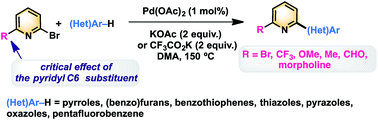
A phosphine-free palladium catalytic system was found to be very active to promote C–H bond activation/arylation of 5-membered ring heterocycles or electron-deficient arenes with 6-substituted 2-bromopyridines, providing a general, straightforward and environmentally benign synthetic approach to a broad variety of 2-(hetero)arylpyridines. The reactivity of 2-bromopyridines is strongly dependent on the substituent at the C6 position. Several C6 substituents such as Br, CF3, CH3, CHO, or morpholine have been employed. Moreover, the use of 2,6-dibromopyridine as the coupling partner allowed the synthesis in high yields of symmetrical and unsymmetrical 2,6-di(hetero)arylpyridines, as well as 2-heteroarylpyridines after the C–Br bond cleavage.
One of the most suitable approaches for the fast construction of substituted pyridines was the derivatization of pyridines, albeit some procedures relying on condensation reactions,7 multi-component reactions,8 and cyclizations9 were also described as efficient protocols for the synthesis of pyridines.2d
Among the diverse synthetic pathways that have been disclosed for the synthesis of 2-(hetero)arylpyridine derivatives, the transition-metal-catalyzed cross-couplings have proven to be important methods and are being utilized extensively. Two disconnections have been reported. First, starting from 2-halopyridines in the presence of palladium catalysts with a variety of organometallic reagents, namely, ArZnCl,10 ArLi,10b ArMgX,11 ArSi(OR)3,12 ArMnCl,13 Ar2InCl,14 Ar3Bi,15 ArB(OH)2 16 or ArBF3K (Fig. 2a).17 The reversed strategy involved metalated pyridines (e.g., 2-PyZnX,18 2-PyLi,19 2-PyB(OH)2,20 2-PySnMe3 21) in the presence of (pseudo)aryl halides under palladium catalysis (Fig. 2b).22 Among these cross-coupling reactions, the Suzuki coupling has been proven to be one of the most efficient synthetic approaches for the preparation of 2-(hetero)arylpyridines.20 Despite being quite versatile, the synthesis of 2-(hetero)arylpyridine derivatives via these traditional cross-coupling reactions involves the use of hazardous organometallic reagents, which required preliminary preparations. Since these last decades, direct functionalization of C–H bonds has emerged as one of the most eco-friendly and valuable alternatives to these traditional cross-coupling reactions reducing the amount of wastes and providing a straightforward access to complex molecules.23 However, the application of such novel technologies to the synthesis of 2-(hetero)arylpyridines is very scarce. In 2005, Fagnou and co-workers reported palladium-catalyzed direct C2-arylation of N-oxide pyridine (Fig. 2c).24 Other palladium-catalyzed directed C2-arylation of pyridines was reported using N-iminopyridinium ylide (Fig. 2c).25 More recently, the syntheses of symmetrical 2,6-di-arylpyridines from picolinic acid via palladium/copper-catalyzed sequential decarboxylative and direct C–H arylation were also reported.26 However, these methodologies did not afford a general and practical access for the synthesis of 2-arylpyridines with broad substrate scope, especially for 2-(hetero)arylpyridines.27 The reversed strategy, namely, the cross-coupling between 2-halopyridines and (hetero)arenes via palladium-catalyzed C–H bond activation, was not very popular yet. If in few cases good yields of coupling products were obtained; however, many couplings led to poor yields of the desired 2-(hetero)arylpyridines.28 Moreover, in most reports only one or two examples of coupling reactions have been described. Therefore, it is very difficult to rationalize the trend of the reactivity of 2-halopyridines in palladium-catalyzed direct (hetero)arylations. We propose, herein to survey the reactivity of 2-bromopyridine derivatives, especially the 6-substituted ones, as coupling partners in phosphine-free palladium-catalyzed direct arylation of several (hetero)arenes (i.e., thiazoles, (benzo)furans, benzothiophene, pyrroles, and pentafluorobenzene) (Fig. 2d).
Based on our expertise on palladium-catalyzed direct arylation of heteroarenes,29 we already demonstrated that 3-bromopyridine could be easily coupled with a wide scope of heteroarenes. As example, 2-ethyl-5-methylthiazole gives A in a high yield using phosphine-free Pd(OAc)2 associated to KOAc as base in DMA at 150 °C (Fig. 3(1)).30 In the literature, there is one example where 2-bromopyridine has been successfully coupled with 2-ethyl-4-phenylthiazole but under harsh conditions, namely using 5 mol% of Pd(OAc)2 and K2CO3 as base in N-methylpyrrolidone (NMP) at 180 °C under microwave irradiations. However, the 2-(thiazolyl)pyridine B has been isolated in a poor 21% yield (Fig. 3(2)).28h On the other hand, we have reported that 2-chloropyridine could be a suitable 2-pyridyl source in C–H bond arylation of thiazole, albeit the coupling product C was again isolated in a poor yield (Fig. 3(3)).31
![]() | ||
| Fig. 3 Previous examples of palladium-catalyzed direct heteroarylation with 3-bromopyridine and 2-halopyridines. | ||
Surprisingly, when we applied the same reaction conditions than with 2-chloropyridine but with 2-bromopyridine, no reaction occurred (Scheme 1(1)). Even, the use of a diphosphine–palladium catalyst for this coupling failed. However, when 2,5-dibromopyridine was subjected to the same reaction conditions, a mixture of the mono- and di-arylated products 2 and 3 was obtained in 14% and 37% yields, respectively (Scheme 1(2)). In addition, the same reaction performed in the presence of 2-bromopyridine was not completely inhibited, but only 2 was isolated in 21% yield (Scheme 1(3)). This result strongly suggests that the substituent at the pyridyl C6 position plays a critical role in the catalytic cycle.
![]() | ||
| Scheme 1 Preliminary results. (i) Pd(OAc)2 (1 mol%), KOAc (2 equiv.), DMA, 150 °C, 16 h; (ii) PdCl(C3H5)(dppb) (2 mol%), KOAc (2 equiv.), DMA, 150 °C, 16 h. | ||
Then, we decided to evaluate the parameters of the reaction in order to improve the 2/3 selectivity (Table 1). Firstly, we attempted to get only mono-arylated product 2 from 2,6-dibromopyridine. The use of a slight excess of 2,6-dibromopyridine (1.25 equiv.) gave a mixture of the mono- and di-arylated products 2 and 3 in 63
:
37 ratio (Table 1, entry 1). Other palladium sources (e.g., PdCl2 and PdCl(C3H5)(dppb)) had no effect on the selectivity (Table 1, entries 2 and 3). A reduced reaction time of 5 hours also gave a complete conversion of 2-ethyl-4-methylthiazole with the same selectivity, while after two hours the reaction was not complete but a higher selectivity in favor of 2 was obtained (Table 1, entries 4 and 5). Then, we decided to investigate the effect of the base (Table 1, entries 6–10). Potassium or lithium carbonates were less effective than KOAc for both conversion and selectivity (Table 1, entries 6 and 7). A lower selectivity in favor of 2 was also obtained using CsOAc as base (Table 1, entry 8). The conversion of 2-ethyl-4-methylthiazole with potassium pivalate as base was complete, but 2 was obtained in only 60% selectivity (Table 1, entry 9). Finally, the best base was found to be potassium trifluoroacetate, which delivered the mono-arylated product 2 in 87% selectivity with full consumption of thiazole (Table 1, entry 10). This selectivity could rise to 97% by the use of a higher excess of 2,6-dibomopyridine (1.5 equiv.) and the mono-heteroarylated product 2 was isolated in 88% yield (Table 1, entry 11). Then, we evaluated other solvents for this transformation (Table 1, entries 12–14). Carbonates, such as diethyl carbonate are polar, aprotic, nontoxic, and biodegradable solvents,32 which have been previously used in C–H bond functionalizations.33 However, in our conditions this solvent was not efficient, as 2,6-dibromopyridine was recovered at the end of the reaction (Table 1, entry 12). 3-Methylbutan-1-ol, which has also already been used in C–H bond functionalizations,34 also gave no conversion of the 2,6-brobromopyridine under these optimized conditions (Table 1, entry 13). Metal-catalyzed C–H bond arylation has been already performed in cyclopentyl methyl ether (CPME),35 which is also a eco-friendly solvent. However, this solvent gave again no positive result (Table 1, entry 14). In addition, the di-heteroarylated product 3 could be isolated in 91% yield using 2.5 equivalents of 2-ethyl-4-methylthiazole and KOAc as base in the presence of 1 mol% of Pd(OAc)2 with a longer reaction time (i.e., 16 h) (Table 1, entry 15).
| Entry | [Pd] | Base | t (h) | Conv.a (%) | 2 : 3 ratioa |
|---|---|---|---|---|---|
| a Determined by 1H-NMR analyses using trichlorobenzene as internal standard and based on 2-ethyl-4-methylthiazole consumption.b 1.5 equiv. of 2,6-dibromopyridine was used.c Isolated yield in 2.d The reaction was performed in DEC (diethyl carbonate) instead of DMA.e The reaction was performed in 3-methylbutan-1-ol instead of DMA.f The reaction was performed in CPME (cyclopentyl methyl ether) instead of DMA.g 1 equiv. of 2,6-dibromopyridine and 2.5 equiv. of 2-ethyl-4-methylthiazole were used.h Isolated yield in 3. | |||||
| 1 | Pd(OAc)2 | KOAc | 16 | 100 | 63 : 37 |
| 2 | PdCl(C3H5)(dppb) | KOAc | 16 | 100 | 56 : 44 |
| 3 | PdCl2 | KOAc | 16 | 100 | 58 : 42 |
| 4 | Pd(OAc)2 | KOAc | 5 | 100 | 64 : 36 |
| 5 | Pd(OAc)2 | KOAc | 2 | 87 | 70 : 30 |
| 6 | Pd(OAc)2 | K2CO3 | 4 | 89 | 55 : 45 |
| 7 | Pd(OAc)2 | Li2CO3 | 4 | 88 | 53 : 47 |
| 8 | Pd(OAc)2 | CsOAc | 4 | 100 | 55 : 45 |
| 9 | Pd(OAc)2 | PivOK | 4 | 100 | 60 : 40 |
| 10 | Pd(OAc)2 | CF3CO2K | 4 | 100 | 87 : 13 |
| 11b | Pd(OAc)2 | CF3CO2K | 4 | 100 | 97 : 3 (88%)c |
| 12b,d | Pd(OAc)2 | CF3CO2K | 4 | 0 | — |
| 13b,e | Pd(OAc)2 | CF3CO2K | 4 | 0 | — |
| 14b,f | Pd(OAc)2 | CF3CO2K | 4 | 0 | — |
| 15g | Pd(OAc)2 | KOAc | 16 | 100 | 2 : 98 (91%)h |
Having determined the best reaction conditions for both mono- and di-heteroarylations of 2,6-dibromopyridine, we turned our attention to the scope of the reaction using a set of (hetero)arenes (Scheme 2). First, the reactivity of other thiazoles – containing more than one reactive C–H bonds was investigated. 4-Methylthiazole and 2-isobutylthiazole reacted only at the C5 position to afford 4 and 5 in 46% and 78% yields, respectively. A furan bearing an electron-withdrawing group (CO2Me) at C2 position was arylated at C5 position affording 6 in good yield. Benzofuran displayed a higher reactivity to afford 7 as a single regioisomer in 85% yield through the activation of the C2–H benzofuranyl bond. This result was quite surprising, as with other aryl bromides, benzofuran generally afforded a mixture of C2 and C3 arylation products.36 In contrast, benzothiophene exhibited a moderate reactivity affording the C2 regioisomer 8 in 52% yield. N-phenylpyrrole was arylated at C2 position to afford 2-bromo-6-(N-phenylpyrrol-2-yl)pyridine (9) in 72% yield. 5-Chloro-1,3-dimethylpyrazole has been coupled with 2,6-dibromopyridine in poor yield. Interestingly, this methodology is not limited to the formation of heteroaryl-pyridine bonds, as pentafluorobenzene – which is also a suitable substrate for C–H bond activation via a concerted metalation-deprotonation (CMD) pathway – 37 nicely reacted to afford 2-aryl-6-bromopyridine 11 in 58% yield. In addition, using 2.5 equivalents of heteroarenes and KOAc as base, the symmetrical 2,6-di(hetero)arylpyridines 12–14 were also synthesized in good yields. Symmetrical 2,6-di(hetero)arylpyridines are important subunits present in many ligands and related complexes, which found applications in electronic devices.38
We have demonstrated that a bromo substituent at C6 position of 2-bromopyridines is critical to employ them as viable coupling partners in palladium-catalyzed C–H bond arylation reaction. We postulated that the bulkiness of the pyridyl C6-substituent prevents the coordination of the pyridine unit, avoiding a palladium deactivation. In order to get more insights on this effect, we decided to investigate the influence of other pyridyl C6 substituents having different electronic properties (Scheme 3). For the following reactions, as the formation of di-arylation products is not possible, we decided to use KOAc as base. A trifluoromethyl group at pyridyl C6 position, which is also a bulky group but with a strong electron-withdrawing character, seems to be very effective. Indeed, thiazoles nicely reacted with 2-bromo-6-(trifluoromethyl)pyridine to afford 2-thiazolylpyridines 15–17 in 90–94% yields. 6-(Trifluoromethyl)pyridines 18 and 19 bearing benzofuran or benzothiophene moieties at C2 position have also been synthetized in high yields. 2-Furylpyridines 20 and 21 were obtained from 2-bromo-6-(trifluoromethyl)pyridine with similar yields than the reaction from 2,6-dibromopyridine. 2-Bromo-6-(trifluoromethyl)pyridine displayed a higher reactivity than 2,6-dibromopyridine when pyrazole or pentafluorobenzene were used as substrates affording the desired products 22 and 24 in 85% yields. 2,5-Diphenyloxazole was also a suitable heteroarene for these couplings, affording 2,5-diphenyl-4-(6-(trifluoromethyl)pyridin-2-yl)oxazole (23) in 85% yield. In contrast, a 2-bromopyridine bearing an electron-donating substituent such as methoxy group at C6 position displayed a lower reactivity in palladium-catalyzed direct arylation. As examples, the 2-(hetero)arylated pyridines 26 and 27 – resulting from the coupling with thiazole or pentafluorobenzene – were isolated in only 53% and 32% yields, respectively. 2-Bromo-6-methylpyridine, in which the methyl group has a low electron-donating character, gave a lower yield in the desired coupling product 28. This lower reactivity could be attributed to the less important steric hindrance of the methyl group than methoxy substituent. 6-Bromopicolinaldehyde also displayed a poor reactivity due to its partial decomposition into 2-bromopyridine via palladium-promoted decarbonylation reaction.39 As example, its coupling with 4-methylthiazole delivered 6-(4-methylthiazol-5-yl)picolinaldehyde (29) in only 42% yield. Next, we investigated the influence of an electron-donating bulky group at the pyridyl C6 position such as morpholine. In addition, 4-(pyridin-2-yl)morpholine motif is very important due to its presence in pharmaceuticals such as befetupitant and sonidegib. Thiazoles were coupled using classical reaction conditions to afford 6-thiazolyl-4-(pyridin-2-yl)morpholines 30 and 31 in excellent 87–88% yields. 2-n-Butylfuran was also successfully coupled with 4-(6-bromopyridin-2-yl)morpholine to give 32 in 76% yield. The 2-arylpyridine 33 could also be synthetized through C–H bond activation of pentafluorobenzene in a high yield.
There are several factors that can explain the effect of the pyridyl C6 substituent on the reactivities of these 2-bromopyridines. It is well established that electronic properties of the substituents on pyridines can modulate the basicity of the pyridyl nitrogen atom.40 An electron-withdrawing group such as Br, CF3, CHO reduces the basicity of the pyridyl nitrogen atom resulting in a lower ability to coordinate to palladium species. Such electron-withdrawing groups could also facilitate the oxidative addition of the C–Br bond to the palladium(0). This is in line with our observations, namely lower reactivity of 2-bromo-6-methylpyridine and 2-bromo-6-methoxypyridine compared to 2,6-dibomopyridine and 2-bromo-6-(trifluoromethyl)pyridine. In addition, the bulkiness at the C6 position seems to be essential to deliver the coupling products in high yields (cf., reactivity of 4-(6-bromopyridin-2-yl)morpholine vs. 2-bromo-6-methylpyridine).
In order to demonstrate the critical influence of the position of the pyridyl substituents, we decided to perform similar reactions with 2-bromo-5-(trifluoromethyl)pyridine (Scheme 4). The direct coupling with thiazole under phosphine-free palladium conditions is more sluggish and the desired product 34 was obtained in only 12% yield. This yield can be slightly improved using more reactive diphosphine-palladium catalysis, namely, PdCl(C3H5)(dppb). However, no reaction occurred with 2-n-butylfuran and N-methylpyrrole. These results suggest that the steric effect of the pyridyl C6 substituent could prevent its strong coordination to palladium species, it could be a complementary explanation for the higher reactivities of the 6-substituted 2-bromopyridines.
![]() | ||
| Scheme 4 Pd-catalyzed direct heteroarylation of 2-bromo-5-(trifluoromethyl)pyridine. aPdCl(C3H5) (dppb) was used instead of Pd(OAc)2. n.r. = no reaction. | ||
In order to gain more insights into the influence of the C6-substituents on the reactivity of 2-bromopyridine derivatives, we also performed four competition reactions to probe the substituent preference of this catalyst system for such couplings (Scheme 5). From an equimolar mixture of 2-bromo-6-(trifluoromethyl)pyridine (1 equiv.) and 2-bromo-6-methoxypyridine (1 equiv.) using 2-isobutylthiazole (1 equiv.) as the coupling partner, in the presence of 1 mol% Pd(OAc)2 catalyst and 2 equiv. of KOAc in DMA at 150 °C, we observed the formation of a mixture of 17 and 26 in a 85
:
15 ratio (Scheme 6, entry 1). A similar observation was made using 2,6-dibromopyridine instead of 2-bromo-6-(trifluoromethyl)pyridine, albeit the formation of both mono- and di-heteroarylated products 5 and 12 (Scheme 5, entry 2). These results suggest that an electron-withdrawing group favors the reaction, probably due to the higher oxidative addition rate of electron-poor aryl bromides to palladium(0). Two other competitive experiments with 2-bromopyridine were performed (Scheme 5, entries 3 and 4). The addition of 2-bromopyridine to a mixture of 2-bromo-6-(trifluoromethyl)pyridine and 2-isobutylthiazole seems to have no influence on the reaction, as 17 was formed in 83% yield whereas the coupling product 37 resulting from the reaction of 2-isobutylthiazole with 2-bromopyridine was not detected. A similar result was observed with 2-bromo-6-methoxypyridine, albeit 26 was formed in a lower yield confirming the lower reactivity of a more electron-rich 2-bromopyridine.
![]() | ||
| Scheme 5 Competitive reactions. (i) Pd(OAc)2 (1 mol%), KOAc (2 equiv.), DMA, 150 °C, 16 h, (a) determined by 1H-NMR and GC-analysis [n.d. = not detected]. | ||
On the other hand, we also demonstrated the high potential of this methodology for the synthesis of unsymmetrical 2,6-di-substituted pyridines via a second direct heteroarylation (Scheme 6, top). 6-Substituted 2-bromopyridine 2 reacted with benzoxazole in the presence of 2 mol% of PdCl(C3H5)(dppb) catalyst and KOAc as base in DMA to furnish 38 in 74% yield. Such unsymmetrical 2,6-disubstituted pyridines are important motifs, which found many applications such as pincer ligands for catalysis,41 or in the formation of cyclometalated transition metal complexes for the preparation of electronic devices.38 Additionally, this methodology is also an open wedge to the synthesis of 2-(heteroaryl)pyridines from 2,6-dibromopyridine via a palladium-catalyzed direct (hetero)arylation followed by a debromination. Indeed, debromination of 2 using Pd/C under a hydrogen atmosphere was performed to give 2-ethyl-4-methyl-5-(pyridin-2-yl)thiazole (1) in excellent 96% yield (Scheme 6, bottom).
Footnote |
| † Electronic supplementary information (ESI) available. See DOI: 10.1039/c6ra01861k |
| This journal is © The Royal Society of Chemistry 2016 |