Marianna Barbalinardoa,
Denis Gentilia,
Marco Brucalea,
Francesco Vallea,
Ilse Manetb,
Giulia Foschic,
Massimo Zambianchib,
Manuela Melucci*b and
Massimiliano Cavallini*a
aIstituto per lo Studio dei Materiali Nanostrutturati, Consiglio Nazionale delle Ricerche, (ISMN-CNR), Via P. Gobetti 101, 40129 Bologna and (MB) Via Salaria km 29,3 00015 Monterotondo, Roma, Italy. E-mail: massimiliano.cavallini@cnr.it
bIstituto per la Sintesi Organica e la Fotoreattività, Consiglio Nazionale delle Ricerche, (ISOF-CNR), Via P. Gobetti 101, 40129 Bologna, Italy. E-mail: manuela.melucci@cnr.it
cSCRIBA Nanotechnologie S.r.l., Via di Corticella 183/8, 40128 Bologna, Italy
First published on 29th January 2016
We report on the fabrication of self-protective self-assembled monolayers constituted by a highly fluorescent component and a linear alkyl chain. We demonstrate the formation of an interpenetrated molecular network in which the alkyl component acts as an ultra-thin protective layer able to effectively shield the functional component from several types of aqueous solution.
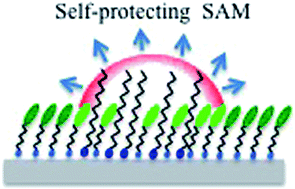
Although SAMs are generally stable systems, in some cases (e.g. fluorescent SAMs) their functional groups can be very sensitive to the environment, and even a weak interaction with an unfavourable ambient can significantly damage them or alter their characteristics, thus hindering their functionality.10,11 Due to this, sensitive SAMs need to be protected because of the intrinsically limited quantity of material constituting them. This problem can be overcome by using a protective film; however, this approach is not always feasible since it can result in a layer with a thickness of a few nanometers,24 which can compromise the SAM's functionality for some of their specific applications such as responsive surfaces3,7 or constructive lithography.25 Therefore, the fabrication of ultrathin protective layers is highly desirable for several systems.
Here, we fabricated a self-protective two-component SAMs by exploiting the reiterated micro contact printing (μCP), which is a method already proved capable to print interpenetrate SAMs,26 in which the first component is a fluorescent compound and the second component is a linear alkyl chain, which imparts the protective action. We choose to test our approach on a fluorescent SAM because of its high sensitivity to chemical perturbations, which can be detected as alterations in its luminescence properties.3
The protective effect was proved for some of the most common buffer solutions used in biology and for extreme pHs. For our experiments we have used well-known compounds such as n-octadecyltrichlorosilane (OTS), which is one of the most used silanes in surface science,27–30 and fluorescent bis (2,5-dioxo-pyrrolidin-1-yl) 5,5′-(benzo[1,2,5] thiadiazole-4,7-diyl)bis(thio-phene-2-carboxylate) (1), which is grafted to a preformed 3-(aminopropyl)triethoxysilane (APTS) SAM to give targeted 1-SAM.26 The chemical structures of both compounds are shown in Scheme 1. Samples were characterized by means of fluorescence microscopy (FM), laser scanning confocal fluorescence microscopy (LSCM), atomic force microscopy (AFM) and static contact angle measurements (CA).
Self-protective two-component SAMs (SP-1-SAMs) were prepared by printing OTS on 1-SAMs (Fig. 1). The samples were prepared both by printing OTS on 1-SAM previously growth in solution (see ESI†) and on 1-SAM obtained by μCP as described in previous work (including the full characterization of 1-SAM).26
Fig. 1 shows the scheme of the process. Briefly, OTS is deposited on a PDMS stamp, after that the stamp is placed in contact for a few minutes with 1-SAM and rinsed in clean solvent. The experimental details are reported in ESI.†
The effective surface functionalization by interpenetrated SAMs was confirmed by the different CA of 1-SAM and SP-SAMs, which were measured to be respectively 87 ± 7° and 106 ± 4°. The fluorescence properties of compound 1 were measured to be fully preserved after the OTS printing step. Remarkably, the mean CA value of SP-1-SAMs is the same, within the experimental error, of conventional OTS-SAMs grown on silicon (103 ± 1°) by conventional procedure.
Despite an occasional small decrease of fluorescence intensity (<5%, estimated value from FM images), SP-1-SAMs appear almost indistinguishable from 1-SAM (Fig. 2a). On the other hand, when 1-SAM is exposed to a buffer solution, the fluorescence is quenched (Fig. 2b). The quenching is moderate in ultra-pure water or at pH < 7 (<30% intensity decrease, as estimated from FM) or dramatic (>80%) in aqueous solutions with a pH higher than 8 and in common buffer solutions used in molecular biology such as Dulbecco's phosphate buffered saline (DPBS), Tris(hydroxymethyl)aminomethane hydrochloride buffer (Tris–HCl) and Dulbecco's modified eagle's high glucose medium (DMEM).
Solution treatments were performed leaving the samples exposed to medium 3 hours at 37 °C in a saturated humidity atmosphere containing 95% air and 5% CO2.
While 1-SAM undergoes a dramatic quenching of fluorescence within a few minutes, SP-1-SAMs remains unaltered, preserving its morphology and luminescence properties. Confocal time-resolved fluorescence imaging has shown that neither the spectral features nor the fluorescence lifetimes of SP-1-SAMs are affected by its exposure to a buffer, as shown in Fig. 2. In detail, we observed a fluorescence spectrum with a maximum at ca. 575 nm (Fig. 2e). The fluorescence decay of selected regions of interest could be fitted to a biexponential function yielding an average intensity-weighted lifetime of 4.48 ns as well as two fluorescence lifetimes and 1.20 and 5.20 ns with similar intensity weights before and after treatment, respectively. Noticeably, there's a drastic change in fluorescence lifetime for the treated 1-SAM compared to the untreated sample. Indeed the intensity-weighted average fluorescence lifetime decreases from 3.90 to 1.90 ns and fitting requires a tripexponential function yielding lifetimes of 0.70, 2.05 and 4.62 ns. Clearly the absence of the protective layer is responsible of this change that may be due to a change in the local fluorophore environment upon exposure to medium considering that the spectral features do not change. Remarkably, no aging effect was observed after storage of the sample in the dark and in air at room temperature before the solution treatment or leaving them in DPBS at 4 °C for six months.
SP-1-SAMs morphology was investigated by AFM in Peak-Force mode (see Experimental details in ESI†). Samples for AFM were specifically fabricated by printing parallel, 15 μm wide stripes of OTS on 1-SAM. Despite the presence of some outgrowth thicker than 10 nm, the stripes of SP-1-SAM are clearly visible in topography, exhibiting a thickness of 0.5 ± 0.2 nm and an increased r.m.s. roughness (Sq) of 2.1 nm with respect to the Sq of unprinted areas (1.9 nm). Fig. 3 shows a representative AFM image of printed stripes of OTS on 1-SAM prepared in solution.
The protective layer is stable upon mechanical perturbation with the AFM tip and does not show any alteration after contact imaging performed at a mean applied force of 10 nN.
We attributed the protective effect of OTS to its strong hydrophobic character. Since OTS molecular length is significantly longer than that of compound 1, which is placed parallel to the surface,26 the part of the molecule exceeding the length of 1-SAM probably acts as a protective ultra thin layer (see Fig. 1) that physically separates the functional SAM from the upper solution.
We excluded the formation of a multilayer since the thicknesses of zones printed with both compound 1 and OTS (i.e. SP-1-SAMs) is identical to those just containing OTS. In addition, the presence of a further layer on the fluorescent SAM should influence the fluorescence properties of the 1-SAM, which instead are unaffected. However, although morphology (thickness), wettability and fluorescence properties support the presence of interpenetrating SAMs, we cannot exclude the minor presence of some defects originated by the reaction of free silane of 1 (that have not reacted with the surface) and OTS end group during the second printing step. This possibility might explain the occasional small decrease of fluorescence intensity that we occasionally observed in some samples.
In summary, reiterated μCP has been used to reliably fabricate a self-protecting mixed SAM consisting of two interpenetrated SAMs of two different compounds.
The first SAM contains a high fluorescent group and provides the functionality, while the longer second compound generates the protective layer preserving the functionality of the first SAM upon external perturbations. The proposed approach is simple, versatile and introduces a facile manner to fabricate self-protective ultra thin layer less than one nanometer thick, within the same technological platform used for the SAM fabrication. The process exploits at the same time two typical properties of SAMs i.e. their role as building block element and their role as protective layer. In this respect, our work represents an important advance in the application of functional SAMs in surface science and nanotechnology.
MB and DG contributed in the same manner to this work. The activity has been supported by national Project N-CHEM, Flagship NANOMAX.
Footnote |
| † Electronic supplementary information (ESI) available: Experimental details. See DOI: 10.1039/c5ra27454k |
| This journal is © The Royal Society of Chemistry 2016 |