Yao Xiea,
Di Chen*a,
Shujing Lina,
Zhigang Wangb and
Daxiang Cuia
aKey Lab. for Thin Film and Microfabrication Technology of Ministry of Education, Shanghai Intelligent Diagnosis and Treatment Instrument Engineering Technology Research Center, Department of Instrument Science and Engineering, School of Electronic Information and Electrical Engineering, Shanghai Jiao Tong University, 800 Dongchuan Road, Shanghai 200240, P. R. China. E-mail: dchen@sjtu.edu.cn; Tel: +86-21-3420-6992
bDepartment of General Surgery, The Sixth People's Hospital, Shanghai Jiao Tong University, Shanghai 200240, P. R. China
First published on 16th March 2016
A robust and easily integrated plasma separation chip is very important for integration with microfluidic chips. Robust means that the system can tolerate small deviations in the boundary conditions (flow rate, temperature, position, hematocrit, dilutions and so on) without failure of the system. If a separation technique requires a precise flow rate and delivers other results, then the approach is not robust. Easily integrated means that the processing of fabrication and operation of the separation chip must be compatible with other parts of the microfluidic chip. In this work, a microfluidic plasma separation chip that uses the gravitational sedimentation effect to separate plasma from whole blood has been designed, fabricated and evaluated. The weir structure was constructed by using high-aspect-ratio SU-8 thick-photoresist molds, and then a double-polydimethylsiloxane (PDMS) layer was fabricated by casting, demolding and bonding with the PDMS layer. The high-aspect-ratio weir structure is beneficial for retaining blood cells in the gap of the weir structure. The conventional soft lithography process and use of PDMS materials makes it easy to integrate with other microfluidic technology. The simple weir structure is clogging-free and robust for the majority of plasma requirements. 20 μL of plasma was extracted from 65 μL of diluted blood (diluted factors ≥ 1
:
9) and the separation efficiency was above 90%.
Automation and integration of a blood plasma separation step in microfluidic chips is ideal for point-of-care (POC) diagnostics. According to the presence or absence of an additional external field, plasma separation microfluidic chips are classified into two categories: the passive methods that separate without external fields and the active methods that require an additional external field. The passive separating techniques for a microfluidic chip include flow rate control,4–8 micro-filtration,9–12 geometrical obstacles,13,14 inertial force and gravitational sedimentation.13,15–18 The active separating techniques for a microfluidic chip include CD type centrifugation,19 acoustic separation and electrical separation.20–22 Especially, making use of gravity to realize plasma separation will greatly simplify the chip system and bring blood tests on microfluidic chips a step closer to real application. The gravitational sedimentation in a micro-scale channel/chamber can cause an obvious blood delamination within a short time. For example, plasma separation has been obtained by combining cross-flow filtration and a gravitational sedimentation effect on an interchannel microstructure at a slow injection flow rate of 1 μL min−1.23 In another report, a self-powered microfluidics blood analysis system based on sedimentation was developed and used to realize instantaneous detection of protein in plasma from a single drop of blood.16 Although the chip-based plasma pheresis systems that make use of the blood delamination effect are suitable for disposable application purposes, their long term performance may cause clogging of the chip with narrow channels. Therefore, because of the inherent limitations of these methods, they are prone to issues, including microchannel clogging, low efficiencies and long separation times.3 Furthermore, these methods have rarely been applied in integrated microfluidic chips as they are lacking in robustness and universality of integration.24 Some improvements include reducing the complexity of the microfluidic design and the amount of external support equipment required, while simultaneously reducing the number of components (such as pump, valves and membrane), or changing the fabrication processing and materials used.16,25,26
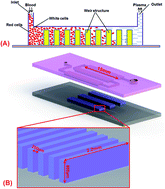
In this paper, we developed a robust and easily integrated plasma separation chip by gravitational sedimentation of blood cells. The weir structure was constructed by using high-aspect-ratio SU-8 thick-photoresist molds, and then the double-polydimethylsiloxane (PDMS) layer was fabricated by casting, demolding and bonding with the PDMS layer. The SU-8 molds can be reused for pouring and molding PDMS, this method was easy and could also decrease the fabrication cost. The high-aspect-ratio weir structure has the advantage of retaining blood cells in the gap of the weir structure. The absolutely soft lithography process is easy to integrate with other microfluidic technologies. The simple weir structure is clogging-free and robust for the majority of plasma requirements.
![]() | ||
| Fig. 1 Schematic of the plasma separation chip. (A) Schematic illustration of plasma separation in weir structure. (B) Size of weir structure and whole of separation chip. | ||
:
1 mixture (w/w) of PDMS and curing agent was prepared and poured over the molds. The molds were then cured at 60 °C for 3 h. Afterward, the two parts of the PDMS structures were peeled off from the SU8 mold structure, and holes were punched at the sites of the reservoirs. Finally, both PDMS structures were bonded to each other with oxygen plasma treatment (Fig. 2).
:
1, 1
:
3, 1
:
5, 1
:
7, 1
:
9) using phosphate buffered saline (PBS). Both the heparin sodium and PBS can further maintain the activity of blood cells (Fig. 3).
| η = [(Nw − Ns)/Nw] × 100% |
:
1 to 1
:
9 (the hematocrits from 25% to 5%) was carried out on the plasma separation chip. Experiments have been carried out for flow rate in the range of 2.5 to 7.5 μL min−1. Before quantification of the data obtained in the experiments, we calculated the volume of the whole separation chamber to be about 45 μL. Theoretically, when the blood cells were completely filled in the gap of weir structure, 62 μL of plasma could be separated from the blood sample. However, because of incomplete sedimentation of blood cells in the gap of the weir structure and streaming with plasma fluid, the amount of plasma separated from blood is less than 62 μL.
When the volume of 65 μL of blood was entirely sucked into the chamber of the device, and the chamber of device was completely filled with blood, blood plasma volume ranging from 10 to 30 μL was extracted. Fig. 4 shows that the different extraction volumes and dilution factors affect the separation efficiency. It gives us an indication that the separation efficiency was not obviously influenced by extractions volume of less than 20 μL. However, the separation efficiency was brought down on account of the volume of extraction more than 20 μL. As previously mentioned, the whole volume of the chamber of the chip is about 45 μL, so when 65 μL of diluted blood was injected into the chamber, 20 μL of plasma could be extracted from the chamber, and 45 μL of liquid remained in the chamber. Meanwhile, the continual extraction of plasma can move more blood cells forward upstream of the liquid, which caused the more blood cells to move into the plasma. Therefore, extraction of 20 μL of plasma was the most appropriate approach.
![]() | ||
| Fig. 4 The influence of different extracted volumes and dilution factors on separation efficiency (flow rate, 2.5 μL min−1). | ||
Based on the above results, extraction volume of plasma was chosen as 20 μL from 65 μL of diluted blood at a flow rate of 2.5 μL min−1. As shown in Fig. 5, most of the blood cells were blocked in the gaps of the weir structure in the first and second row of the chamber. Blood cells in the interface between the weir structure and the outlet channel remain in the bottom of the chamber, and the number of blood cells is low (Fig. 6). Meanwhile, the number of blood cells in the extraction plasma decreased with increasing dilution ratio.
![]() | ||
| Fig. 5 Blood cells in the middle of the plasma separation chip; the bottom image indicates the observation position. | ||
At a certain extraction volume of sample, the separation efficiency will also be influenced by the extraction rate and dilution ratio. During the experiments, it was observed that as the flow rate was decreased, the efficiency of separation increases, which was attributed to sufficient gravitational sedimentation. Therefore, experiments were carried out to find the relation between the flow rate and the separation efficiency. Fig. 7 provides us the complete details of the different dilution ratios for the three extraction rates. The separation efficiency increased with decreasing flow rate. It can be seen that the separation efficiency of the higher dilution ratio was sensitive to a higher flow rate. The separation efficiency was above 90% at the 2.5 μL min−1 flow rate.
It is important to note that the separation process relied on sedimentation. To investigate the separation efficiency with respect to sedimentation time of blood cells in the chamber of the device, we compared the separation efficiency of two types of sample suction mode. When each of sample was sucked into the end of each row of the weir structure, the syringe pump was held to wait a minute, and then blood suction restarted. The influence of suction modes on the separation efficiency was studied at flow rates of 2.5 μL min−1, 5 μL min−1 and 7.5 μL min−1. The comparison of separation efficiency on the different flow rates is shown in Fig. 8. It is clear that the percentage of blood cells removed from the plasma increased with waiting 3 minutes. The waiting 3 minutes contributed to the improvement of the separation efficiency. This method had a significant effect on the condition of the higher flow rates and hematocrit.
![]() | ||
| Fig. 8 Waiting 3 minutes and no waiting for relationship of different hematocrit and separation efficiency, flow rate, (A) 2.5 μL min−1, (B) 5 μL min−1, (C) 7.5 μL min−1. | ||
Footnote |
| † Electronic supplementary information (ESI) available. See DOI: 10.1039/c6ra01447j |
| This journal is © The Royal Society of Chemistry 2016 |