
J. H. Christiana,
J. A. Teprovich Jr.a,
J. Wilsona,
J. C. Nicholsona,
T.-T. Truonga,
M. R. Kestersona,
J. A. Veltena,
I. Wiedenhöverb,
L. T. Babyb,
M. Anastasioub,
N. Rijalb and
A. L. Washington II*a
aSavannah River National Laboratory, Aiken, South Carolina 29803, USA. E-mail: Aaron.Washington@srnl.doe.gov
bDepartment of Physics, Florida State University, Tallahassee, Florida 32306, USA
First published on 13th April 2016
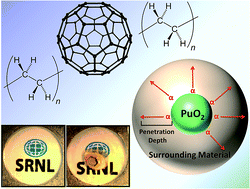
In nuclear facilities utilizing plutonium, polymeric materials are subjected to long-term, close-contact, and continuous α radiation exposure, which can lead to compounding material degradation and eventual failure. Herein we model the attenuation of α particles by linear-low-density polyethylene (LLDPE), polyvinyl alcohol (PVA) thin films, and C60 using Monte Carlo N-Particle Extended (MCNPX) software. The degradation of these materials was investigated experimentally by irradiating them with a beam of α particles of 5.8 MeV energy at a tandem Van de Graaff accelerator delivering a dose rate of 2.95 × 10⁶ rad s−1 over a 7.1 mm2 sample area. Our development of a method to test α particle-induced material degradation using a tandem accelerator is significant as degradation from naturally occurring α sources (i.e. Pu, Am) occurs too slowly for these sources to be used in practical experiments. Our results show that PVA nanocomposites containing 5 wt% C60 were found to withstand about 7 times the α dose of undoped PVA films before a puncture in the film was detected. When these films were adhered to a LLDPE sheet the dual layer polymer was capable of withstanding about 13 times the dose of LLDPE and nearly twice the dose of the doped PVA thin film alone. Doping polymers with C60 is an attractive way to generate more durable, radiation tolerant materials without increasing the thickness of the material which would lead to greater waste for disposal. Thus, the results herein help to resolve a prevalent technical challenge faced in nuclear facilities that utilize polymeric materials for nuclear processing and disposal.
In general, the extent of polymer alteration by ionizing radiation is dependent on the radiation source, the dose, and the type of polymer being irradiated. Therefore, the dissociation, abstraction, and addition reactions that often lead to alteration by cross-linking or chain scission, occur on varying timescales after irradiation.1–3 Upon alteration, a slew of undesirable physical changes can occur such as polymer softening, decreased ductility, an increase or decrease in the melting temperature, and embrittlement.1,2 Despite the ubiquity of polymers and the well-known radiation-induced degradation they can experience, a small amount of work has been done to improve the performance of these materials in radiation environments. The majority of said work has been directed at remediating the effects of gamma radiation through the addition of “antirad” compounds to the polymer matrix.4–7 These antirads can decrease the reaction rates of chain scission and cross-linking by scavenging radicals, intermediates, and ejected electrons as they form during irradiation.4 For example, 2-vinylnaphthalene and 4-vinylbiphenyl have been used to increase γ radiation resistance of poly(vinyl chloride) (PVC),4 and aromatic diacetylenes have been shown to remediate radiation-induced damage in polyurethane.8 In many applications, however, polymeric materials are frequently subjected to a variety of ionizing radiation types.
Alpha (α) radiation has been especially overlooked in terms of its material altering properties due to its charge and high mass, which can be readily attenuated. However, long-term exposure to α radiation can still cause unwanted material alteration at material surfaces which can accumulate and lead to material failure. This was exemplified in March of 2002 when the Los Alamos National Laboratory (LANL) experienced an unexpected release of 238Pu due to failure of a polytetrafluoroethylene (PTFE) valve seal that was badly degraded from close exposure to α emissions.9 Incidentally, α-emitting plutonium waste is often stored in linear-low-density polyethylene (LLDPE) bags to prevent contamination while awaiting permanent disposal. In this interim state, LLDPE also undergoes rapid degradation especially when in close contact with α sources.10 This degradation can cause the bags to become brittle and susceptible to puncturing, which can result in radiological contamination to surrounding areas. To mitigate this risk, the current practice is to periodically repackage the waste in new LLDPE bags. The degraded bags then contribute negatively to the overall level of waste, leading to increased costs for the disposing entity and increased risk of worker exposure. Furthermore, decomposition of the LLDPE hydrocarbon has the potential to generate hydrogen gas that can accumulate over time, creating a flammability and over-pressurization hazard in closed environments.10
While polymer durability and puncture resistance have improved in recent years through the use of various additives11,12 and metallocene catalysts13–15 commercial availability of radiation tolerant polymers remains scarce. Recently, polymer nanocomposites based on various forms of carbon (e.g. carbon black, carbon nanotubes, graphene) have been used for their improved mechanical properties.11,16–18 However, no work has been done to date which studies the effects of α radiation on carbon-based nanocomposites. However, we postulate that the high electron density of these carbon materials is ideal for quenching the charge differential and energy of α particles as they travel through a doped polymer. This quenching should limit the damage resulting from α particle/polymer interactions. To test this idea, we developed a Monte Carlo N-Particle Extended (MCNPX) model to simulate α particle interactions with carbon materials and various host polymers. Our computational results show that the penetration depth of incident α radiation through carbon materials is significantly lower than in the modeled polymers.
With this in mind, we experimentally studied for the first time, the effects of α radiation on polymer nanocomposites utilizing water dispersible C60. We report herein on the fabrication of these materials and the extended lifetime they experience with respect to α particle-induced failure. Radiation resistance was tested using a beam of 5.8 MeV He2+ ions (α particles) from a Tandem Van de Graaff accelerator, which was delivered over a 3 mm diameter onto a polymer surface. The development of a method to observe α particle-induced degradation using a tandem accelerator is arguably the most important aspect of this work since degradation caused by natural α particle sources is too slow to achieve experimentally significant results. Utilizing the tandem accelerator allows for a much higher dose rate to be achieved relative to natural sources (∼106 rad s−1 vs. ∼103 rad s−1), and allows for the concentrated dose to be delivered with precision thereby eliminating uncertainty about the particle scattering physics between the source and the polymer film. Our nanocomposites withstood nearly seven times the dose of an undoped PVA film, and over thirteen times the dose of a LLDPE sheet. This development of a more durable polymer radiological containment system through doping with an electron-dense additive provides a quick and convenient method for improving existing polymer systems to achieve enhanced radiation resistance, and appears to be a fruitful new research area.
A COMSOL Multiphysics21 2D, axisymmetric, Heat Transfer Module was also used to simulate the steady state temperature of LLDPE and PVA films, 100 mm in diameter by 150 μm thick, irradiated with 5.8 MeV of α particles with varying currents from 1 to 50 nA. The model was used to ensure that heating effects caused by irradiation were not significant enough to cause our samples to melt when tested with the accelerator beam. This would prevent us from observing the long-term radiological degradation effects imparted on the polymers by the α particles.
000 g mol−1 (80% hydrolyzed) and C60 (99.9% purity) were purchased from Sigma Aldrich. Metallocene catalyzed LLDPE sheets with melt index and density of 1.0 g/10 min and 0.918 g cm−3 respectively were purchased from Extra Packaging Corporation (Product # 32-21667.01).
| Solid state material | Packing density (g cm−3) | Molecule density (molecule per cm3) | Electron density (electrons per cm3) |
|---|---|---|---|
| LLDPE | 0.93 | 5.60 × 10²⁰ | 9.00 × 10²¹ |
| PVA | 1.20 | 1.64 × 10²² | 3.94 × 10²³ |
| C60 | 1.65 | 1.21 × 10²¹ | 4.53 × 10²³ |
Our model simulated the particle physics (coulombic and kinetic interactions) over the path of the α particles as they penetrated through 1 μm layers of the solid state material. The distance at which the particles were completely attenuated is hereafter referred to as the penetration depth. Smaller penetration depths correlate to greater α attenuation.
Materials with small penetration depths promise to enhance radiation resistance due to their ability to rapidly dissipate radiation energy, thus limiting material damage. In Fig. 2, the collisions of α particles with each successive 1 μm layer in LLDPE, PVA, and C60 are shown. Our simulations determined that the penetration depth was 32 μm, 36 μm, and 41 μm for C60, PVA, and LLDPE respectively. These depths correspond to a respective decrease in electron density for the materials, thus confirming attenuation is correlated to the electron density.
![]() | ||
| Fig. 2 Simulated α-particle collisions in LLDPE, PVA, and C60. The vertical colored lines represent α-particle collisions through each medium. | ||
To determine the effects of on- and off-contact radiation exposure, we also simulated the α particle penetration through the thin films with no space present between the α particle source and the film (on-contact exposure), and with air gaps (off-contact exposure) of 100 μm, 3 mm, and 1 cm between the film and the radiation source. Because an α particle's penetration range in air is approximately 4.5 cm, off-contact exposure was utilized to test for air's attenuation effects. Pragmatically, slightly off-contact is the expected form of material exposure in most real applications while on-contact exposure represents the worst case scenario for material interaction. The probability of simulated α particle interactions in these films for on- and off-contact exposure is shown in Fig. 3. The 100 μm air gap revealed only a small effect on decreasing the α penetration depth, while the 3 mm and 1 cm gaps caused a significant decrease in the penetration depth through the simulated materials. The penetration depth simulations were used as a first order guide for thickness development of our radiation tolerant thin films and as a guide for the potential performance of the films. In order to ensure that no α particles exited the attenuating media, we developed films that were significantly thicker (∼150 μm) than the simulated penetration depths.
To ensure the degradation of our films during accelerator tests (vide supra) was solely due to α radiation and not by melting from an intense beam, COMSOL Multiphysics Heat Transfer Module21 was used to simulate the steady state temperature of LLDPE and PVA as a function of α beam diameter and beam current. The beam diameter was varied from 1–3 mm and the current from 1–50 nA. Our simulations represent a worst-case scenario from a thermal standpoint, as they assume that all of the energy of the α particles is added to the irradiated materials in the form of thermal energy and the only method of heat removal from the sample was in the form of surface-to-ambient thermal radiation with an emissivity value of 0.2. Additionally the energy of the modeled particles goes to zero, and the endothermic energy associated with removing electrons from the irradiated material was not considered. In actuality the α particles do not go to a zero energy state and some heat would be removed from ionization events. As can be seen in Fig. 4, the temperature of both LLDPE and PVA increases with beam current and a smaller beam size causes greater heating of the polymer at lower currents. Using these simulations, we were able to optimize our accelerator test parameters to minimize heating effects on the studied polymers. Specifically, the accelerator current was fixed at 12 nA and the beam diameter was 3 mm. According to our worst-case scenario simulations, these parameters could only cause heating up to temperatures less than the melting/softening points of our polymer samples.
![]() | ||
| Fig. 4 Steady state maximum temperatures of LLDPE and PVA as a function of α particle flow rate and beam diameter. | ||
Transparency of radiological containment bags is important to minimize potential worker hazards (handling of sharps/unknown waste contents) and to comply with the safety basis of the waste storage site. Cross sectional microscopy images used to measure the thickness of each sample are shown in Fig. 5.
Following fabrication, each sample was exposed to 5.8 MeV accelerated charged helium nuclei (i.e. α particles) in a Van de Graaff accelerator employing a 2.95 × 10⁶ rad s−1 dose rate. This high dose rate was employed to accelerate the effects of 238Pu α radiation (5.89 × 10³ rad s−1) that the polymers would experience over an extended period of time while being used for radiological containment. During exposure, a Faraday cup, placed 6 inches behind our irradiated samples, was used to detect when a breach occurred in the testing materials. A threshold current for the detector was fixed at 60 pA which we correspond directly to a failure in the sample. This allowed us to accurately measure how long it took to penetrate the samples. The time spent in the beam could then be extrapolated to the time of on-contact 238Pu exposure before material failure. Following irradiation each sample was visibly altered as shown in Fig. 6. In this figure, degradation in the films can be seen by observing the distortion in the background text and image. More visible degradation is apparent for the doped films due to the substantially longer exposure time they were able to withstand before failure.
![]() | ||
| Fig. 6 Each studied sample is shown before and after α irradiation. The background image is used to show sample transparency, color, and radiation damage induced to each polymer film. | ||
After five measurements on each sample, we found that the average time for failure in the LLDPE was 16.5 min. Undoped PVA thin films lasted only slightly longer and failed in 18.1 min. PVA thin films containing C60 failed in 123.2 min, and the PVA thin film containing C60 that was adhered to LLDPE failed in 217.5 min. These times correspond to irradiation dose rates of 2.92 × 10⁹ rad s−1, 3.21 × 10⁹ rad s−1, 2.18 × 10¹⁰ rad s−1, and 3.85 × 10¹⁰ rad s−1 for LLDPE, undoped PVA, doped PVA, and doped PVA on a LLDPE substrate respectively. These data are summarized in Table 2.
| Sample | Average time to failure in accelerator (min) | Average α-particle dose absorbed before failure (rad s−1) | Estimated time until failure in a 238Pu environment (days) |
|---|---|---|---|
| LLDPE sheet | 16.5 | 2.92 × 10⁹ | 5.8 |
| PVA thin film with no additives | 18.1 | 3.21 × 10⁹ | 6.3 |
| PVA thin film doped with C60 | 123.2 | 2.18 × 10¹⁰ | 42.9 |
| PVA thin film doped with C60 and adhered to a sheet of LLDPE | 217.5 | 3.85 × 10¹⁰ | 75.8 |
Using the dose absorbed by our polymers and nanocomposites in the accelerator and the typical dose emitted by 238Pu metal (∼5.88 × 10³ rad s−1) over the same surface area as our accelerator samples (3 mm), the lifetime until failure of each sample in a 238Pu environment was calculated. The failure durations in a 238Pu environment would be 5.8 days, 6.3 days, 42.9 days, and 75.8 days for LLDPE, undoped PVA, doped PVA, and doped PVA on a LLDPE substrate respectively. Importantly, these times represent the worst-case performance of the studied materials, one in which the full dose from 238Pu is absorbed through direct contact and only on a 3 mm target area. In actuality where on- and off-contact exposure occur, and the α dose is distributed three-dimensionally on a larger surface area, the time until failure would be considerably longer.
Our results show there is a strong correlation between the electron densities of each irradiated material and the resistance towards α-particle-induced failure, which is in excellent agreement with our modeling data. Additionally, some synergism appears to occur when coating the PVA film onto LLDPE as evidenced by the non-linear improvement in penetration resistance for the doped PVA on a LLDPE substrate in comparison to doped PVA and LLDPE alone. The time until failure of our nanocomposites clearly show that C60 is an excellent additive for improving the resistance towards radiological-induced degradation in PVA.
To better understand the mechanism of degradation in our samples, we performed XRD and FTIR measurements on each sample pre- and post-irradiation. XRD measurements of non-irradiated LLDPE (Fig. 7) show that the material is highly crystalline with sharp diffraction peaks corresponding to polyethylene. Several other peaks are present in the diffraction pattern and are tentatively ascribed to metallocene catalyst which is copolymerized with the olefin monomers during resin synthesis.24 Following irradiation, the LLDPE becomes noticeably more amorphous as evidenced by the formation of two broad humps in the diffraction pattern. We believe the decrease in LLDPE crystallinity might be an important consequence of polymer degradation in radiological environments. Since crystalline LLDPE is more durable than it's amorphous analogue, a loss of crystallinity will lead to increased probability of mechanical failure by the polymer system.25 The cause of the decrease in crystallinity is currently unknown, and would be the subject of future studies. Further, the additional peaks attributed to metallocene are noticeably absent from post-irradiated samples, thus suggesting the large absorbing cross-section of metallocene14,15 makes it particularly prone towards radiation-induced degradation.
![]() | ||
| Fig. 7 XRD measurements of pre- and post-α-irradiated LLDPE are shown with the diffraction pattern of polyethylene. The irradiated analogue becomes noticeably less crystalline following irradiation. | ||
Measurements of undoped pre- and post-irradiated PVA films (Fig. 8) show an amorphous structure in both cases due to retention of water resulting from our drop-casting fabrication process. When C60 is added to the polymer matrix a sharp peak is seen at 26°. This peak corresponds to the most intense diffraction line from graphitic carbon, and confirms that C60 is well encapsulated in the films. The other diffraction peaks from graphitic carbon are not well-resolved presumably due to the low dopant concentration. It is also observed that the relative intensity of this peak to the amorphous hump between 10° and 25° is greater in the irradiated sample than it is in the non-irradiated sample. Thus, when PVA is irradiated it undergoes a change that causes its diffraction intensity to decrease relative to the C60 dopant peak, suggesting that perhaps pristine C60 is retained in the film during irradiation, while PVA is degraded.
FTIR spectra of pre and post-irradiated LLDPE and PVA films are shown in ESI Fig. S4–S6.† Our measurements revealed that none of the studied polymers undergo functional group changes following irradiation. In fact, all LLDPE and PVA spectra were in excellent agreement with their respective literature spectra.26,27 The spectra of doped PVA films were subtly different than undoped films, showing a small difference in the peaks ∼3000 cm−1, likely from the small amount of C60 dopant present.
Though XRD and FTIR measurements were useful in characterizing the changes in our samples, a more rigorous study on the degradation mechanism, beyond the scope of this paper, is still needed.
These studies would likely include more in-depth polymer characterization techniques such as gel permeation chromatography (GPC), differential scanning calorimetry (DSC), and nuclear magnetic resonance (NMR) in addition to FTIR spectroscopy for characterizing composite molar mass and distribution. Detailed transmission electron microscopy (TEM) measurements should also be employed for studying additive dispersion properties to ensure agglomeration is not significant in resulting samples.
Footnote |
| † Electronic supplementary information (ESI) available: Additional spectroscopic characterization. See DOI: 10.1039/c6ra01126h |
| This journal is © The Royal Society of Chemistry 2016 |