Novel Pd-catalyzed electroless Au deposition method using a sulfite solution

Bing Li, Ning Li*, Deyu Li and Yanqing Wang
Department of Applied Chemistry, Harbin Institute of Technology, Harbin 150001, China. E-mail: lininghit@263.net

Received 31st December 2015 , Accepted 23rd March 2016

First published on 24th March 2016


Abstract

A novel method is reported for the electroless deposition of Au using nanoscale Pd catalysts in a sulfite solution. The method is simple, stable, and environmentally compatible. The Pd structures provided beneficial reactive properties. In the presence of a Pd layer, the reaction proceeded less through a displacement reaction pathway, and the size of the Au particles produced could be refined.

Electroless nickel immersion gold (ENIG) is a type of surface plating used for printed circuit boards. It consists of electroless nickel plating covered with a thin layer of immersion gold. This Au plating proceeds through a galvanic displacement reaction.1,2 During these displacement/immersion processes, the electrons required to reduce the Au ions in solution are supplied by anodic dissolution of the substrate, which is typically Ni–P. Therefore, a “black pad” is generally considered to be a layer of nickel oxide that often generated after ENIG plating,2 because of Ni–P corrosion.3 In this case, the solder of a BGA package may undergo joint failure during a surface mount assembly process or during the use of a final product.4,5 To remedy this, a layer of electroless palladium can be plated onto nickel to create electroless nickel electroless palladium immersion gold (ENEPIG) technology.

A variety of techniques have been implemented to synthesize Au films. In the ENIG and ENEPIG processes, an Au layer is usually deposited by the displacement reaction. Electroless Au plating via an autocatalytic method can be used to avoid problems associated with the substrate dissolution. Au plating on Ni in an autocatalytic bath can produce thick uniform coatings.6 However, autocatalytic baths are thermodynamically unstable and their useful lifetime is relatively short. The substrate-catalyzed reaction is a good way to solve this problem.

The first substrate-catalyzed electroless Au plating process was invented by Iacovangelo and Zarnoch.7 In their method, hydrazine was used as the reducing agent. Following their study, several investigators improved upon their formulation using deposition baths that contained hydrazine, DMAB, and other reducing agents that underwent oxidation reactions on the Ni surface.8–10 However, during this plating process, the Ni substrate will dissolve during the replacement reaction. The reductant is oxidized by Ni2+ and the bath becomes unstable. Therefore, it is advantageous to find a stable process that uses a mild reducing agent in the gold bath and to select a high catalytic activity substrate.

Pd has a high catalytic activity for many chemical reactions. In recent research reports, Pd as an electrocatalyst has shown many interesting advancements such as a facile synthetic method,11,12 the ability to synthesize a network structure,13,14 and catalytic activity of different palladium alloy compositions.15 In the electroless plating processes, Pd layers or Pd nanoparticles are always used as catalysts for the electroless metallization of non-metallic materials.16–20 When employed in the surface finishes of PCBs,21–23 a thin Pd layer between the Ni and Au layers can prevent Ni dissolution during immersion Au plating, preventing the corrosion-induced accumulation of P in the ENEPIG finish. ENEPIG boards are more reliable after reflow than ENIG boards and they have excellent characteristics under all conditions after thermal aging. However, very few have studied the catalytic activity of Pd for the ENEPIG process.

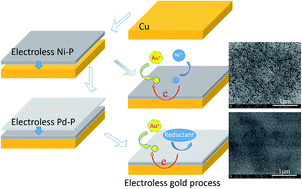
In this study, a Pd nanolayer was deposited as a catalyst for electroless Au plating. A Pd–P nanolayer was deposited on a Ni–P surface using sodium hypophosphite as a reducing agent. The Ni and Pd bath compositions are given in Table SI and SII, respectively. The plating baths used in this study for electroless Au plating were cyanide-free and contained sulfite and thiosulfate as complexing agents. The bath compositions and operating conditions are listed in Table SIII. The corrosion resistance of the coating was investigated using a Tafel plot analysis from data acquired using a three-electrode electrochemical cell and a CHI760D electrochemical workstation. A saturated calomel electrode (SCE) and Pt plate were used as reference and counter electrodes, respectively. Field emission scanning electron microscopy (FESEM, Helios Nanolab 600i) was used to observe the Pd–P nanolayers and the Au films. Atomic force microscopy (AFM, Dimension Fast) was applied to characterize the samples smoothness. Au deposition on the Pd–P surface was verified using flame atomic absorption spectrometry (FAAS, Shimadzu, AA-6300) for metal ion determination. The ENIG process and the added Pd interlayer process are shown in Scheme 1 (see Experimental details in the ESI).


image file: c5ra28168g-s1.tif
Scheme 1 Schematic of the electroless Au deposition process on the Pd–P and Ni–P surfaces.

Ni–P films were deposited in the first step. Au was deposited directly on the Ni–P surface via an immersion process, creating the established ENIG material through the displacement reaction between Ni–P and Au. However, Pd–P was deposited first on the Ni–P surface. When Au was then deposited on the Pd–P surface, the displacement reaction between Ni–P and Au was partially prevented and Au deposition was partially catalyzed by the Pd–P.

In this study, Pd–P films with different thicknesses were deposited onto Ni–P surfaces. Fig. 1 shows SEM images of the Ni–P and Pd–P films generated with different plating times. The electroless deposition rate of Pd–P was approximately 0.01 μm min−1. Fig. 1(a) shows the morphology of the Ni–P surfaces. Hemispherical clusters were observed on the Ni–P surface. However, as shown in Fig. 1(b), the surface was covered with an approximately 0.01 μm thick Pd–P layer, and the nodal boundaries of Ni–P were blurred. When more Pd–P was deposited, the surfaces were smoother. According to the micrographs, the Pd–P layer grew more uniformly on the Ni–P surface. When the Pd–P thickness exceeded 0.03 μm, no clear grain boundaries were observed. Black spots are typically observed along the nodal boundaries of an underlying Ni–P layer.2 Therefore, the deposited Pd–P layer should aid in avoiding unfavourable galvanic corrosion.


image file: c5ra28168g-f1.tif
Fig. 1 SEM micrographs of electroless plated Pd–P on Ni–P with different plating times of (a) 0 min, (b) 1 min, (c) 3 min, and (d) 10 min.

The Au immersion deposition process is known to proceed via a displacement reaction. However, in a plating bath containing sulfite, J. Sato et al.24,25 found that sulfite participated in the substrate (Ni–B)-catalyzed reaction as a reducing agent. In this study, test pieces of Ni–P with different Pd–P thicknesses were immersed in an Au plating bath for 5 min. After several pieces were immersed, the concentrations of metal ions in the Au bath were analysed using FAAS. The related results from different Au plating baths are summarized in Table 1.

Table 1 The concentrations of metal ions in different Au plating baths after immersion Au deposition (1 g L−1 initial Au concentration)
  Sample Thickness/μm C (ion)/g L−1 Displacement reaction
Au Ni Pd
1 Ni 4 0.341 0.101 0 100%
2 Pd/Ni 0.05/4 0.124 0.076 <5 ppm 56.7%
3 Pd/Ni 0.10/4 0.337 0.034 <5 ppm 34.2%
4 Pd/Ni 0.20/4 0.258 0.016 <5 ppm 14.9%


The displacement reactions that can occur in the immersion Au process are as follows:

 
Ni + 2Au+ → Ni2+ + 2Au (1)
 
Pd + 2Au+ → Pd2+ + 2Au (2)

The amount of Au that can be replaced with Ni and Pd can be calculated from the quantity of Ni2+ and Pd2+ in the Au bath, which is represented by ms. The total amount of Au deposited can be calculated by the decrease in Au ion concentration, which is represented by m. The contribution of the galvanic displacement reaction was calculated by (ms/m) × 100%. As listed in Table 1, Au deposition proceeded entirely via a replacement reaction on the Ni–P surface. However, a portion of the Au deposition reaction was a substrate-catalyzed reaction once Pd–P was coated onto the Ni–P surface. The proportion of the displacement reaction decreased as the thickness of the Pd–P layer increased. With a 0.1 μm thick Pd–P layer, 34.2% of the reaction was a displacement reaction. Sulfite was the only possible reductant in the Au bath. Therefore, the anodic reaction of sulfite also occurred on the Pd–P layer. Because this reaction did not occur at the Ni–P surface, it was a Pd-catalyzed electroless Au deposition process.

Unlike conventional galvanic displacement processes, the substrate-catalyzed processes did not attack the Pd–P substrates and the Au films were produced with very low porosities. The morphologies of different thickness Au films on Ni–P and Pd–P (0.05 μm) were examined by SEM and are shown in Fig. 2.


image file: c5ra28168g-f2.tif
Fig. 2 SEM images of electroless deposited Au on a Ni–P surface for (a1) 0 min, (a2) 1 min, and (a3) 3 min and electroless deposited Au on a Pd–P surface for (b1) 0 min, (b2) 1 min, and (b3) 3 min.

As shown in Fig. 2, Au deposits produced on the Ni–P and Pd–P surfaces were significantly different. Comparison of the three images in Fig. 2(a1–a3) clearly indicates that the Au formed on the Ni–P surfaces was composed of nanoparticles. While on the Pd–P surfaces, Au initially formed a complete covering composed of an evenly distributed layer.

In Fig. 2(a3), more Au crystals were observed, but the nodal boundaries of the substrate were not covered by Au. However, on the Pd–P surface, voids and exposed substrate were not observed, as shown in Fig. 2(b2) and (b3). This demonstrated that Au deposited on Pd–P formed a high quality Au thin-film. In addition, this conclusion was also obtained from AFM imaging, as shown in Fig. 3. The roughness values of different samples were as follows: Ra(Ni) = 18.5 nm, Ra(Ni/Pd) = 14.9 nm, Ra(Ni/Au) = 20.8 nm, and Ra(Ni/Pd/Au) = 16.0 nm. Fig. 3 and the roughness values of Ni/Au and Ni/Pd/Au illustrate that the Au layer grown on Pd surface is smoother than that on the Ni surface. Such a finely coated Au film would significantly improve corrosion resistance for electronic applications, as shown in Fig. 4.


image file: c5ra28168g-f3.tif
Fig. 3 Three-dimensional AFM image of the different coatings.

image file: c5ra28168g-f4.tif
Fig. 4 Tafel curves of copper substrate and different coated specimens in 5 wt% NaCl solution.

Fig. 4 reveals that the Ni, Ni/Au and Ni/Pd/Au coatings have a very high protective efficiency. The corrosion properties of the coatings were determined from the polarization curves: Ecorr(Ni/Au) = −0.237 V vs. SCE, icorr(Ni/Au) = 4.78 × 10⁻⁶ A cm−2; Ecorr(Ni/Au) = −0.237 V vs. SCE, icorr(Ni/Pd/Au) = 3.20 × 10⁻⁶ A cm−2. Compared with the Ni/Au coating, Ni/Pd/Au had better corrosion resistance.

Conclusions

A newly developed method was reported for the Pd-catalyzed electroless deposition of Au from a sulfite solution. Compared with Ni–P layers, nanoscale Pd deposition had excellent catalytic activity towards the immersion Au process in the absence of other reductants. The Pd–P films obtained via electroless plating were smooth, compact, and uniformly distributed on the entire Ni–P surface. The addition of a thin Pd layer between the Ni and Au layers prevented Ni dissolution during the immersion Au plating process. When the Pd–P layer was thicker than 0.1 μm, the reaction was less than 40% a displacement reaction. Simultaneously, a uniform and high quality Au film was generated by the Pd-catalyzed electroless Au deposition.

Acknowledgements

This study was performed with the support of the Highnic Group (China).

References

  1. Q. V. Bui, N. D. Nam, J. W. Yoon, D. H. Choi, A. Kar, J. G. Kim and S. B. Jung, J. Electron. Mater., 2011, 40, 1937–1942 CrossRef CAS.
  2. Y. S. Won, S. S. Park, J. Lee, J.-Y. Kim and S.-J. Lee, Appl. Surf. Sci., 2010, 257, 56–61 CrossRef CAS.
  3. P. Snugovsky, P. Arrowsmith and M. Romansky, J. Electron. Mater., 2001, 30, 1262–1270 CrossRef CAS.
  4. G. Milad, Circuit World, 2010, 36, 10–13 CrossRef CAS.
  5. K. J. Zeng, R. Stierman, D. Abbott and M. Murtuza, JOM, 2006, 58, 75–79 CrossRef CAS.
  6. C. D. Iacovangelo, J. Electrochem. Soc., 1991, 138, 976–982 CrossRef CAS.
  7. C. D. Iacovangelo and K. P. Zarnoch, J. Electrochem. Soc., 1991, 138, 983–988 CrossRef CAS.
  8. T. Osaka, T. Misato, J. Sato, H. Akiya, T. Homma, M. Kato, Y. Okinaka and O. Yoshioka, J. Electrochem. Soc., 2000, 147, 1059–1064 CrossRef CAS.
  9. M. Kato, J. Sato, H. Otani, T. Homma, Y. Okinaka, T. Osaka and O. Yoshioka, J. Electrochem. Soc., 2002, 149, C164–C167 CrossRef CAS.
  10. J. Sato, M. Kato, H. Otani, T. Homma, Y. Okinaka, T. Osaka and O. Yoshioka, J. Electrochem. Soc., 2002, 149, C168–C172 CrossRef CAS.
  11. D. C. L. Tan, B. Khezri, W. Amatyakul, R. D. Webster and H. Sato, RSC Adv., 2015, 5, 88805–88808 RSC.
  12. K. C. Poon, D. C. L. Tan, T. D. T. Vo, B. Khezri, H. B. Su, R. D. Webster and H. Sato, J. Am. Chem. Soc., 2014, 136, 5217–5220 CrossRef CAS PubMed.
  13. J. F. Zhang, Y. Xu and B. Zhang, Chem. Commun., 2014, 50, 13451–13453 RSC.
  14. M. J. Ren, L. L. Zou, T. Yuan, Q. H. Huang, Z. Q. Zou, X. M. Li and H. Yang, J. Power Sources, 2014, 267, 527–532 CrossRef CAS.
  15. M. Slojewski, J. Kowalska and R. Jurczakowski, J. Phys. Chem. C, 2009, 113, 3707–3712 CAS.
  16. J. H. Byeon, B. J. Ko and J. G. Hwang, J. Phys. Chem. C, 2008, 112, 3627–3632 CAS.
  17. M. W. Wang, T. Y. Liu, D. C. Pang, J. C. Hung and C. C. Tseng, Surf Coat Tech, 2014, 259, 340–345 CrossRef CAS.
  18. Y. B. Fu, L. D. Zhang and J. Y. Zheng, J. Nanosci. Nanotechnol., 2005, 5, 558–564 CrossRef CAS PubMed.
  19. L. Fu, S. H. Yu, L. Thompson and A. M. Yu, RSC Adv., 2015, 5, 40111–40116 RSC.
  20. M. Q. Huang, Z. D. Cui, X. J. Yang, S. L. Zhu, Z. Y. Li and Y. Q. Liang, RSC Adv., 2015, 5, 30038–30045 RSC.
  21. N. D. Nam, Q. V. Bui, H. T. Nhan, D. V. Phuong and M. Z. Bian, J. Electron. Mater., 2014, 43, 3307–3316 CrossRef CAS.
  22. J.-W. Yoon, B.-I. Noh and S.-B. Jung, J. Electron. Mater., 2011, 40, 1950–1955 CrossRef CAS.
  23. S.-S. Ha, J. Park and S.-B. Jung, Mater. Trans., 2011, 52, 1553–1559 CrossRef CAS.
  24. M. Kato, J. Sato, H. Otani, T. Homma, Y. Okinaka, T. Osaka and O. Yoshioka, J. Electrochem. Soc., 2002, 149, C164 CrossRef CAS.
  25. J. Sato, M. Kato, H. Otani, T. Homma, Y. Okinaka, T. Osaka and O. Yoshioka, J. Electrochem. Soc., 2002, 149, 5 CrossRef.

Footnote

Electronic supplementary information (ESI) available. See DOI: 10.1039/c5ra28168g

This journal is © The Royal Society of Chemistry 2016
Click here to see how this site uses Cookies. View our privacy policy here.