
P. A. Abramov*ab,
C. Vicentc,
N. B. Kompankova,
J. A. Larichevaa and
M. N. Sokolovab
aNikolaev Institute of Inorganic Chemistry SB RAS, Novosibirsk, 630090, Russia. E-mail: abramov@niic.nsc.ru
bNovosibirsk State University, Novosibirsk, Russia 630090
cServeis Centrals d’Instrumentació Científica, Universitat Jaume I, Av. Sos Baynat s/n, 12071 Castelló, Spain
First published on 28th January 2016
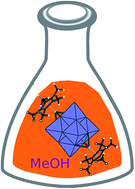
Sodium salts of hybrid organometallic POM complexes consisting of [M6O19]8− (M = Nb, Ta) and half-sandwich fragments {Cp*M}2+ (Cp* = η5-C5(CH3)5; M = Rh, Ir) and {(C6H6)Ru}2+ dissolve only in one organic solvent, that is, in methanol. From methanolic solutions, crystals of Na4[trans-{(C6H6)Ru}2Nb6O19]·14.125MeOH·2H2O (1), K4[trans-{Cp*Rh}2Nb6O19]·4MeOH·10H2O (2) and K4[trans-{Cp*Ir}2Nb6O19]·10MeOH·4H2O (3) were isolated and characterized by X-ray analysis. Methoxo species [{LM′}2M6O19−n(OCH3)n] (n = 1–3) were detected in solution by ESI-MS and NMR, and they account only for about half of the total speciation in the solution. DFT calculations were used to calculate 13C NMR chemical shifts in the methoxo complexes and to assess their relative stability. Reasons for the preferred solubility in methanol are discussed.
5 were prepared. The main reason of the strong bias in favor of choosing water as the solvent is the high charge of the polyniobates, which requires large numbers of counter cations, typically alkali metal cations. This leads to high lattice energies, which can be counterbalanced only by a solvent with a high dielectric constant and donor/acceptor number, preferably with water. Hydrogen bonds also play an important part in stabilizing the highly charged polyanions, and those are again best provided by water. Can hydrated alkali metal salts of highly charged polyoxometalates be dissolved and handled in organic solvents? One can expect that coordination of a positively charged organometallic moiety such as {Cp*M}2+ (M = Rh, Ir) or {(arene)Ru}2+ (arene is benzene and its derivatives) to [Nb6O19]8− would reduce the overall negative charge and simultaneously increase the hydrophobicity of the hybrid complex, thus enabling solubility in organic solvents. Indeed, Proust et al. reported that the neutral complex [{(p-cym)Ru}4Nb6O19] (p-cym = 1-methyl-4-(1-methylethyl)benzene) was soluble in CH3OH, and the negative ion mode electrospray mass spectrum of methanolic solutions detected formation of the methoxo complexes [{(p-cym)Ru}2Nb6O16(OCH3)3]− and [{(p-cym)Ru}3Nb6O18(OCH3)]−, arising from de-complexation of one or two {(p-cym)Ru}2+ fragments and formation of Nb–OCH3 bonds.6 This solvolitic behavior in methanol is strongly reminiscent of the reactivity of [Nb2W4O19]4− towards CH3OH, and of [P2W15V3O62]9− with CH3C(CH2OH)3.7,8 In the present study we found that sodium salts of [{(C6H6)Ru}2Nb6O19]4−, [{Cp*Rh}2Nb6O19]4− and [{Cp*Ir}2Nb6O19]4− were soluble in methanol, but not in ethanol or other organic solvents. Both the solvolysis of the anion and solvation of the alkali metal cation are the driving force in our case: the methoxo species [{LM′}2M6O19−n(OCH3)n] (n = 1–3) are detected by ESI-MS and NMR, and they account for about half of the total speciation of the hybrid complexes in methanol. From these solutions, crystals of Na4[{(C6H6)Ru}2Nb6O19]·14.125MeOH·2H2O (1), K4[trans-{Cp*Rh}2Nb6O19]·4MeOH·10H2O (2) and K4[trans-{Cp*Ir}2Nb6O19]·10MeOH·4H2O (3) were isolated in high yields, which bear no Nb–OCH3 groups, but show direct coordination of CH3OH to Na+ instead. These observations are presented and discussed in detail below.
:
1 Rh/M6 ratio in water yielded solids containing [(Cp*Rh)2M6O19]4− anions.
When their ESI (−) mass spectra were investigated using methanol as the solvent, signals attributed to methoxo species were readily identified on the basis of their m/z value as well as their isotopic distribution. In particular signals from the 2:1 species [{Cp*Rh}2Nb6O19H3]− (m/z 1340), [{Cp*Rh}2Nb6O18(OCH3)H2]− (m/z 1354), [{Cp*Rh}2Ta6O19H3]− (m/z 1868) and [{Cp*Rh}2Ta6O18(OCH3)H2]− (m/z 1882) were identified. Table S1† shows the m/z values for the methoxo species. Signals from the 1
:
1 adducts, namely [{Cp*Rh}Nb6O19H5]− (m/z 1104), [{Cp*Rh}Nb6O17(OCH3)2H3]− (m/z 1132), [{Cp*Rh}Nb6O18(OCH3)H4]− (m/z 1118), [{Cp*Rh}Ta6O18(OCH3)H3]2− (m/z 824), and [{Cp*Rh}Ta6O18(OCH3)H4]− (m/z 1646),9 were also observed in their respective ESI mass spectra in methanol. We also found that sodium salts of the 2
:
1 and 1
:
1 complexes Na4[{Cp*Ir}2Nb6O19]·22H2O and Na6[{Cp*Ir}Ta6O19]·27H2O were soluble in CH3OH, and signals from the corresponding anions as well as from their mono- and di-methylated derivatives [{Cp*Ir}2Nb6O18(OCH3)H]2− (m/z 765) and [{Cp*Ir}2Nb6O17(OCH3)H2]− (m/z 1532) were detected (see for example Fig. S1 and S2†) in these solutions.10 Methoxo complexes were also detected in the ESI-MS spectra of [{Cp*Ir}2TeNb5O19]3− and [{Cp*Ir}TeNb5O19]5−.11 This indicates the tendency of the Lindqvist POMs to form methoxo species upon dissolving in methanol.
Since in all cases formation of methylated hybrid anions was detected by ESI-MS experiments in freshly prepared methanolic solutions, it would appear that they rapidly form in solution in significant amounts, up to a certain equilibrium point between the starting oxo and methoxo species. However, we are aware that the large methanol excess employed for sample preparation for ESI-MS analysis (sample concentration ca. 5 × 10⁻⁵ M in CH3OH) might exaggerate the propensity of the oxo or hydroxo groups to be replaced by methoxo; in addition, the appearance of the signals due to the methoxo species may be due to secondary processes operative only in the gas phase under experimental conditions. Therefore we tried to isolate methoxo complexes directly from methanolic solutions and demonstrate their formation in solution by X-ray crystallography and NMR techniques, respectively.
The crystal structure of 1 consists of trans-[{(C6H6)Ru}2Nb6O19]4− hybrid anions and sodium cations, which aggregate into [(MeOH)3Na(μ-MeOH)Na(H2O) (MeOH)2]2+ dimers; hence the formula of 1 is better rendered as [(MeOH)3Na(μ-MeOH)Na(H2O)(MeOH)2]2[{(C6H6)Ru}2Nb6O19]·2.125MeOH. The cationic dimers unite the anions into a 3D framework (Fig. 1). This is the first example of breaking the standard layered structural motif common to all previously known hybrid complexes bearing two coordinated C6H6 or Cp* fragments.6,9 The formation of the 3D framework (the building block is represented in Fig. S3†) creates infinite channels running along the [010] and [100] crystallographic directions, which are filled with disordered methanol molecules (2.125 molecules per formula unit from XRD refinement) (Fig. S4†). The methanol molecules that are coordinated to the cations form strong hydrogen bonds with bridging oxo ligands (d(MeOH⋯μ2-O) is 2.645 and 2.701 Å) of the hybrid POM. Moreover, one solvate water molecule forms a weaker hydrogen bond with μ2-O (the H2O⋯O distance is 2.821 Å).
trans-K4[{Cp*Rh}2Nb6O19]·20H2O (ref. 9) and trans-K4[{Cp*Ir}2Nb6O19]·22H2O (ref. 10) also dissolve in methanol, but crystalline samples could not be obtained by straightforward evaporation of the solvent. In one of the crystallization attempts we added a few milligrams of dibenzo-18-crown-6 to the methanolic solutions, which then were left at 2 °C. Yellow single crystal plates were obtained in both cases, but curiously enough, no crown ether molecules entered the structure, the formulae of the products being trans-K4[{Cp*Rh}2Nb6O19]·4MeOH·10H2O (2) and trans-K4[trans-{Cp*Ir}2Nb6O19]·10MeOH·4H2O (3). Possibly the crown ether binds excess water, forming associates with strong hydrogen bonds, which remain in solution, but this hydration shifts the equilibrium and facilitates formation of 2 and 3. The two salts are obviously not isostructural, and 2 crystallizes in the P21/c space group while 3 adopts the P
group. This difference is due to the different values in the content of methanol and water molecules. However, whatever the differences are, in both structures the hybrid anions trans-[{Cp*M}2Nb6O19]4− are combined with the cationic part (there are infinite chains of the cations connected with the solvate methanol, water molecules and oxygen ligands of the anions, Fig. S5 and S6†) into the layers spreading along the [011] (M = Rh) or [110] (M = Ir) crystallographic directions (Fig. S7 and S8†). Both in 2 and 3 additional K+ cations coordinate free {Nb3O3} faces of the anions. In 2 such cations have CN 7 (with three oxo ligands from the anion face, three water molecules and one methanol, Fig. S9†), and in 3 K+ has CN 8 (three oxo ligands from the anion face, three water molecules and two methanol molecules, Fig. S10,† left). Methanol molecules, coordinated to the cations, form hydrogen bonds with POM both in 2 and 3. In 2 only the methanol molecules that are located in the positions near to the anion produce hydrogen bonds (d(Nb
O⋯HOCH3) is 2.761 Å) stronger than those in water molecules (d(Nb
O⋯H2O) is 2.900 Å) (Fig. S9†). This effect is more significant in the case of 3, which has more CH3OH molecules in the structure. All methanol molecules are oriented in a way to afford hydrogen bonding with the anion (d(O⋯O) is 2.717–2.748 Å) (Fig. S10,† right). Details of XRD experiments and refinement are summarized in Table S2.†
Qualitative experiments have shown that also Cs+ (Ta), K+ (Nb), and Na+ (Ta, Nb) salts for [{Cp*M}2M6O19]4− complexes (M = Rh, Ir), and K+ (Nb), and Na+ (Nb, Ta) salts for [{(C6H6)Ru}2M6O19]6− complexes are soluble in methanol. Attempts to get crystals from these solutions failed. The crystal packing of all starting materials consists of the layers formed by the hybrid anions and solvated cations which stack together only through π–π interactions between the aromatic rings of the organic ligands. Methanol can penetrate between such layers and replace water in the coordination spheres of the cations, while CH3CN or CH2Cl2 cannot do this.
Since free methanol gives a 13C NMR resonance at 49.5 ppm, these signals can be assigned to coordinated CH3O−. Indeed, Errington et al. reported (Bu4N)2[(MeO)NbW5O18] in CD3CN δCH3O at 65.91 ppm.12 Similar chemical shifts for various methoxy species were reported elsewhere.13 Karaliota et al. even discriminated between terminal Nb–OCH3 and bridging Nb–(μ-OCH3)–Nb modes, assuming δ 67 ppm for the bridging and 60–64 ppm for the terminal methoxy ligands for solutions of NbCl5 in methanol.14 Thus 13C NMR gives evidence for the formation of methoxo complexes in methanolic solutions of 2 and 3. In order to confirm this assignment we carried out DFT calculation of the 13C chemical shifts taking methylated isomers of [{Cp*Ir}2Nb6O18(OCH3)]3− as models, which yielded δCH3 60.6 ppm and 63.4 ppm for the terminal and bridging methoxide, respectively. These results show that the difference between the chemical shifts of the terminal and bridged methoxo ligands is meaningful and agrees with Karaliota’s assignment. According to 13C NMR, we have complexes with both terminal (upfield) and bridging (downfield) CH3O− ligands in solution. Three isomers are possible, as shown in Fig. 4. The formation of the new species in CH3OH solutions can be also deduced from new signals from Cp* which appear at 93.70 and 94.23 ppm as broad resonances, together with signals from the starting trans-[{Cp*Rh}2Nb6O19]4− at 92.91 and 92.68 ppm.
The methyl group proton (1H NMR) resonances which appear in solutions of NbCl5 in CH3OH fall in three series around the 4.5 ppm, 4.2–3.8 ppm, and 3.3 ppm regions, and are due to bridging methoxides, terminal methoxides, and to free methanol, respectively.14,15 1H NMR of 1 in MeOH gives δ = 3.530, 3.520, 3.504, 3.491, and 3.468 ppm for terminal coordination and δ = 4.284 ppm for bridging coordination, but in 13C NMR we observed only one signal at 61 ppm. For complex 2 1H NMR also shows formation of terminal MeO− species (δ = 3.67 ppm), but peaks from bridging ligands also appear at 4.53–4.55 ppm. The Cp* signals from trans-[{Cp*Rh}2Nb6O19]4− appear at 1.90 and 1.87 ppm, together with new signals at 1.92 and 1.94 ppm. The latter two signals can be assigned to the signals from Cp* groups in the CH3O− complexes. The signal intensity at 3.67 ppm is 5% of that of the two signals with δ = 1.90 and 1.87 ppm, hence the corresponding Cp* signal must have a 10-fold intensity, which in turn corresponds to that of the peak with δ = 1.92 ppm. In the same way, the integral intensity of the signals from the bridging CH3O group (from various isomers at 4.53–4.55 ppm) is only 1%, which correlates with the intensity of the Cp* peak at 1.94 ppm (10%). The total intensity of the Cp* signals from the methoxo complexes is 60% of that of trans-[{Cp*Rh}2Nb6O19]4− which indicates a high degree of methylation (37.5%), in qualitative agreement with the ESI data. A methanolic solution of 3 demonstrates signals from terminal (3.68 ppm) and bridging (4.35, 4.33, 4.32, 4.30, 4.29, and 4.26 ppm) groups. The signals from Cp* appear at 1.83 and 1.81 ppm (for trans-[{Cp*Ir}2Nb6O19]4−) and 1.85–1.87 ppm (for methylated POMs). The signal at 1.85 ppm can be assigned to the isomers with a terminal CH3O group (10% of the intensity of the Cp* groups from the starting trans-[{Cp*Ir}2Nb6O19]4−), and that of 1.87 ppm to the isomers with a bridging methoxide (100% of the intensity). This corresponds to the total methylation of ca. 53% of the starting complex. The formation of the new species in CH3OH solutions can be also deduced from new signals from Cp* which appear at 84.75 and 85.65 ppm as broad resonances, together with the signals from the starting trans-[{Cp*Ir}2Nb6O19]4− at 83.67 and 83.64 ppm. Observed signals in 1H NMR for all complexes are summarized in Table 1. Also both for Rh and Ir there is a signal at δ = 29.4 ppm (1H NMR δ = 3.37 ppm) which appears also in ref. 14, and was assigned by the authors of this work to CH3Cl. But we assign it as an acetone trace (30 ppm, http://nmrshiftdb.nmr.uni-koeln.de/).
The conclusion from this part of the work is that the formation of the methoxo complexes does take place in methanolic solutions and contributes to enhanced solubility of Na4[{(C6H6)Ru}2Nb6O19] and K4[{Cp*M}2Nb6O19] (M = Rh, Ir) in methanol as a result of specific solvolysis.
This means that the coordination of {Cp*Ir}2+ “polarizes” the Lindqvist structure in such a way that more negatively charged oxygen atoms belong to the face opposite to the {Cp*IrNb3O3} group. This perhaps explains preferential formation of the trans-isomers observed for the bicapped [{XM}2M6O19]4− species.9–11
Capping of [Nb6O19]8− with half-sandwich moieties also significantly increases the positive charge at the Nb atoms (by almost 0.2 e). This may lead to stabilization of an intermediate with CN 7, where a CH3OH molecule is coordinated to Nb; in fact there are examples of POMs with seven-coordinated Nb.16 Following this, we can envision proton transfer to one of the terminal or bridging oxides, followed by substitution of CH3O− for OH−. We have calculated total energies and Hirshfeld charges for various isomers of monomethylated trans-[{Cp*Ir}2Nb6O18(OCH3)]3−. The formation of a single possible terminal methoxo complex by methylation of one of the six equivalent terminal Nb
O groups (Fig. 4, isomer I) is slightly favored over the bridging isomer where methylation occurs at either of the six equivalent Nb–O–Nb groups (isomer II). The isomer with capping μ3-OCH3 (isomer III) is the least favored (Table S3†).
This is in agreement with Errington’s isolation of (Bu4N)2[(MeO)NbW5O18] with a terminal Nb–OCH3 group,12 but does not exclude the presence of methoxo-bridged isomers in equilibrium, as can be seen from the NMR spectra in our case.
To conclude, exclusive solubility of the hybrid organometallic–POM complexe salts with alkali metal cations in methanol is due to the formation of the methoxo complexes (as detected in solution) and solvation of Na+ and K+ (as is seen in the crystals of the solids which were isolated from such solutions), and hydrophobic interactions with Cp* and C6H6 moieties. This, prima facie, does not explain the lack of solubility in ethanol, which is a better donor (being more basic). But CH3OH strongly differs from C2H5OH in having a significantly larger value of the dielectric constant (ε), of 31 vs. 24.
Thus methanol is better suited for dismantling the crystal lattice of these ionic compounds due to a sufficiently high ε value. The packing in the crystals of hydrates such as trans-K4[{Cp*Rh}2Nb6O19]·20H2O (ref. 9) and trans-K4[{Cp*Ir}2Nb6O19]·22H2O (ref. 10) consists of the layers formed by hybrid anions and solvated cations which stack together only through π–π interactions between organic ligands. Methanol can penetrate between such layers and replace water in the coordination spheres of the cations.
:
water (50
:
50) in the mass range from m/z 50 to 3000. Sample solutions ca. 5 × 10⁻⁵ M in water or methanol were infused via a syringe pump directly connected to the ESI source at a flow rate of 10 μl min−1. The observed isotopic pattern of each compound perfectly matched the theoretical isotope pattern calculated from their elemental composition using the MassLynx 4.1 program.
A Hirshfeld population analysis was performed and NMR spectra obtained according to the corresponding modules of the ADF program.
DFT calculations were used for comparison of the 13C NMR shifts of different positions of methoxo ligands in the [{Cp*Ir}Nb6O18(OCH3)]5− backbone. Comparison of the energies of [{Cp*Ir}Nb6O18(μ-OCH3)]5− and [{Cp*Ir}Nb6O18(OCH3)]5− gives very close equal values suggesting that rapid exchange of the MeO− ligand between different positions can be very fast in the solution.
Footnote |
| † Electronic supplementary information (ESI) available: ESI-MS data, NMR data, crystal packing information, details of X-ray experiments and refinement. CCDC 1423580–1423582. For ESI and crystallographic data in CIF or other electronic format see DOI: 10.1039/c5ra23918d |
| This journal is © The Royal Society of Chemistry 2016 |