Lei Qinab,
Weiping Shiab,
Weifeng Liuac,
Yongzhen Yang*ac,
Xuguang Liu*ab and
Bingshe Xuac
aKey Laboratory of Interface Science and Engineering in Advanced Materials (Taiyuan University of Technology), Ministry of Education, Taiyuan 030024, China. E-mail: liuxuguang@tyut.edu.cn; yyztyut@126.com
bCollege of Chemistry and Chemical Engineering, Taiyuan University of Technology, Taiyuan 030024, China
cResearch Center of Advanced Materials Science and Technology, Taiyuan University of Technology, Taiyuan 030024, China
First published on 26th January 2016
Surface molecular imprinting is an effective measure to get adsorbent materials for definite substances. In this work, ordered mesoporous carbon nanospheres (OMCNS) were prepared as carriers by a hydrothermal method with phenolic resol as the carbon source and triblock copolymer Pluronic PF127 as the soft template. A surface molecularly imprinted polymer (SMIP/OMCNS) was then obtained through a series of functionalization, grafting and elution processes with dibenzothiophene (DBT) as a template, which was designed for the deep desulfurization of fuel products by removing DBT and its derivatives. By adopting OMCNS as a carrier, SMIP/OMCNS shows excellent adsorption capacity towards DBT (218.29 mg g−1), owing to the ordered mesoporous structure and high surface area of OMCNS. The better fitted pseudo-first-order model indicates that the adsorption involves mainly physical interactions, which are promoted by the mesoporous structure of OMCNS. The Langmuir and Freundlich models fitted better than the Dubinin–Radushkevich and Scatchard isothermal models did, which suggests the occurrence of both monolayer and multilayer interactions. The thermodynamics, selectivity and regenerability of SMIP/OMCNS were also investigated. The adsorption of DBT on SMIP/OMCNS proves to be an endothermic process. And the relative selectivity coefficients against benzothiophene, biphenyl and fluorine interferents reached 2.19, 2.29 and 2.37, respectively. As a result, SMIP/OMCNS can be a potential adsorbent material for deep desulfurization of fuel products and recovering DBT and its derivatives as valuable reagents for other value-added applications.
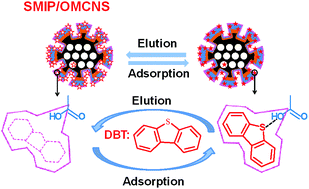
Surface molecular imprinting is an effective measure to get adsorbent materials selective for definite substance. With this measure, the surface molecularly imprinted polymer (SMIP) layer can be grafted on certain carriers and targeted for deep desulfurization.4 Because the specific molecular recognition sites are created during the grafting process, SMIP, as an advanced adsorbent, is then provided with unique advantages in selective adsorbing and removal of specific organic sulfur-containing compounds from fuels in the presence of other similar interferential compounds.5,6
The adsorption desulfuration with SMIP is considered as an attractive approach in comparison with other processes such as oxidation,7,8 HDS,9,10 extraction11,12 and biodesulfurization,13,14 owing to the easy operation and low cost. Especially, SMIP is effective for deep desulfurization without any detriment to the fuel quality, as it does not break the bonds and structures of the olefins and aromatic hydrocarbons in fuels besides the target DBT molecules.
By locating the imprinted sites on the carrier surface, SMIP is advantageous for easy elution, high selectivity, good accessibility and fast mass transfer, in comparison with traditional bulky imprinted materials. It is generally difficult to get bulky imprinted polymers in uniform particles15 and their rigid structure also makes the extraction or adsorption of templates difficult through the thick cross-linked polymeric layer.16
The nature of a carrier is crucial to get an SMIP with demanded properties such as mono-dispersion, homogeneity, uniform orientation and excellent mechanical, chemical and thermal stabilities. Nowadays, multitudinous materials including Al2O3,9 TiO2,17,18 K2Ti6O13,19 CdS, ZnS quantum dots, SiO2,20 silica gel,21 carbon-microspheres,22,23 carbon nanotubes24,25 and graphene26 have been used as the carriers for SMIP. Among them, porous carbon materials, especially ordered mesoporous carbon nanosphere (OMCNS), are supposed to be ideal carrier for preparing SMIP, because of their high porosity, high surface area, low density, high mechanical stability, large pore volume, easy functionalization, high mechanical and thermal stability, as well as good biocompatibility.27,28 The open-framework, ordered mesoporous structure and nanosized particles of OMCNS make it widely applicable in adsorption and separation,29 controllable drugs release,30 electrochemical energy storage,31 and catalysis.32
In this work, OMCNS was prepared by hydrothermal method with phenolic resol as carbon source and triblock copolymer Pluronic PF127 as soft template. Designed for the deep desulfurization of fuel products by removing DBT and its derivatives and collecting them as valuable chemicals, the corresponding surface molecularly imprinted polymer (SMIP/OMCNS) was then obtained through a series of functionalization, grafting and elution processes with OMCNS as carrier and dibenzothiophene (DBT) as template. The adsorption kinetics, thermodynamics, selectivity and regenerability of SMIP/OMCNS were investigated by gas chromatography (GC). The synergistic effect between SMIP and OMCNS on the excellent performance of SMIP/OMCNS in selective adsorption of DBT was then elucidated.
600, PEO106PPO70PEO106, SIGMA-Aldrich) dissolved in 15 mL of H2O was added and the mixture was stirred at 66 °C for 2 h, followed by the addition of 50 mL of H2O to dilute the solution, leaving the mixture reaction for another 17 h. After that, the reaction kettle filled with 10 mL of the resultant solution and 30 mL of H2O was heated at 130 °C for 24 h. The products were collected after centrifugation and washed with deionized water for several times and dried at room temperature. At last, OMCNS was obtained by carbonization and removal of PF127 at 700 °C in nitrogen atmosphere for 3 h.
C– bridge for subsequent MAA grafting. Typically, 0.3 g of OMCNS, 1 mL of KH570 and 60 mL of mixed solvent (C2H5OH/H2O, 3
:
1 by volume) were added into a three-neck flask; the pH value was modified to 5 by acetic acid. The mixture was stirred at 65 °C for 2 h and the products were filtered and washed with ethanol, and then dried at 50 °C overnight, to get KH570 grafted OMCNS (KH570/OMCNS).After that, 0.2 g of KH570/OMCNS, 20 mL of H2O, 0.105 g of (NH4)2S2O8 and 1 mL of functional monomer methacrylic acid (MAA, 99%) were sufficiently mixed in a three-neck flask and stirred under nitrogen atmosphere at 80 °C for 24 h. The products were filtered and washed with ethanol, and then dried at 50 °C overnight, to obtain polymethacrylic acid (PMAA) grafted KH570/OMCNS (PMAA/OMCNS). Grafting of functional monomer is the key step of SMIP preparation. Since certain intermolecular interactions exist between functional monomer and template molecule, the adsorption of SMIP largely depends on the template–monomer complex interactions. For the template molecule DBT, MAA is a favourable monomer according to our previous work.33,34 The complex DBT–MAA processes a certain degree of binding energy to guarantee the ability of corresponding SMIPs for the identification and adsorption of DBT.
After MAA grafting and template pre-assembling, the crosslinking agent EDMA is needed to form a reticularly structured polymer layer to fix the DBT–MAA complex sites. Thus 0.1 g of PMAA/OMCNS, 0.1843 g of DBT and 10 mL of chloroform were sufficiently mixed and stirred for 0.5 h at 25 °C to pre-assemble DBT with PMAA/OMCNS. Then 4 mL of ethylene glycol dimethacrylate (EDMA, 98%) as cross-linking agent was added under continuous stirring; the mixture was heated to 50 °C and held at this temperature for another 10 h.
Finally, the product was washed successively with methanol/acetic acid (9
:
1, by volume) to remove DBT, until no DBT could be detected in the eluent by GC analysis. Finally, SMIP/OMCNS was obtained by drying the collected product overnight at 50 °C.
For comparison, the non-imprinted polymer carried on OMCNS, denoted as NIP/OMCNS, was prepared via the same procedures without adding DBT as template.
According to values of C0 and Ct, the adsorption capacities (Q, mg g−1) at given times (t) can be calculated by eqn (1):
| Q = MV(C0 − Ct)/m | (1) |
| Qe = MV(C0 − Ce)/m | (2) |
:
1, by volume) with a suction filter to completely elute DBT. The regenerated SMIP/OMCNS was obtained by suction filtering and washing thoroughly with ethanol and H2O after completely removing residual methanol and acetic acid. The changes of DBT concentrations in filtrate with the dosage of methanol/acetic acid were analyzed by GC. In addition, the recovered SMIP/OMCNS adsorbent was then reused for the subsequent adsorption tests. To test the recyclability of SMIP/OMCNS adsorbent, the adsorption–desorption cycles were repeated for 6 cycles under the same conditions.
In comparison with OMCNS, however, SMIP/OMCNS exhibits rougher surfaces; larger particles and certain degree of agglomeration owing to the coating of imprinted polymer layer. The sizes of OMCNS and SMIP/OCNS are statistically analyzed as 139.02 and 156.89 nm, respectively from the FESEM images according to Fig. 3(a). The diameter increased 17.87 nm from OMCNS to SMIP/OMCNS. And the overall thickness of the polymer layer is 8.94 around. Besides, the ordered porous structure can be clearly observed in the TEM images of SMIP/OMCNS. And the size distributions of OMCNS and SMIP/OMCNS indicate that the average pore sizes of OMCNS and SMIP/OMCNS are 3.08 and 2.01 nm, respectively according to Fig. 3(b).
![]() | ||
| Fig. 3 (a) Particle size distributions of OMCNS and SMIP/OMCNS and (b) pore size distributions of OMCNS, SMIP/OMCNS and regenerated SMIP/OMCNS. | ||
The textural properties of OMCNS, SMIP/OMCNS, saturated SMIP/OMCNS and regenerated SMIP/OMCNS are summarized in Table 1. After imprinting, SMIP/OMCNS has a lower surface area (327.61 m2 g−1) than the OMCNS carrier (488.02 m2 g−1). Meanwhile, the total pore volume and average pore size of SMIP/OMCNS are also decreased after imprinting. The coating of imprinted polymer layer leads to a moderate increase in particle size, but a decrease in specific surface area and pore volume and diameter, indicating that the mesoporous structure of OMCNS carrier has been effectively used in the preparation of SMIP/OMCNS. However, the mesoporous structures of OMCNS would prevent the whole surface of OMCNS to be covered with polymer layer completely. The thicknesses of polymer layer could not be all the same on all parts of SMIP/OMCNS since it can be speculated that the thickness of polymer layer on the inner walls of pores could be thinner than that on the surrounding areas of pores. Thus, the surface area of OMCNS still plays a role in dictating the overall surface area of SMIP/OMCNS.
| Adsorbent | S (m2 g−1) | Vpore (cm3 g−1) | dpore (nm) |
|---|---|---|---|
| a Note: The surface area (S) was calculated by the multipoint BET model from nitrogen adsorption data; the pore volume (Vpore) was calculated by the V–t plot method; and the pore diameter (dpore) was determined by the BJH model from the desorption branches of the isotherms. OMCNS was preprocessed at 300 °C while SMIP/OMCNS, saturated SMIP/OMCNS and regenerated SMIP/OMCNS were preprocessed at 100 °C by considering their thermal stabilities. | |||
| OMCNS | 488.02 | 0.193 | 3.08 |
| SMIP/OMCNS | 327.61 | 0.079 | 2.01 |
| Saturated SMIP/OMCNS | 290.32 | 0.041 | 2.00 |
| Regenerated SMIP/OMCNS | 390.58 | 0.068 | 2.01 |
Moreover, after fully adsorbing DBT, the saturated SMIP/OMCNS shows even smaller surface area, total pore volume and average pore size since the imprinting cavities are loaded with DBT. On the other hand, according to the data of regenerated SMIP/OMCNS, the pore structures can be well recovered by removing the DBT with methanol/acetic acid (9
:
1, by volume) solution.
The FT-IR spectra of OMCNS, SMIP/OMCNS and the intermediates during molecular imprinting are shown in Fig. 4(a). A large amount of oxygen-containing functional groups are distributed on their surface. The bands at 3435 and 1631 cm−1 are ascribed to –OH and –C
O stretching vibration, respectively. From OMCNS to SMIP/OMCNS, no new bands are found, indicating no new functional groups are introduced. It should be noted that KH570/OMCNS exhibits much stronger bands for the oxygen-containing functional groups than OMCNS owing to the grafting of KH570.35 As a result of the graft copolymerization of MAA, however, these absorption bands become weaker for PMMM/OMCNS, SMIP/OMCNS, and NIP/OMCNS.
![]() | ||
| Fig. 4 (a) FT-IR spectra of the adsorbent products at different steps; (b) TG curves of the adsorbent products at different steps (N2, 10 K min−1). | ||
The TG curves of OMCNS, SMIP/OMCNS and the intermediates during preparation upon heating in N2 from 100 to 800 °C are illustrated in Fig. 4(b) for the purpose of finding the amount of each reagent (KH570, MAA and EDMA) that is grafted on. After annealing, OMCNS exhibits excellent thermal stability with a weight loss of 1.5% till 800 °C. The total weight loss of KH570/OMCNS is around 4.6% till 800 °C, which is caused by the decomposition of KH570 at 350–500 °C. And the total weight loss of PMAA/OMCNS is around 8.9% till 800 °C, which is caused by the weight losing of KH570 and PMAA at 350–500 °C and 150–350 °C, respectively. Correspondingly, the weight loss of SMIP/OMCNS upon heating till 800 °C is 12.1%, a little less than that of NIP/OMCNS (13.3%).
PMAA grafting is the most significant step for the preparation of SMIP/OMCNS, through which the functional groups for DBT recognizing and capturing are introduced. As a result, the degree of PMAA grafting (Dg) is an indicator for the adsorption ability towards DBT,22 which is defined as
| Dg = (Wlater − Wformer)/Wformer × 100% | (3) |
![]() | ||
| Fig. 5 Kinetic adsorption curves of DBT dissolved in n-hexane solution on SMIP/OMCNS, NIP/OMCNS and OMCNS. | ||
As expected, SMIP/OMCNS exhibits a much higher saturated DBT adsorption capacity (218.29 mg g−1) than both NIP/OMCNS (95.07 mg g−1) and OMCNS (68.22 mg g−1) at 298 K. SMIP/OMCNS and NIP/OMCNS are covered with polymer layers on their surface, which may improve their adsorption abilities. However, only SMIP/OMCNS is provided with imprinted polymer layer with specially designed recognition sites and cavities, which brings the specific binding with DBT molecule by electrostatic interaction, hydrogen bonds and shape selection. In comparison, the polymer layer on NIP/OMCNS does not have suitable imprinted cavities and recognition sites, giving NIP/OMCNS a much lower adsorption capacity towards DBT. The adsorption superiority of SMIP/OMCNS over NIP/OMCNS can be intuitively described with an imprint factor (fimp),36
| fimp = Qe(SMIP)/Qe(NIP) | (4) |
Furthermore, the adsorption profiles are also fitted with pseudo-first-order (eqn (5)) and pseudo-second-order (eqn (6)) kinetic models,36,37
ln(Qe − Qt) = ln Qe − k1t/2.323
| (5) |
| t/Qt = 1/(k2Qe2) + t/Qe | (6) |
The fitting results are summarized in Table 2. By viewing from the value of R2, the pseudo-first-order model fits better than the pseudo-second-order one. It is then speculated that the adsorption involves mainly physical interaction between DBT and the adsorbent. Besides, there are no new chemical bonds formed or destructed during the adsorption process and the adsorption rate and equilibrium time are not significantly affected by the temperature, which also suggests that the adsorption process of DBT on the surface of SMIP/OMCNS can be judged as a physical adsorption process. However, the excellent adsorption ability of SMIP/OMCNS beyond that of OMCNS comes from the imprinted polymer layer, on which are distributed many imprinted cavities that are tailored for DBT. The size and shape of cavities are matching with DBT. Besides, the functional monomers in these cavities provide some non-covalent interactions with DBT, such as ionic bonds, hydrogen bonds, electrostatic interaction and van der Waals force. Although the binding energies of non-covalent bonds are relatively small, multiple non-covalent bonds and multiple interaction sites working together can be strong enough to interact with DBT.5,33 Along with the shape selectivity of the cavities towards DBT SMIP/OMCNS process much more excellent identity adsorption capacity than OMCNS does.
| Adsorbent | T (K) | Qe,exp (mg g−1) | Pseudo-first-order | Pseudo-second-order | ||||
|---|---|---|---|---|---|---|---|---|
| Qe,cal (mg g−1) | k1 (min−1) | R2 | Qe,cal (mg g−1) | k2 (g mg−1 min−1) | R2 | |||
| NIP/OMCNS | 298 | 95.07 | 94.63 | 0.1225 | 0.9913 | 98.70 | 0.00187 | 0.9889 |
| SMIP/OMCNS | 298 | 218.29 | 216.78 | 0.0856 | 0.9970 | 232.75 | 0.00041 | 0.9896 |
| 308 | 227.55 | 225.62 | 0.0905 | 0.9972 | 239.52 | 0.00043 | 0.9900 | |
| 318 | 238.98 | 237.49 | 0.0983 | 0.9976 | 252.09 | 0.00045 | 0.9872 | |
| Ce/Qe = Ce/Qm + 1/(QmkL) | (7) |
ln Qe = ln Ce/n + ln kF
| (8) |
ln Qe = ln Qm − βε2
| (9) |
| Qe/Ce = kSb − Qeb | (10) |
ε = RT ln(1 + 1/Ce)
| (11) |
The nonlinear regressions of Langmuir and Freundlich isotherm models for the adsorption of DBT on SMIP/OMCNS are illustrated in Fig. 6 since these two models fit better with the experimental results. All the isotherm curves at various temperatures show similar tendency; the adsorption amount increases rapidly with the DBT concentration at low concentration and levels off at high concentration.
![]() | ||
| Fig. 6 Adsorption isotherms of DBT dissolved in n-hexane solution on SMIP/OMCNS at different temperatures. | ||
As summarized in Table 3, the values of Freundlich constant n are all larger than 1, representing a favourable adsorption. By viewing from the correlation coefficient R2, both Langmuir and Freundlich models are fairly good in fitting the adsorption data. In fact, both models have some limitations in describing the adsorption processes on SMIP/OMCNS over a wide range of DBT concentration, even though they are widely used.23 Langmuir model is used to describe the monolayer adsorption with only one kind of binding site, whereas Freundlich equation is usually used to describe the multilayer adsorption and thus fits some poorly near the saturated portion. The Dubinin–Radushkevich isotherm is used to estimate the porosity of adsorbent. The lower R2 values for Dubinin–Radushkevich fittings can be ascribed to the porous adsorption occurred on SMIP/OMCNS. At the same time, the Scatchard plot, known as independent site-oriented model, helps to evaluate the adsorption. The lower R2 values for Scatchard model fitting indicate a heterogeneous surface of SMIP/OMCNS and various types of active sites involved in the adsorption process. Taking all these factors into consideration, leads to the speculation that the adsorption of DBT on SMIP/OMCNS may be an integration of monolayer and multilayer adsorption, as the imprinted layer generally presents certain heterogeneity. Some porous adsorption also takes place during the adsorption process.
| T (K) | Langmuir | Freundlich | ||||
|---|---|---|---|---|---|---|
| Qm (mg g−1) | kL (L mmol−1) | R2 | n | kF | R2 | |
| 298 | 231.48 | 7.794 | 0.9702 | 6.238 | 191.4 | 0.9781 |
| 308 | 237.53 | 14.403 | 0.9731 | 8.077 | 208.4 | 0.9718 |
| 318 | 250.63 | 15.465 | 0.9751 | 7.830 | 220.3 | 0.9708 |
| T (K) | Dubinin–Radushkevich | Scatchard | ||||
|---|---|---|---|---|---|---|
| Qm (mg g−1) | β (mol2 kJ−2) | R2 | kS (mg g−1) | b (mmol L−1) | R2 | |
| 298 | 223.60 | 0.0237 | 0.9336 | 234.08 | 7.253 | 0.9401 |
| 308 | 255.12 | 0.0134 | 0.9519 | 238.89 | 13.624 | 0.9484 |
| 318 | 246.29 | 0.0120 | 0.9557 | 252.03 | 14.628 | 0.9483 |
ΔGθ = −RT ln Kc
| (12) |
ln Kc = −ΔHθ/(RT) + const
| (13) |
| ΔSθ = (ΔHθ − ΔGθ)/T | (14) |
As given in Table 4, the negative value of ΔGθ and positive value of ΔSθ suggest that the adsorption of DBT on SMIP/OMCNS takes place spontaneously. The absolute value of ΔGθ is lower than 20, which confirms that the overall adsorption process is dominated by physical interaction, in accordant with the adsorption kinetic analysis. Moreover, the adsorption is an endothermic process with a positive ΔHθ, in accordant with above adsorption isotherm analysis.
| T (K) | Kc (mg L g−1 mmol−1) | ΔGθ (kJ mol−1) | ΔHθ (kJ mol−1) | ΔSθ (kJ mol−1 K−1) |
|---|---|---|---|---|
| 298 | 159.60 | −12.57 | 0.0422 | |
| 308 | 177.19 | −13.26 | 7.39 | 0.0431 |
| 318 | 184.37 | −13.79 | 0.0434 |
The endothermic feature can also be considered as an evidence to prove that physical interactions predominate in the overall adsorption process, because previous theoretical calculations pointed out that the chemical interaction between DBT and functional monomer MAA is exothermic. Like most solid–solute interface adsorptions ever reported, the adsorption capacity can be promoted by rising the temperature.41,42 On one hand, the mass transfer, pore diffusion and orientation adjustment of DBT towards the imprinted sites can be accelerated by rising temperature; on the other hand, the solvent influence is weakened under real adsorption conditions.43 As a whole, the adsorption of DBT on SMIP/OMCNS presents as an endothermic process.
![]() | ||
| Fig. 7 Adsorption selectivity of SMIP/OMCNS towards DBT against BT, biphenyl and fluorene interferents. | ||
The adsorption capacity of SMIP/OMCNS towards DBT is much larger than that towards other similar molecules, because the imprinted cavities are just tailor-made for DBT and do not match with other three analogical interferents in shape, size and spatial arrangement.22,26 Noteworthily, SMIP/OMCNS exhibits much higher adsorption capacity and better selectivity towards DBT than NIP/OMCNS, as the later does not have the DBT imprinted polymer layer. As to OMCNS, it shows no selectivity towards DBT in the same mixed solution. The adsorption amounts towards DBT, BT, biphenyl and fluorine are almost same since only nonselective porous adsorption occurs on the OMCNS. Besides, the lack of loosen polymer layer on the surface of OMCNS causes the relatively low adsorption amounts of each molecule.
Three interferents are also different in their molecular structure and interaction with the adsorbent. BT molecule with a smaller size may enter and leave the cavities more easily, but its mismatched spatial shape and higher energy gap give it less opportunity to be sited in the DBT imprinted cavities.44 On the other hand, although biphenyl and fluorene are dimensionally close to DBT, the lack of specific interaction sites and relatively larger steric hindrance also make them harder to be adsorbed on SMIP/OMCNS. All these results suggest that SMIP/OMCNS is able to identify and adsorb DBT selectively; the selective adsorption ability can be described by the relative selectivity coefficient (K and K′), following eqn (15)–(17),17,23
| Kd = Qe/(MCe) | (15) |
| K = Kd(DBT)/Kd(interferent) | (16) |
| K′ = K(SMIP)/K(NIP) | (17) |
As given in Table 5, the relative selectivity coefficients (K′) of SMIP/OMCNS towards DBT against BT, biphenyl and fluorene are 2.19, 2.29 and 2.37, respectively. It illustrates that SMIP/OMCNS has a stronger adsorption affinity and selectivity towards DBT with respect to NIP/OMCNS, owing to the matched binding sites and cavity size with DBT in SMIP/OMCNS. Meanwhile, the distribution coefficient (Kd) of SMIP/OMCNS towards DBT is much greater than those towards the BT, biphenyl or fluorene interferents.
| Adsorbate | SMIP/OMCNS | NIP/OMCNS | K′ | ||||
|---|---|---|---|---|---|---|---|
| Qe (mg g−1) | Kd (L g−1) | K | Qe (mg g−1) | Kd (L g−1) | K | ||
| DBT | 131.24 | 0.3113 | — | 62.35 | 0.1271 | — | — |
| BT | 54.60 | 0.1569 | 1.98 | 49.48 | 0.1401 | 0.91 | 2.19 |
| Biphenyl | 61.72 | 0.1540 | 2.02 | 58.24 | 0.1440 | 0.88 | 2.29 |
| Fluorene | 58.33 | 0.1325 | 2.35 | 56.73 | 0.1284 | 0.99 | 2.37 |
:
1, by volume). The regenerated SMIP/OMCNS processes higher values of S, Vpore and dpore than saturatedly adsorbed SMIP/OMCNS. Furthermore, these values are similar with corresponding values of as-prepared SMIP/OMCNS, which indicates the good stability and recyclability of SMIP/OMCNS.
According to the adsorption experiments, the saturated adsorption capacity of SMIP/OMCNS is 218.29 mg g−1. Thus, the total content of DBT on 50 mg of saturatedly adsorbed SMIP/OMCNS is around 10.91 mg. The changes of DBT concentrations in filtrate with the dosage of methanol/acetic acid were analyzed by GC as shown in Fig. 8(a), the amount of DBT in 100 mL of filtrate is 7.49 mg and the value increases with the dosage of methanol/acetic acid. The amount of DBT in 1000 mL of filtrate reaches 9.93 mg, which means that 91% of DBT can be recovered from SMIP/OMCNS.
![]() | ||
| Fig. 8 (a) Recovery efficiency of DBT in methanol/acetic acid mixture and (b) the recyclability of SMIP/OMCNS for DBT adsorption. | ||
The spent SMIP/OMCNS adsorbent can be effectively regenerated through washing with methanol/acetic acid. As illustrated in Fig. 8(b), the adsorption capacity of SMIP/OMCNS towards DBT declines only about 12.53% after six cycles. The slight drop in adsorption ability may be attributed to the low density and strength of mesoporous OMCNS. However, the binding and release ability of SMIP/OMCNS for DBT remains almost unchanged, meaning that the identification ability and specific memory effect towards DBT are maintained. As a result, SMIP/OMCNS can be considered as a regenerable desulfurization adsorbent with excellent structural stability.
The adsorption kinetics, thermodynamic, selectivity and recyclability of the SMIP/OMCNS adsorbent towards DBT were then investigated. The results demonstrate that SMIP/OMCNS is provided with outstanding adsorption capacity towards DBT (218.29 mg g−1, 298 K), in comparison with those previously reported. The adsorption of DBT on SMIP/OMCNS is an endothermic process involving monolayer and multilayer physical interaction. Some porous adsorption also takes place during the adsorption process. Moreover, SMIP/OMCNS is able to recognize DBT selectively for adsorption against the interferents with similar structures; the relative selectivity coefficients of SMIP/OMCNS towards DBT against BT, biphenyl and fluorene reach 2.19, 2.29 and 2.37, respectively. The spent SMIP/OMCNS adsorbent can be effectively regenerated through washing with methanol/acetic acid; the adsorption capacity of SMIP/OMCNS towards DBT declines only slightly after six adsorption–regeneration cycles. All these suggest that SMIP/OMCNS obtained in this work can be a potential adsorbent material for deep desulfurization of fuel products and recovering of DBT and its derivatives as valuable reagents for chemical synthesis.
| This journal is © The Royal Society of Chemistry 2016 |