
Chenwu Yue
,
Jian Feng*,
Junzong Feng and
Yonggang Jiang
Science and Technology on Advanced Ceramic Fibers and Composites Laboratory, National University of Defense Technology, Changsha 410073, China. E-mail: fengj@nudt.edu.cn; Fax: +86 0731 84576578; Tel: +86 0731 84576291
First published on 11th January 2016
Aerogels such as SiO2 aerogels, Al2O3 aerogels and carbon aerogels have been widely used in thermal insulation. However, graphene aerogels (or reduced graphene oxide aerogels), which have similar structures, have never been used in this field. In this paper, the concept of suppressing the thermal conductivities of graphene aerogels by introducing defects or doping atoms in graphene was introduced. Nitrogen-doped (N-doped) graphene aerogels with low thermal conductivity were prepared with paraphenylene diamine as a bridging and doping agent by CO2 supercritical drying. With the introduction of doping atoms and the bridging agent, the solid thermal conductivity is depressed. Also, with CO2 supercritical drying, the pore size is reduced, and the gaseous thermal conductivity is suppressed. The lowest thermal conductivity of N-doped graphene aerogels is 0.023 W (m−1 K−1), which is nearly 1/2 of the lowest reported value and even lower than that of static air. Meanwhile, the thermal insulation mechanisms were also studied. The low thermal conductivity and low bulk density make N-doped graphene aerogels a potentially useful thermal insulation material that may significantly lighten thermal insulation systems.
Graphene is a single atomic layer of sp2 carbon atoms.7,8 Since it was first obtained by mechanical exfoliation,6 it has received considerable attention duce to its excellent electrical,9 thermal,10 optical11 and mechanical12 properties. Its measured values of thermal conductivity at room temperature for suspended samples are as high as 2500–5300 W (m−1 K−1).13,14
However, defects and doping atoms in graphene may significantly impact its thermal conductivity.15,16 Several groups have studied the effects of different kinds of defects (vacancies17–19 and doping20,21) on its thermal conductivity by computer simulation using the force-constant method,22 molecular dynamics23 and Green's function method.17 These studies revealed that the thermal conductivity of graphene sharply decreases with increasing amount of defects or doping atoms. Taking the fact that the thermal conductivity of graphene oxide (3.19 W (m−1 K−1)) is much lower than that of graphene (5300 W (m−1 K−1)) into consideration, the thermal conductivity of graphene can be decreased by introducing a large amount of defects or doping atoms.
Zhong24 reported the thermal conductivities of graphene aerogels (reduced graphene oxide (rGO) aerogels) prepared by hydrothermal reduction and freeze-drying for the first time. The thermal conductivity measured using the laser flash technique is as high as 2.183 W (m−1 K−1). The bulk density and surface area are 227 mg cm−3 and 43 m2 g−1, respectively. Fan25,26 studied the effects of thermal treatment on the thermal conductivities of graphene aerogels (rGO aerogels) using infrared microscopy. The aerogels were prepared by CO2 supercritical drying, which reduces their pore size and hence decreases the gaseous thermal conductivity. However, the thermal conductivities of the graphene aerogels before and after thermal treatment at 450 °C for 5 h are still 0.12–0.36 W (m−1 K−1) and 0.18–0.31 W (m−1 K−1), respectively, and the corresponding bulk densities are 14.1–52.4 mg cm−3 and 16.4–49.0 mg cm−3, respectively. Tang27 synthesized graphene aerogels (rGO aerogels) with paraphenylene diamine (PPD) as a reducing and functionalizing agent in the presence of ammonia (NH3·H2O) by freeze-drying and characterized their thermal conductivities using a Hot Disk Techmax TPS1500 thermal meter. The thermal conductivity ranges from 0.040–0.053 W (m−1 K−1) for bulk densities in the range of 1.8 to 27.2 mg cm−3. Due to the use of freeze-drying, the pore size of the aerogels is relatively large. Thus, the thermal conductivity can be further depressed by reducing the pore size.
In this paper, the concept of decreasing the thermal conductivities of graphene aerogels by introducing defects and/or doping atoms to graphene was introduced. By introducing doping atoms together with reducing the pore size by drying with supercritical CO2, N-doped graphene aerogels with low thermal conductivity were obtained. These aerogels are potentially useful in thermal insulation due to their low thermal conductivity and low bulk density.
![]() | ||
| Fig. 1 (a) Broad XPS spectra, (b) C 1s spectra, (c) N 1s spectra and (d) O 1s spectra of as-prepared N-doped graphene aerogels. | ||
| Element | C | O | N |
| Content (at%) | 76.68 | 9.98 | 13.34 |
However, in contrast to freeze drying, the porous network is fully preserved after CO2 supercritical drying. Fig. 2 shows SEM micrographs of the as-prepared N-doped graphene aerogels. As shown in the images, the N-doped graphene sheets are randomly interconnected with each other, forming pores with sizes of several dozens or hundreds of nanometers. The pore size is much smaller than that of N-doped graphene aerogels prepared by freeze drying (Fig. 3). The microstructures of the as-prepared N-doped graphene aerogels are homogeneous to some extent.
The N2 adsorption–desorption isotherm and BJH pore size distribution of the as-prepared N-doped graphene aerogels with a bulk density of 34.5 mg cm−3 are shown in Fig. 4. The isotherm is a typical type III adsorption–desorption isotherm,28 revealing plenty of pores with sizes of more than 5 nm and a wide range of pore sizes. This result is consistent with the SEM results. Also, the adsorption capacity is large, reflecting the large pore volume. According to the BJH pore size distribution, most of the pore diameters are larger than 10 nm, with a maximum diameter of 49 nm. This further verifies the SEM results. The pore volume decreases as the pore diameter increases to 140 nm, but the number of pore with sizes exceeding 140 nm is still large. These pores cannot be studied by N2 adsorption–desorption but can be observed by SEM. According to the bulk densities of the as-prepared N-doped graphene aerogels (11.1–35.0 mg cm−3, Table 2), the pore volume may be 28–89 cm3 g−1, compared with 3.26–5.88 cm3 g−1 determined by the BJH method based on N2 adsorption–desorption isotherms.
![]() | ||
| Fig. 4 N2 adsorption–desorption isotherms (left) and BJH pore size distribution (right) of as-prepared N-doped graphene aerogels. | ||
| GO concentration (mg ml−1) | Bulk density (mg cm−3) | BET surface area (m2 g−1) | Pore volume (cm3 g−1) |
|---|---|---|---|
| 3 | 11.1 ± 0.7 | 568.7 | 3.26 |
| 6 | 19.9 ± 0.6 | 705.5 | 4.93 |
| 9 | 24.7 ± 1.1 | 802.4 | 4.90 |
| 12 | 34.5 ± 1.0 | 891.7 | 5.88 |
| 15 | 35.0 ± 1.1 | 751.7 | 4.15 |
At the same time, a shrinkage of 1–8% in sample diameter was observed with the variation of GO concentration during CO2 supercritical drying. This may be attributed to the surface tension during drying, although it is relatively weak due to most of the resolve in the gels have been replaced by the supercritical CO2. However, the shrinkage does not impact the structures and appearances of the as-prepared N-doped graphene aerogels, and cracks are not observed in the photograph (Fig. 5) or micrograph (Fig. 2).
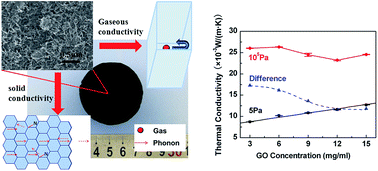
Fig. 6 shows the thermal conductivity of the as-prepared N-doped graphene aerogels with different GO concentrations. As the GO concentration increases from 3 to 12 mg ml−1, the thermal conductivity of the as-prepared N-doped graphene aerogels at room temperature (25 °C) and atmospheric pressure (105 Pa) decreases. However, when the GO concentration increases further to 15 mg ml−1, the thermal conductivity increases slightly. At a GO concentration of 12 mg ml−1, the thermal conductivity is only 0.023 W (m−1 K−1). The thermal conductivity at room temperature and 5 Pa shows a different trend. The thermal conductivity increases almost linearly with increasing GO concentration. Increasing the GO concentration increases the bulk density of the as-prepared N-doped graphene aerogels. This reinforces the junctures of graphene sheets and magnifies the solid content in the unit volume. Since graphene sheets are the carriers of heat, the solid thermal conductivity increases. As the radiant thermal conductivity at this temperature and the gaseous thermal conductivity at 5 Pa are both negligible, the thermal conductivity at room temperature and 5 Pa primarily consists of solid thermal conductivity. Thus, the thermal conductivity of the as-prepared N-doped graphene aerogels at 5 Pa increases with increasing GO concentration. In contrast, the difference between the thermal conductivity at atmospheric pressure and that at 5 Pa decreases. The difference matches very well with the inverse S-curve. The reason for this is that the difference is mainly attributed to gaseous thermal conductivity. The enhancement of bulk density caused by the increase in GO concentration decreases the pore size of as-prepared N-doped graphene aerogels (Fig. S11† and 2). Hence, the gaseous thermal conductivity was restrained to a greater extent. When the GO concentration is relatively low (<6 mg ml−1), the pore size is relatively large, and the gaseous thermal conductivity is not significantly restrained. Meanwhile, when the GO concentration is relatively high (>12 mg ml−1), the effect of the GO concentration on bulk density diminishes. Hence, the relationship between GO concentration and gaseous thermal conductivity is weaker. Thus, as the GO concentration increases, the difference (namely, gaseous thermal conductivity) shows an inverse S-curve. Logically, the linear increase in the thermal conductivity at 5 Pa and the nonlinear decrease in the difference (the gaseous thermal conductivity) induces the variation in the thermal conductivity of the as-prepared N-doped graphene aerogels at atmospheric pressure.
Compared with the values reported in previous works (Table 3), the thermal conductivity of the as-prepared N-doped graphene aerogels is significantly lower (almost half of the lowest value ever reported). This result may be attributed to four factors.
First, as reported by Fan et al.,26 the defects in graphene and the relatively small sizes of graphene sheets limit the transmission of heat and thus reduce the thermal conductivity of the as-prepared N-doped graphene aerogels to some extent.
Second, drying with supercritical CO2 sharply diminishes the pore size in as-prepared N-doped graphene aerogels. According to the computation using the BJH method based on the N2 adsorption–desorption curve, the pore size distribution centers on 49 nm. This is shorter than the mean free path of the molecule (∼70 nm3) at room temperature and atmospheric pressure and hence can obviously depress the gaseous thermal conductivity. The work of Feng et al.29 showed that the gaseous thermal conductivity will be critically suppressed only when the pore diameter is smaller than two-times of the molecule's mean free path (namely, 140 nm at room temperature and atmospheric pressure). Thus, the gaseous thermal conductivity is reduced. In addition, the two-dimensional structure of graphene sheets may effectively block the transfer of gas molecules in wall-like fashion compared to other aerogels (e.g., SiO2 aerogels, Al2O3 aerogels, and carbon aerogels) with three-dimensional open-cell network structures (Fig. 7). Hence, graphene aerogels can greatly suppress the gaseous heat transmission through gas molecular collisions. Through these two mechanisms, the gaseous thermal conductivity of the as-prepared N-doped graphene aerogels is significantly depressed.
![]() | ||
| Fig. 7 Schematic diagram of an aerogel with an open-cell network structure (left) and the as-prepared N-doped graphene aerogels (right). | ||
Third, the introduction of doping atoms transforms sp2 carbon atoms into sp3 carbon atoms, destroying the perfect π-electron conjugated structure and crystal structure, which makes up the main path of heat transmission through graphene. Phonons, the main carrier of heat delivery in graphene, transfer heat by lattice vibration. With the introduction of doping atoms, the crystal structure of doped graphene is divided into smaller pieces by sp3 carbon atoms (namely, carbon chemically linked with doping atoms (Fig. 1(b), the peaks at 285.4 and 286.1 eV)). The scattering of phonons by these obstacles together with the defects and edges can significantly diminish the amount of heat passing through the doped graphene (Fig. 8). Meanwhile, electrons also transfer heat in graphene via electron travelling. With the introduction of doping atoms, the intactness of the π-electron conjugated structure is broken, boosting the resistance of electron motion. As a result, the heat transferred through electron travelling is reduced. In this way, the solid thermal conductivity of as-prepared N-doped graphene aerogels is further decreased. Fig. 9 shows the thermal conductivity (5 Pa) of the as-prepared N-doped graphene aerogels (GO concentration = 12 mg ml−1) with different masses of PPD. When the mass of PPD is no more than 4.8 g, the thermal conductivity at 5 Pa decreases with increasing PPD mass. Since increasing PPD mass increases the amount of N doped into the sample, the as-prepared N-doped graphene aerogels with more PPD show better thermal insulation performances at 5 Pa.
![]() | ||
| Fig. 9 Thermal conductivity (5 Pa) of as-prepared N-doped graphene aerogels with different masses of PPD. | ||
Finally, PPD also acts like a bridging agent. It links doped graphene sheets with each other. With the introduction of a bridging agent, the heat transferred between the graphene is significantly limited. The bridging agent crucially restricts the heat flux in a bottleneck-like fashion. Therefore, the heat passing through the as-prepared N-doped graphene aerogels is reduced, and the solid thermal conductivity decreases. According to Fig. 9, the increase in thermal conductivity (5 Pa) at a PPD mass of 6.0 g illustrates the increase in the number of ‘bridges’ accelerating the heat transfer to some extent.
Due to the above four reasons, the thermal conductivity of the as-prepared N-doped graphene aerogels is low, even lower than that of static air (0.026 W (m−1 K−1)).30 The low thermal conductivity (0.023–0.026 W (m−1 K−1)) and low bulk density (11.1–35.0 mg cm−3) are crucially important for the use of N-doped graphene aerogels in thermal insulation. The use of this material may significantly lighten the weights of thermal insulation systems. Meanwhile, the gaseous thermal conductivity of N-doped graphene aerogels still makes up a large proportion of the thermal conductivity. This may be because the percentage of pores with relatively large sizes (>140 nm) is still considerable. Thus, the thermal conductivity of N-doped graphene aerogels may be further depressed by decreasing the pore size.
Footnote |
| † Electronic supplementary information (ESI) available. See DOI: 10.1039/c5ra23236h |
| This journal is © The Royal Society of Chemistry 2016 |