Modulated multiferroic properties of MnWO4 via chemical doping

J. Yanga, J. Chena, Y. Fang*a, Z. D. Hana, S. M. Yanb, B. Qiana, X. F. Jianga, D. H. Wangb and Y. W. Dub
aJiangsu Laboratory of Advanced Functional Materials, Department of Physics, Changshu Institute of Technology, Changshu 215500, China. E-mail: fangyong@cslg.cn
bNational Laboratory of Solid State Microstructures and Key Laboratory of Nanomaterials for Jiang Su Province, Nanjing University, Nanjing 210093, P. R. China

Received 11th October 2015 , Accepted 18th December 2015

First published on 22nd December 2015


Abstract

Here we prepare polycrystalline Mn1−xNixWO4 ceramics with x = 0, 0.02, 0.04, 0.06 for investigating their magnetic, ferroelectric, and multiferroic properties. The Ni2+-substitution gradually expands the lattice and modifies the magnetic performance with increasing x, resulting in a strong modulation of electric properties of those samples. For Mn0.96Ni0.04WO4, ferroelectric polarization is observed in the whole temperature regime below TAF2, and is well modified by an external magnetic field, which is discussed under the framework of a spin-current model in this manuscript.

1. Introduction

Magnetoelectric multiferroic materials, with the coexistence of magnetism and ferroelectricity, and their close coupling provide an extra degree of freedom in the design of data storage, sensors, and spintronic devices, and have been one of the hottest topics in condensed matter physics and materials science in recent years.1–3 Stimulated by such technological and fundamental aspects, extensive exploration of single-phase multiferroics with outstanding magnetoelectric coupling performance have emerged.4,5 Up to now, many intriguing intrinsic couplings have been observed in the so-called type-II multiferroics, in which ferroelectric polarization is induced by the non-centrosymmetric magnetic structure.6,7 There are mainly two mechanisms accounted for these spin-correlated ferroelectric polarizations. One is the inverse Dzyaloshinskii–Moriya (DM) interaction or spin-current model based on spin–orbit coupling, which can be applied to qualitatively understand the relationship between magnetism and ferroelectricity in those materials with noncollinear spin structure. The other is the exchange-striction mechanism generated by spin–lattice coupling associated with collinear, typically the up-up-down-down magnetic structure or E-type antiferromagnetic structure.8–11 With the purpose of deep understanding the microcosmic mechanism and optimizing the magnetoelectric coupling performance of type-II multiferroics, many efforts have been devoted to modifying their magnetic interaction through many approaches, due to the key role of spin ordering in determining the ferroelectric properties of these materials.12–15

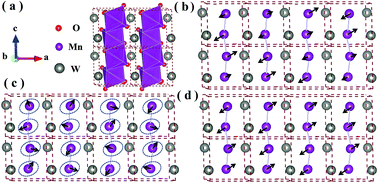
MnWO4, which crystallizes in a monoclinic structure with the space group P2/c and presents spin-driven ferroelectricity in the spiral magnetic structure, has been well studied, because of its complicated spin ordering established out of competition and subtle balance among complex multiple magnetic interactions.16–20 As shown in Fig. 1(a), this compound is constituted by the distorted MnO6 octahedral with two Mn2+ ions filled in-between, forming zigzag chains along the c axis. The W6+ ions, which are coordinated by corner-sharing MnO6 octahedral, stack alternately along the a axis. Within this crystalline structure, the magnetic interaction between Mn2+ and Mn2+ of MnWO4 can surprisingly sustain over the 11th neighbors, making the interaction competition very complicated. As a consequence, this compound undergoes three magnetic phase transitions: AF3, AF2, and AF1, upon decreasing the temperature.16–20 According to the previous results, the magnetic phase transition from paramagnetic state to AF3 phase, which is an incommensurate sinusoidal spin-density wave state with wave vector q3= (−0.214, 0.5, 0.457), takes place at about 13.5 K. In this AF3 phase, spins are collinear in the ac plane with an angle of about 35° with respect to the a axis, which is schematically plotted in Fig. 1(b). Further decrease of the temperature results in appearance of the AF2 phase at 12.6 K. As shown in Fig. 1(c), a finite spin component moment along the b axis develops, forming a helix spin structure, with the wave vector remains unchanged (q2 = q3). Finally, a transition to the commensurate magnetic structure (AF1) characterized by a frustrated up-up-down-down magnetic structure with wave vector q1= (±0.25, 0.5, 0.5) is found around 8 K. According to the inverse Dzyaloshinskii–Moriya interaction or spin-current model, ferroelectric polarization can be expected to exist in the spiral AF2 phase, in which the spin rotation axis doesn't parallel to the wave vector. Since the ferroelectric polarization of MnWO4 originates from AF2 magnetic phase, various approaches have been adopted to modulate the exchange interaction of magnetic ions in this compound, resulting in modification of its multiferroic properties.19–29 As reported, the magnetic easy axis of NiWO4 is found midway between the hard and easy axes of MnWO4, which is different from those of CoWO4 and FeWO4, indicating that Ni-dopant in this compound would modify its magnetic structure and ferroelectric properties from a disparate approach.30 Along this line, a series of Mn1−xNixWO4 (x = 0, 0.02, 0.04, 0.06) compounds were synthesized to investigate their magnetic, ferroelectric, and multiferroic properties in this letter.


image file: c5ra21079h-f1.tif
Fig. 1 Sketch of the lattice and magnetic structures of MnWO4; (a) the crystal structure of this compound; (b) the sinusoidal spin order in AF3 phase; (d) AF2 phase with a spiral magnetic structure; (c) magnetic structure in the AF1 phase with a frustrated up-up-down-down spin configuration.

2. Experimental details

Polycrystalline Mn1−xNixWO4 (x = 0, 0.02, 0.04, 0.06) were synthesized by the conventional solid state reaction. The high-purity MnO, NiO, and WO3 were chosen as raw materials and thoroughly ball-milled in stoichiometric ratio for 24 h, following by ground and fired at 873 K for 12 h in a muffle furnace. After grinding and sintering at 873 K for 12 h again, the powders were furnace cooled. The resultant products were pelletized and then sintered at 1223 K for 20 h in air with intermediate grindings. The X-ray diffraction (XRD) using Cu kα radiation was performed at room temperature to check the phase purity and crystallinity of these samples, following by structural refinement using the general structure analysis system (GSAS) program. To obtain magnetic data, the superconducting quantum interference device (MPMS, Quantum Design) was applied to characterize the temperature-dependent magnetization in zero-field mode. With Au electrodes spurted on both sides of the samples, the ferroelectric polarization was measured by the physical property measurement system (PPMS, Quantum Design) using pyroelectric current method. Before measurement, the sample was first poled in an electric field, E = 667 kV m−1, with the temperature decreasing from 20 to 2 K. Then, the pyroelectric current was collected with an electrometer (6514 A, Keithley) during the warming process at a rate of 3 K min−1, after short-circuiting for a long-enough time to maintain the zero-charge state. Details of the measurement can be found in earlier reports. Electric polarization was obtained by integrating pyroelectric current with respect to time plus a careful exclusion of other possible contributions other than the pyroelectric current.

3. Results and discussion

3.1. Structural characterization

Fig. 2(a) shows the XRD θ–2θ patterns of all the as-prepared samples, in which all the reflections can be indexed with a single monoclinic structure (space group P2/c) and no identifiable second phase is observed within the apparatus resolution. The sharp diffraction peak indicates the high crystalline quality of these samples. To obtain the detailed structural parameter of Mn1−xNixWO4 (x = 0, 0.02, 0.04, 0.06), Rietveld refinement of the XRD data is performed. In Fig. 2(b), a representative Rietveld refining is profiled for x = 0.04, in which the difference between the measured spectrum and the calculated one is negligible, confirming formation of the phases. For the other samples, the obtained reliability factors (not shown) are also very small, indicating the calculated curves are strongly consistent with the experimental data. The volumes as a function of the doping content for these samples, which were presented in the inset of Fig. 2(b), were calculated by the diffraction data. It is noticed that the unit cell of Mn1−xNixWO4 (x = 0, 0.02, 0.04, 0.06) extends monotonously with the doping content increasing, owing to the ionic radius of Ni2+ (0.069 nm) slightly larger than that of Mn2+ (0.067 nm).31,32
image file: c5ra21079h-f2.tif
Fig. 2 (a) The room-temperature powder X-ray diffraction pattern of Mn1−xNixWO4 (x = 0, 0.02, 0.04, 0.06); (b) Rietveld refinement of Mn0.96Ni0.04WO4. Inset shows the volumes of these samples as function of doping content x.

3.2. Magnetic behaviors

Fig. 3(a)–(d) shows the magnetization as a function of temperature (MT) of Mn1−xNixWO4 (x = 0, 0.02, 0.04, 0.06) in zero-field-cooling mode, in which the magnetic properties have been seriously modified by doping Ni2+ ions. First, it is obvious that the magnetization were remarkably suppressed by ion substitution over the whole temperature range covered here, because of smaller moment of Ni2+ (∼2.0μB) than that of Mn2+ (3.8–5.0μB).22,33 Second, the magnetic phase transition temperature of this series shown in the inset of Fig. 3(a)–(d) increase from 13.5 K to 13.9 K, upon increasing doping content x, which indicates that the magnetic exchange interactions of those samples have been modulated by doping Ni2+ ions. Third, anomalies in particular that the TAF1 in these MT curves of the substituted samples becomes obscure, which indicates that Ni2+ substitution does have an impact on the multifold interaction allowing the reshuffling of the spin configuration, leading to AF1 phase partially replaced by AF2 phase.22
image file: c5ra21079h-f3.tif
Fig. 3 Magnetization and dM/dT (inset) versus temperature in the ZFC mode under 0.1 T of (a) MnWO4; (b) Mn0.98Ni0.02WO4; (c) Mn0.96Ni0.04WO4; (d) Mn0.94Ni0.06WO4.

3.3 Pyroelectric and ferroelectric properties

Since the spiral spin orders plays a crucial role in determining the ferroelectricity in MnWO4, many efforts have been made to modulate the stability of AF2 phase by substituting the Mn2+- or W6+-sites with other ions, which truly affects the multiferroicity of this compound.16,17,19–22 As for Ni2+-doped MnWO4, the temperature-dependent magnetization of these samples suggests that the balance between the commensurate AF1 and helical AF2 phases can be affected by the substitution of Ni2+ ions, which could also be reflected in the ferroelectric behaviors, because of the close relationship between magnetism and polarization of this system.34 The ferroelectric polarization measured through pyroelectric current method for all these Mn1−xNixWO4 (x = 0, 0.02, 0.04, 0.06) are shown in Fig. 4. Since the domain states in the ferroelectric phase are memorized even when the samples are cooled to the nonpolar AF1 phase, the ferroelectricity of Mn1−xNixWO4 (x = 0, 0.02, 0.04, 0.06) can be characterized through collecting the pyroelectric current from 2 K.22,34 For MnWO4, it is clearly that the high-T peak is located exactly at TAF2, indicating the appearance of the AF2 phase, and negative current occurs at lower temperature, suggesting the replacement of the AF2 phase by AF1 phase, which is identical to earlier report.22 With increasing of the doping content x, the negative current is dramatically reduced, and is completely erased when x reaches 0.04, which would be ascribed to suppression of the commensurate up-up-down-down magnetic structure by Ni2+-ions substitution. Meanwhile, the intensities of pyroelectric current peaks around TAF2 remain almost unchanged. Through integrating the pyroelectric current, the ferroelectric polarization as a function of temperature (PT) is obtained, which is shown in the inset of Fig. 4. For sample x = 0, the PT curve is quite similar to earlier report, and the polarization appears only within the AF2 phase between TAF2 and TAF1. However, the ferroelectric polarization of the Ni2+-doped MnWO4 has been drastically modified. There are two major consequences of Ni2+ substitution in terms of ferroelectricity for Mn1−xNixWO4 (x = 0.02, 0.04, 0.06). On one hand, similar to Co2+-substituted MnWO4 and others,17,19,20,23 ferroelectric polarization has been found in the original AF1 phase regime (paraelectric phase), due to suppression of the AF1 phase. On the other hand and more importantly, the measured ferroelectric polarization in the AF2 phase regime remains roughly unchanged with the doping content x less than 0.04. However, when it exceeds this value, the ferroelectric polarization reduces, which could be ascribed to breakage of the long range AF2 magnetic structure by substituting Mn2+ sites with large quantity of Ni2+ ions in this system. As for doping content x = 0.04, ferroelectric polarization of this compound is observed in the whole measured temperature regime and enhanced in the AF1 phase, indicating that the AF1 phase is almost fully substituted by the AF2 phase. The scenario suggests Ni-dopant in MnWO4 is preferred, due to efficient modification of the ferroelectricity with less doping level. Since the ferroelectric polarization is induced by special spin ordering, the polarized state of this system would be modulated by the external magnetic field.34–37 Here, Mn0.96Ni0.04WO4 is adopted to investigate its magnetoelectric effect through measuring the pyroelectric current under various magnetic fields. As shown in Fig. 5, the current peaks appear around TAF2, of which the magnitude is well suppressed and the position slightly move to lower temperature under applied magnetic field. After integrating the pyroelectric current with respect to time, the temperature dependence of ferroelectric polarization under various magnetic field is obtained, which is plotted in the inset of Fig. 5. Remarkably, the onset temperature of paraelectric–ferroelectric transition agrees with that of the AF2 phase, and the external magnetic field can effectively modify the ferroelectric polarization of this system. In the framework of the spin-current model (Pijeij × (Si × Sj), Si and Sj are two adjacent spins along the propagation direction eij), the magnitude of ferroelectric polarization is related to the angle between the two adjacent spins, by which the tendency of ferroelectric polarization under external magnetic field can be easily understood.9 Since the ferroelectricity and magnetism of Mn0.96Ni0.04WO4 are of spin origin, the angle between two neighboring magnetic moment would be modulated by the applied magnetic field, leading to change of the ferroelectric polarization.
image file: c5ra21079h-f4.tif
Fig. 4 The temperature dependence of pyroelectric current of Mn1−xNixWO4 (x = 0, 0.02, 0.04, 0.06) under zero field. Inset shows the temperature-dependent ferroelectric polarization of these compounds.

image file: c5ra21079h-f5.tif
Fig. 5 Pyroelectric current and ferroelectric polarization (inset) as a function of temperature under various magnetic fields for the samples Mn0.96Ni0.04WO4.

4. Conclusion

In this letter, we have shown that slight Ni2+-doping in the Mn-sites of MnWO4 can effectively modify the magnetism, ferroelectricity and multiferroic properties of those samples. With increase of doping content Ni2+ ions, the AF1 paraelectric phase is gradually suppressed, and then completely substituted by AF2 phase when x reaches 0.04, resulting in increase of ferroelectric polarization. In this compound, the ferroelectric polarization can be well modified by the external magnetic field, which could be understood by the spin-current mechanism. Further increase of x reduces the polarization in the whole measured temperature regime, probably due to the breakage of the long–rang Mn2+ spiral magnetic structure. The present work approves that chemical substitution is a useful method to modulate the competition between different magnetic phase, and then the ferroelectricity of the magnetic multiferroics.

Acknowledgements

This work is supported by the Natural Science Foundation of Jiangsu province (BK20150392), Zhejiang Provincial Natural Science Foundation of China (Grant No. LQ15A040006), National Natural Science Foundation of China (Grant No. 11374043, 11174043 and 51371004).

References

  1. J. F. Scott, Nat. Mater., 2007, 6, 256–257 CrossRef CAS PubMed.
  2. J. P. Velev, S. S. Jaswal and E. Y. Tsymbal, Philos. Trans. R. Soc., A, 2011, 369, 3069–3097 CrossRef CAS PubMed.
  3. S. Fusil, V. Garcia, A. Barthélémy and M. Bibes, Annu. Rev. Mater. Res., 2014, 44, 91–116 CrossRef CAS.
  4. Y. Tokura, S. Seki and N. Nagaosa, Rep. Prog. Phys., 2014, 77, 076501(1) CrossRef PubMed.
  5. Y. Tokura, J. Magn. Magn. Mater., 2007, 310, 1145–1150 CrossRef CAS.
  6. S. W. Cheong and M. Mostovoy, Nat. Mater., 2007, 6, 13–20 CrossRef CAS PubMed.
  7. T. H. Arima, J. Phys. Soc. Jpn., 2011, 80, 052001(1) CrossRef.
  8. I. A. Sergienko and E. Dagotto, Phys. Rev. B: Condens. Matter Mater. Phys., 2006, 73, 09443(1) CrossRef.
  9. H. Katsura, N. Nagaosa and A. V. Balatsky, Phys. Rev. Lett., 2005, 95, 057205(1) CrossRef PubMed.
  10. S. Ishiwata, Y. Kaneko, Y. Tokunaga, Y. Taguchi, T. H. Arima and Y. Tokura, Phys. Rev. B: Condens. Matter Mater. Phys., 2010, 81, 100411(1) Search PubMed.
  11. I. A. Sergienko, C. Şen and E. Dagotto, Phys. Rev. Lett., 2006, 97, 227204(1) CrossRef PubMed.
  12. K. Hayashi, R. Fukatsu, T. Nozaki, Y. Miyazaki and T. Kajitani, Phys. Rev. B: Condens. Matter Mater. Phys., 2013, 87, 064418(1) Search PubMed.
  13. J. R. Sahu, C. R. Serrao and C. N. R. Rao, Solid State Commun., 2008, 145, 52–55 CrossRef CAS.
  14. S. Mitsuda, T. Nakajima, M. Yamano, K. Takahashi, H. Yamazaki, K. Masuda, Y. Kaneko, N. Terada, K. Prokes and K. Kiefer, Physica B, 2009, 404, 2532–2534 CrossRef CAS.
  15. K. Dey, A. Karmakar, S. Majumdar and S. Giri, Phys. Rev. B: Condens. Matter Mater. Phys., 2013, 87, 094403(1) CrossRef.
  16. L. Meddar, M. Josse, M. Maglione, A. Guiet, C. La, P. Deniard, R. Decourt, C. Lee, C. Tian, S. Jobic, M.-H. Whangbo and C. Payen, Chem. Mater., 2012, 24, 353–360 CrossRef CAS.
  17. L. Q. Yan, B. Lee, S. H. Chun, I. Kim, J. H. Chung, S. B. Kim, J. Y. Park, S. H. Lee, Y. S. Chai and K. H. Kim, J. Phys. Soc. Jpn., 2013, 82, 094708(1) Search PubMed.
  18. D. Niermann, C. P. Grams, P. Becker, L. Bohatý, H. Schenck and J. Hemberger, Phys. Rev. Lett., 2015, 114, 037204(1) CrossRef PubMed.
  19. Y. S. Song, L. Q. Yan, B. Lee, S. H. Chun, K. H. Kim, S. B. Kim, A. Nogami, T. Katsufuji, J. Schefer and J. H. Chung, Phys. Rev. B: Condens. Matter Mater. Phys., 2010, 82, 214418(1) Search PubMed.
  20. K. C. Liang, Y. Q. Wang, Y. Y. Sun, B. Lorenz, F. Ye, J. A. Fernandez-Baca, H. A. Mook and C. W. Chu, New J. Phys., 2012, 14, 073028(1) Search PubMed.
  21. H. W. Yu, X. Li, L. Li, M. F. Liu, Z. B. Yan and J.-M. Liu, J. Appl. Phys., 2014, 115, 17D722(1) Search PubMed.
  22. H. W. Yu, M. F. Liu, X. Li, L. Li, L. Lin, Z. B. Yan and J. M. Liu, Phys. Rev. B: Condens. Matter Mater. Phys., 2013, 87, 104404(1) Search PubMed.
  23. N. Poudel, K. C. Liang, Y. Q. Wang, Y. Y. Sun, B. Lorenz, F. Ye, J. A. Fernandez-Baca and C. W. Chu, Phys. Rev. B: Condens. Matter Mater. Phys., 2014, 89, 054414(1) CrossRef.
  24. R. P. Chaudhury, B. Lorenz, Y. Q. Wang, Y. Y. Sun, C. W. Chu, F. Ye, J. Fernandez-Baca, H. Mook and J. Lynn, J. Appl. Phys., 2009, 105, 07D913(1) CrossRef.
  25. Y. S. Song, J. H. Chung, K. W. Shin, K. H. Kim and I. H. Oh, Appl. Phys. Lett., 2014, 104, 252904 CrossRef.
  26. M. Ptaka, M. Maczkaa, K. Hermanowicza, A. Pikula and J. Hanuza, Spectrochim. Acta, Part A, 2012, 86, 85–92 CrossRef PubMed.
  27. P. Patureau, M. Josse, R. Dessapt, J. Y. Mevellec, F. Porcher, M. Maglione, P. Deniard and C. Payen, Chem. Mater., 2015, 54(22), 10623–10631 CAS.
  28. R. P. Chaudhury, F. Ye, J. A. Fernandez-Baca, B. Lorenz, Y. Q. Wang, Y. Y. Sun, H. A. Mook and C. W. Chu, Phys. Rev. B: Condens. Matter Mater. Phys., 2011, 83, 014401(1) CrossRef.
  29. Y. S. Song, J. H. Chung, J. M. S. Park and Y. N. Choi, Phys. Rev. B: Condens. Matter Mater. Phys., 2009, 79, 224415(1) Search PubMed.
  30. C. Wilkinson and M. J. Sprague, Z. Kristallogr., 1977, 145, 96–107 CrossRef CAS; J. B. Forsyth and C. Wilkinson, J. Phys. Condens. Matter, 1994, 6, 3073 CrossRef; R. Chaudhury, B. Lorenz, Y. Wang, Y. Sun and C. Chu, Phys. Rev. B: Condens. Matter Mater. Phys., 2008, 77, 104406 CrossRef.
  31. Q. Sun, Y. Zeng and K. Zuo, AIP Adv., 2011, 1, 042102(1) Search PubMed.
  32. M. Acikgoz, J. Phys. Chem. Solids, 2009, 70, 1366–1368 CrossRef CAS.
  33. P. I. Archer, P. V. Radovanovic, S. M. Heald and D. R. Gamelin, J. Am. Chem. Soc., 2005, 127(41), 14479–14487 CrossRef CAS PubMed.
  34. A. H. Arkenbout, T. T. M. Palstra, T. Siegrist and T. Kimura, Phys. Rev. B: Condens. Matter Mater. Phys., 2006, 74, 184431(1) CrossRef.
  35. K. Taniguchi, N. Abe, S. Ohtani and T. Arima, Phys. Rev. Lett., 2009, 102, 147201(1) CrossRef PubMed.
  36. T. Kimura, T. Goto, H. Shintani, K. Ishizaka, T. Arima and Y. Tokura, Nature, 2003, 426, 55–58 CrossRef CAS PubMed.
  37. X. Wang, Y. S. Chai, L. Zhou, H. B. Cao, C.-D. Cruz, J. Y. Yang, J. H. Dai, Y. Y. Yin, Z. Yuan, S. J. Zhang, R. Z. Yu, M. Azuma, Y. Shimakawa, H. M. Zhang, S. Dong, Y. Sun, C. Q. Jin and Y.-W. Long, Phys. Rev. Lett., 2015, 115, 087601(1) Search PubMed.

This journal is © The Royal Society of Chemistry 2016
Click here to see how this site uses Cookies. View our privacy policy here.