


Pd-catalyzed instant hydrogenation of TiO2 with enhanced photocatalytic performance†
Abstract
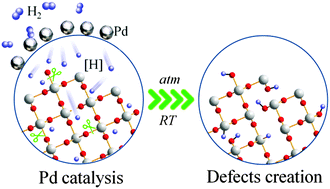
Hydrogenated TiO2 with remarkably elevated photocatalytic activity has triggered great interest, which, unfortunately, has been commonly obtained so far under severe conditions such as extraordinarily high pressure (20.0 bar) and/or high temperature (up to 700 °C) over a long period of treatment (up to several days). Here, through doping with a slight amount of Pd, hydrogenated TiO2 is obtained at room temperature under non-pressurised H2 or H2/O2 gas flow within several minutes. This extremely facile Pd-catalyzed hydrogenation strategy is based on the discovered fact that H2 could spontaneously dissociate on the Pd surface to generate highly active atomic hydrogen species [H], which would diffuse into and interact with the TiO2 lattice to generate durable point defects (Ti3+, oxygen vacancies) and even surface disorder, resulting in the largely enhanced solar energy utilization of TiO2. Additionally, the proposed Pd-catalyzed hydrogenation strategy turns out to be applicable to reduce other transition metal oxides, providing a general methodology for oxide hydrogenation under ordinary conditions.
 Please wait while we load your content...


