Selective and sensitive chromogenic and fluorogenic detection of sulfur mustard in organic, aqueous and gaseous medium

Vinod Kumar* and Hemlata Rana
Synthetic Chemistry Division, Defence Research & Development Establishment, Jhansi Road, Gwalior 474002, India. E-mail: vkpal77@yahoo.co.in; Fax: +91 751 2341148; Tel: +91 751 2390203

Received 11th September 2015 , Accepted 15th October 2015

First published on 16th October 2015


Abstract

We present a highly selective and sensitive detection protocol for the chemical warfare agent sulfur mustard (SM). The chromogenic and fluorogenic system uses a squaraine dye (SQ) that not only detects SM but also discriminates it from other chemical warfare agents (CWAs) and potent electrophilic interferents. A water soluble dithiol, 2-(3,5-bis(mercaptomethyl)phenoxy)acetic acid 1, in the presence and absence of SM, behaves differently towards the squaraine dye (SQ) to give different chromogenic and fluorogenic responses. With an aim to mimic real-life scenarios for the onsite and offsite detection, the sensing protocol was further implemented in spiked water and soil samples, on surfaces, and in the gas phase. The lower detection limit (much lower than the lethal dose) of both visual inspection and the fluorescence technique will be highly useful to mankind in order to sensitively detect SM.

1. Introduction

Chemical warfare agents (nerve and blister agents) are among the deadliest chemicals created by humankind (Fig. 1).1 Blister agents such as Sulfur Mustard (SM) or HD were used in World War I, World War II and more recently in the Iran–Iraq war.2 SM is known to be extremely toxic, quite stable, and easy to synthesize, and therefore, has been named as the ‘king of warfare agents’.3 It causes severe skin, as well as eye, blistering and lung lesions upon exposure due to the alkylation of DNA.4 After long term exposure, this can result in carcinogenic and mutagenic effects.5 Apart from SM, nitrogen mustard (NM) also produces a similar but remarkable blistering effect.6 NM is even more toxic than SM but there is no report which certifies the use of NM as a chemical weapon. This is probably due to its poor stability under normal conditions, hence it is stored in its hydrogen chloride salt form. Instead, it has been used in the treatment of cancer7 and chemotherapy.8
image file: c5ra18641b-f1.tif
Fig. 1 Molecular structures of chemical warfare agents.

Destructive properties, the absence of an antidote9 and simple preparation methods make this agent a first choice for use as a chemical weapon when a country or terrorist group decides to build up a capacity or intend to use CWAs. The unlawful use of chemical weapons has posed grave concern among the international community, which has prompted the urgent need to develop a protocol for SM detection.

Unfortunately, there are very few detection methods and they often rely on the use of low toxic simulants to demonstrate the proof-of-concept rather than using real agents. However, while considerable efforts have been directed on the detection of nerve agents,10 the detection of SM is very rare. Nowadays, SM is detected either using instrumentation methods11 including hand-held detectors12 or by chemical methods12a,13 like chemically doped detection paper and residual vapour detection kits. Though, selectivity, sensitivity and portability always remain major issues. As an alternative to these chemical and instrumental methods, other approaches such as the use of molecularly imprinted polymers,14 immunochemicals,15 a quartz crystal microbalance,16 platinum(II) pincer complexes,17 dansyl-ligated gold nanoparticles18 and rhodamine–thioamide,19 have also been reported. Despite these elegant efforts, ‘full-proof detection’ of SM is almost non-existent.

Using a SQ-OH dye (Fig. 2), a proof-of-principle study for recognising and sensing 2-chloroethyl ethyl sulfide (CEES), a mustard simulant, has recently been demonstrated.20 Unlike CEES, which on reaction with 1 forms a podand 3, SM is a bialkylating agent with two ‘reactive groups’ and is supposed to form a macrocycle 2 (Scheme 1). With this change, the experimental conditions and the concentration of the molecular species involved may also change. Another reason for studying the detection of SM is that recently we demonstrated the detection of the real nerve agents tabun and Vx using SQ.21 Hence, the present study along with a previous one will provide a single platform for the detection of three real warfare agents viz. SM, tabun and Vx, thus fulfilling the detection of both categories i.e. blistering and nerve agents. Both reasons compelled us to demonstrate and provide accurate experimental settings for the sensing of SM, so that in real situations no further modification will be required.


image file: c5ra18641b-f2.tif
Fig. 2 Molecular structures of the squaraine dyes (SQ-OH and SQ).

image file: c5ra18641b-s1.tif
Scheme 1 Schematic presentation of the reactions of 1 with SM and its simulant (CEES).

2. Results and discussion

2.1. Chromo-fluorogenic detection of sulfur mustard

Here we briefly summarize the approach. In the absence of SM, the dithiol 1 will react with SQ resulting in the bleaching of the dye. However, in the presence of the analyte, 1 reacts with SM to form a macrocycle 2 (Scheme 1), and this is then added to a solution of SQ. This results in the persistence of the blue colour of the dye, with no loss of the chromogenic and fluorogenic properties of SQ. The formation of 2 was confirmed by mass spectrometry of the reaction mixture (Fig. 3). SQ is an organic electrophilic dye showing an intense blue colour and fluorescence, which undergoes discoloration by nucleophilic attack.22 The thiol groups in 1, in the presence of K2CO3, are strong nucleophiles, and react rapidly at the central cyclobutene ring of SQ. This breaks the conjugation of the dye resulting in the loss of its chromogenic and fluorogenic properties. When SM is present it reacts with 1 to form 2, which is not sufficiently nucleophilic to react with SQ, thus the dye retains its optical properties.
image file: c5ra18641b-f3.tif
Fig. 3 Mass spectra of macrocycle 2 present in the reaction mixture (a) ESI(−)-MS and (b) ESI(−)-MSMS.

Since the dye used in the earlier method,20a SQ-OH (Fig. 2), was found to be sensitive under basic operating conditions due to the presence of two phenolic functional groups, a slight excess of base (K2CO3) could change the optical response while working in real scenarios. This prompted us to first explore a dye that is non-responsive to basic media. Hence, we used SQ in our present study (Fig. 2).

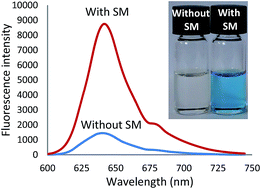
In order to establish the sensing protocols for SM and to determine the necessary concentrations of SQ and 1, we explored the responses of SQ towards 1. A solution of 1 containing 3.0 equivalents of K2CO3 reacts with SQ resulting in the bleaching of the dye as indicated by a visual change and a fluorescence study (Fig. 4). Next, the visual detection of SM was performed using 1 and SQ. A solution of 1 (0.2 mM) in methanol containing 3.0 equivalents of K2CO3 was allowed to react with 1.4 equivalents (59.0 μM) of SM (optimized equivalent quantity) at 80 °C for one minute in a closed vial. The solution of 1 (42 μM) was then treated with SQ (15.0 μM) in chloroform. The blue color of the dye persists, which indicates the presence of SM (Fig. 5). Without SM, 1 bleaches the dye and hence the color disappears. Using solutions of 1 (40 μM), SM (55 μM), and SQ (0.3 μM), fluorescence titration was also performed (Fig. 6). The presence of the analyte displays a large enhancement in intensity at 640 nm, while in its absence, the intensity remains completely quenched.


image file: c5ra18641b-f4.tif
Fig. 4 (a) Fluorescence intensity of SQ in CHCl3 at 0.3 μM and 640 nm in the presence of increasing amounts of 1 (0.1 mM) in MeOH (excitation wavelength at 625 nm), inset: colorimetric response of SQ in CHCl3 at 15.0 μM with 1, from left to right: SQ only and SQ + 1 (42 μM). (b) Isotherm showing the decrease in the fluorescence intensity of SQ with the addition of 1.

image file: c5ra18641b-f5.tif
Fig. 5 Chromogenic response of SQ (15.0 μM) with SM (59 μM with 1 at a conc. of 42 μM) and other intereferents (59 μM) (from left to right) sarin, soman, cyclosarin, tabun, Vx, and BCEE.

image file: c5ra18641b-f6.tif
Fig. 6 Fluorescence data of SQ (0.3 μM) in the presence and the absence of SM (55 μM with 1 at a conc. of 40 μM).

2.2. Interferences studies

Studies on possible interferences with the reactive and non-reactive species in the detection of CEES have been previously established.20a The selectivity of SM over other CWAs such as sarin, cyclosarin, soman, tabun, Vx and bis(2-chloroethyl)ether (BCEE) are demonstrated here in organic and aqueous medium. Following similar reactions mentioned earlier in this paper, 2.0 equivalents of these interfering agents were allowed to react with 1 (0.2 mM) in methanol containing 3.0 equivalents of K2CO3, followed by treatment with SQ (15.0 μM). Interestingly, we observed the disappearance of the colour with these agents (Fig. 5). Therefore, the use of a slight excess of interfering agents did not have any effect on the chemical sensing. This is because under these conditions, most of the potential interferents decomposed (except BCEE) and were not available to react with 1. BCEE, being unreactive, did not react with 1. In these cases the unreacted 1 bleaches SQ, hence no response was found with the interferents.

2.3. Reactivities of thiols

In an attempt to compare the reactivities of thiols towards SM, 1 along with 1,3-benzenedimethanethiol (BDMT) and benzyl mercaptan (BM) were allowed to react with SM, separately under similar experimental conditions. We observed that 1 reacts faster in comparison with BDMT and BM. Even among the dithiols 1 and BDMT, 1 reacts at a faster rate than BDMT. The difference in the reactivity of the dithiols (1 and BDMT) over the monothiol (BM) towards the bialkylating SM can be attributed to the formation of macrocyclic compound 2,5,8-trithia[9]-m-cyclophane. It is evident that SM in the presence of an ionizing solvent shows greater electrophilicity enhancement due to the formation of three-membered cationic sulphonium heterocycles.23 Therefore, it can be inferred that the presence of the carboxylate group in 1 could be providing a greater degree of ionization in the medium thus enhancing the reactivity towards SM over BDMT. Another aspect which discourages the use of BDMT in place of 1 lies in the poor water solubility of both the staring material and macrocyclic product. A fast rate of reaction with SM and good solubility in both organic and water medium prompted us to use 1 for our present study.

2.4. Detection in real-time scenario

Once deployed, SM can remain active for several hours up to a few weeks depending upon the environmental conditions.24 It has been found to persist in soil and water for decades,25 which can lead to lethal accidents.26 Therefore, it has become imperative to tune our protocol in order to determine the presence of SM in water, on surfaces, in soil and in the vapour phase. Our first focus was on the detection in water. An advantage of using 1 is that it is soluble in both organic and water medium.20 A SM solution in water was allowed to react with 1 (0.2 mM) in water in the presence of 3.0 equivalents of K2CO3 at 80 °C for one minute. This reaction mixture was then treated with SQ (15 μM) in a mixed solution of CHCl3[thin space (1/6-em)]:[thin space (1/6-em)]acetonitrile (4[thin space (1/6-em)]:[thin space (1/6-em)]96). The solution was not bleached, thus showing the presence of SM. A control experiment (absence of SM in water) caused bleaching of SQ, as shown in Fig. 7a. Similarly, selectivity for SM over other CW agents, their mimics and other reactive electrophiles (in excess) was also tested using an aqueous solution of 1 and SQ in a mixed solution of acetonitrile[thin space (1/6-em)]:[thin space (1/6-em)]CHCl3 (4[thin space (1/6-em)]:[thin space (1/6-em)]96 ratio). These possible interferents did not respond to the sensing protocol.
image file: c5ra18641b-f7.tif
Fig. 7 (a) Chromogenic response of SQ (15.0 μM) in CHCl3[thin space (1/6-em)]:[thin space (1/6-em)]acetonitrile (4[thin space (1/6-em)]:[thin space (1/6-em)]96) in water, left vial: response in the absence of SM, right vial: response in the presence of SM. (b) Chromogenic response of SQ (15.0 μM) when no SM is present in the soil sample (left vial) and when SM is present in the soil sample (right vial). (c) Detection of gaseous SM using SQ dye adsorbed on a TLC plate: left: unexposed with SM, right: exposed with SM.

In order to determine the presence of SM in soil, a spiked soil sample was directly treated with 1 (0.2 mM) in methanol containing 3.0 equivalents of K2CO3 at 80 °C. After centrifugation of the reaction mixture, the solution was allowed to react with the SQ dye (15 μM). The persistence of the blue colour of the dye indicates the presence of the agent in the soil. Additionally, an unspiked soil sample was also treated with 1 (0.2 mM), which bleached the dye immediately, showing its absence in the soil (Fig. 7b). To complete the list of possible matrices, we next sought to investigate the detection of SM in the vapour phase with the intention of developing test strips and devices. 1 (200 μL, 0.2 mM) in methanol containing 3.0 equivalents of K2CO3 was sprayed equally on two TLC plates; one was heated (80 °C) and exposed to SM vapour for 5 minutes. This plate along with an unexposed SM plate was then treated with a drop of SQ dye (30 μM). The unexposed TLC plate shows the disappearance of the blue colour while the exposed one shows the persistence of the colour (Fig. 7c). Hence a simple and user-friendly test-strip assay can be created for the detection of SM in the vapour phase.

2.5. Sensitivity

SM is deadliest when used in a large excess. The relative toxicities of SM by inhalation and through skin per individual were found to be 1500 (LC50 mg min m−3) and 100 (LD50 in mg) respectively. However, the minimum quantity required to cause blisters on the skin is 0.2 mg. The lowest detection limits of our protocol for SM were determined to be 40 μM and 18 μM by the visual and fluorescence methods respectively, which are far below the level of toxicity that causes health hazards.

3. Conclusion

In summary, we have demonstrated the chromo-fluorogenic detection of sulfur mustard (SM). The detection of SM has proven to be quite selective and discriminative as no interference was observed from other CWAs and reactive and non-reactive agents in organic and aqueous medium. The developed protocol was also proven to be highly sensitive for the agent as the LOD was much lower than the lethal dose. Successful extension of the protocol to the detection of the agent in analytical settings such as in spiked water and soil samples, contaminated surfaces, and in the gaseous phase will be useful for real-time monitoring. Further research work is directed towards customizing, miniaturizing and further simplifying the technique, in order to develop a chemosensor kit and portable devices for onsite and offsite deployment.

Acknowledgements

We thank Dr Lokendra Singh, Director, DRDE, Gwalior for his keen interest and encouragement. We also greatly acknowledge Dr Eric V. Anslyn, University of Texas at Austin, USA for the excellent technical discussion and support. Authors also thank Dr J. Acharya for providing us with the CWAs.

Notes and references

  1. (a) L. Szinicz, History of chemical and biological warfare agents, Toxicology, 2005, 214, 167–181 CrossRef CAS PubMed; (b) S. M. Somani and J. A. Romano, in Chemical Warfare Agents, CRC Press, Washington, DC, 2001, p. 447 Search PubMed; (c) Report S–16433, United Nations Security Council, New York, 1984.
  2. (a) J. B. Tucker, War of Nerves: Chemical Warfare from World War I to Al-Qaeda, Pantheon Books, New York, 2006 Search PubMed; (b) K. A. Coleman, History of Chemical Warfare Pelgrave, Macmillan, Basingstoke, 2005 Search PubMed; (c) E. Croddy, Chemical and Biological Warfare, Springer-Verlag, New York, 2001 Search PubMed; (d) J. Paxman and R. A. Harris, Higher Form of Killing: The Secret History of Chemical and Biological Warfare, Arrow, London, 2001 Search PubMed; (e) J. L. McWilliams and R. J. Steel, Gas! The Battle for Ypres, 1915, Vanwell Publishing Limited, Canada, 1985 Search PubMed.
  3. (a) R. C. Gupta, Handbook of Toxicology of Chemical Warfare Agents, Academic Press, London, 2009 Search PubMed; (b) R. N. Saladi, E. Smith and A. N. Persaud, Clin. Exp. Dermatol., 2006, 31, 1–5 CrossRef CAS PubMed; (c) M. Shohrati, M. Davoudi, M. Ghanei, M. Peyman and A. Peyman, Cutaneous Ocul. Toxicol., 2007, 26, 73–81 CrossRef CAS PubMed; (d) J. C. Dacre and M. Goldman, Pharmacol. Rev., 1996, 48, 289–326 CAS; (e) J. Liu, K. L. Powell, H. D. Thames and M. C. MacLeod, Chem. Res. Toxicol., 2010, 23, 488–496 CrossRef CAS PubMed.
  4. (a) K. Kehe and L. Szinicz, Toxicology, 2005, 214, 198–209 CrossRef CAS PubMed; (b) K. G. Davis and G. Aspera, Ann. Emerg. Med., 2001, 37, 653–656 CrossRef CAS PubMed.
  5. (a) G. P. Wheeler, Cancer Res., 1962, 22, 651–688 CAS; (b) H. M. Bolt, R. J. Laib, H. Peter and H. J. Ottenwaelder, J. Cancer Res. Clin. Oncol., 1986, 112, 92–96 CrossRef CAS; (c) P. D. Lawley, in Chemical Carcinogens, ed. E. C. Searle, American Chemical Society, Washington, 1984, p. 326 Search PubMed; (d) D. T. Beranek, Mutat. Res., 1990, 231, 11–30 CrossRef CAS.
  6. Q. Wang, R. A. Begum, V. W. Day and K. Bowman-James, Org. Biomol. Chem., 2012, 10, 8786–8793 CAS.
  7. L. S. Goodman, M. M. Wintrobe, W. Dameshek, M. J. Goodman, A. Gilman and M. T. McLennan, J. Am. Med. Women’s Assoc., 1946, 126–132 CrossRef CAS PubMed.
  8. B. A. Chabner and T. G. Roberts, Nat. Rev. Cancer, 2005, 5, 65–72 CrossRef CAS PubMed.
  9. U. Pathak, S. K. Raza, A. S. Kulkarni, R. Vijayaraghvan, P. Kumar and D. K. Jaiswal, J. Med. Chem., 2004, 47, 3817–3822 CrossRef CAS PubMed.
  10. (a) L. M. Eubanks, T. J. Dickerson and K. D. Janda, Chem. Soc. Rev., 2007, 36, 458–470 RSC; (b) K. Kim, O. G. Tsay, D. A. Atwood and D. G. Churchill, Chem. Rev., 2011, 111, 5345–5403 CrossRef CAS PubMed; (c) M. R. Sambrook and S. Notman, Chem. Soc. Rev., 2013, 42, 9251–9267 RSC; (d) M. Burnworth, S. J. Rowan and C. Weder, Chem.–Eur. J., 2007, 13, 7828–7836 CrossRef CAS PubMed; (e) S. Royo, R. Martínez–Máñez, F. Sancenón, A. M. Costero, M. Parra and S. Gil, Chem. Commun., 2007, 4839–4847 RSC; (f) D. Ajami and J. Rebek Jr, Org. Biomol. Chem., 2013, 11, 3936–3942 RSC; (g) S. Goswami, A. Manna and S. Paul, RSC Adv., 2014, 4, 21984–21988 RSC; (h) D. R. Goud, D. Pardasani, V. Tak and D. K. Dubey, RSC Adv., 2014, 4, 24645–24648 RSC.
  11. N. R. Brletich, M. J. Waters, G. W. Bowen and M. F. Tracy, Worldwide Chemical Detection Equipment Handbook; Chemical and Biological Defense Information Analysis Center, Aberdeen, MD, 1995 Search PubMed.
  12. (a) Y. Sun and K. Y. Ong, Detection technologies for Chemical Warfare Agents and Toxic Vapors, CRC Press, Boca Raton, Florida, 1st edn, 2005, p. 272 Search PubMed; (b) C. E. Kientz, J. Chromatogr. A, 1998, 814, 1–23 CrossRef CAS; (c) A. L. Makas and M. L. Troshkov, J. Chromatogr., B: Anal. Technol. Biomed. Life Sci., 2004, 800, 55–61 CrossRef CAS PubMed; (d) J. I. Baumbach and G. A. Eiceman, Appl. Spectrosc., 1999, 53, 338A–355A CrossRef CAS.
  13. (a) G. M. Murray and G. E. Southard, Sensors for chemical weapons detection IEEE Instrumentation and Measurement magazine, 2002, pp. 12–21 Search PubMed; (b) M. E. Kosal, The Basics of Chemical and Biological Weapons Detectors Center for Nonproliferation Studies, USA, November 24, 2003 Search PubMed; (c) A Review of Chemical Warfare Agent (CWA) Detector Technologies and Commercial-Off-The-Shelf Items http://www.1ic.mil/cgi-bin/Get TRDoc?AD=ADA502856.
  14. M. Boopathi, M. V. S. Suryanarayana, A. K. Nigam, P. Pandey, K. Ganesan, B. Singh and K. Sekhar, Biosens. Bioelectron., 2006, 21, 2339–2344 CrossRef CAS PubMed.
  15. (a) G. P. van der Schans, D. Noort, R. H. Mars-Groenendijk, A. Fidder, L. F. Chau, L. P. A. de Jong and H. P. Benschop, Chem. Res. Toxicol., 2002, 15, 21–25 CrossRef CAS PubMed; (b) G. P. vander Schans, A. G. Scheffer, R. H. Mars-Groenendijk, A. Fidder, H. P. Benschop and R. A. Baan, Chem. Res. Toxicol., 1994, 7, 408–413 CrossRef CAS.
  16. R. Bunkar, K. D. Vyas, V. K. Rao, S. Kumar, B. Singh and M. P. Kaushik, Sens. Transducers J., 2010, 113, 41–47 CAS.
  17. Q. Wang, R. A. Begum, V. W. Day and K. Bowman-James, Inorg. Chem., 2012, 51, 760–762 CrossRef CAS PubMed.
  18. R. C. Knighton, M. R. Sambrook, J. C. Vincent, S. A. Smith, C. J. Serpell, J. Cookson, M. S. Vickersa and P. D. Beer, Chem. Commun., 2013, 49, 2293–2295 RSC.
  19. D. R. Goud, A. K. Purohit, V. Tak, D. K. Dubey, P. Kumar and D. Pardasani, Chem. Commun., 2014, 50, 12363–12366 RSC.
  20. (a) V. Kumar and E. V. Anslyn, Chem. Sci., 2013, 4, 4292–4297 RSC; (b) V. Kumar and E. V. Anslyn, J. Am. Chem. Soc., 2013, 135, 6338–6344 CrossRef CAS PubMed.
  21. V. Kumar and H. Rana, Chem. Commun., 2015 10.1039/c5cc06580a.
  22. (a) J. V. Ros-Lis, R. Martínez-Máñez and J. Soto, Chem. Commun., 2002, 2248–2249 RSC; (b) H. S. Hewage and E. V. Anslyn, J. Am. Chem. Soc., 2009, 131, 13099–13106 CrossRef CAS PubMed; (c) J. V. Ros-Lis, B. Garcıa-Acosta, D. Jimenez, R. Martınez- Manez, F. Sancenon, J. Soto, F. Gonzalvo and M. C. Valldecabres, J. Am. Chem. Soc., 2004, 126, 4064–4065 CrossRef CAS PubMed.
  23. J. S. Fruton, W. H. Stein, M. A. Stahmann and C. Golumbic, J. Org. Chem., 1946, 11, 571–580 CrossRef CAS.
  24. (a) R. M. Black, R. J. Clark, R. W. Read and M. T. J. Reid, in Proceedings of the ERDEC Scientific Conference on Chemical Defense Research held at Aberdeen Proving Ground, Maryland on November 16–19, 1993 ERDEC-SP-024, ed. J. D. Williams, D. A. Berg and P. J. Reeves, Compilers U.S. Army Edgewood Research, Development and Engineering Center: Aberdeen Proving Ground, MD, 1994, pp. 227–233, Unclassfied Report (AD-A286 742) Search PubMed; (b) G. W. Wagner and B. K. Maclver, Langmuir, 1998, 14, 6930–6934 CrossRef CAS; (c) TOMES system Micromedex, (CD-ROM), ed. A. H. Hall and B. H. Rumack, Englewood, CO, 1993 Search PubMed.
  25. (a) S. Franke, Chemistry of Chemical Warfare Agents; Manual of Military Chemistry, Deutscher Militırverlag, Berlin, (East), Translated from German by US Department of Commerce, National Bureau of Standards, Institute for Applied Technology, NTIS no. AD-849 866, 1967, vol. 1 Search PubMed; (b) Y. C. Yang, L. L. Szfraniec, W. T. Beaudry and R. J. Ward, J. Org. Chem., 1988, 53, 3293–3297 CrossRef CAS.
  26. B. S. Jørgensen, B. Olesen and O. Berntsen, Ugeskr. Laeg., 1985, 147, 2251–2254 Search PubMed.

This journal is © The Royal Society of Chemistry 2015
Click here to see how this site uses Cookies. View our privacy policy here.