M. Gaoa,
D. Fenga,
G. Yaoa,
Y. Zhanga,
C.-L. Chenbc and
Y. Lin*ad
aState Key Laboratory of Electronic Thin Films and Integrated Devices, University of Electronic Science and Technology of China, Chengdu, Sichuan 610054, P. R. China. E-mail: linyuan@uestc.edu.cn
bDepartment of Physics and Astronomy, University of Texas at San Antonio, San Antonio, Texas 78249, USA
cDepartment of Physics and The Texas Center for Superconductivity, University of Houston, Houston, Texas 77204, USA
dInstitute of Electronic and Information Engineering in Dongguan, University of Electronic Science and Technology of China, Dongguan, Guangdong 523808, P. R. China
First published on 26th October 2015
The nature of strain tuned dielectric properties in CaCu3Ti4O12 (CCTO) films was systematically studied with chemical strain (various doping rates) and physical strain (different oxygen pressure treatments). Microstructural characterization revealed that the lattice parameters of the highly epitaxial CCTO thin films are strongly dependent upon both Zr doping rates and annealing oxygen pressures. Dielectric property measurements indicate that the dielectric loss can be tuned by optimizing the doping rate and annealing oxygen pressure. These findings indicate that the dielectric properties of CCTO can be manipulated by the in-plane strain achieved from either chemical or physical treatment.
To understand the nature of doping effects on the physical properties of CCTO for practical device development, it is critical to systematically study the dielectric properties of the doped CCTO with single crystallinity. Unfortunately, there is no single crystal CCTO with various doping available. Therefore, epitaxial CCTO films with various doping ratios become a practical technique to tackle these fundamental issues. On the other hand, the interfacial strain in the epitaxial thin films, crucial to the performance of thin-film devices,15 may couple with the chemical strain induced from doping ratio to tune the dielectric properties. Our previous study revealed that a proper high oxygen pressure annealing can significantly reduce the dielectric loss of CCTO film since a high oxygen pressure annealing can decrease the oxygen vacancy density in the CCTO films.16 Therefore, it is practical to combine both chemically Zr doped treatments and physically high oxygen pressure annealing to optimize the dielectric properties of the epitaxial CCTO thin films and to further establish the relationship of dielectric properties, microstructures, and chemicals of CCTO films.
Recently, we have investigated the evolvements of the microstructures and the dielectric properties in CCTO epitaxial films with chemical treatments by various doping rates of Zr and physical annealing under various oxygen pressures (from 0.1 to 0.55 MPa). It is surprisingly found that by optimizing the epitaxial quality, the lattice parameters and the physical properties of the CCTO films can be significantly affected by the chemical and physical treatments or specifically, the dielectric permittivity is determined by the in-plane stain which can be tuned by either physical or chemical modifications.
:
Cu
:
Ti = 1
:
3
:
4 were mixed together to yield the final precursor solution for CCTO. Then, Zr4+ solution was mixed with the CaCu3Ti4 precursor solution to achieve the deposition solution with various molar ratios of Zr4+/Ca2+, i.e., 5 mol%, 10 mol% and 15 mol%. The as-prepared solutions were spin-coated on the LaAlO3 (001) substrates to form the precursor films. The precursor films were gradually heated from room temperature to 510 °C to burn out the polymer. The films were then heated from 510 to 900 °C slowly in pure oxygen atmosphere under a normal oxygen pressure (0.1 MPa) or a high oxygen pressure (0.55 MPa) using a high pressure tube furnace (MTI OTF 1200x), and kept at 900 °C for 10 hours under the same oxygen pressure condition before being naturally cooled down to room temperature. The thicknesses of CCTO films are about 150 nm, which were determined by scanning electron microscopy. X-ray diffraction (XRD) was employed to characterize the lattice structures and phases of the as-prepared CCTO films. The interdigital capacitance measuring technique was applied to determine the dielectric properties of the as-grown Zr-doped CCTO films.18,19 Au/Ni electrodes with cross-finger-shape were prepared on the surface of the CCTO thin films by DC-sputtering technique. The interdigital pattern has a total of 100 fingers with a finger length of 400 μm, a finger width of 20 μm, and a finger gap of 20 μm. Capacitance and loss tangent of the films were measured by an Agilent 4294A Precision Impedance Analyzer.
| Zr doping percentage (mol%) | Out-of-plane (%) | In-plane (%) | ||
|---|---|---|---|---|
| Normal pressure | High pressure | Normal pressure | High pressure | |
| 0 | −0.11 | 0.31 | 0.22 | −0.46 |
| 5 | −0.03 | 0.44 | −0.48 | 0.50 |
| 10 | 0.09 | 0.35 | 0.10 | 1.00 |
| 15 | 0.20 | 0.45 | 0.75 | −0.89 |
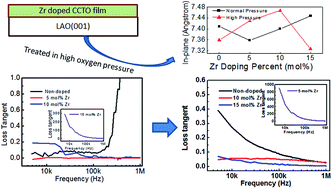
As shown in Fig. 2(b), the in-plane lattice parameters of the chemically treated films also basically increase with the increase of the Zr proportions. It should be pointed out that the in-plane lattice parameters are reduced from 7.41 Å for un-doped CCTO film to 7.36 Å for 5 mol% Zr-doped film for the normal pressure annealed samples. The in-plane lattice parameters for the physically treated films (the high pressure annealed samples) gradually increase with the doping proportions from 7.40 Å to 7.46 Å nm for the 10 mol% Zr-doped film before its sudden drop to 7.33 Å for the 15% Zr-doped films. This may result from the residual in-plane tensile strain effects due to the different thermal expansive coefficients for LAO and CCTO systems. Since the lattice parameter of the LAO substrate (3.79 Å) is larger than half of the lattice parameter of the bulk CCTO (∼3.7 Å), the in-plane tensile strain would be induced in the CCTO films during the epitaxial growth. On the other hand, since the thermal expansion coefficient for LAO [∼10 × 10−6/°C] is slightly larger than CCTO [4.4 × 10⁻⁶/°C],7,20 the interface compressive strain will accumulate during the cooling process from 900 °C to room temperature. The residual interface strains are therefore dependent upon the competition of the lattice and thermal misfits between the LAO substrate and the CCTO film systems. For the CCTO films doped with a small amount of Zr, i.e. 5 mol%, the doping induced chemical strain may help release the strain induced by lattice misfit at the crystallization temperature. In this case, the compressive strain induced by thermal misfit during the cooling process would gradually dominate the final in-plane strain in the film with more Zr dopants. In other words, the in-plane lattice parameters decrease with the increase of the doping rates from 0 to 5 mol% for the normal pressure annealed samples. Then, with further increases of the doping rates, since there will be more the substitution of Ti4+ by Zr4+, leading to larger lattice parameters, the chemical tensile strain will start to dominate the lattice structure and make the in-plane lattice parameter of the film increase. For both chemically and physically treated CCTO films (high pressure annealed doped-samples), as shown in Table 1, the tensile interfacial strain and chemical strain gradually dominate the in-plane lattice parameter when the Zr doping rate increases from 1 to 10 mol%. But when the tensile strain is beyond the capability of the CCTO lattice (doped with 15% Zr), the in-plane lattice parameter drops to its smallest value. Also, the volume of one unit cell can be calculated from the as-achieved lattice parameters, as shown in Fig. 2(c). The trend of the unit cell volume with the proportion of Zr is similar to that of the in-plane lattice parameters.
The dielectric properties of the as-prepared CCTO thin films were characterized from 5 kHz to 1 MHz. Fig. 3 is the dielectric properties of the Zr doped CCTO films annealed under the normal pressure (chemically treated). It is found that small amount of Zr doping (5 mol%) can significantly decrease the dielectric loss of the film by an order of magnitude compared to non-doped film although it only slightly decreases its dielectric constant. While the doping amount is increased to 10 mol%, the dielectric constant of the film reaches to about 600, or about 1/3 higher than that from the non-doped sample, and the dielectric loss is still smaller than that from the non-doped sample when the frequency is higher than 30 kHz. However, the further increase of the Zr doping amount to 15 mol% results in the dramatic increase of the dielectric loss, about three orders of magnitude higher than that from the non-doped films. By carefully evaluating the lattice parameters shown in Fig. 2, it is obvious that the huge increase of the dielectric loss is highly related to the in-plane lattice parameters. In other words, the smaller the in-plane lattice parameters, the less the dielectric loss. It should be also noted that a large fluctuation of dielectric constant with the frequency was observed for samples with high doping rates (10% and 15%), which may be related to the inhomogeneity of the films induced by the large amount of Zr doping.
Fig. 4 shows the dielectric behavior for the as-grown films, both chemically and physically treated under high oxygen pressures. Although the Zr doping does not significantly change the dielectric constants of the samples, it can stabilize the dielectric spectra in the measured frequency ranges, which may possibly be attributed to the improved homogeneity of the doped-samples by the high pressure treatment. Especially, as seen in Fig. 4(b), the dielectric loss reaches its smallest value in the 15 mol% Zr doped film. More exactly, the 15 mol% Zr-doped CCTO shows the lowest dielectric loss values with the most steady dielectric constant spectra in the as-measured frequency range. Clearly, the lowest dielectric loss is also achieved in the Zr-doped film with the smallest in-plane lattice. This physically treated result is in good agreement with the conclusions from the chemically treated results under the normal pressure treatments. However, it should be noted that as shown in the insets of Fig. 4, the 5 mol% Zr doped film (with the best dielectric property from the chemical treatment) treated in high oxygen pressure reveals the highest dielectric loss values and most unstable dielectric constant spectra. Although the detailed mechanisms for how the Zr doping ratio and high oxygen pressure annealing change the in-plane lattice parameters are not fully understood yet, our results imply that the smaller the in-plane lattice, the lower the dielectric loss. This finding may provide a practical technique for material manipulation in enhancing the dielectric properties of CCTO for modern device development.
| This journal is © The Royal Society of Chemistry 2015 |