Bin Yanga,
Chunnuan Wub,
Bin Jic,
Xiaoyu Aid,
Xiao Kuanga,
Mingrui Wua,
Mengchi Suna,
Cong Luoa,
Zhonggui Hea and
Jin Sun*ae
aDepartment of Pharmaceutics, School of Pharmacy, Shenyang Pharmaceutical University, China. E-mail: sunjin66@21cn.com
bDepartment of Pharmacy, Tianjin Medical University Cancer Institute and Hospital, China
cDepartment of Pharmaceutical Analysis, School of Pharmacy, Shenyang Pharmaceutical University, China
dCollege of Pharmacy, Nankai University, China
eMunicipal Key Laboratory of Biopharmaceutics, School of Pharmacy, Shenyang Pharmaceutical University, China
First published on 16th November 2015
The aim of the present study is to investigate whether the use of the biorelevant concentration of conventional surfactants as an alternative medium to simulated fasted state intestinal fluid (FaSSIF) for drugs with different acid–base properties is feasible. First, the equilibrium solubility of seven drugs representing diverse acid–base properties was determined. The solubility of those drugs was studied in pH 6.5 blank FaSSIF, FaSSIF containing physiological levels of sodium taurocholate and lecithin, and blank FaSSIF containing a series of concentrations of Tween 80 or sodium dodecyl sulfate (SDS) at 37 °C using the shake-flask method. The results demonstrated that the solubility of the seven drugs in 0.07% and 0.10% Tween 80 solutions matched better with the biorelevant media FaSSIF than SDS solutions (0.05% to 0.10%). Then the dissolution behavior of the BCS class II drug lacidipine was determined in SDS solutions, Tween 80 solutions and FaSSIF. Compared with FaSSIF, 0.07% Tween 80 was proved to be the best biorelevant-mimetic medium for lacidipine oral solid formulations. Then the dissolution tests of micronized lacidipine, carbamazepine, glimepiride and carvedilol tablets were conducted as internal and external validations, respectively. The results all demonstrated that the biorelevant concentration of Tween 80 could be set as 0.07% and such a cost-effective medium will hold a great potential in drug development and quality control of oral solid dosage forms.
Biorelevant media are adapted to simulate human small intestinal fluids, including fasted state simulated intestinal fluid (FaSSIF) and fed state simulated intestinal fluid (FeSSIF) in terms of pH, buffer capacity and osmolality, as well as bile salt and phospholipids’ concentration.5,6 Biorelevant media have been proved valuable in establishing IVIVC for poorly soluble drugs.7 Though the biorelevant media play an important role in formulation development, their high labor requirements and great cost restrict their routine application in industrial and research fields, especially for the flow-through cell method which requires a large volume of dissolution media.8,9 In addition, biorelevant media are surfactant-enriched solutions and the application of these media is also restricted in biphasic dissolution systems.10 As a consequence, it would be desirable if conventional surfactants could be used to replace these biorelevant media for evaluating the dissolution behavior of oral solid formulations.11
Zoeller and Klein12 tried to simplify biorelevant media with a single surfactant for FaSSIF and a surfactant mixture for FeSSIF. They found the type and concentration of surfactants had a remarkable influence on the surface tension of the media, while there was little impact by pH, osmolality, and buffer capacity. Lehto et al.13 evaluated such properties as solubilization, wettability, diffusivity and surface tension between two conventional surfactant solutions (anionic surfactant sodium dodecyl sulfate (SDS) and non-ionic surfactant Tween 80) and FaSSIF. However, only neutral drugs were determined in this report. Peter et al. found that acidic and basic drugs showed different solubility behavior compared with neutral drugs in FaSSIF.14 So it is of great importance to investigate whether the use of conventional surfactant solutions to substitute FaSSIF for drugs with different acid–base properties is feasible.
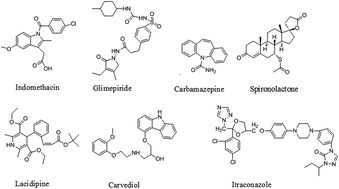
In the study, we measured the solubility of seven drugs representing different acid–base properties in two conventional surfactant solutions (anionic surfactant sodium dodecyl sulfate (SDS) and non-ionic surfactant Tween 80), and compared the results of FaSSIF to those of the two conventional surfactant solutions. Then the dissolution behavior of the BCS class II drug lacidipine was determined in these media to confirm the results. The dissolution tests of micronized lacidipine, carbamazepine, glimepiride and carvedilol tablets were conducted as internal and external validations, respectively.
The SSDS/SFaSSIF ratio helps to analyze the relationship between SDS solutions and FaSSIF and can be expressed as follows:
The equilibrium solubility of the three neutral drugs (lacidipine, spironolactone, and carbamazepine) in the SDS solution gradually increased along with the SDS concentration between 0.05–0.10%, but it sharply increased in 0.3% and 0.5% SDS solutions, due to the formation of SDS micelles.16 Additionally, the solubility of spironolactone and carbamazepine in 0.3% and 0.5% SDS solutions were 10-fold higher than lacidipine. The reason for this phenomenon was that spironolactone and carbamazepine had better wetting characteristics than lacidipine.13 Fig. 2a shows the SSDS/SFaSSIF change of the three neutral drugs with various SDS concentrations. With FaSSIF as the control, the SSDS/SFaSSIF for 0.05%, 0.07% and 0.10% SDS matched well with the biorelevant media FaSSIF. Even though the three neutral drugs have different wetting characteristics and lipophilicity, they all showed similar solubility in FaSSIF compared with SDS solutions (0.05–0.1%).
The glimepiride and indomethacin represented weakly acidic drugs. The solubility of glimepiride was still very low in SDS solutions. The large increase in solubility resulted in a shift from BCS class II to class I in the apparent classification of indomethacin in FaSSIF and SDS solutions.17 Although the two acidic drugs manifested different solubility-changing trends in SDS solutions, the relationship between FaSSIF and SDS solutions was further studied. As shown in Fig. 2b, the increase in SSDS/SFaSSIF of glimepiride in 0.05% SDS, 0.07% SDS and 0.10% SDS was 1.5-fold, 2-fold and 3-fold, respectively. Based on these data, the solubility of glimepiride in SDS solutions ranging from 0.05–0.10% gradually became higher than that in FaSSIF.
The solubility of carvedilol, a model basic drug, in the 0.05% and 0.10% SDS solutions, with concentration below CMC, showed a slight decrease. Since carvedilol was in its cationic state at pH 6.5 and SDS was predominantly in an anionic state, SDS then interacted with the cationic carvedilol to form an insoluble ionic complex leading to reduced solubility. When the concentration of SDS rose above CMC (10 mmol L−1), the solubility of carvedilol was increased in 0.3% and 0.5% SDS solutions, due to micellar solubilization. In addition, SDS interacted with the cationic carvedilol, perhaps enhancing the partition of carvedilol into the cationic micelles, rather than the formation of the insoluble precipitates.16 As for itraconazole, its solubility in FaSSIF and SDS solutions was much like the neutral drugs, since it is a very weak drug (pKa = 3.70) and in its molecular form at pH 6.5. As shown in Fig. 2c, the SSDS/SFaSSIF of carvedilol for 0.05–0.10% SDS was less than one, but that of itraconazole increased with SDS concentration, ranging from 10- to 100-fold. Based on the above results, SDS solutions ranging from 0.05–0.10% generally showed a higher solubilization capability than FaSSIF for drugs representing different acid–base properties.
The STween 80/SFaSSIF ratio helps to analyze the relationship between Tween 80 solutions and FaSSIF and can be expressed as follows:
As shown in Fig. 3, the STween 80/SFaSSIF of drugs increased with Tween 80 concentration, and these drugs (spironolactone, carbamazepine, glimepiride, indomethacin and carvedilol) all show a slightly increasing trend. With FaSSIF as the control, the solubility of the seven drugs in 0.07% and 0.10% Tween 80 solutions matched well with the biorelevant media FaSSIF, indicating that Tween 80 solutions and FaSSIF have nearly equivalent solubilization ability. To sum up, the solubilization behavior of the seven drugs representing different acid–base properties in Tween 80 solutions ranging from 0.07% to 0.10% was closer to the biorelevant media FaSSIF than SDS solutions (0.05–0.10%).
The solubility of lacidipine in 0.05% SDS, 0.07% SDS, 0.10% SDS and FaSSIF was 2.4, 4.2, 6.9 and 4.6 μg mL−1, respectively. Therefore, the three SDS concentrations of 0.05%, 0.07% and 0.10% were selected for further investigation of their comparable solubilizing capacity to FaSSIF.
Fig. 4 shows the dissolution profiles of two formulations of lacidipine in FaSSIF and the above three SDS solutions with concentrations ranging from 0.05% to 0.1%. The dissolution of formulation A was complete in FaSSIF and SDS solutions within 30 min (Fig. 4A), but the dissolution rate was slower in FaSSIF than in SDS solutions, due to the higher translational diffusion coefficient of SDS than FaSSIF (12 × 10−6 versus 0.69 × 10⁻⁶ cm2 s−1).13 However, the dissolution of formulation B was incomplete even within 60 min and the ranked order of the dissolution media was as follows: 0.10% SDS > 0.07% SDS > FaSSIF > 0.05% SDS (Fig. 4B). The dissolution rate of formulation B was in parallel with the SDS concentration. With FaSSIF as the control, the calculated f2 values for 0.05% SDS, 0.07% SDS and 0.10% SDS solutions were 46, 44 and 47 for formulation A and 70, 69 and 46 for formulation B, respectively. Apparently, the SDS solutions didn’t match well with the biorelevant media FaSSIF. It was reported that SDS at concentrations above the CMC value resulted in a surface tension of about 30 mN m−1, which is much lower than that of FaSSIF (45 mN m−1).1,13 Thus the surfactant SDS appeared unsuitable as an alternative to FaSSIF. Meanwhile, the results indicated that the dissolution of formulation B was extremely sensitive to the concentration of surfactants, and as a result the selection of surfactant concentration should be judicious.
![]() | ||
| Fig. 4 Dissolution profiles of two lacidipine formulations in FaSSIF and SDS solutions ((A): formulation A; (B): formulation B, data are expressed as mean ± S.D., n = 3). | ||
As shown in Fig. 5, the two formulations demonstrated similar dissolution profiles in 0.07% Tween 80 solution to FaSSIF, with f2 values being 69 for formulation A and 83 for formulation B, respectively. In 0.10% Tween 80 solution, formulation A showed a faster dissolution rate and formulation B exhibited a higher dissolution, compared to those in FaSSIF. The comparable surface tension and lacidipine solubility could contribute to the similar dissolution performances of the two lacidipine formulations in FaSSIF and 0.07% Tween 80. This result was also in line with the previous report that danazol and spironolactone showed the same dissolution efficiency in FaSSIF and 0.07% Tween 80.13
![]() | ||
| Fig. 5 Dissolution profiles of two lacidipine formulations in FaSSIF and Tween 80 solutions (— for formulation A and --- for formulation B, data are mean ± S.D., n = 3). | ||
The dissolution rate was faster in SDS than that in Tween 80, especially for formulation A. As we know, the dissolution process is the combined result of drug solubilization and drug diffusion through the diffusion layer into the dissolution medium. In this respect, the diffusivity of drug molecules and drug–micelle complexes plays an important role. The diffusivity of drug–micelle complexes is several-fold less than the drug molecule, and the net change in the dissolution rate was the sum of enhanced solubility and declined effective diffusivity.18,20 Compared with SDS, the higher molecular weight of Tween 80 (1310 versus 288.4 g mol−1) and the greater aggregation weight of its micelles (76
000 versus 15
900 g mol−1)21,22 resulted in lower diffusivity of drug–micelle complexes and hence a slower dissolution rate.18 Taken together, 0.07% Tween 80 was a better alternative to FaSSIF than 0.05–0.1% SDS solutions.
The dissolution of carbamazepine tablets was comparable in FaSSIF and 0.07% Tween 80 (Fig. 7). The dissolutions of two glimepiride commercial tablets were conducted in blank FaSSIF, FaSSIF and 0.07% Tween 80 solution. As a weakly acidic compound, glimepiride tablets demonstrated poor dissolution (10–18%) at physiological pH (blank FaSSIF) and the dissolution could be improved to a certain extent in the biorelevant conditions (Fig. 8). In FaSSIF and 0.07% Tween 80 solution, the dissolutions of formulation A and B were both increased by two-fold. With FaSSIF as the control, the f2 values were 81 for A and 83 for B in 0.07% Tween 80. As shown in Fig. 9, the dissolution of carvedilol tablets was comparable in FaSSIF and 0.07% Tween 80. The dissolution of commercial tablets in 0.07% Tween 80 solution and FaSSIF was ∼80% within 1 h. With FaSSIF as the control, the f2 values were 68 for carvedilol tablets in 0.07% Tween 80.
![]() | ||
| Fig. 7 Dissolution profiles of carbamazepine tablets in FaSSIF and 0.07% Tween 80 solution (data are mean ± S.D., n = 3). | ||
![]() | ||
| Fig. 9 Dissolution profiles of carvedilol tablets in FaSSIF and 0.07% Tween 80 solution (data are mean ± S.D., n = 3). | ||
The above external validation results of oral solid dosage forms of carbamazepine, glimepiride and carvedilol further confirmed that the 0.07% Tween 80 was a promising alternative to FaSSIF.
As for the fasted state, the condition of the small intestine is relatively complicated which is difficult to simulate with simple surfactants.23,24 Nevertheless, mixed micelles may be more feasible. Zoeller and Klein12 proposed the mixed micelles formed by natural bile components and the results showed the dissolution profiles of ketoconazole obtained from a blank FeSSIF consisting of 0.25% Tween 80 and 0.25% triethanolamine were superimposable to those obtained from FeSSIF. In further studies, we will study the combination of Tween 80 and other biosurfactants as an alternative to FeSSIF. To sum up, such biorelevant cost-effective 0.07% Tween 80 solutions would be valuable in drug development and preparation.
Footnote |
| † Electronic supplementary information (ESI) available. See DOI: 10.1039/c5ra17674c |
| This journal is © The Royal Society of Chemistry 2015 |