
Direct access to pyrimidines through organocatalytic inverse-electron-demand Diels–Alder reaction of ketones with 1,3,5-triazine

Gongming Yanga, Qianfa Jiaa, Lei Chena, Zhiyun Du*a and Jian Wang*ab
aAllan H. Conney Laboratory for Anticancer Research, Guangdong University of Technology, Guang Dong 510006, China
bDepartment of Chemistry, National University of Singapore, 3 Science Drive 3, Singapore 117543. E-mail: wangjian1999@hotmail.com

Received 22nd August 2015 , Accepted 4th September 2015

First published on 7th September 2015


Abstract

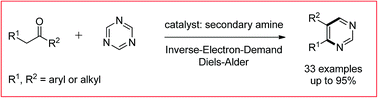
An organocatalytic inverse-electron-demand Diels–Alder reaction of ketones with 1,3,5-triazine through enamine catalysis has been developed. This method could furnish 4,5-disubstituted pyrimidines in good yields and high levels of regioselectivities.

Pyrimidines are ubiquitous heterocyclic moieties present in natural products, drugs and functional materials.1 A number of pyrimidines exhibit biologically important activities.2 As shown in Fig. 1, sulfadiazine is a sulfonamide antibiotic that contains a 5-aminopyrimidine.3 Trimethoprim is a bacteriostatic antibiotic known as dihydrofolate reductase inhibitor, mainly used in the prevention and treatment of urinary tract infections.4 Bosentan is a drug for treating cardiovascular pathology.5
image file: c5ra16995j-f1.tif
Fig. 1 Examples of important pyrimidines.

Although a number of approaches for the preparation of pyrimidine frameworks have been developed,6,7 a general and highly selective method for the synthesis of 4,5-disubstituted pyrimidine skeleton has rarely been investigated. One of the most efficient strategies for making such a structure is mainly focused on the basis of N–C–N condensations. For examples, condensation of an amidine with a 1,3-diketone or derivative is one of major methods for the direct preparation of the six-membered-ring pyrimidine (Scheme 1a).8 Notably, easily preparation of the prerequisite diketones or dicarbonyl derivatives makes this a more attractive strategy for synthesis of substituted pyrimidines. Condensation of an amidine with a nitrile derivative, a common N–C source, is another versatile approach. Despite these advances, due to the significance of pyrimidines in drug discovery, preparations of diversely substituted pyrimidines are still in high demand.9 Therefore, developing new efficient method for the constructuion of various substituted pyrimidines would be of high interest.


image file: c5ra16995j-s1.tif
Scheme 1 Strategies in preparation of pyrimidines.

In 1975, Neunhoeffer and Bachmann demonstrated that 1,3,5-triazine could undergo a rapidly regiospecific cycloaddition reaction with ynamines, followed with a subsequent loss of hydrogen cyanide, to efficiently form pyrimidines.10 In 1982, the Boger group reported a regiospecific pyrimidine synthesis via a thermal cycloaddition of 1,3,5-triazine with enamines.11 Surprisingly, to the best of our knowledge, such a catalytic example of 1,3,5-triazine reacted with in situ generated enamines to assemble pyrimidines has not yet been reported. As a part of our continuing interests in this area,12 especially in expanding enamine chemistry13 to generate heterocycles, herein, we report our new progress regarding an enamine-catalyzed inverse-electron-demand14 Diels–Alder of ketones with 1,3,5-triazine, which provided an efficient and complementary route for pyrimidine synthesis (Scheme 1b).

Initial experiments were conducted by using cyclohexanone 1a and 1,3,5-triazine 2 in the presence of 10 mol% loading of amine catalysts, such as secondary amines (I–VII) and tertiary amines (VIII and IX). Among the catalysts tested (Table 1), we found that secondary amines are generally more effective than tertiary amines (Table 1, 9). Tertiary amines exhibited low catalytic activities (entries 8 and 9, <5% and 18%, respectively). Pleasingly, secondary amine prolinamide I showed higher reactivity than other catalysts (entry 1, 81%). Surprisingly, the similar derivative proline VI only provided a moderate chemical yield (entry 6, 28%). Finally, prolinamide I was identified as the most effective catalyst. Further optimization of other reaction parameters revealed that solvent was another crucial factor. When reaction carried out in DMSO, reactivity was positively influenced, leading to the desired product 3a in 81% yield. Other solvents, such as toluene, MeCN, CHCl3, THF, MeOH, DMA, and DMF, caused a significant decrease in chemical yields (Table 1, 18–65%, entries 10–16). Lowering the reaction temperature to 60 °C resulted in a poor chemical yield (entry 17, 41%, 32 h). Changing the catalyst loading of I from 20 mol% to 10 mol% caused a decrease in chemical yield (Table 1, entry 18, 71%). Notably, addition of 10 mol% TEA further promoted the reaction (entry 19, 91%). Finally, the best combination was achieved when the reaction was performed in the presence of 10 mol% of prolinamide I as catalyst and 10 mol% of TEA as additive.

Table 1 Optimization of the reaction conditionsa

image file: c5ra16995j-u1.tif

Entry Cat. Solvent Yieldb/% Entry
a Reaction conditions: a mixture of 1a (0.20 mmol), 2 (0.10 mmol) and catalyst (20 mol%) in the solvent (0.25 mL) was stirred at 90 °C for 24 h.b Isolated yield.c The reaction was conducted at 60 °C for 32 h.d 10 mol% catalyst I used.e 10 mol% catalyst I and 10 mol% Et3N as additive.f 10 mol% catalyst I and 10 mol% AcOH as additive.
1 I DMSO 81 1
2 II DMSO 54 2
3 III DMSO 36 3
4 IV DMSO 61 4
5 V DMSO 32 5
6 VI DMSO 28 6
7 VII DMSO 24 7
8 VIII DMSO <5 8
9 IX DMSO 18 9
10 I DMF 65 10
11 I DMA 53 11
12 I Toluene 41 12
13 I MeOH 35 13
14 I THF 62 14
15 I CH3CN 42 15
16 I CHCl3 43 16
17c I DMSO 41 17c
18d I DMSO 71 18d
19e I DMSO 91 19e
20f I DMSO 63 20f


With the optimized reaction conditions in hand, we then investigated a variety of ketones 1 with 2. The results are summarized in Table 2. Interestingly, among the various examined ketones, cyclic ketones (e.g. five-, six-, seven-, eight- and twelve-membered rings), all gave high to excellent yields under standard conditions (Table 2, 3a–3p, 80–95%). The best yield was obtained with cyclooctanone, which afforded the corresponding pyrimidine 3d in 95% isolated yield (Table 2, 3d). It is worth noting that phenyl ring fused cyclohexanone 1o also worked with 1,3,5-triazine 2 and afforded the corresponding product 3o in 83%. To further indicate the generality and potential of our approach, we turned our attention to examine other types of ketones (e.g. acyclic ketones). Acetophenone 4a was employed to react with triazine 2 in the presence of catalyst prolinamide I. However, only 54% yield was achieved after 72 h. In order to improve reaction efficiency, a further reaction optimization was conducted (see ESI). Finally, amine V was found to be the most efficient catalyst for this type of ketones (Table 2, 87%, 72 h). As indicated in Table 2, aryl methyl ketones 4b–i gave good to excellent yields (5b–i, 84–92%). Pleasingly, heteroaryl methyl ketones 4j–l also afforded the corresponding pyrimidine products in high yields (5j–l). Propiophenones and butanophenone were also well tolerated (5n–p). Other alkyl ketones (e.g. symmetric and dissymmetric alkyl ketones) were also investigated and the desired products was obtained in moderate chemical yields (5q and 5r, 56% and 62%, respectively). Notably, all above reactions provided excellent levels of regioselectivity. This phenomenon can be explained by the Diels–Alder reaction occurring with most stabilized enamine (Table 3).

Table 2 Scope of cyclic ketonesa

image file: c5ra16995j-u2.tif

a Conditions see Table 1.
image file: c5ra16995j-u3.tif


Table 3 Scope of acyclic ketonesa

image file: c5ra16995j-u4.tif

a Reaction conditions: a mixture of 4 (0.20 mmol), 2 (0.10 mmol) and catalyst V (20 mol%), TEA (10 mol%) in MeOH (0.50 mL) was stirred at 90 °C for 72 h.
image file: c5ra16995j-u5.tif


Our postulated reaction pathway is summarized in Scheme 2. While the reaction mechanism is unclear at this stage, it is still believed that the sequence is triggered by the generation of iminium 6 via the condensation of 4a and catalyst V. Iminium 6 rapidly converts to intermediate enamine 7 via a tautomerization. Enamine 7 continuously reacts with 1,3,5-triazine 2 via an inverse-electron-demand Diels–Alder reaction to access the intermediate 8. Notably, this cycloaddition process demonstrates a high regioselectivity, which leading to directly introduce a diverse set of substituents to pyrimidine scaffold. Intermediate 8 then transfers to intermediate 9 after an elimination of HCN. Last, a liberation of catalyst V leads to the formation of final product 5a.


image file: c5ra16995j-s2.tif
Scheme 2 Proposed mechanism.

In summary, an organocatalytic inverse-electron-demand Diels–Alder reaction between various ketones and 1,3,5-triazine has been developed. The reaction is catalyzed by second amines to generate 4,5-disubstituted- or 5-monosubstituted pyrimidines with high levels of regioselectivity. It is noteworthy that this Diels–Alder reaction proceeds efficiently with a simple and inexpensive amine catalyst. Considering the large variety and ready availability of the starting materials and the operational simplicity, a convenient, practical and highly modular pyrimidine synthesis has been developed. We believe that this work will arouse more research interest in organocatalytic synthesis of other biologically active heterocycles. Such studies are actively under way in this laboratory, and more results will be reported in due course.

Acknowledgements

The authors acknowledge the financial support from National Natural Science Foundation of China (NSFC 21272043), the Science and Technology Planning Project of Guangdong Province (2007A020300007-10, 2011B090400573) and Guangdong Natural Science Foundation (S2011010004967).

Notes and references

  1. For selected examples, see: (a) D. J. Brown, in Comprehensive Heterocyclic Chemistry, ed., A. R. Katritzky, C. W. Rees and E. F. V. Scrieven, Pergamon, Oxford, 1984, vol. 3, ch 2.13, pp. 142–155 Search PubMed; (b) P. Callery and P. Gannett, in Foye's Principles of Medicinal Chemistry, ed. D. A. Williams and T. L. Lemke, Lippincott Williams and Wilkins, Philadelphia, 2002, pp. 934–935 Search PubMed; (c) K. S. Jain, T. S. Chitre, P. B. Miniyar, M. K. Kathiravan, V. S. Bendre, V. S. Veer, S. R. Shahane and C. J. Shishoo, Curr. Sci., 2006, 90, 793 CAS; (d) S. von Angerer, Science of Synthesis, ed. Y. Yamamoto, Thieme, Stuttgart, 2003, vol. 16, pp. 379−572 Search PubMed; (e) A. S. Karpov and T. J. J. Müller, Synthesis, 2003, 2815 CAS; (f) K. S. Atwal, S. V. O'Neil, S. Ahmad, L. Doweyko, M. Kirby, C. R. Dorso, G. Chandrasena, B.-C. Chen, R. Zhao and R. Zahler, Bioorg. Med. Chem. Lett., 2006, 16, 4796 CrossRef CAS PubMed; (g) M. Alvarado, M. Barcelo, L. Carro, C. F. Masaguer and E. Ravina, Chem. Biodiversity, 2006, 3, 106 CrossRef CAS PubMed; (h) E. T. Buurman, A. E. Blodgett, K. G. Hull and D. Carcanague, Antimicrob. Agents Chemother., 2004, 48, 313 CrossRef CAS.
  2. For selected examples, see: (a) M. S. Puar, A. K. Ganguly, A. Afonso, R. Brambilla, P. Mangiaracina, O. Sarre and R. D. MacFarlane, J. Am. Chem. Soc., 1981, 103, 5231 CrossRef CAS; (b) S. Ananthan, H. S. Kezzar III, R. L. Carter, S. K. Saini, K. C. Rice, J. L. Wells, P. Davis, H. Xu, C. M. Dersch, E. J. Bilsky, F. Porreca and R. B. Rothman, J. Med. Chem., 1999, 42, 3527 CrossRef CAS; (c) N. Oku, S. Matsunaga and N. Fusetani, J. Am. Chem. Soc., 2003, 125, 2044 CrossRef CAS PubMed; (d) S. A. Raw, C. D. Wilfred and R. J. K. Taylor, Chem. Commun., 2003, 2286 RSC; (e) J. C. McManus, J. S. Carey and R. J. K. Taylor, Synlett, 2003, 365 CAS; (f) J. C. McManus, T. Genski, J. S. Carey and R. J. K. Taylor, Synlett, 2003, 369 CAS; (g) M. Botta, F. Corelli, G. Maga, F. Manetti, M. Renzulli and S. Spadari, Tetrahedron, 2001, 57, 8357 CrossRef CAS; (h) R. Garg, S. P. Gupta, H. Gao, M. S. Babu, A. K. Debnath and C. Hansch, Chem. Rev., 1999, 99, 3525 CrossRef CAS PubMed; (i) M. Botta, F. Occhionero, R. Nicoletti, P. Mastromarino, C. Conti, M. Magrini and R. Saladino, Bioorg. Med. Chem., 1999, 7, 1925 CrossRef CAS; (j) D. Hurst, in An Introduction to Chemistry & Biochemistry of Pyrimidines, Purines & Pteridines, Wiley, Chichester, 1988 Search PubMed; (k) D. J. Brown, in The Pyrimidines, Interscience Publishers, New York, 1994 Search PubMed.
  3. M. Finland, E. Strauss and O. L. Peterson, JAMA, J. Am. Med. Assoc., 1984, 251, 1467 CrossRef CAS.
  4. S. Hess, M. Dolker, D. Haferburg, H. P. Kertscher, F.-M. Matysik, J. Ortwein, U. Teubert, W. Zimmermann and K. Eger, Pharmazie, 2001, 56, 306 CAS.
  5. W. Neidhart, V. Breu, K. Burri, M. Clozel, G. Hirth, U. Klinkhammer, T. Giller and H. Ramuz, Bioorg. Med. Chem. Lett., 1997, 7, 2223 CrossRef CAS.
  6. For selected reviews on the preparation of pyrimidine derivatives, see: (a) M. D. Hill and M. Movassaghi, Chem.–Eur. J., 2008, 14, 6836 CrossRef CAS; (b) D. M. D'Souza and T. J. J. Mueller, Chem. Soc. Rev., 2007, 36, 1095 RSC; (c) I. M. Lagoja, Chem. Biodiversity, 2005, 2, 1 CrossRef CAS PubMed; (d) S. von Angerer, Sci. Synth., 2004, 16, 379 CAS.
  7. For selected recent examples on the preparation of pyrimidine derivatives, see: (a) M. Movassaghi and M. D. Hill, J. Am. Chem. Soc., 2006, 128, 14254 CrossRef CAS; (b) A. S. Karpov, E. Merkul, F. Rominger and T. J. J. Mueller, Angew. Chem., Int. Ed., 2005, 44, 6951 CrossRef CAS PubMed; (c) M. Matloobi and C. O. Kappe, J. Comb. Chem., 2007, 9, 275 CrossRef CAS PubMed; (d) M. Blangetti, A. Deagostino, C. Prandi, C. Zavattaro and P. Venturello, Chem. Commun., 2008, 1689 RSC; (e) H. Kakiya, K. Yagi, H. Shinokubo and K. Oshima, J. Am. Chem. Soc., 2002, 124, 9032 CrossRef CAS; (f) M. M. Heravi, S. Sadjadi, H. A. Oskooie, R. H. Shoar and F. F. Bamoharram, Tetrahedron Lett., 2009, 50, 662 CrossRef CAS PubMed; (g) M. D. Hill and M. Movassaghi, Synthesis, 2008, 823 CAS; (h) F. Xie, S. Li, D. Bai, L. Lou and Y. Hu, J. Comb. Chem., 2007, 9, 12 CrossRef CAS; (i) J. M. Kremsner, A. Stadler and C. O. Kappe, J. Comb. Chem., 2007, 9, 285 CrossRef CAS PubMed; (j) A. S. Kiselyov, Tetrahedron Lett., 2005, 46, 1663 CrossRef CAS PubMed; (k) A. S. Karpov and T. J. J. Mueller, Org. Lett., 2003, 5, 3451 CrossRef CAS; (l) T. J. J. Mueller, R. Braun and M. Ansorge, Org. Lett., 2000, 2, 1967 CrossRef CAS PubMed.
  8. For reviews, see: (a) K. Undheim and T. Benneche, in Comprehensive Heterocyclic Chemistry II, ed. A. R. Katritzky, C. W. Rees, E. F. V. Scriven and A. McKillop, Pergamon, Oxford (UK), 1996, vol. 6, pp. 93–231 Search PubMed; (b) I. M. Lagoja, Chem. Biodiversity, 2005, 2, 1 CrossRef CAS PubMed; (c) J. P. Michael, Nat. Prod. Rep., 2005, 22, 627 RSC; (d) J. A. Joule and K. Mills, in Heterocyclic Chemistry, Blackwell Science, Cambridge (MA), 4th edn, 2000, pp. 194–232 Search PubMed; (e) A. W. Erian, Chem. Rev., 1993, 93, 1991 CrossRef CAS; (f) M. D. Hill and M. Movassaghi, Chem.–Eur. J., 2008, 14, 6836 CrossRef CAS PubMed.
  9. For selected papers on the functional group transformation to 4,5-disubstituted pyrimidines, see: (a) H. Sard, M. D. Gonzalez, A. Mahadevan and J. McKew, J. Org. Chem., 2000, 65, 9261 CrossRef CAS; (b) N. Boudet, S. R. Dubbaka and P. Knochel, Org. Lett., 2008, 10, 1715 CrossRef CAS PubMed; (c) M. Schlosser, O. Lefebvre and L. Ondi, Eur. J. Org. Chem., 2006, 1593 CrossRef CAS PubMed; (d) H. Togo, S. Ishigami, M. Fujii, T. Ikuma and M. Yokoyama, J. Chem. Soc., Perkin Trans. 1, 1994, 2931 RSC; (e) R. J. Mattson and C. P. Sloan, J. Org. Chem., 1990, 55, 3410 CrossRef CAS; (f) H. Yamanaka, T. Sakamoto, S. Nishimura and M. Sagi, Chem. Pharm. Bull., 1987, 35, 3119 CrossRef CAS; (g) T. J. Kress, J. Org. Chem., 1985, 50, 3073 CrossRef CAS; (h) T. J. Kress, J. Org. Chem., 1979, 44, 2081 CrossRef CAS.
  10. H. Neunhoeffer and M. Bachmann, Chem. Ber., 1975, 108, 3877 CrossRef CAS PubMed.
  11. D. L. Boger, J. Schumacher, M. D. Mullican, M. Patel and J. S. Panek, J. Org. Chem., 1982, 47, 2673 CrossRef CAS.
  12. (a) W. J. Li, Q. F. Jia, Z. Y. Du and J. Wang, Chem. Commun., 2013, 49, 10187 RSC; (b) D. K. J. Yeung, T. Gao, J. Y. Huang, S. F. Sun, H. B. Guo and J. Wang, Green Chem., 2013, 15, 2384 RSC; (c) L. Wang, J. Y. Huang, X. J. Gong and J. Wang, Chem.–Eur. J., 2013, 19, 7555 CrossRef CAS; (d) W. Li and J. Wang, Angew. Chem., Int. Ed., 2014, 53, 14186 CrossRef CAS; (e) L. J. T. Danence, Y. Gao, M. Li, Y. Huang and J. Wang, Chem.–Eur. J., 2011, 17, 3584 CrossRef CAS PubMed; (f) L. Wang, S. Y. Peng, L. J. T. Danence, Y. Gao and J. Wang, Chem.–Eur. J., 2012, 18, 6088 CrossRef CAS PubMed.
  13. For reviews and books: see: (a) P. I. Dalko and L. Moisan, Angew. Chem., Int. Ed., 2001, 40, 3726 CrossRef CAS; (b) M. Benaglia, A. Puglisi and F. Cozzi, Chem. Rev., 2003, 103, 3401 CrossRef CAS; (c) A. Berkessel and H. GrMger, Metal-Free Organic Catalysts in Asymmetric Synthesis, Wiley-VCH, Weinheim, 2004 Search PubMed; (d) K. N. Houk and B. List, Special Issue: Asymmetric Organocatalysis, Acc. Chem. Res., 2004, 37, 487 Search PubMed; (e) P. I. Dalko and L. Moisan, Angew. Chem., Int. Ed., 2004, 43, 5138 CrossRef CAS PubMed; (f) J. T. Mohr, M. R. Krout and B. M. Stoltz, Nature, 2008, 455, 323 CrossRef CAS PubMed; (g) D. W. C. MacMillan, Nature, 2008, 455, 304 CrossRef CAS PubMed; (h) A. Berkessel and H. Groger, Asymmetric Organocatalysis, Wiley, Weinheim, 2005 Search PubMed; (i) P. I. Dalko, Enantioselective Organocatalysis, Wiley, Weinheim, 2007 Search PubMed; (j) M. T. Reetz, B. List, S. Jaroch and H. Weinmann, Organocatalysis, Springer, 2007 Search PubMed; (k) B. List, Asymmetric Organocatalysis, Springer, 2009 Search PubMed; (l) B. List, Acc. Chem. Res., 2004, 37, 548 CrossRef CAS.
  14. For selected reviews of inverse-electron-demand Diels–Alder reaction, see: (a) D. L. Boger, Tetrahedron, 1983, 39, 2869 CrossRef CAS; (b) D. L. Boger, Chem. Rev., 1986, 86, 781 CrossRef CAS; (c) L. Lee and J. K. Snyder, Adv. Cycloaddit., 1999, 3, 119 Search PubMed; (d) K. A. Jorgensen, Angew. Chem., Int. Ed., 2000, 39, 3558 CrossRef CAS; (e) M. Behforouz and M. Ahmadian, Tetrahedron, 2000, 56, 5259 CrossRef CAS; (f) P. Buonora, J. C. Olsen and T. Oh, Tetrahedron, 2001, 57, 6099 CrossRef CAS; (g) H. Pellissier, Tetrahedron, 2009, 65, 2839 CrossRef CAS; (h) J.-L. Li, T.-Y. Liu and Y.-C. Chen, Acc. Chem. Res., 2012, 45, 1491 CrossRef CAS.

Footnote

Electronic supplementary information (ESI) available. See DOI: 10.1039/c5ra16995j

This journal is © The Royal Society of Chemistry 2015
Click here to see how this site uses Cookies. View our privacy policy here.