
Aditi A. Jadhav,
Priyesh V. More and
Pawan K. Khanna*
Nanochemistry/QDsR & D Laboratory, Department of Applied Chemistry, Defence Institute of Advanced Technology (DIAT), Ministry of Defence, DRDO, Govt. of India, Girinagar, Pune – 411 025, India. E-mail: pawankhanna2002@yahoo.co.in; Fax: +91-020-24389360; Tel: +91-020-24389360
First published on 1st September 2015
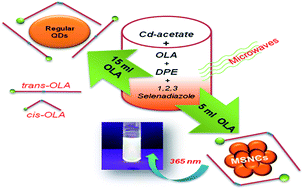
A rapid, green and one-pot microwave synthesis of magic sized nano clusters (MSNCs) of CdSe is presented by use of various cycloalkeno-1,2,3-selenadiazoles as a selenium source. The effect of different parameters i.e. time, surfactant and solvent on the morphology and the cluster size have been investigated. Oleic acid (OLA) is preferred as the capping agent which promotes the growth of MSNCs due to a long carbon chain structure and also due to its non-interaction with the CdSe surface, chemically. The optical spectroscopy studies (UV-visible and PL) revealed the formation of various clusters of CdSe MSNCs families having band gap absorptions at 390 and 450 nm (CdSe13 to CdSe34). The combination of various clusters in the sample leads to white light emission when illuminated under a 365 nm UV light source. It is believed that, in the present studies the white light is generated by well known surface related defects due to large non-coordinating Se or Cd atoms on the surfaces. The samples were thoroughly characterized and stable white light emission was observed for more than 2 months.
Although regular quantum dots have already found many advanced applications in photonics and electronics, it has been noticed that size smaller than regular dots (<2 nm) have attracted greater attention (e.g. CdSe NCs). Their defined molecular structures offer vast scope for researchers to dwell in fundamental studies and relate the findings to technical applications. Such MSNCs show sharp absorptions and broad emission properties covering the entire visible spectrum indicative of white light emission.10–15 It is further documented that these small clusters (<2 nm) are thermodynamically more stable than the larger clusters because of their close-shell structure.12 According to Eichkorn and Ahlrichs,16 these small clusters possess even larger confinement effects on the energy levels than those of larger nanoparticles leading to potential of CdSe magic clusters in white light devices. This property sets CdSe MSNCs apart from CdSe QDs counterparts.17
Although using organometallic approach, reproducible monodisperse CdSe NCs with high-quality tailored size and shape have been synthesized, there are still difficulties in synthesis of QDs and MSNCs.10 This difficulty arises due to lack of versatile, high performing and green Se-precursors. The major problem in following organometallic synthesis of CdSe nanoclusters is that reaction require high temperature (300 °C) and the process needs annealing within a few seconds to prevent further growth of the particles,5,13 which makes such synthetic process uncontrollable and prevents the possibility of formation of CdSe MSNCs. Additionally, there are notable reports on synthesis of MSNCs such as, by growing larger NCs followed by chemical etching by use of suitable etchants.18,19 Rosenthal et al.1 published a series of CdSe nanoclusters synthesized in TOPO/HDA/DPA as capping agents. It was reported that the typical CdSe absorption spectrum exhibits a sharp absorption onset followed by multiple electronic states that are visible in the spectra from 350–550 nm. Peng et al.11 reported the nucleation and growth of colloidal CdSe nanoclusters with a variety of elongated shapes by using the alternative cadmium precursors e.g. cadmium–phosphonic acid complexes, which possessed a sharp and dominated absorption, peak at 349 nm. Khanna et al.4a observed early stage CdSe in polymer matrix which showed sharp absorption peaks along with signature of regular QDs. Hydrophilic luminescent CdSe MSNCs have been reported by Xia et al.4b using cysteine as a surface capping agent. Multiple families of CdSe MSNCs with bandgap emission were reported by Yu et al.6 employing non injection one-pot synthetic approach using 1-octadecene as a solvent of reaction that has fatty acid as surface capping reagent (ODE).
Despite several recent articles, it has been understood that the synthesis of CdSe MSNCs by chemical methods is relatively less explored and only a few reports have appeared so far by essentially following the same protocol as that of regular QDs.20 However, to date, there is no report on the synthesis of MSNCs of CdSe using microwave energy by employing selenadiazoles as precursor for Se. Alkeno-1,2,3-selenadiazoles are organo-selenium compounds containing nitrogen and selenium elements with C–Se–N bonds. These are thermally labile compounds undergo decomposition process by eliminating nitrogen molecule and reactive elemental selenium21 thus can be considered as an important precursor for selenium leading to metal selenide of various shapes and sizes with varying properties, when related with metal salts. Indeed, we have shown that in several of our recent publications where we observed in situ generation of selenium and its conversion to CdSe quantum dots from 1,2,3-selenadiazoles.22 Through the present research, we herein report a simple one-step facile microwave irradiation strategy to grow and isolate MSNCs of CdSe using organoselenium compound as precursor for Se. It is shown that the current method is a one-pot, instant, simple, less hazardous and environmental friendly approach for synthesis MSNCs of CdSe which possibly be extended to other similar binary semiconductors.
:
1 proportion in a 50 ml beaker with a glass lid capable of releasing pressure in case built by solvent vapor due to the irradiation. Initially, cadmium acetate and oleic acid (5 ml) were subjected to microwave irradiation (power, 180 watt) for 2–3 min in order to form a reactive cadmium precursor. Subsequently, desired 1,2,3-selenadiazoles pre-dissolved in diphenyl ether (10 ml) were added to the beaker and the reaction mixture so generated was homogenized with a glass rod. Thereafter, microwave irradiation was continued for 12 minutes at 180 watt power. The reaction was monitored by UV-visible spectroscopy at every 3 minute interval by taking a drop of reaction mixture and diluted in toluene. Finally, reaction mixture was cooled down naturally to room temperature. Hexane and methanol were added and the mixture was kept overnight for aging process. Precipitated MSNCs were separated by centrifugation with repeated washing by methanol to remove unreacted reagents. The isolated MSNCs were dried in hot air oven at about 50 °C for 2–3 h. The yield was typically in the range of 50–60% with respect to cadmium source.Similarly, the reactions by using other selenadiazoles i.e. cyclopenteno (SDZ-5), cyclohexeno (SDZ-6) and cyclohepteno (SDZ-7) and cycloocteno-1,2,3-selenadiazoles (SDZ-8) were conducted and corresponding MSNCs were labeled as (C5) (C6) (C7) and (C8) respectively. In order to study the effect of surfactant amount, solvent and duration on the final product, same procedure was followed with varying amount of oleic acid and/or without using diphenyl ether (DPE) as a solvent. Cycloocteno-1,2,3-selenadiazole was generally selected for these reactions. We also studied the effect of irradiation of microwave power on the formation of MSNCs by conducting selective experiments at 450 watt. The results are reproducible with moderate to good yield.
In general, the formation of MSNCs depends on various parameters such as temperature, variation in amount of surfactant and reaction time. The systematic control of these reaction parameters can lead to meta-stable CdSe MSNCs.23 Microwave method aids to the formation of such MSNCs by altering the reaction kinetics and also reducing the overall reaction time. Previously, we have reported the synthesis of CdSe MSNCs and/or CdSe QDs by wet-chemical method at 180 °C using cyclohexeno-1,2,3 selenadiazole and/or its derivative.22
However, the current method offers greater technological advantages due to rapid one-step approach employing microwave energy to yield white light emitting MSNCs in just 12 min. We identified the formation of CdSe MSNCs by monitoring the reaction with UV-visible and PL spectroscopy (Fig. 2a and b). For this purpose, MSNCs formation from 5-membered selenadiazole was taken as a typical case. Aliquots from the reaction mixture were taken after systematic time intervals for measurements. It was observed that formation of CdSe MSNCs was initiated instantly after just 3 min and fully matured MSNCs were formed within 12 min of reaction time. The absorption peaks at 370 and 395 were appeared after 12 min of reaction time indicating the formation of CdSe MSNCs. However, a hint of formation of slightly large sized CdSe nanoclusters was observed as the absorption peak at 450 nm emerged in the absorption spectrum of the final product which was isolated after precipitation and aging process carried out at overnight. The final nanoparticles (MSNCs) were collected via centrifugation process and were re-dispersed in toluene before recording the absorption spectrum. It is believed that the formation of the large sized MSNCs of CdSe (λabs @ 450 nm) could be due Ostwald ripening occurring in the reaction mixture during the aging process.24 Thus, it was possible to grow various MSNCs of CdSe during the same reaction process. This leads to the formation of various sized CdSe magic sized clusters in the final product. Similarly, combine UV-visible spectra of compounds C5–C8 showed in Fig. 2c indicating peaks below 450 nm. By changing the selenium precursors there was not any considerable change observed in absorption spectra. The PL spectrum (Fig. 2d, C5–C8) of the CdSe MSNCs showed four peaks at 405, 435, 465 nm and a broad peak centered at 550 nm. Interestingly, the as-synthesized CdSe MSNCs displayed an emission spectra which almost covered the entire visible spectrum leading to white light emission. The broad peak could be the result of surface related defects due to non-coordinating selenium sites present on the surface. The initial three peaks resembles emission from three different families of CdSe MSNCs.
For better understanding, we also performed the synthesis by altering various parameters (viz. amount of OLA, MW power, and solvent) of the reaction. For instance, for the sample prepared using C8, the amount of OLA was thought to be of great important as excessive presence of long carbon chain in a surface may affect the degree of formation of small clusters. Indeed, when the experiment was conducted with 5 ml OLA in presence of DPE as solvent and at 180 watt microwave power, the best results for MSNCs were obtained. When OLA amount was doubled to 10 ml, an additional peak at 540 nm was obtained in the absorption spectra along with the peaks corresponding to CdSe MSNCs (Fig. 3a). This additional peak resembles formation of slightly large sized, regular CdSe QDs. When the microwave power during the synthesis was increased from 180 to 450 watt, a doublet at 430 and 460 nm was observed in the absorption spectra (Fig. 3b). Thus, the increase in microwave power during the synthesis leads to the formation of larger sized clusters as higher microwave power increased the temperature of the reaction system. However, when the reaction was conducted in absence of DPE as solvent and OLA alone (15 ml), the product consisted mainly regular sized CdSe QDs with a hint of formation of 450 family (Fig. 3c and SI1, ESI†). Hence, OLA surely had a major role in formation of CdSe nanocrystals.
Based on the experimental findings, we assume that along with temperature, amount of oleic acid plays a crucial role in formation of MCNCs during the current synthetic approach adopted herein. Optimum amount of OLA in the reaction (<5 ml) exclusively results in CdSe MSNCs however a two-fold increase in OLA resulted in regular QDs along with MSNCs. Previous reports have shown that similar reactions by thermal methods produce CdSe MSNCs below 150 °C and regular CdSe QDs at a temperature of around 180 °C in presence of OLA.22 Thus, in order to obtain CdSe MSNCs exclusively, one needs to control the temperature below 150 °C or else due to the crystal nucleation process at higher temperatures, early stage nano-crystals gets converted to regular sized QDs. It should be noted that the concentration of OLA was excess in the all those methods. In the present method, we varied the concentration of OLA keeping microwave irradiation time same thus, maintaining almost same temperature for all the experiments. It is therefore opined that the change in the amount of OLA was a key factor in particle growth of CdSe. Additionally, oleic acid is known to get converted elaidic acid (trans-form of oleic acid) by eladinization reaction during excess heating.25 The geometry of the capping molecule could play a major role in the growth of the clusters. Elaidic acid has a linear geometry as compared to its cis counterpart which poses a boomerang like shape (Fig. 4). We assume that, boomerang shaped cis OLA molecules arrest the particle growth of the CdSe due to restricted movement within the umbrella create by cis OLA leading to CdSe MSNCs. On the other hand, the linear elaidic acid molecules promote particle growth via freedom of movement of early stage nano-crystal promoting random crystal nucleation to form regular CdSe QDs.4 The overall mechanism is presented in Fig. 4 and the summary of the formation of CdSe nanocrystals by altering the reaction parameters is mentioned in Table SI2.†
![]() | ||
| Fig. 4 Schematic representation for effect of oleic acid (OLA) on the growth mechanism of CdSe nanocrystals (MSNCs vs. regular QDs). | ||
The difference between the fluorescence and absorption maxima (Stokes shift) was calculated for individual peaks (see Table 1). The Stokes shift is the energy difference between the optically bright and optically dark states. It is affected by the spacing of fine structure energy levels, relaxation processes within QDs, and the size distribution of QDs.26 The resonant Stokes shift is characteristically caused by a spin triplet dark exciton ground state. The electron–hole exchange interaction can create this dark ground state.26,27 Here, the Stoke shift values increased with decrease in MSNCs sizes. It has been experimentally established that decreasing QD diameter increases the Stokes shift. The co-relation can be valid as the electron–hole exchange interaction increases with increased QD size. However, large Stoke shift are also attributed to the presence of surface related trap states or dangling bonds. It would be a valid discussion, as 90% of the atoms would reside on the surface of such MSNCs due to their high surface-to-volume ratios.28 Hence, surface of such MSNCs plays a very important role in their optical properties. The relaxation processes in CdSe MSNCs are more complex, but analogous to organic molecules. Absorption and relaxation in MSNCs differs from that in organic molecules as they exhibit strong spin-orbit coupling.29 This phenomenon may create different types of electronic states in MSNCs. The structural states of MSNCs may be the eigen functions of the angular momentum.30 Generally, in nano-clusters, excitation occurs to an optically allowed bright state and later, relaxation occurs within the fine structure states.
| Sample name | λ(abs) (nm) | λ(em) (nm) (λ(ex) @ 350 nm) | Stoke shift (nm) | Crystallite size by XRD (nm) | ‘d’ (for 111) by XRD (nm) | Inter-particle spacing by SAXS (nm) |
|---|---|---|---|---|---|---|
| a The emission peak at 550 nm is originated due to surface related defects and cannot be used for stoke shift calculations. | ||||||
| C5 | 370, 395 & 450 | 405, 435, 465 & 550a | 35, 35 & 15 | 1.25 | 0.166 | 0.450 |
| C6 | 370, 395 & 450 | 402, 435, 465 & 550a | 32, 35 & 15 | 1.45 | 0.164 | 0.465 |
| C7 | 370, 395 & 450 | 400, 435, 465, 550a | 30, 35 & 15 | 1.52 | 0.168 | 0.480 |
| C8 | 370, 395 & 450 | 400, 435, 465, 550a | 30, 35 & 15 | 1.27 | 0.164 | 0.455 |
The relaxation then prefers specific non-radiative decay pathways.30,31 The characteristic features of the as-prepared CdSe MSNCs such as absorption maxima, emission maxima, Stoke shift, crystallite size and inter-particle spacing ‘d’ are all mentioned in the Table 1.
The non-radiative relaxation processes were studied in more detail for C8 sample by conducting time-resolution spectroscopy measurements. The PL lifetime decay analysis was carried out after one month of synthesis by re-dispersing the sample in toluene. The understanding of non-radiative recombinations following photo-excitation is the key to understand nanoclusters dynamics. The obtained emission peak positions and intensity in PL spectrum was found to have varied to some extent as compared to PL spectrum of freshly prepared sample (Table 1). This might be due to the change in surface related properties as well as the instrument factors.32b For this purpose, the PL lifetime of all the observed emission peaks (389 nm, 400 nm, 460 nm and 561 nm) were measured. The PL lifetime was estimated from τavg = (B1τ12 + B2τ22 + B3τ32)/(B1τ1 + B2τ2 + B3τ3) by fitting the tri-exponential equation I(t) = B1exp(2t/τ1) + B2exp(2t/τ2) + B3exp(2t/τ3) to the experimental data, where ‘τn’ is the time constant and ‘Bn’ is the amplitude of each component. The ‘τavg’ calculated for emission peaks of 389 nm, 400 nm, 460 nm and 561 nm were 0.219 ns, 1.15 ns, 3.4817 ns and 10.9 ns respectively.
The PL decay times for emission peaks increased with increase in PL wavelength (Fig. 3d). The shorter decay times could justify that the smaller MSNCs have lesser surface related defects as compared to the larger MSNCs. The long decay times for the emission peak observed at 561 nm possibly due to non-radiative recombination occurring because of large surface related defects. The multiple emission profile is also attributed to the charge recombination from surface mid-gap states that evolve from the presence of non-coordinated surface selenium sites (dangling bonds) from CdSe MSNCs. It has been well documented that the band-edge emission occurs by direct recombination of the electron and hole within the nanoclusters and the deep trap emission occurs when a photo-generated hole, trapped in a mid-gap state, encounters an electron before it can relax non-radiatively to the ground state.32 PL excitation and the absorption spectrum of CdSe MSNCs (Fig. 2c and d) clearly indicated three distinct transitions. Here, two sharp peaks of optical absorption can be associated with electron transitions from light-hole and heavy-hole energy levels of valence band into the lowest energy level of conduction band.33 These transactions have been assigned to the 1S–1S, 1S–2S, and 1P–1P transitions, as generally observed in small CdSe NCs (emission wavelength < 520 nm).34,35 As the growth of different cage like structures of CdSe took place simultaneously, it was difficult to deduce the exact energy transitions.
The surface related states are largely affected by the presence or absence of capping ligands and the interaction of capping ligands with the MSNCs. Recently, it was reported that the nature of surface passivating ligand influences the broad emission peak36 and that OLA used as capping agent shows chemically weak interaction with the surface Cd or Se atoms.37 Since the (–COOH) functional group is thermodynamically unfavourable to react with either surface Cd or Se, a weak physical adsorption is believed to be present.38 This may result in many non-coordinating surface atoms in such MSNCs leading to surface related defects, as observed earlier. The FT-IR spectra of all the CdSe MSNCs (C5–C8) samples revealed similar profile but with suppression of C
O stretching peak at 1710 cm−1 which was dominantly present in reference OLA sample (Fig. SI3†). All the FT-IR transmittance spectra of both CdSe MSNCs and pure oleic acid exhibited well defined triplet peaks, i.e. 2853, 2923 and 2954 cm−1 corresponding to CH2 stretching (sp3). The peaks around 1525 cm−1 are due to asymmetric COO− stretching mode of vibration. Thus, it could be assumed that OLA molecules can form H-bonding within the samples, creating dense network around the CdSe MSNCs. The 1H-NMR spectrum confirms the presence of oleic acid in the samples as all typical peaks were observed (Fig. SI4†). The integrals of these signals, however, do not match those of the pure oleic acid. There are 6 different peaks observed for 6 different types of protons. Peak at 5.5 ppm is for
CH at more downfield region due to de-shielding effect of C
C bond.
The formation of CdSe MSNCs was eventually confirmed by X-ray diffraction pattern (Fig. 5a). All peaks of cubic zinc blende CdSe were obtained for crystal planes (110), (220) and (311) with 2θ values centered at around 25.3°, 42.40° and 51.2°, respectively for all the samples. The d spacings from XRD were calculated (Table 1) employing Bragg's equation and were found to be in close agreement with those reported for MSNCs and or regular quantum dots.22 The crystallite size calculated from XRD spectra by using Debye–Scherrer's equation was 1.25, 1.45, 1.52 and 1.27 nm for C5, C6, C7 and C8 samples respectively. To identify the particle size of CdSe MSNCs, dynamic light scattering (DLS) technique was used. The particle size distribution obtained showed majority of nanocrystals were below 2 nm (Fig. SI6a†). We decided to cross examine the results and used XRD and UV-visible spectroscopy as a tool to calculate the particle size. As MSNCs show discrete band gap absorption positions, here the particles sizes also calculated by effective mass approximation equation39 given below
| Eg = h2/8a2 (1/me + 1/mh) |
| d = 2π/q* |
:
1 ratio (Fig. SI6b†).
![]() | ||
| Fig. 5 (a) XRD patterns of as-synthesized samples. (b) SAXS spectra of various CdSe MSNCs. Here ‘q’ is the scattering vector; (c and d) HR-TEM images of C8 sample and (e) SAED pattern. (More images of TEM are provided in ESI Fig. SI5†). | ||
The TGA analysis of the samples confirmed more than 40% weight loss which can be attributed to decomposition of OLA (Fig. SI7†). This confirms that large amount of OLA is present in the sample. In order to check the purity and composition, the synthesized MSNCs (C8) were characterized by X-ray photoelectron spectroscopy (XPS). Each element was found to have characteristic specific binding energy which matches well with the reported values. The shape of each peak and the binding energy can be slightly altered by the chemical state of the emitting atom.
The corresponding XPS spectra are shown in Fig. 6a and b. No peak other than those corresponding to Cd, Se, C and O was observed in XPS scan. Two peaks at orbital splitting of Cd 3d5/2 and Cd 3d3/2 at about 405.2 eV, and 411.7 eV, respectively and one peak at about 54.3 eV for Se 3d binding energy were observed for CdSe. It can be confirmed by XPS analysis that the CdSe MSNCs are pure and not oxidized as peaks for residual CdOx and SeOx were absent. All the observed binding energy values are in good agreement with reported values.1,44
![]() | ||
| Fig. 6 XPS spectra of MSNCs of CdSe (C8). Binding energy of (a) Cd, (b) Se and (c) Raman spectra of CdSe MSNCs (C5–C8) along with OLA. | ||
The Raman spectra (Fig. 6c) of C5–C8 samples along with oleic acid were also recorded to observe the effect of size reduction on bond scattering in CdSe. Four broad peaks were observed for CdSe MSNCs centered at 342 cm−1, 840 cm−1, 1300 cm−1 and 1700 cm−1. The Raman peaks observed for CdSe nanoparticles are due to the scattering of CdSe longitudinal optical (LO) phonons, transverse optical (TO) phonons and their overtones. In our case Raman spectra of CdSe MSNCs were unlike the reported spectra for bulk CdSe. Where, LO phonon frequency was observed at LO = 208 cm−1 and its first overtone (2LO) was observed at LO = 408 cm−1.45 Here observed broad peaks which are shifted towards longer frequency. In case of metal chalcogenide nanoparticles the longitudinal phonon modes are size dependent due to mechanical boundary conditions and lattice contractions.46 The broadness of LO mode compared to that of bulk CdSe due to phonon confinement and bond distortion induced by a significant structural relaxation in small nanoparticles.47,48
The LO phonon frequency in MSNCs being almost as high as for bulk CdSe can be related to compressive strain in the MSNCs, with the corresponding upward shift compensating for the downward shift due to phonon confinement. The net compressive strain could be a result of the structural reconstruction, changes in the bond lengths and elastic properties in MSNCs which were reported theoretically as well as experimentally.49,50 This fact indicates that the structure of CdSe MSNCs is significantly different from the bulk crystalline lattice. The excess oleic acid capping also affect the scattering of phonons that's why various modes get merged together resulted in to broad peak. The peaks at around 342 cm−1 due to LO phonons and at around 840 cm−1 are due to their overtone vibrations. The peaks at around 1300 cm−1 (C–O–C) 1488 cm−1 (C–O–O) and 1700 cm−1 (–C
O) are for oleic acid.
Footnote |
| † Electronic supplementary information (ESI) available: Containing reproducibility testing and additional experimental data, Fig. SI1–SI7, Table SI1 and SI2. See DOI: 10.1039/c5ra14625a |
| This journal is © The Royal Society of Chemistry 2015 |