
Raghunandan Sharmaa and
Kamal K. Kar*ab
aAdvanced Nanoengineering Materials Laboratory, Materials Science Programme, Indian Institute of Technology Kanpur, Kanpur-208016, India
bAdvanced Nanoengineering Materials Laboratory, Department of Mechanical Engineering, Indian Institute of Technology Kanpur, Kanpur-208016, India. E-mail: kamalkk@iitk.ac.in; Fax: +91 512 2597408
First published on 24th July 2015
The cost-efficient fabrication of cathode catalyst layers with low Pt-loadings and high oxygen reduction reaction (ORR) performances is of prime importance towards the commercialization of low temperature fuel cells. Here, an attempt has been made to fabricate a hierarchically structured cathode catalyst layer consisting of Pt-nanoparticle clusters supported on defective carbon nanotube (CNT) coated carbon fiber (CNTCF). CNTs were grown on carbon fiber (CF) using chemical vapor deposition (CVD), while electrodeposition was employed to deposit Pt-nanoparticle clusters onto the CNTCF. The effect of Pt-loading on the oxygen reduction reaction (ORR) performance of the Pt-coated CNTCF (Pt-CNTCF) electrocatalysts was studied by varying the electrodeposition time (ted) between 5 and 30 min, which resulted in a variation of the Pt weight fraction in Pt-CNTCF from almost zero to ∼0.3. Linear sweep voltammetry using a Pt-CNTCF modified glassy carbon (GC) rotating disc electrode (RDE) was employed to study the ORR performance of the samples. The CNTCF support, due to the defective structure of the CNTs, itself exhibits significant ORR activity with an electron transfer number (n) of ∼2.6, which leads to a synergistic enhancement of the overall electrocatalytic performance of Pt-CNTCF. For low Pt-loading on the GC (∼5 μg cm−2), the contribution of the CNTCF support dominated, while the Pt-nanoclusters governed the ORR performance at higher Pt-loading (>10 μg cm−2), with n > 3.5. Hence, a very low Pt-loading (∼5 μg cm−2) may not be suitable for polymer electrolyte membrane fuel cells as the production of substantial amounts of H2O2 on the catalyst supports may accelerate membrane degradation.
Efforts towards the realization of such catalyst layers have been focused on either the reduction of Pt-loading or Pt-free catalysts.7,8 To synthesize highly active catalyst layers with low-Pt loading, Pt-particles with an optimized size are dispersed uniformly on a highly corrosion resistant support material. Among others, carbon nanomaterials such as carbon nanotubes (CNTs) and graphene, due to their high strengths, large surface areas,9–11 high corrosion resistances12 and excellent thermal as well as electronic conductivities,13,14 have been studied extensively as catalyst supports.15–17 Their performance is affected significantly by factors such as the electronic connectivity between individual catalyst particles and the catalyst support,18 contact resistance at the catalyst layer/gas diffusion layer interface,19 agglomeration of the catalyst support and/or catalyst particles,20 catalyst layer thickness,21 catalyst particle size,22 etc. These factors can be controlled by employing various structural modifications in the catalyst support and/or by using different routes to deposit the catalyst particles.23–28 Catalyst layers having various CNT arrangements such as randomly orientated, aligned or 3-dimensional (3D) networked CNTs have been studied.18,23,24,29 Among these, the 3D network formed by the secondary growth of CNTs on a primary aligned CNT array has been reported to provide a considerably high surface area and high internal connectivity.29 Superior performance can also be attained by reducing the catalyst layer thickness through the high loading of Pt-nanoparticles with a narrow size distribution.25 Composites consisting of CNT coated carbon cloth/carbon paper (CC/CP) synthesized by the direct growth of CNTs on CC/CP have been employed as catalyst supports for highly durable catalyst layers.30–33 However, the direct coating of CNTs onto the CC/CP only partially covers their fibers and forms a layer of CNTs on the surface.
Apart from their applications as catalyst supports, defective carbon nanomaterials, particularly nitrogen containing CNTs and graphene, are being studied as Pt-free electrocatalysts for the ORR.34 More recently, apart from Pt-free catalysts, N-doped CNTs/graphene have also been employed as catalyst supports for Pt-nanoparticles to fabricate catalyst layers with enhanced ORR activities compared to those of pristine CNT/graphene supported Pt.35–37 The enhancement may be attributed to the modified structural as well as electronic configurations.38 Chetty et al. have attributed the enhanced activity to the anchoring effect of the pyridinic/pyrrolic-N sites during metal deposition.39 Similarly, a better dispersion of Pt-nanoparticles on N-doped CNTs compared to that of CNTs has been reported.36 More recently, Liu et al. have shown that the presence of defects in the outer CNT walls improves their ORR activity significantly.40 However, the contribution of such a defective CNT-based support on the ORR performance of a catalyst layer has not been investigated well.
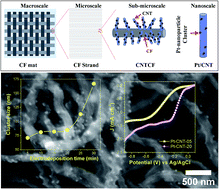
The present study reports a hierarchically structured and 3D networked FC cathode/anode catalyst layer consisting of Pt-nanoparticle clusters supported on CNT coated carbon fiber (CNTCF). Here, hierarchically structured CNTCF was synthesized by the direct growth of CNTs on the carbon fiber (CF) substrate by chemical vapor deposition (CVD). The direct growth of CNTs on CF provides good electronic connectivity between the CNTs and CF surface.11,41 The catalyst coating on the CNTCF was performed using an electrodeposition technique. Furthermore, the effects of increasing Pt-loading on the catalytic activity were studied by varying the electrodeposition time (ted). Finally, the ORR activity of the Pt-coated CNT samples was compared with that of the CNTCF support.
Cyclic voltammetry (CV) measurements were performed to study the catalytic performance in terms of the ORR activity and electrochemical surface area (ESA) using a three-electrode setup attached to an Agilent 5500 AFM. A Pt-CNTCF modified glassy carbon (GC) electrode (φ = 3 mm) was used as the working electrode, while Ag/AgCl (1 M KCl) and Pt-wire electrodes served as reference and counter electrodes, respectively. To prepare the working electrode, 10 mg of Pt-CNTCF was dispersed in 2 ml of C2H5OH via ultrasonication for 1 h and 5 μl of the dispersion was drop-casted onto a cleaned GC electrode and dried for 1 h. The electrocatalytic activity towards the ORR was measured by CV in O2 saturated 0.1 M KOH with a potential scan ranging from −1.0 to 0.2 V at a scan rate of 50 mV s−1. Similarly, the ESA was calculated from the hydrogen desorption peak of the CV curve in 1.0 M H2SO4 with a potential scan ranging from −0.1 to 0.8 V at a scan rate of 50 mV s−1. Similarly, linear sweep voltammetry (LSV) was performed using a home-made rotation disk electrode (RDE) setup.43,44 The amount of Pt loaded on the Pt-CNTCF modified working electrode was estimated by thermogravimetric analysis (TGA) using a Perkin-Elmer Diamond TG/DTA analyzer. TGA of the Pt-CNTCF dispersion (250 μl) used to prepare the modified GC electrode was performed in an O2 environment (flow rate: 200 ml min−1) from 40 to 750 °C at a heating rate of 10 °C min−1.
![]() | ||
| Fig. 1 Schematic of the hierarchically structured catalyst layer consisting of Pt-CNTCF at different length scales. | ||
The Pt-cluster size distributions of Pt-CNTCF for varying ted are shown in Fig. S3 (ESI†). To obtain the Pt-cluster size distribution of a typical Pt-CNTCF sample, the areas of individual Pt-clusters visible in the SEM image were approximated by the areas of ellipses encircling them. Significant increments in the cluster density (number of clusters/area) were observed with increasing ted, suggesting the continuous formation of new clusters as well as the growth of the individual particles within a cluster during the electrodeposition process.
Fig. 4a shows the thermal drift corrected TGA of the Pt-CNTCF dispersion (250 μl), performed in an O2 atmosphere at a heating rate of 10 °C min−1. A correction for thermal drift was performed using the TGA of an empty sample pan under similar conditions and the weight drift during heating was recorded. The final thermal drift calculated by fitting the data with a polynomial of order three was used to correct the TGA data (inset; Fig. 4a). The residual weights of the drift corrected TGA plots, which exhibit an increasing trend with ted, are considered as the net weight of Pt-nanoparticles in a 250 μl dispersion. The variations in the Pt-cluster size (DPt), % area coverage and Pt loading on the GC/electrode area (wPt), with ted are shown in Fig. 4b. Increasing ted from 10 to 30 min, caused a large increment in the value of DPt from ∼70 to ∼170 nm. However, for ted values below 20 min, DPt increased marginally due to the combined effects of the growth of existing clusters and the formation of new ones. Again, on increasing ted from 05 to 30 min, the Pt-loading increased from 3.8 to 15.7 μg cm−2, while the fractional area coverage changed from ∼0.5 to ∼15%. For higher ted values, the area coverage neared saturation due to the overlap of individual clusters.
The variations in Pt-loading and area coverage with ted exhibit complex behavior, revealing the rate of deposition to be highest between a ted of 10 to 15 min, followed by saturation. This may be attributed to the combined effects of the nucleation and growth of the Pt-nanoparticles and the decreasing Pt-ion concentration in the coating bath with increasing ted. Initially, the rate of deposition remained low during the incubation period, while it increased with ted due to particle growth, until the Pt-ion concentration was depleted. Similarly, for ted values below 20 min, DPt increased marginally due to the combined effects of the growth of existing clusters and the formation of new ones. For higher ted values, the DPt exhibited fast growth due to the overlap of individual clusters.
A typical XRD pattern of Pt-CNTCF for a ted of 30 min is shown in Fig. 5. The presence of a diffraction peak at a 2θ value of ∼26° corresponding to the (002) plane of graphite (JCPDS 41-1487) reveals the graphitic structure of the CNTCF substrate. Again, the presence of diffraction peaks at 2θ values of ∼40, ∼47, ∼68 and ∼81° corresponding respectively to the Pt(111), Pt(200), Pt(220) and Pt(311) planes (JCPDS 87-0642) reveal the coating of polycrystalline Pt-nanoparticles. The XRD patterns in the inset of Fig. 5 show the variation in the intensity of the Pt(111) and Pt(200) peaks with ted. With increasing ted, the intensities of the individual diffraction peaks increase due to the larger number of Pt-crystallites. However, the area ratios of the Pt(111) and Pt(200) peaks exhibit no significant variation, revealing similar crystallographic orientation for all the Pt-CNTCF samples. Similarly, the Pt-crystalline size also remains constant at ∼10 nm, which suggests a continuous nucleation of the Pt-particles during electrodeposition.
![]() | ||
| Fig. 5 XRD pattern of Pt-CNTCF for a ted of 30 min. The inset shows the variation in the Pt(111) and Pt(200) peaks with ted from 5 to 30 min. | ||
![]() | ||
| Fig. 6 (a) CV scans of Pt-CNTCF in Ar saturated 1.0 M H2SO4 at a scan rate of 50 mV s−1. (b) The variation of the ESA with ted. | ||
The ORR activity of Pt-CNTCF was studied in alkaline media through CV (stationary electrodes) and LSV (RDE; 1600 rpm) measurements in an O2 saturated 0.1 M KOH electrolyte using a Pt-CNTCF modified GC working electrode. The CV scans of the Pt-CNTCF electrodes in the O2 saturated electrolyte at a potential scan rate of 50 mV s−1 are shown in Fig. 7, where a cathodic peak at ∼−0.4 V (vs. Ag/AgCl) is observed. The cathodic peak, which disappears in the Ar saturated electrolyte (ESI; Fig. S5†), corresponds to the ORR. The variation in the ORR performance of the Pt-CNTCF samples with varying ted can be analyzed qualitatively in terms of the intensity of the ORR peak. As can be inferred from Fig. 7, the ORR peak intensities remain high for a ted value of 10 to 20 min, which can be attributed to the increasing number and uniform dispersion of agglomeration-free Pt-nanoparticles. With further increases in the ted beyond 20 min, despite the increasing wPt, the ORR peak intensities reduce due to the reduction in the effective surface area from the overlapping Pt-clusters.
The variation in the ORR activity with ted was further studied through LSV using a Pt-CNTCF modified GC working RDE (1600 rpm) in 0.1 M KOH at a potential scan rate of 10 mV s−1 (Fig. 8a). The corresponding Tafel plots are shown in Fig. 8b. As defective CNTs are known to show catalytic activity in the ORR,40 LSV corresponding to the CNTCF (without a Pt coating) has also been incorporated. The CNTCF modified GC electrode was prepared through a route similar to that adopted for the preparation of the Pt-CNTCF modified GC electrode. As can be seen from Fig. 8a, the CNTCF modified GC electrode exhibits significant ORR current and hence contributes to the overall ORR activity, due to the defective structure of the CNTs (Fig. 2f; Raman spectroscopy). The variation in the ORR activities of the Pt-CNTCF samples with the ted was evaluated in terms of the ORR onset potential (VOnset), ORR current (|JORR|), and Tafel slope, with high ORR activity being characterized by a high |JORR|, more positive value of VOnset, and lower Tafel slope.43,48 The parameter VOnset is estimated from the intersection point of the tangents to the LSV curve in the proximity of the ORR peak, while the |JORR| is taken as the current density at a potential of −0.3 V. The variation in the |JORR| shown in Fig. 8c suggests low ORR activity for a ted of 5 min, which increased with increasing ted to reach a saturation for ted values above 15 min. For example, the |JORR| exhibited a two-fold increment on increasing the ted from 5 to 15 min. Again, the variations in the VOnset and Tafel slope with ted shown in Fig. 8d exhibit similar trends with respective shifts from ∼−190 to ∼−75 mV and from 190 to 120 mV per decade on increasing the ted from 5 to 20 min. Compared to Pt-CNTCF, the CNTCF exhibited a more negative VOnset of ∼−200 mV and a larger Tafel slope of ∼240 mV per decade. The large variations in the VOnset and Tafel slope with the ted may be attributed to the varying relative contributions of the CNT support and supported Pt-nanoparticles to the overall ORR current, where the ORR current from the CNT support dominates at lower ted. The variations in the VOnset and Tafel slope parameters suggest a different nature of the ORR active sites and hence, different ORR mechanisms for the CNT support and the supported Pt.
LSV curves at different rotation rates were obtained for the Pt-disk (2 mm diameter), Pt-CNTCF modified and CNT modified GC RDEs (Fig. 9a–c). Furthermore, to understand the nature of the ORR active sites, the measured disk current densities (jd) were applied to the Koutecky–Levich (KL) equation (eqn (1)).49
![]() | (1) |
| B = 0.62nFC0D02/3v−1/6 = nA, with A = 0.62FC0D02/3v−1/6 | (2) |
For the present RDE setup, the value of A was obtained from the averaged slope of the KL plots (jd−1 vs. ω−0.5; Fig. 9d) at −0.45 and −0.50 V for the Pt RDE, assuming n = 4 for Pt. Similarly, the n values for Pt-CNTCF (ted = 20 min), as well as the CNT modified GC RDE, were obtained from the slopes of corresponding KL plots (Fig. 9e and f). The values of n for bare CNTs and Pt-CNTCF were calculated to be 2.57 and 3.53, respectively. This suggests the dominance of a two-electron pathway in the ORR on the CNT support, which reduces the overall n value for Pt-CNTCF.
Since the electrodeposition process depends not only on the ted but also on other parameters such as the temperature, applied potential, electrolyte composition and concentration, etc., wPt has been considered as the key parameter affecting the electrocatalytic activity of Pt-CNTCF, instead of ted.
Fig. 10 depicts the variations in the electrochemical activity of Pt-CNTCF, in terms of the parameters |JORR|, VOnset and Tafel slope, with respect to Pt-loading and Pt-cluster size (DPt). Increasing the Pt-loading from ∼0.2 to 0.6 μg, increased the ORR activity of the Pt-CNTCF monotonously, while it remained practically constant for higher Pt-loadings (0.6–1.2 μg). Similarly, the variations in the parameters |JORR|, VOnset and Tafel slope with DPt are exhibited in Fig. 10c and d. On increasing DPt beyond 100 nm, the ORR parameters exhibited constant values with no significant dependence on DPt. This is attributed to the reduction of the ESA with the increase in Pt-loading. The saturation of the ORR activities of the Pt-CNTCF samples with higher loadings of Pt is contrary to the known behavior of Pt-based ORR electrocatalysts, which have a lower overpotential at higher Pt-loading.50 This can be understood by the fact that the ESA reduced from 82 to 64 m2 g−1 with an increase in the Pt-loading from ∼14 to ∼16 μg cm−2 due to the increased overlap of the Pt-clusters. Hence, Pt-CNTCF with a high Pt-loading and agglomeration-free Pt-clusters can provide the highest ORR performance. Moreover, as the Pt-ion concentration of the coating bath decreases with time during electrodeposition, the growth of Pt-nanoparticles with different surface crystallographic orientations (hkl) could be possible. Such a preferred orientation may affect the ORR performance significantly.51 However, this possibility is discarded as the XRD analysis reveals no such preferred orientation, confirming that the variation in the ORR performance can be attributed solely to the variation in Pt-loading and the extent of Pt-cluster overlap.
Finally, the electrochemical stability of the Pt-CNTCF modified GC electrode (ted = 60 min) was investigated by potential cycling between −1.0 to 0.2 V in air saturated 0.1 M KOH electrolyte at a scan rate of 50 mV s−1 and the area under the hydrogen desorption peak (forward scan) between −0.80 and 0.55 V was measured. A comparatively high Pt loading (ted = 60 min) was used for the stability study to obtain a measurable peak area. For the initial 100 cycles, the area shows a small (<2%) decrease. The Pt-CNTCF electrocatalyst exhibits a high stability as the peak area shows a reduction of <2% after the first 100 potential cycles (Fig. 11). Hence, Pt-nanoparticles supported on defective CNTs may be used to fabricate cathode catalyst layers with high stability, low Pt-loading and high ORR activity.
![]() | ||
| Fig. 11 Electrochemical stability of the Pt-CNTCF (ted = 60 min) modified GC electrode in air saturated 0.1 M KOH at a scan rate of 50 mV s−1. | ||
The hierarchically structured CNTCF supported Pt-based catalyst layer exhibits a high ORR performance in terms of both the ORR and ESA. Table 1 compares the ESA and ORR performance of the present catalyst with those of a few previously reported ones. The ORR performance of the various catalysts has been compared in terms of the ORR current (IORR; A gPt−1) at −0.3 V obtained from RDE measurements under similar conditions (0.1 M KOH, Ag/AgCl reference). The present catalyst exhibits superior ORR performance (>2×) in terms of both the ESA as well as the IORR. Hence, catalyst layers with high ORR performance and low-Pt-loading can be fabricated using defective CNT coated CF as the catalyst support.
| Parameter | Literature value | Present work |
|---|---|---|
| a IORR = current density at −0.3 V from RDE plots (A cm−2)/Pt loading on the RDE (gPt cm−2). | ||
| IORR at −0.3a V (A gPt−1) | Pt/C: 47 (ref. 52) | 90–115 |
| ESA (m2 g−1) | Pt/CNT/CP: 52 (ref. 30) | 70–80 |
| Pt/CNx: 55.6; Pt/CNT: 40.9 (ref. 37) | ||
| Pt/Pt–Ni alloy: 33–62 (ref. 53) | ||
| PtxIry/MWCNT: 48–98 (ref. 54) | ||
| Functionalized Pt/CNT: 71 (ref. 55) | ||
| Pt/SWCNT/CNF: ∼39–43 (ref. 56) | ||
However, the low electron transfer number (n = 2.57) of the ORR active CNT support suggests the production of H2O2 by reduction of O2. As H2O2 is known to cause damage to perfluorosulfonated electrolyte membranes,57 the use of such defective carbon supported, low Pt-loading catalyst layers in PMEFCs may decrease their durability. Additionally, as the facile synthesis of defect-free CNTs is difficult, the production of small amounts of H2O2 during the operation of fuel cells based on carbon supported cathode catalyst layers is inevitable. Hence, at low Pt-loadings, where the ORR current from the catalyst support is substantial, the defective nature of the CNTs and other carbonaceous catalyst supports may not be suitable, particularly for PEMFCs.
Footnote |
| † Electronic supplementary information (ESI) available. See DOI: 10.1039/c5ra13866c |
| This journal is © The Royal Society of Chemistry 2015 |