Shengyuan A. Yanga,
Hui Panb and
Fan Zhang*c
aResearch Laboratory for Quantum Materials, Singapore University of Technology and Design, Singapore 487372, Singapore
bDepartment of Physics, Beihang University, Beijing 100191, China
cDepartment of Physics, University of Texas at Dallas, Richardson, Texas 75080, USA. E-mail: zhang@utdallas.edu
First published on 24th September 2015
We study the magnetic response of two-dimensional buckled honeycomb-lattice materials. The buckling breaks the sublattice symmetry, enhances the spin–orbit coupling, and allows the tuning of a topological quantum phase transition. As a result, there are two doubly degenerate spin–valley coupled massive Dirac bands, which exhibit an unconventional Hall plateau sequence under strong magnetic fields. We show how to externally control the splitting of anomalous zeroth Landau levels, the prominent Landau level crossing effects, and the polarizations of spin, valley, and sublattice degrees of freedom. In particular, we reveal that in a p–n junction, spin-resolved fractionally quantized conductance appears in a two-terminal measurement with a spin-polarized current propagating along the interface. In the zero- or low-field regime where the Landau quantization is not applicable, we provide a semiclassical description for the anomalous Hall transport. We comment briefly on the effects of electron–electron interactions and Zeeman couplings to electron spins and to atomic orbitals. Our predictions can be examined in the magneto-transport and/or magneto-optic experiments.
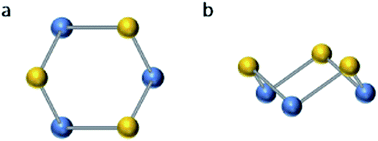
Among these 2D materials, a class of materials have honeycomb-lattice geometries as their stable structures. For example, graphene, silicene,12 the predicted germanene,12 X-hydride/halide (X = N–Bi) monolayers,13,14 and stanene15 all have such a kind of structure. As a result, they shared several common interesting properties in their electronic band structure. First, the low energy spectrum usually has two inequivalent valleys located at the hexagonal Brillouin zone corners known as K and K′ points. (Note that the last three materials have an extra valley at Γ point, which we will comment in the Discussion section). This valley degree of freedom has been proposed as a novel means to encode information, and how to control and manipulate it have led to the concept of valleytronics.16 Second, the honeycomb structure has two triangular sublattices, usually labeled as A and B, which leads to a pseudospin structure of the electron wave function. When the sublattice (chiral) symmetry is broken, a band gap can be opened at K and K′ points. This symmetry breaking could arise simply because two sites are occupied by different atoms, or as we are more interested in, because the lattice has buckling such that A and B sites have a relative shift along the direction perpendicular to the 2D plane.
In the presence of buckling, the inversion symmetry can be broken by a perpendicular electric field and the induced gap size can be tuned by controlling the field strength. In addition, the crystal symmetry allows the presence of an intrinsic spin–orbit coupling (SOC).17 This SOC is the key ingredient in the Kane–Mele quantum spin Hall (QSH) insulator originally proposed in graphene.17,18 Of course, the SOC strength is negligibly small in graphene.19,20 Later, it was found that the SOC could be enhanced by the buckling due to the direct hybridization between π and σ orbitals, as being predicted for the case of silicene and germanene.21,22 Recently, several QSH insulators with large SOC gaps are proposed. In particular, theoretical analysis have revealed that for X-hydride/halide (X = N–Bi) monolayers,13 huge intrinsic SOC up to 1 eV could arise because the low energy bands have px and py instead of pz orbital character (like graphene and silicene).13,14,23 These distinct features lead to rich transport properties of these materials. Especially, the switch between the QSH and trivial insulating phases, tunable through an electric field,24 may be utilized for designing energy efficient spintronic devices.
In this paper, we will study the transport properties of buckled honeycomb-lattice materials in response to an applied magnetic (orbital) field, in a consistent and comprehensive manner. Previously, the Landau level (LL) structures of this class of materials have been studied.25–29 In this paper, we contribute to this topic in four different aspects: (i) the quantum Hall transport in a PN junction geometry, (ii) the anomalous Hall transport in the absence of LLs, (iii) the valley splitting due to the lattice effect and the Zeeman coupling to electron spins and atomic orbitals, and (iv) the estimation of interaction effects in the quantum Hall regime. As discussed above, the intrinsic buckling breaks the sublattice symmetry, enhances the spin–orbit coupling, and allows the tuning of inversion asymmetry. The resulting low energy spectrum thus splits into two sets of doubly degenerate spin–valley coupled massive Dirac fermions with different masses. Importantly, the electric field is able to tune the mass difference and the quantum phase transition between the QSH and trivial insulating phases. Under strong magnetic fields, the interplay between the SOC and the inversion asymmetry leads to an unconventional Hall plateau sequence. Due to the mass difference, the LL spectrum shows prominent crossing effects. Because the pseudospin chirality switches between the two valleys, the energies of the zeroth LLs are valley-dependent. We will explicitly show that it is possible to control the valley polarization of carriers by tuning doping level as well as external electrical and magnetic fields. This valley polarization is a pure lattice effect, and we will also estimate how this effect is corrected by the Coulomb interactions and the Zeeman couplings to electron spins and atomic orbitals. Moreover, the quantum Hall transport in a PN junction geometry is a characteristic feature of any multi-band 2D material. As ideal candidates for bipolar nanoelectronics, buckled honeycomb lattices exhibit intriguing fractionally quantized conductance in a two-terminal measurement, with a spin-polarized current propagating along the interface. Remarkably, we find that this effect can be tuned by an electric field, which is inaccessible in graphene30–34 and in MoS2.35 In the low-field or strong-disorder regime, the Landau quantization is not applicable and LLs become absent. For a buckled honeycomb lattice, however, the energy band gap, the spin–orbit coupling, and the tunable inversion asymmetry can still lead to appealing anomalous Hall effects. We will use a standard semiclassical treatment to examine the anomalous Hall transport in the absence of LLs.
Our paper is organized as follows. In Section II, we introduce the low energy effective model describing this class of buckled honeycomb-lattice materials, with emphases on the roles of the sublattice symmetry and the intrinsic buckling. In Section III.A, we derive the LL structures for the QSH and the trivial insulating phases, followed by discussions on the SU (4) symmetry breaking of the anomalous zeroth LLs. We then analyze the LL crossing effects and the unconventional Hall plateau sequences for both phases in Section III.B. We note that the LL structures have been studied before, but we reproduce them here to make our following studies more grounded and to make our analysis consistent and comprehensive. In Section III.C, we further study the two-terminal conductances in unipolar and bipolar regimes and find some extra integer and fractionally quantized plateaus. In Section III.D, we reveal the possible electric-field control of the spin, valley, and sublattice polarizations. We also provide a semiclassical theory in Section III.E for the anomalous Hall transport in the low-field regime where the Landau quantization is not applicable. Finally, in Section IV we discuss the complexity added by the states at the Γ point, some speculations on the role of electron–electron interactions, and an estimation of the Zeeman couplings to electron spins and atomic orbitals.
| H0 = ℏv(τzkxσx + kyσy), | (1) |
The gapless nature of eqn (1) is protected by the following sublattice (or chiral) symmetry
| {H0, σz} = 0 | (2) |
An energy difference between the two sublattices breaks inversion and sublattice symmetries producing a trivial band gap at the Dirac point, which can be modeled by
| Hg = λσz. | (3) |
Another essential ingredient in the low energy physics of these materials is the following intrinsic SOC that is allowed by the lattice symmetry,
| Hso = λsoτzσzsz. | (4) |
In the following, we shall focus on the generic model
| H = H0 + Hg + Hso, | (5) |
In this model, sz = ±1 is a good quantum number, because the buckling in the considered materials is small and the mirror-plane symmetry breaking is weak. The model can thus be written as
| H = ℏv(τzkxσx + kyσy) + Δτzszσz, | (6) |
| Δτzsz ≡ λ + λsoτzsz, | (7) |
Each flavor of τzsz (1 or −1) at different valleys corresponds to opposite spins, i.e., a spin–valley locking. Moreover, the chirality (relaxed due to the energy gap) for the same flavor also differs between the two valleys. This can be easily observed by tracking how the pseudospin's in-plane component rotates around a constant energy surface at each valley. These properties opposite at the two valleys will be of importance for the interesting physics discussed below.
and
, where π± = πx ± iπy and the magnetic length
nm. This model and all the following results are approximately valid when ℏv/
B is smaller than the bandwidth of the effective Dirac model. The ladder operators satisfy the relations [b, b†] = 1,
, and b|0〉 = 0, where |n〉 is the nth LL eigenstate of a conventional 2D electron gas. Written in terms of the ladder operators and in the basis of |n〉, Hamiltonian (6) can be easily diagonalized and the resulting spectrum reads
![]() | (8) |
is the cyclotron frequency, δ is the Kronecker delta function, and n is a non-negative integer denoting the LL orbitals. This spin–valley resolved LL structure is schematically shown in Fig. 3. In the absence of the mass terms, e.g., in the case of graphene, the LLs are fourfold degenerate at each energy. For the case Δτzsz ≠ 0 the SU (4) symmetry of the zeroth (or n = 0) LLs are completely broken at the single-particle level, whereas all other LLs are broken into two groups with τzsz = ±1 and are doubly degenerate at each energy.
![]() | ||
| Fig. 3 The first few LLs of each spin–valley resolved band for (a) the QSH insulator phase (λso > λ > 0) and for (b) the trivial insulator phase (λ > λso > 0). The red (blue) color represents the spin up (down), and the n = 0 LLs are marked with thicker lines with an asymmetric feature. Note that the positions of the n = 0 LLs for the two lower bands (τzsz = −1) differ between the two phases. We have used the same parameter values as in Fig. 2. | ||
In particular, the n = 0 LL energies −λτz − λsosz are independent of the magnetic field strength B. Evidently, the SU (4) symmetry in the zero-mass case is broken between the two valleys as well as between the two spins. On one hand, when λso > λ > 0, the two n = 0 LLs of spin up are at the valence band top whereas the two of spin down are at the conduction band bottom, independent of their valley indices. In this scenario, the ν = 0 state has a quantized spin Hall conductivity that survives at B = 0, reflecting the QSH state nature in the presence of an approximate mirror-plane symmetry.38 On the other hand, when λ > λso > 0, the two n = 0 LLs of valley K are at the valence band top whereas the two of valley K′ are at the conduction band bottom, independent of their spins. This scenario is consistent with the fact that the half filled ν = 0 state is adiabatically connected to the trivial insulating state at B = 0, in which both the charge and spin Hall conductivities are zero. The transition between the two scenarios occurs when λ = λso, companied by a gap closure at two of the four spin–valleys with τzsz = −1. The wavefunctions of n = 0 LLs at valley K and K′ are (0, |0〉)T and (|0〉, 0)T, respectively. Thus, for the n = 0 LLs the valley and sublattice degrees of freedom coincide. This feature allows to tune the n = 0 LL energies via the buckling of the two sublattices and the perpendicular electric field, namely, λso and λ. Note that we have neglected the roles of electron–electron interactions and Zeeman couplings to the electron spins and the atomic orbitals, and we will comment on these effects in Section VIII.
We mention by passing that the asymmetric LL structure is a generic feature of massive Dirac fermions and is related to the opposite chirality of the two valleys and to the spin–valley dependent mass terms.35 One intuitive picture, as noted above, is to make a connection between the charge, spin, and valley Hall conductivities of the ν = 0 quantum Hall state and the classification of the B = 0 states.39 A more intuitive picture can be provided by the semiclassical theory of electron dynamics at low fields.40 Due to the pseudospin–orbit coupling, a wave packet near a valley center has a self-rotation, which produces an intrinsic orbital magnetic moment39,41
![]() | (9) |
as for the case of massless Dirac fermions. On the opposite limit, at low fields, for small LL orbitals, and with large band gaps, nB ≪ Δ±2/(2eℏv2), the LL energies goes linearly with B as for the case in conventional quantum wells. In the latter case, we can expand eqn (8) and write LL energies of group I as
![]() | (10) |
In general, when there is more than one channel of 2D conduction electrons, their differences in velocity and in mass give rise to the LL crossing effect. Such effects occur in the conventional quantum wells as a result of the Zeeman splitting between the spin up and spin down carriers,42 on the (111) surface of SnTe due to the presence of the symmetry-unrelated
and
Dirac surface states,43 in ABA trilayer graphene because of the chiral decomposition of the monolayer-like and bilayer-like subbands,44–47 and in monolayer MoS2 owing to the peculiar SOC of d-electrons in the valence bands.35
For the case of buckled honeycomb lattice, the LL crossing effect must occur, since the two groups of LLs have different masses. By equating the LL energies of the two groups in eqn (8), we find that the crossing point for two LLs with index nI and nII occurs at
![]() | (11) |
This result applies to both the conduction and the valence bands, since they are symmetric with respect to the zero energy, as shown in Fig. 4. Note that in those cases for nII, nI > 0 the crossing points are all fourfold degenerate, whereas in those cases for nI = 0 and nII > 0 the crossing points are all threefold degenerate. This is because both nI = 0 LLs are non degenerate whereas all n ≠ 0 LLs are doubly degenerate. The scenarios for both the QSH phase and the trivial phase are sketched in Fig. 4. Notably, the two scenarios only qualitatively differ in the ν = 0 cases. In Fig. 4, we label each gapped state by its spin up, spin down, and total filling factors. Take the (1, 0, 1) state for example, the two spin up n = 0 LLs (red) are filled and thus ν↑ must be 1; only one of the two spin down n = 0 LLs (blue) is filled and thus ν↓ must be 0, leading to a total filling factor ν = 1 + 0 = 1. Consider the (0, −1, −1) state, it is simply a time-reversal and particle-hole partner of the (1, 0, 1) state. We note that even the simple LL structures, shown in Fig. 4, are richer than those in monolayer transition metal dichalcogenides,35 where the fourfold degeneracy of the n = 0 LLs is not fully lifted.
When the electron–electron interactions are not substantial, as assumed in this paper, the LL crossing effect further leads to the enhancement of longitudinal magnetoresistance in transport. When the interactions become substantial in the presence of strong magnetic fields and weak disorders, small gaps may open at the crossing points and the magnetoresistance peaks split. More interestingly, the LL crossing effect disappears at λ = 0, which can be tuned by an external electric field. Thus, the magnetoresistance in buckled honeycomb lattice can also be controlled by the electric field.
Even in the absence of interactions, the Hall plateaus follow an unconventional sequence: ν = ⋯, −2M − 4, −2M − 2, −2M, −2M + 1,⋯, −3, −1, 0, 1, 3,⋯, 2M − 1, 2M, 2M + 2, 2M + 4,⋯ here the nI = 0 LL lies between the LLs with nII = M − 1 and nII = M, with M given by
![]() | (12) |
In the presence of magnetic disorders or strong mirror symmetry breaking, sz is not conserved. Because of the redistribution of the chiral quantum Hall edge currents at the junction, the net conductance in units of e2/h across the junction is quantized as32–35
| Gpp,nn = min{|ν1|, |ν2|}, | (13) |
![]() | (14) |
When the residue disorder is nonmagnetic and the mirror symmetry is approximately preserved, sz can be considered as a good quantum number and the n = 0 LLs are spin filtered. We note that this limit is more appealing and directly relevant to honeycomb lattices with low buckling. It follows that the full equilibrium must be achieved within each sz subspace independently. Consequently, the net conductance across the junction is
![]() | (15) |
Only when ν↑ ≠ ν↓ on at least one side of the junction, the conductance in eqn (15) is essentially different with the simple case (with magnetic disorders) in which only the total filling factors ν1 and ν2 matter. In the absence of an electric field, i.e., λ = 0, consider a junction with ν1 = 0 and ν2 = 4n − 2 for some integer n, This indicates that ν1↑ = −ν1↓ = 1 and ν2↑ = ν2↓ = 2n − 1. From eqn (15) we find that G = (4n − 1)/(2n) for n > 0 and that G = (3 − 4n)/(2 − 2n) for n ≤ 0.
We then consider the scenario of λso > λ > 0, in the presence of a small perpendicular electric field. The conductance is unchanged for the above case with ν1 = 0 and ν2 = 4n − 2. Now imagine while fixing ν1 = 0 we tune the gate in region two such that ν2 = 2m − 1 for some integer m. The latter filling indicates that ν2↑ = ν2↓ + 1 = m. Thus, G = (2m − 1)/m for m > 0 and G = (1 − 2m)/(1 − m) for m ≤ 0.
When the electric field is sufficiently large to invert the band gap such that λ > λso > 0, in this scenario, ν1 = 0 would indicate that ν1↑ = ν1↓ = 0. Thus, G = 0 as long as one region of the junction is half filled, in sharp contrast to the QSH phase.
Although we have focused on the case with ν1 = 0 to illustrate the essence of the physics, we exhaustively show the full map of conductance in Fig. 5 for |ν1|, |ν2| ≤ 2. The two numbers in a parenthesis are the net conductances with and without spin mixing respectively. Fig. 5(a) is for the QSH phase whereas Fig. 5(b) is for the trivial phase. One observes that the difference between the two phases is exhibited for the cases with either ν1 = 0 or ν2 = 0, as we discussed before. One may also consider the cases in which the two sides of the junction are in different phases. The analysis is straightforward and our results eqn (13)–(15) still apply. These above mentioned interesting features are indeed richer than those in graphene30–34 and monolayer transition metal dichalcogenides.35 Thus, the conductance across the junction, distinct in the two phases, can serve as a useful diagnosis for the phase of buckled honeycomb-lattice material under an electric field.
In addition to the unconventional transport properties, STM probes at the interface can also detect a special fingerprint of the spin-filtered n = 0 LLs. This is the case as long as the Fermi energies of the two regions lie in different energy windows that are divided by the n = 0 LLs (see Fig. 3). In particular, spin-filtered edge states, whose number is given by |ν1sz − ν2sz|, will propagate along the interface. The interface current can be controlled in the following senses. (i) Switching the magnetic field direction flips the spin polarization of the current. (ii) Interchanging ν1 and ν2 switches the current direction while tuning ν1 and ν2 adjusts the current amplitude. (iii) Tuning one Fermi energy to a different energy window while fixing the other one may change the carrier type, besides the effects in (i) and (ii). (iv) Most importantly, as we have analyzed above, the electric field can tune the integer or fractionally quantized conductance in an unprecedented way, and even diagnose the topological nature of the phase of the material.
We start from the case in which the electric field is zero, λ = 0. From the LL structure eqn (8), at a fixed chemical potential, there is no valley polarization, but there exists finite spin polarization of the charge carriers. This is easily understood by noticing that the four n = 0 LLs are valley degenerate but spin split. For example, the n = 0 LLs at the conduction (valence) band bottom (top) for the two valleys are both of spin down (up). All higher LLs are spin and valley degenerate. As a result, the valley and spin polarizations are respectively given by
| Pv ≡ ν+ − ν− = 0, | (16) |
| Ps ≡ ν↑ − ν↓ = 2δν,0, | (17) |
When a small electric field is applied such that λso > λ > 0, the LLs split into two groups with τzsz = ±1. As shown in Fig. 3(a), all the LLs are doubly degenerate except the four non-degenerate n = 0 LLs; in ascending order of energy, these four LLs are indexed by spin up and valley K, spin up and valley K′, spin down and valley K, and spin down and valley K′. When one or three n = 0 LLs are filled, the filling factor ν is odd, and both the spin and the valley polarizations are one. When two of them are filled, ν becomes zero and the spin polarization is maximized whereas the valley polarization vanishes. When all of them are filled or empty, ν is even and both polarizations are zero. Therefore,
| Pv = δν,2n−1, | (18) |
| Ps = δν,2n−1 + 2δν,0 | (19) |
Further increasing the electric field such that λ > λso > 0, the two middle n = 0 LLs switch their energy orders, as seen in Fig. 3(b). This follows from the topological quantum phase transition between the QSH and quantum valley Hall phases at B = 0. (The latter phase is also referred as a trivial phase in other sections.) As an interesting result, spin and valley switch their roles. Therefore, we can anticipate that
| Ps = δν,2n−1, | (20) |
| Pv = δν,2n−1 + 2δν,0 | (21) |
The above results of spin and valley polarizations for states with filling factors |ν| ≤ 3 are listed in Table 1. One notes that the coupled valley and spin polarizations are non-vanishing at odd filling factors. Here, the difference between the QSH phase and the trivial phase is reflected in the ν = 0 case: for QSH phase, it is spin polarized but valley non-polarized, whereas the situation is reversed for the trivial phase.
| Filling factor ν | −3 | −2 | −1 | 0 | 1 | 2 | 3 |
|---|---|---|---|---|---|---|---|
| QSH (Ps, Pν) | (1, 1) | (0, 0) | (1, 1) | (2, 0) | (1, 1) | (0, 0) | (1, 1) |
| Trivial (Ps, Pν) | (1, 1) | (0, 0) | (1, 1) | (0, 2) | (1, 1) | (0, 0) | (1, 1) |
The simultaneous polarization of carriers in both valley and spin permits versatile methods for their detection and manipulation. Moreover, the polarization reversal occurs at the transition between the topological phase and the trivial phase also offers a way to experimentally differentiate them.
To close this section, we note by passing that for n = 0 LLs the valley pseudospin coincides with the sublattice pseudospin, as the n = 0 LLs of a particular valley completely localize on a particular sublattice. Thus, the discussed valley polarization, induced by the peculiar n = 0 LLs, is equivalent to the sublattice polarization.
![]() | (22) |
![]() | (23) |
First, in the absence of external electric fields, λ = 0 and Δ+ = −Δ− = λso. When the Fermi level is in the band gap, the system is a QSH insulator, with
![]() | (24) |
We are more interested in the case with finite doping, in which the Hall conductivity is not quantized. We shall mainly discuss the n-doped case. The results for p-doped case can be easily obtained by a similar procedure. In the metallic case, the Hall conductivity has additional contributions from scattering of carriers around the Fermi energy.59,60 There is an important side jump contribution61 that is proportional to the Berry curvature at the Fermi energy. Here we shall take a simple Gaussian white-noise scattering model62 and disregard the intervalley scattering which requires a large momentum transfer. For each flavor the Hall conductivity including both intrinsic and extrinsic contributions is given by
![]() | (25) |
![]() | (26) |
When a perpendicular electric field is applied, the bands for the two flavors τzsz = ±1 split. Consider the weakly doped case such that only the τzsz = −1 conduction bands are partially occupied, i.e., |Δ−| < μ < Δ+. For 0 < λ < λso, similar to eqn (25), we find that
![]() | (27) |
![]() | (28) |
Note that there also exists a finite valley Hall conductivity in this case, owing to the spin–valley locking τzsz = −1.
When the gap is inverted by further increasing the electric field, i.e. λ > λso, the Berry curvatures for the two spin–valleys with τzsz = ±1 switch signs after the gap closes and reopens. As a result, both the spin Hall conductivity and the valley Hall conductivity in eqn (28) change signs. Therefore, the sign change in the spin or valley Hall conductivity can be used to detect the topological quantum phase transition, induced by the electric field.
The above results are derived in the presence of time-reversal symmetry and the charge Hall conductivity must be zero. The charge Hall conductivity becomes nonzero when the time-reversal symmetry is explicitly broken by an applied magnetic field. In the high-field regime, the Hall conductivity becomes quantized due to the formation of LLs and follows an unconventional sequence, as we discussed in Section III and IV. Here, instead, we are concerned with the low-field regime, in which LLs are absent but a semiclassical description is applicable. In this picture, the effect of magnetic field is twofold. First, it exerts a Lorentz force on the carriers leading to an ordinary Hall effect. Secondly, it couples with the orbital magnetic moment (9) and shifts the band energy as −mB.39,41 Because the moment has opposite signs between the two valleys, the relative energy shift between the two valleys gives rise to an anomalous contribution to the charge Hall effect. The ordinary Hall conductivity is well known as σordH ≃ ρordH/ρ2, where ρordH = −B/(en) is the ordinary Hall resistivity and ρ is the longitudinal resistivity. In the following, we focus on the weakly doped case |Δ−| < μ < Δ+, where only the τzsz = −1 conduction bands are partially occupied. (The inclusion of τzsz = +1 bands when μ > Δ+ is straightforward and in fact decreases the anomalous effect.)
When 0 < λ < λso, the coupling δE = −mB shifts the τzsz = −1 conduction band at valley K (K′) down (up), according to eqn (9). The relative shift between the band bottoms at two valleys is
![]() | (29) |
From eqn (27), we observe that the contributions to the charge Hall conductivity from the two valleys have opposite signs. The energy shift δμ breaks the perfect cancellation between them and leads to a net charge Hall contribution from the more populated valley
![]() | (30) |
which can be traced back to the different chemical potential dependence between the intrinsic and the side jump terms. The ratio between the anomalous and the ordinary contributions is
![]() | (31) |
![]() | (32) |
| mev2/Δ ≫ 1. | (33) |
For me = 0.51 × 10⁶ eV c−2 and a typical value ν ∼ 0.5 × 10⁶ m s−1, the condition reduces to Δ ≪ 1.4 eV. In general, Δ ≪ 0.5 eV holds for silicene, germanene, and most X-hydride/halide (X = N–Bi) monolayers. Therefore, we conclude that the Zeeman splitting is subdominant in these materials. We note by passing that for monolayer transition metal dichalcogenides, due to the large band gaps, the d-orbital Zeeman effects dominate the spin Zeeman effects and the lattice effect,40 as observed in recent experiments64–67 in the absence of LLs.43
The above discussion is for the small magnetic field case. In relative larger fields, the Zeeman splitting should be much smaller than the LL gaps, although it further break the twofold degeneracy of the obtained LL structure. However, we do emphasize that the Coulomb exchange interaction, with an energy scale
![]() | (34) |
We have mentioned that the staggered sublattice potential λ can be tuned by the external electric field. Another physical way to tune the model parameters is to control the buckling strength. As indicated in ref. 22, a change of buckling strength would strongly affect the SOC strength λso (and would also slightly modify other model parameters such as λ and v), Hence, the buckling strength, controlled by the substrate and by the applied strain in experiment, provides an extra knob to tune the topological phase transitions and the LL spectrum.
Although in transitional metal dichalcogenides the low-energy states also exhibit copies of spin–valley coupled Dirac bands,37 there are clear distinctions. For those materials, the energy gap is dominated by the large inversion symmetry breaking term (λ ≫ λso), and it is in fact difficult to achieve the competition between the two gap terms,35 namely, the topological phase transitions. Therefore, the interesting effects facilitated by the buckling of honeycomb-lattice materials are generally absent in monolayer transitional metal dichalcogenides.
Finally, we point out that the buckling in some honeycomb-lattice materials lead to the emergence of an electron pocket at the Γ point.13,15 It is true that this extra valley adds complexity to the band structure and the corresponding LL spectrum. However, the Γ pocket behaves like a conventional single-band 2D electron gas (2DEG) system. Thus, we expect that the main results would not be changed. For the LL structure that we are extremely interested in, the anomalous features of the n = 0 LLs remain the same, although a conventional LL plateau sequence is superimposed over the unconventional sequence we find in Section IV.
In conclusion, we have investigated the quantum and the anomalous Hall transport phenomena of a class of buckled honeycomb-lattice materials in response to an applied magnetic (orbital) field, with emphases on the tuning effect of an electric field. Furthermore, in a p–n junction geometry we have explored some additional Hall plateaus for these materials, as ideal candidates for bipolar nanoelectronics. Lastly, we have argued the roles of electron–electron interactions, the Zeeman couplings to electron spins and atomic orbitals, and the extra electron pocket at Γ point. Our theoretical predictions can be examined in magneto-transport and/or magneto-optic experiments. The LL crossing enhances the level degeneracies and can be detected via pronounced peaks in the longitudinal resistance.44 The fractionally quantized conductance of a p–n junction can be studied in the standard two-terminal transport30,31 with left and right gates to independently control the chemical potentials on both sides of the junction. The spin polarization can be measured, for example, in Kerr microscopy.63 The valley polarization can be probed by optical circular dichroism;64–67 there is also an additional anomalous Hall contribution which can be detected in Hall transport.68 Our study would facilitate the investigations on the 2D buckled honeycomb-lattice materials and help the design of novel electronic devices that may combine the charge, spin, valley, and sublattice degrees of freedom to achieve better performance and unprecedented functionalities.
| This journal is © The Royal Society of Chemistry 2015 |